Film photography · Medium Format · Photography

Beighton Station

Today’s photograph is of the signalbox that sits beside the railway crossing in Beighton village. The box still holds the title of Beighton Station, although the station was closed back in 1954 and the Great Central Railway signalbox and crossing are now all that remain. The station opened back in 1893 and originall formed part of the Manchester, Sheffield and Lincolnshire Railway. The line is still in regular use.

Being not too far from home, I’ve photographed this scene on a number of occasions, and it featured in the blog before back in 2017 in the post “Twelve frames an hour“.

Someone commented that the signalbox really “pops” in the frame in this shot, and that it reminded them of an old box camera, meniscus lens image. This is fitting, given the Holga also sports a simple meniscus lens. The vignetting and soft edge-focus of the Holga gives an effect not totally dissimilar to the shallow depth of field that might be generated bys a wide aperture on a larger format camera.

Beighton Station

Holga 120N & Ilford FP4+.

Taken on 10 March 2020

Film photography · Medium Format · Photography

FP4Party

I have three entries for this year’s FP4Party. All taken with my Holga 120N.

I didn’t hold a lot of hope for the roll I shot – I felt I was shooting stuff for the sake of it, so was very pleased to find I was very happy with some of the photographs. All three here were taken around the house while trying to finish off the roll – ostensibly the previous week should have been “shoot” week, and I did make some pictures on this same roll then, but work and the weather prevailed so I had the defer some of the shots – happily, I got some nice light on the day in question, even if I didn’t step foot out of the house.

I like the low key look I got, and the Holga, with it’s single-speed shutter and very limited aperture control, has once again delivered in spades.

Of the three, I like the first best. The second is nice, but I’m not sure about the composition – I think I should have moved the vase to the left or right to avoid it blocking the lamp standard. The third is nice too.

Bathroom mirror

Living spaces

Her touch

Holga 120N & Ilford FP4+.

Taken on 10 March 2020

Film photography · Medium Format · Photography

Tinsley Park Cemetery

A couple of weeks ago I paid a short visit to Tinsley Park Cemetery and shot a roll of HP5+ through the Holga. It’s the first time I’ve visited the cemetery in 13 years – the last time was in 2007 when I took some photos with the Canon S2Is bridge camera I used at the time (and which I still have in a cupboard just behind where I sit typing this).

The cemetery is flanked by industrial units near its entrance and then backs onto Tinsley Park Woods and the land that was once part of the short-lived Sheffield Airport.

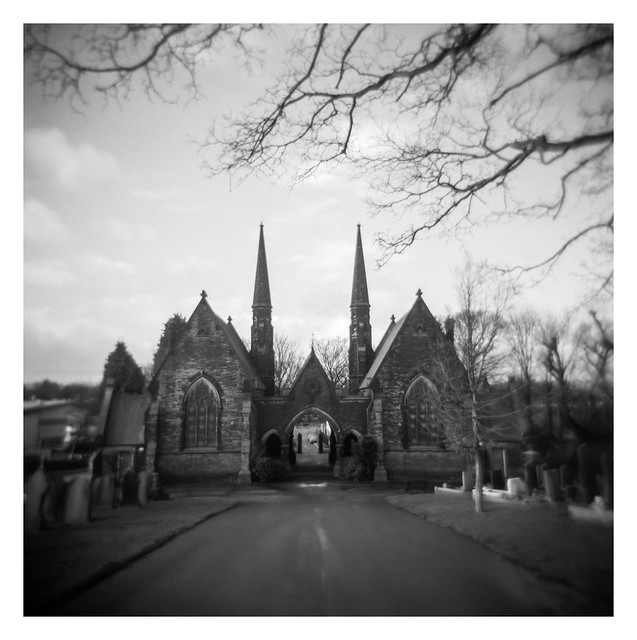
One of its most noteable features is the double gothic chapel, whose twin spires cast a distinctive shape in the air when seen from the nearby Woodburn Road. The two photos below show the chapels as you approach from the entrance and then the view as you descend back down the hill from the cemetery graves.

Approaching Tinsley Park Cemetery

Departing Tinsley Park Cemetery

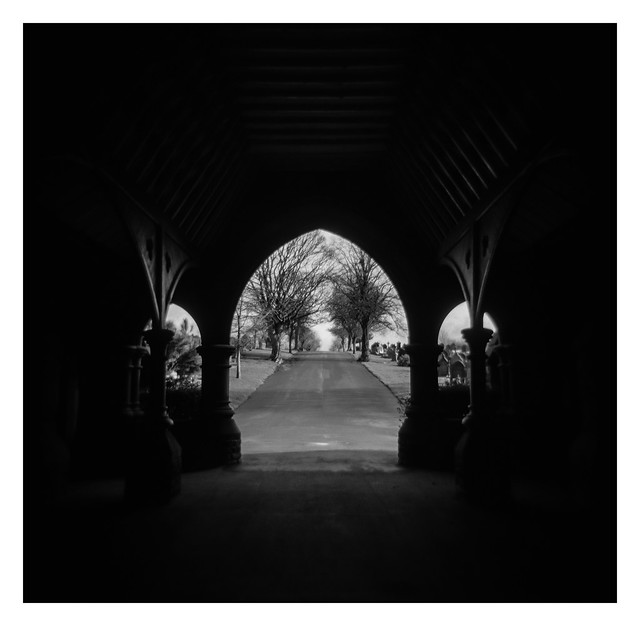
While there are roads around either side of the chapel structure, the arched route through the centre is the most interesting path to take.

Threshold

The cemetery also has an intersesting lodge to your left as you approach the chapels.

The house by the cemetery

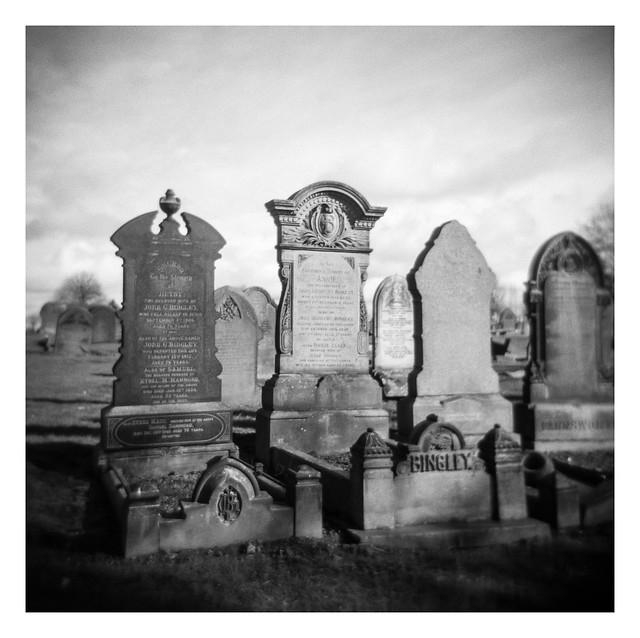
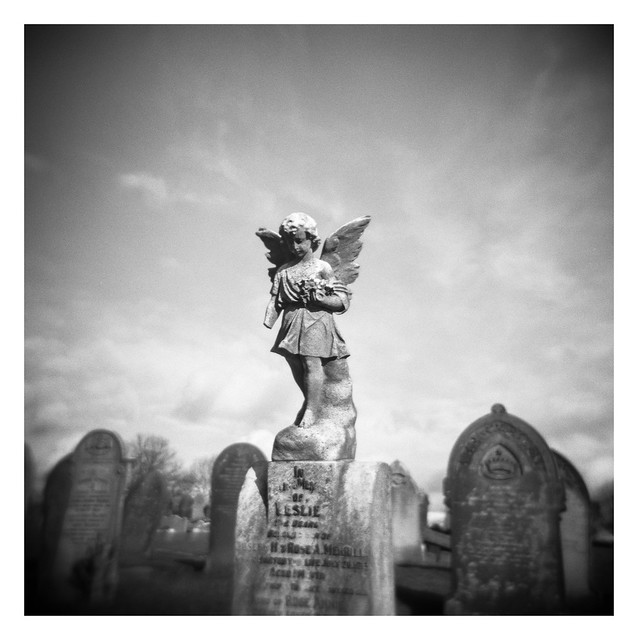
The cemetery was opened back in 1882 and is still in use for new burials today. As with most cemeteries of this age, there are large numbers of impressive Victorian gravestones and other features such as statuettes. Some of these, stood over the graves of Children, are moving to behold.

Fallen

Gravestones

In memory

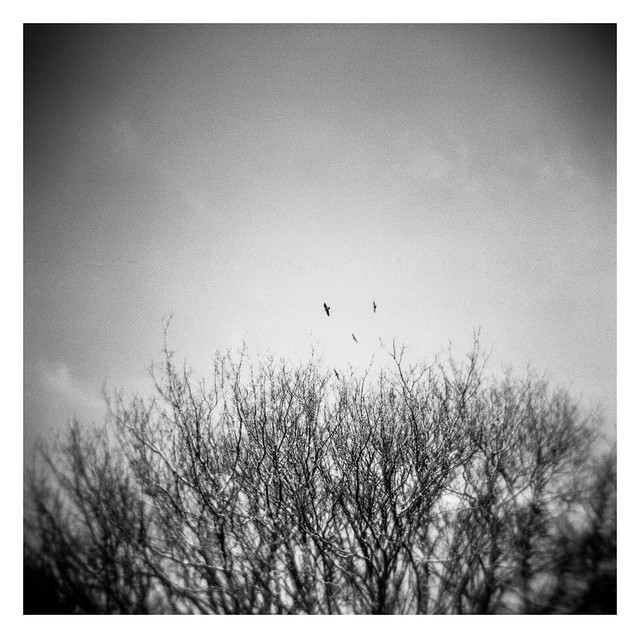
There were large numbers of birds in the trees within the cemetery grounds. I’m assuming them to be ravens, but I’m not a bird expert and they could as easily be rooks or some other member of the crow family.

Four ravens

Another four ravens

Holga 120N & Ilford HP5+.

Taken on 23 February 2020

Film photography · Medium Format · Photography

Cascades at Hell Bank Plantation

One of the ways I like to find potential locations for photography is by browsing Ordnance Survey maps. Usually I look for public footpaths and rights of way and plan a walk in the hope that there might be something interesting to photograph along the route – usually there is. I’ve loved to look at Ordnance Survey maps ever since I first came across them as a child – specifically the 1:25,000 scale Landranger maps. They’re a treasure trove of detail with their beautiful design and iconography, and just skimming across them will turn up evocative little identifiers for things like trig points, towers, tumuli, wells and all manner of other intriguing things. And so it was on this occasion, where my browsing alighted upon the intriguingly named Hell Bank Plantation which also had a little marking stating “Waterfalls“.

So last Saturday, after my walk along the River Derwent at Calver, I decided to head home via a route that would take me to Hell Bank Plantation so I could see what it was like as a location.

After a wrong turn that would have gotten me where I needed to go – if I was on foot(!) – I finally took the right route and managed to get a parking space at the top of the plantation (where a decent number of other vehicles were already parked). The entrance into the plantation was via a stile a few yards from where I’d parked and the trail led down into the pine woodland. After a short distance the main footpath had a fork with the narrower branch heading down towards where I assumed the stream and waterfalls would be.

FILM - Gnarly

The path led me across the stream and then took a left turn so that it descended into the valley with the stream on my left, now at the bottom of a steep-sided gorge. I could see a number of cascades of water down there – nothing spectacular (although I guess it will be much more exciting after some heavy rain) but attractive nontheless. After walking down the valley a couple of hundred yards, it became apparent that there was no easy way to get to the stream from this path down here so I back-tracked. Back near the top I found a place where, with care, I might get down to the water. So, using my tripod as a walking pole, I eased myself down the steep bank to the bottom.

FILM - Hell Bank cascade

Near the bottom was the remains of a stone bridge about ten feet wide, broken in the middle and covered in moss. Thankfully, it also looked like there might be an easier way back up the opposite bank when I finished with my photography. I made my way upstream a little to get in position for some photos – while the stream wasn’t a torrent, there were still some pools that were plenty deep enough to submerge my walking boots fully, so careful progress was required. When I found a good spot I took an incident meter reading and also a couple of spot readings of shadows and highlights to see what they would show (the average wasn’t too far off the incident reading, so I went with that). As I wanted to try and get everything in focus, I metered for f/22 which gave an exposure of around 2 seconds.

FILM - In a narrow gorge

After taking a number of shots I retreated to the broken bridge and, as I’d hoped, was able to climb the eastern bank with relative ease and from there walked back uphill to the car and the journey home.
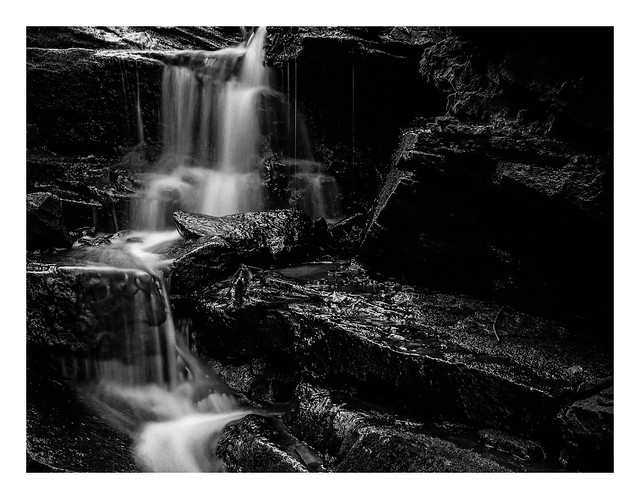
FILM - Cascade

The processed negatives were a little on the thin side, although not unduly so, and I’ve ended up with contrasty images that I like – at least where the stream and cascades of water are concerned. Some of the other shots (including the bridge) are somewhat busy and I think, if I return to the location, it deserves colour to properly seperate the vegetation, rocks, water and wood textures in the pictures.

There is also another waterfall further down the valley according to Ordnance Survey. 🙂

Bronica ETRSi, Zenzanon 75mm f/2.8 & Kodak Tmax 400.

Taken on 25 January 2020

Film photography · Medium Format · Photography

River-side house

Continuing the theme from the past couple of days, here’s a shot of the scene just downstream from the previous locations. As is so often the case when I pre-arrange a day out with the camera, the weather was dull with featureless grey stratus clouds, making for somewhat less than interesting skies. Still, we make do with what we get and, while the conditions might have been better, it was still a very nice walk along the river.

FILM - Oblique

Bronica ETRSi, Zenzanon 75mm f/2.8 & Ilford Pan F Plus.

Taken on 25 January 2020
Film photography · Medium Format · Photography

Through the pines

This was taken on the footpath beside the River Derwent a little further upstream from the bridge I posted a photo of yesterday. I’ve taken a picture at this location before, last year, using my Yashica Mat 124G. Unfortunately something went wrong with that version – I think the camera strap, or possibly the cable release, had gotten in the way of the taking lens without me noticing and the resulting image had a blurry streak across part of the frame. This one worked much better (although prior to this I managed to waste three frames by somehow shooting them with the dark slide in the camera – something I didn’t even think was possible with the ETRSi).

FILM - Can't see the wood for the trees

Bronica ETRSi, Zenzanon 75mm f/2.8 & Ilford Pan F Plus.

Taken on 25 January 2020
Film photography · Medium Format · Photography

Crossing calm waters

This is the road bridge that crosses the River Derwent just above Calver Weir. It carries the A625 and I believe is called New Bridge, although I have no information byond that unfortunately. It makes for nice photographs whether viewed from up or downstream though – the nearby weir means that the water here is deep and slow flowing, producing lots of opportunities for reflections.

This shot is my entry for the 2020 film photography contest I’m taking part in – the theme for January is “Openings”.

FILM - Opening

Bronica ETRSi, Zenzanon 75mm f/2.8 & Ilford Pan F Plus.

Taken on 25 January 2020