I went out on my lunchbreak one day last week to finish this roll of Tmax and came upon this little scene…

Bronica ETRSi, Zenzanon 75mm f/2.8 & Kodak Tmax 400.
Taken on 29 January 2020

35mm, medium format and large format film photography (with the odd bit of digital every now and then…)
I went out on my lunchbreak one day last week to finish this roll of Tmax and came upon this little scene…
Bronica ETRSi, Zenzanon 75mm f/2.8 & Kodak Tmax 400.
Taken on 29 January 2020
One of the ways I like to find potential locations for photography is by browsing Ordnance Survey maps. Usually I look for public footpaths and rights of way and plan a walk in the hope that there might be something interesting to photograph along the route – usually there is. I’ve loved to look at Ordnance Survey maps ever since I first came across them as a child – specifically the 1:25,000 scale Landranger maps. They’re a treasure trove of detail with their beautiful design and iconography, and just skimming across them will turn up evocative little identifiers for things like trig points, towers, tumuli, wells and all manner of other intriguing things. And so it was on this occasion, where my browsing alighted upon the intriguingly named Hell Bank Plantation which also had a little marking stating “Waterfalls“.
So last Saturday, after my walk along the River Derwent at Calver, I decided to head home via a route that would take me to Hell Bank Plantation so I could see what it was like as a location.
After a wrong turn that would have gotten me where I needed to go – if I was on foot(!) – I finally took the right route and managed to get a parking space at the top of the plantation (where a decent number of other vehicles were already parked). The entrance into the plantation was via a stile a few yards from where I’d parked and the trail led down into the pine woodland. After a short distance the main footpath had a fork with the narrower branch heading down towards where I assumed the stream and waterfalls would be.

The path led me across the stream and then took a left turn so that it descended into the valley with the stream on my left, now at the bottom of a steep-sided gorge. I could see a number of cascades of water down there – nothing spectacular (although I guess it will be much more exciting after some heavy rain) but attractive nontheless. After walking down the valley a couple of hundred yards, it became apparent that there was no easy way to get to the stream from this path down here so I back-tracked. Back near the top I found a place where, with care, I might get down to the water. So, using my tripod as a walking pole, I eased myself down the steep bank to the bottom.

Near the bottom was the remains of a stone bridge about ten feet wide, broken in the middle and covered in moss. Thankfully, it also looked like there might be an easier way back up the opposite bank when I finished with my photography. I made my way upstream a little to get in position for some photos – while the stream wasn’t a torrent, there were still some pools that were plenty deep enough to submerge my walking boots fully, so careful progress was required. When I found a good spot I took an incident meter reading and also a couple of spot readings of shadows and highlights to see what they would show (the average wasn’t too far off the incident reading, so I went with that). As I wanted to try and get everything in focus, I metered for f/22 which gave an exposure of around 2 seconds.

After taking a number of shots I retreated to the broken bridge and, as I’d hoped, was able to climb the eastern bank with relative ease and from there walked back uphill to the car and the journey home.
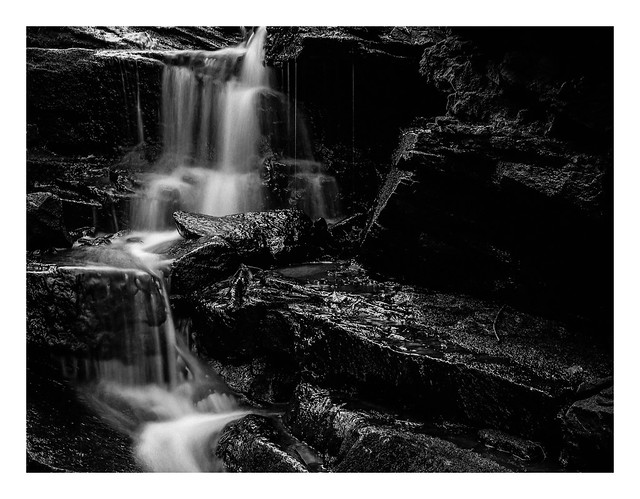
The processed negatives were a little on the thin side, although not unduly so, and I’ve ended up with contrasty images that I like – at least where the stream and cascades of water are concerned. Some of the other shots (including the bridge) are somewhat busy and I think, if I return to the location, it deserves colour to properly seperate the vegetation, rocks, water and wood textures in the pictures.
There is also another waterfall further down the valley according to Ordnance Survey. 🙂
Bronica ETRSi, Zenzanon 75mm f/2.8 & Kodak Tmax 400.
Taken on 25 January 2020
Continuing the theme from the past couple of days, here’s a shot of the scene just downstream from the previous locations. As is so often the case when I pre-arrange a day out with the camera, the weather was dull with featureless grey stratus clouds, making for somewhat less than interesting skies. Still, we make do with what we get and, while the conditions might have been better, it was still a very nice walk along the river.

Bronica ETRSi, Zenzanon 75mm f/2.8 & Ilford Pan F Plus.
Taken on 25 January 2020
This was taken on the footpath beside the River Derwent a little further upstream from the bridge I posted a photo of yesterday. I’ve taken a picture at this location before, last year, using my Yashica Mat 124G. Unfortunately something went wrong with that version – I think the camera strap, or possibly the cable release, had gotten in the way of the taking lens without me noticing and the resulting image had a blurry streak across part of the frame. This one worked much better (although prior to this I managed to waste three frames by somehow shooting them with the dark slide in the camera – something I didn’t even think was possible with the ETRSi).

Bronica ETRSi, Zenzanon 75mm f/2.8 & Ilford Pan F Plus.
Taken on 25 January 2020
This is the road bridge that crosses the River Derwent just above Calver Weir. It carries the A625 and I believe is called New Bridge, although I have no information byond that unfortunately. It makes for nice photographs whether viewed from up or downstream though – the nearby weir means that the water here is deep and slow flowing, producing lots of opportunities for reflections.
This shot is my entry for the 2020 film photography contest I’m taking part in – the theme for January is “Openings”.

Bronica ETRSi, Zenzanon 75mm f/2.8 & Ilford Pan F Plus.
Taken on 25 January 2020
I noticed this plant sprouting atop this boulder during a walk near Calver at the weekend. As I had B&W film in the camera I thought the textures in the leaves would work well.

Bronica ETRSi, Zenzanon 75mm f/2.8 & Ilford Pan F Plus.
Taken on 25 January 2020
Five minutes before this shot was taken the whole structure was enveloped in steam. I quickly made my way to a vantage point where I could get a photograph of the spectacle but, alas, it didn’t reoccur in the time I was able to wait. Smaller volumes of steam were constantly being emitted, as in the shot below, but not the glorious fogbank I’d initially witnessd.

Yashicamat 124G & Ilford HP5+.
Taken on 12 January 2020

This derelict building stands adjacent to the Rotherham United football stadium at the edge of Rotherham town centre. The building is the site of a former brassworks, Guest & Chrimes Ltd, which was established in 1843 by brothers Richard and Edward Chrimes and moved to this site in 1857. The company produced produced taps, sluice valves, hydrants and water meters and expanded rapidly after the invention of the ‘High Pressure Loose Valve Screw-Down Cock‘ (clearly the double entendre had not been invented yet :)) – the forerunner of the modern domestic tap – by Edward Chrimes. The foundry eventually closed in 1999.
There is historic film footage from 1901 showing workers leaving the factory. It’s alarming to see how many young boys are amongst the workforce (although cheering to see that they enjoyed larking about in front of a camera in exactly the same way that boys still do today).

The Grade II listed building is currently surrounded by high fencing, and parts of the structure shown in the last two photos was demolished following a fire in 2018. The entire building is under lease to the neighbouring football club and there are plans to redevelop the building.
This final image features some poignant graffiti that I only noticed when scanning the negative (you may need to click on the image to see the full size version in order to read it).

There is a forum post dating back to 2013 showing some urbex images of the building, including interiors, here.
Yashicamat 124G & Ilford HP5+.
Taken on 12 January 2020
Dating back almost 550 years, the Old Queen’s Head is the oldest surviving domestic building in Sheffield, constructed at the end of the Plantagenet period. The building became a pub in the 1860s when the venue next door extended into this one. Prior to this the buidling was used as a house and may have been a banqueting hall before that. Mary, Queen of Scots was imprisonned in Sheffield in the late 16th century (although not in this building!) and it’s believed that this is where the pubs name is derived.

Holga 120N & Kodak Tmax 400.
Taken on 10 January 2020
This is The Crucible Theatre in Sheffield. It was opened in 1971 and, as well as hosting plays and similar performances, has been the venue for the World Snooker Championship since 1977. The theatre has an unusual stage layout with the audience sitting around three of its sides. The building holds Grade II listed status.
Just opposite (to the right of the scene in this photo) lies the Lyceum Theatre, a more traditional (and older – dating back 120 years) venue.

Holga 120N & Kodak Tmax 400.
Taken on 10 January 2020

