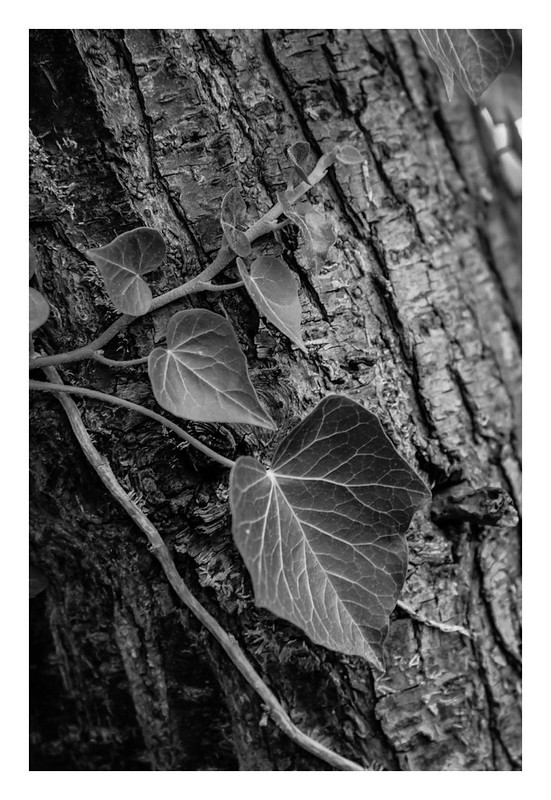
The last few shots from the roll of Fomapan 400 I shot wandering around Wentworth village while my wife looked in the shops at the garden centre.
I’d taken my Olympus OM-2n, which I hadn’t used for some time – a couple of years maybe – mostly because on the last set of results I got from it I though there might have been signs of a light leak. Given I have a couple of other working Olympus OM-series cameras, I wasn’t in a great rush to investigate. Now that I have a bulk-loader however, it’s easy to spin off a short roll of film for testing purposes, so I decided to see if there really was an issue and loaded a 15-exposure roll to see what I got.
It seems that my concerns about light leaks might have been unfounded as there were no noticeable signs of any on the resulting negatives. I’m glad about this as I really do like the OM-2n, and will probably start to use it more as a result.
Following yesterday’s post about the new Holy Trinity church at Wentworth, here’s a picture of the old church and it’s graveyard.
The Old Holy Trinity Church is a now-redundant Anglican church that stands in partial ruin beside the church. It’s also a Grade II* listed building. The church’s tower dates from the 14th or 15th century, while the rest of the building was rebuilt in 1684 for William Wentworth, 2nd Earl of Strafford.
When the new church was built much of the old church’s nave was dismantled leaving a just the medieval tower, the remaining structure of the nave, and a chancel with a chapel.
While the old church is fully visible from the main road through the village, it cannot be seen from afar like its spire-topped replacement.
Holy Trinity Church, Wentworth, is a Grade II* listed Anglican parish church. It was designed by the architect John Loughborough Pearson in a Gothic Revival style and was built between 1872 and 1876 and consecrated on 31 July 1877 by the Archbishop of York. The church was commissioned by William Wentworth-Fitzwilliam, 6th Earl Fitzwilliam, as a memorial to his parents.
The spire of the church is tall and can be seen from far afield and, when I see if from further away I think it has a slightly unnerving look to it. It reminds me of something from an old ghost story or horror tale, perhaps by MR James, HP Lovecraft, or someone of that ilk. The sort of place the protagonist might visit for research purposes and then end up uncovering something they really didn’t want to.
It’s nothing of the sort in reality, of course, but a lifetime of reading supernatural fiction means my mind can’t help but imagine…
I did go inside the church and took several photos but, without faster film, a tripod, or steadier hands than mine, I just ended up with camera shake on all of them. The church replaced another, earlier building, but not on the same precise site and the remains of old Holy Trinity Church still stand a short distance from the new one. A picture of that to come tomorrow.
I already posted a couple of digital pictures from this hike around Damflask reservoir back in August, but the ones shown today are all on film. It’s not the complete set of images from the day as I changed rolls of film partway through the walk and I’ve not yet scanned the others, but I expect they will appear at some point in the future.
We’ve had a long spell of very hot and dry weather through the summer here in the UK (indeed, as has much of Western Europe). Parts of the country were hit by wildfires more serious than would normally be seen in a dry period, and many parts of the nation were placed under drought conditions.
At the time these pictures were taken drought conditions had not yet been imposed by Yorkshire Water, but it’s quite clear by the reservoir levels that insufficient rain had fallen to keep then at a healthy volume (although, looking at an older image I took in 2017 which is very similar to the picture above, the reservoir has been similarly depleted before).
These water gauges give an indication of how the water level has fallen.
This is the spillway from the reservoir for when it overflows. It doesn’t look like much water has flowed over it for some time.
The reservoir would reach the treeline in normal conditions, and the triangular spit of land would be completely submerged.
It will be interesting to revisit in a few months to see if the water has returned to a more healthy level – particularly given we are forecast to have a wet and stormy autumn followed by a cold winter due to this year’s El Nino.
Nikon F80 & Nikkor 24-120mm f/4 ED VR on Fujifilm Acros II. Ilfotec DD-X 1+4 9mins @ 20°
There was some police tape wrapped around this tree when I took a walk around Damflask reservoir a couple of months ago. It was upside down and back to front though.
Nikon F80 & Nikkor 24-120mm f/4 ED VR on Fomapan 400 (@200asa). Ilfotec DD-X 1+4 9mins @ 20°
As of today I have seven rolls of film waiting to be scanned. All 35mm rolls, all 36 exposures except for a single bulk-rolled short roll that just has 15 shots. So somewhere in the region of 230 pictures yet to scan.
I addition I also have three rolls that have been scanned, but not yet post-processed. Again, all 35mm, but this time two 36 exposure rolls and another short roll, which bumps the total up to around 320 images in total.
I have another 36 exposure roll in one of my cameras with perhaps two or three frames remaining, so when that is finished and developed I’m at nearly 360 photographs.
Usually my dev>scan>process workflow is much quicker, but I’ve been holding back recently, in part because I’ve had a bunch of already processed shots to upload and so wasn’t in a rush, but also because of something I saw in a YouTube video I watched a while back from Sean Tucker. The video is all about how to choose your best images and in part refers back to one of his earlier videos where he interviewed landscape photographer Rachel Talibart who explains her approach to reviewing her images.
She says that, often, after a day of photography, she returns home on a high about the pictures she’s taken and can still be tripping about the experience for some time afterwards. This mood, she says, is not the best for objectively assessing the photographs she’s taken. Because she’s still tripping on the experience, the photos will often be a disappointment and no match for the fresh memories of the experience. She also finds it very difficult to edit the photographs while still on the high.
Looking at the photos straight away distorts her appreciation of the images. She’s often looking for something very specific and can discount the images that don’t meet this preconception. As a result she can miss good pictures. However, if she looks at them later – six months, a year, two years, the good images she might have overlooked initially present themselves much more readily to her now more objective eye.
I’ve recently been looking back through older, mostly digital, images and found this to be the case, finding pictures that I did nothing with that are actually, to me at least, quite good and more than worth revisiting.
So, while I have a glut of film pictures, I’m trying to take a similar approach and waiting to scan and process them. I still have an idea what is on most of the rolls I’ve shot, but many of the individual frames have faded from memory so when I come to scan them they will appear fresh to my eye and, hopefully, I’ll be able to objectively assess them and see which are good.
This obviously comes down to my own subjectivity in terms of what I do and don’t like, but I’m looking forward to see how this technique works. At the very least, the anticipation I feel is making me very much look forward to revisiting the scenes I felt worthy of a picture back when I photographed them.
Ironically, some of the photos I have been uploading recently are more recent ones that have jumped the queue, including this slightly apt picture…
Nikon F80 & Nikkor 24-120mm f/4 ED VR on Fujifilm Acros II. Ilfotec DD-X 1+4 9mins @ 20°
Over the course of the summer Sheffield has been visited by lions. Lots of lions. A whole pride of them. 300 lions, to be acurate.
Thankfully these are not escapees from a nearby zoo, but are part of a sculpture project organised to benefit the local children’s hospital, and the third such project in a decade (the first was The Herd of Sheffield, featuring elephants back in 2016, then we were visited by The Bears of Sheffield in 2021). This time we have The Pride of Yorkshire, featuring the aformentioned Lions.
In each of the three events, all the sculptures are each individually decorated and there are trails to be followed to discover them (all of them, should you be dedicated enough!). When they conclude, all the animals are auctioned off, raising money for the hospital charity. While the elephants and bears are not stood in public places any longer, it’s still quite easy to find many of them dotted around the city in their new adopted homes provided by the auction bidders, so it’s not unusual to see one stood in a shop, or atop the roof of a factory or something.
Here’s one of the lionesses stood in Tudor Square, but there are Lions and cubs to be found too. I’ve not photographed many of them (I had an idea about doing a project, but never got around to it), but another may appear on here at some point…
Nikon F80 & Nikkor 24-120mm f/4 ED VR on Fujifilm Acros II. Ilfotec DD-X 1+4 9mins @ 20°