I’ll be posting pictures without commentary while my mental batteries take a break and hopefully recharge. Please feel free to use your imagination to fill in the blanks. 🙂
Normal nonsense will resume shortly…

Ricoh GR III
Taken on 19 June 2024

35mm, medium format and large format film photography (with the odd bit of digital every now and then…)
I’ll be posting pictures without commentary while my mental batteries take a break and hopefully recharge. Please feel free to use your imagination to fill in the blanks. 🙂
Normal nonsense will resume shortly…
Ricoh GR III
Taken on 19 June 2024

Ricoh GRIII
The first part of this post detailed the walk from West Stockwith to Misterton. This part covers the walk though the rest of Misterton and back to my starting point.
I’ll begin with All Saint’s church, a Grade 1 listed building that dates back to the 13th century (although it was largely rebuilt in the mid-19th century. It was a little awkward trying to compose a shot of the church from the entrance to the grounds to the east (the perils of a fixed-lens camera), but a better view was possible from the west, albeit with the church partially obscured by a couple of evergreen trees.


I sometimes go inside churches if they are open, as there is usually something of interest to look at and photograph, but I didn’t have time on this trip. Instead I took the following picture of one of the stained glass windows from the outside. This is perhaps not the best way to appreciate stained glass, but I quite liked the patterns of the lead-work.

Leaving the church along Church Lane, I rejoined the main road through Misterton (the B1403). The road changes names from Church Street to Gringley Road near here and an old-style black and white fingerpost donates directions to various places. I think this one is ready for a lick of fresh paint.

Following Gringley Road south passes a variety of interesting old houses before reaching a bridge that crosses the Chesterfield Canal. It was here that I left the road to join the Cuckoo Way footpath that follows the canal all the way from its source in Chesterfield in Derbyshire.
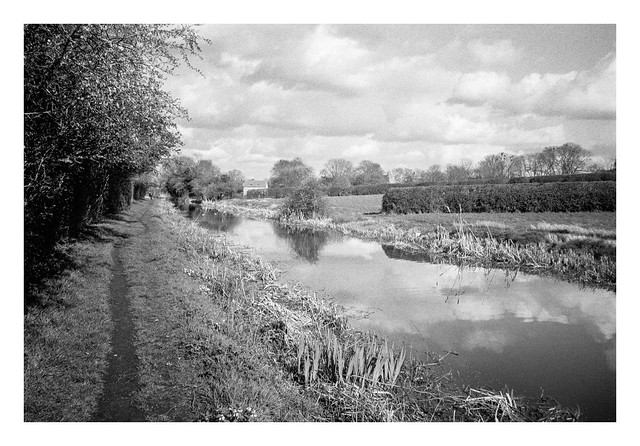
The canal skirts the southern side of Misterton, passing beneath a few bridges, such as this one that carries Grovewood Road.

Further down the canal, it curves attractively past some houses where a man and two boys were fishing, before reaching a series of locks. One of the houses between these locks had a small boat moored beside it’s back garden
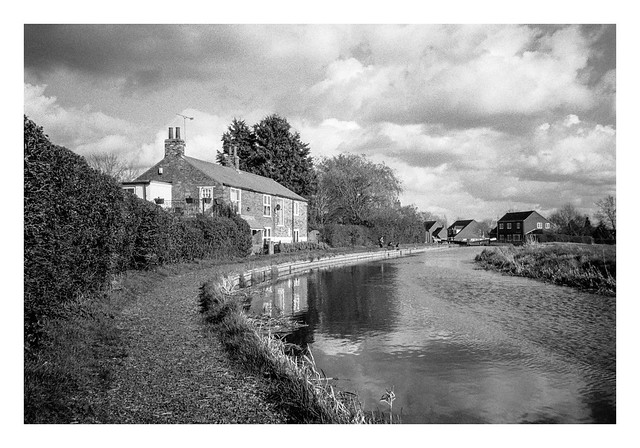

The canal then follows a straight route back towards West Stockwith. There were many narrow-boats moored along this stretch.

There’s a final bridge carrying the main road through West Stockwith before the canal enters Stockwith Basin, a marina that opens directly into the River Trent via locks.

The final stretch of the footpath route follows the flood-bank on the west side of the Trent. The Trent is the third longest river in the UK, flowing 185 miles from its source on Biddulph Moor in Staffordshire, to Trent Falls in Lincolnshire, where it discharges into the Humber Estuary. The river is navigable to Burton on Trent in Staffordshire.
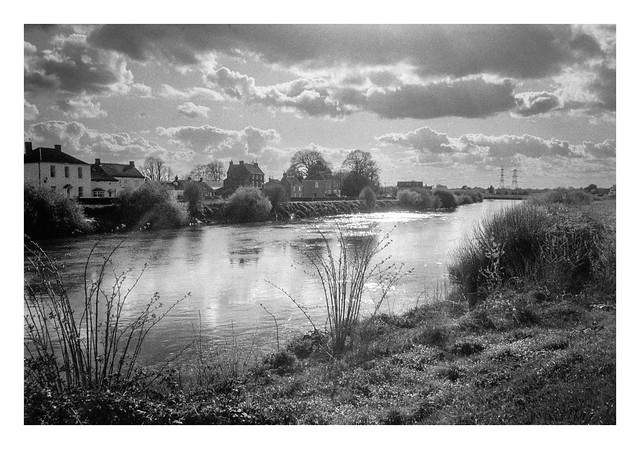
Leaving the riverbank before the mouth of the River Idle, I crossed the bridge across the Idle and back to my start point in West Stockwith.

I enjoyed this walk. The weather was pleasant, the light was nice for photography, and there was plenty to see along the way.
Olympus XA3 & Ilford HP5+ (@800asa). Ilfotec DD-X 1+4 10mins @ 20°
Taken on 24 March 2024
A couple more photographs taken inside St. Martin’s church.


Yashica Mat 124G & Kodak Tri-X. Ilfotec DD-X 1+4 8mins @ 20°
Taken on 9 March 2024
Continuing from yesterday, the second part of this post will cover the leg of the journey from Stoney Middleton back to Eyam.
The footpath I had been following enters Stoney Middleton via backstreets. Where this street merges into another named The Fold, there is a sign affixed to a wall pointing the way back to Eyam to those unsure of the route


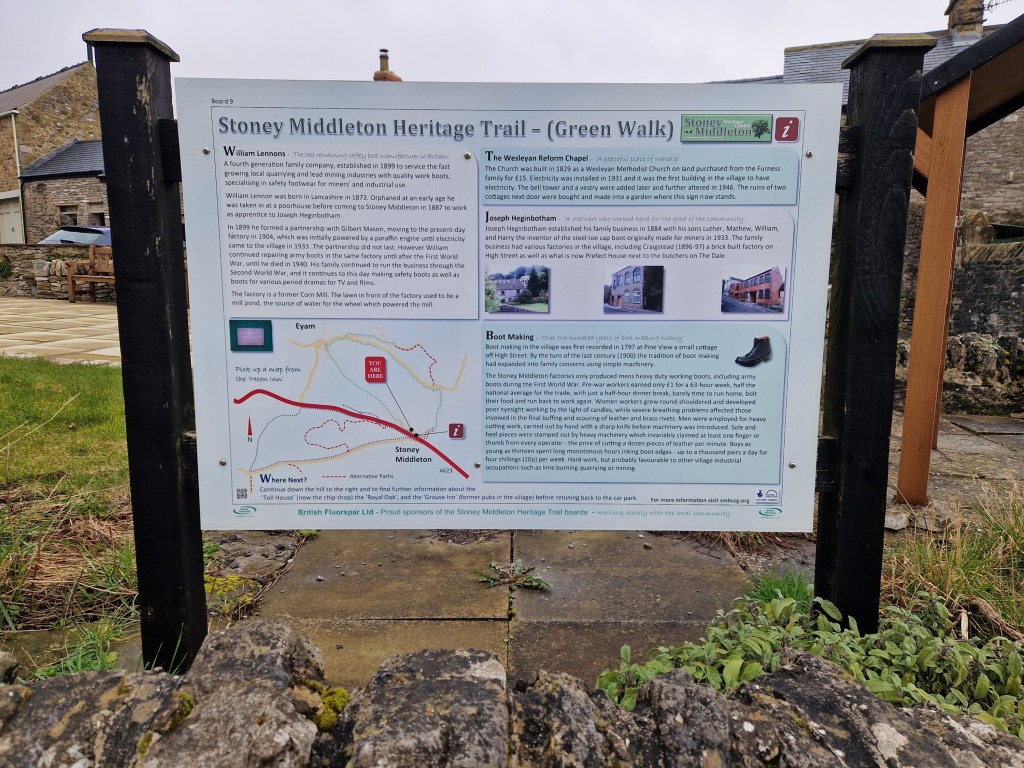
At the bottom of The Fold there is a small open area where Dale Brook flows before disappearing beneath the William Lennon and Co boot factory. The building was formerly a corn mill before William bought it in 1904 along with the Mason brothers, forming Mason Bros & Lennon, where they began repairing, and then manufacturing boots. The factory still operates and is in the hands of Williams great grandchildren, focusing on retro footwear produced using traditional techniques.

The western end of this grassy area is separated from the grounds of the boot factory, and contains a sapling planted to commemorate the Diamond Jubilee of Elizabeth II. Here also sits Toll Bar Fish & Chips, from which a very tempting aroma was drifting. I’ve had chips from here once before and they were very good, but on this occasion it was still a little early for lunch.

More heritage trail signs are present, as well as a blue plaque on the side of the Boot factory remembering the Boot and Shoemaker’s Strike between 1918-1920.
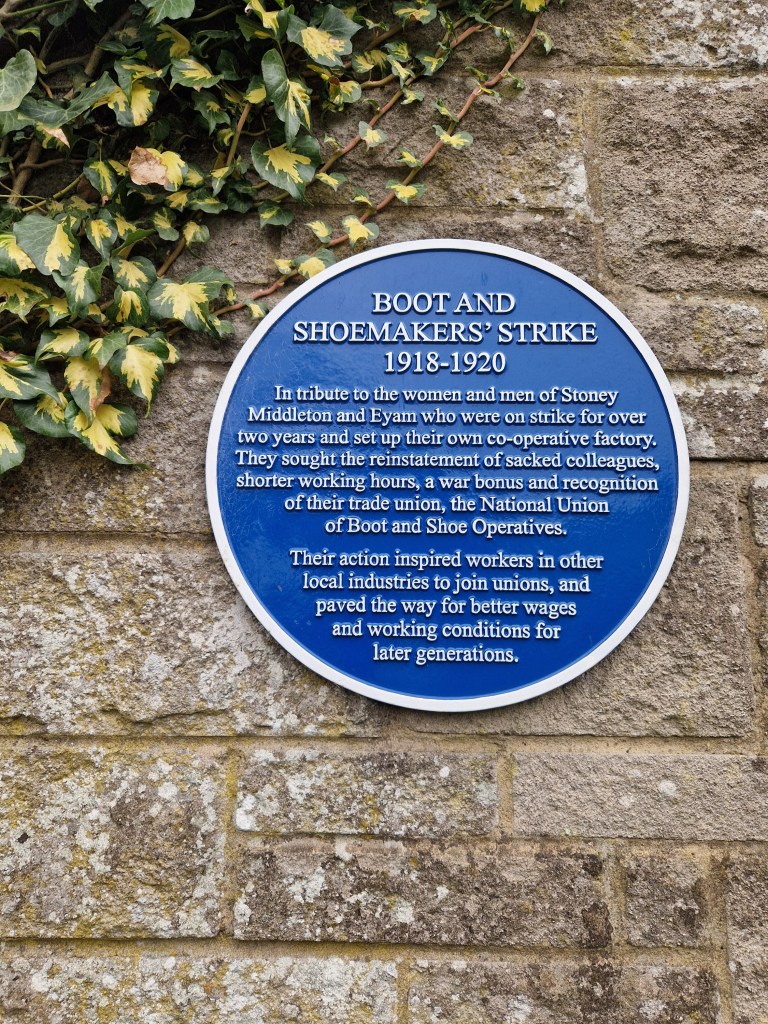
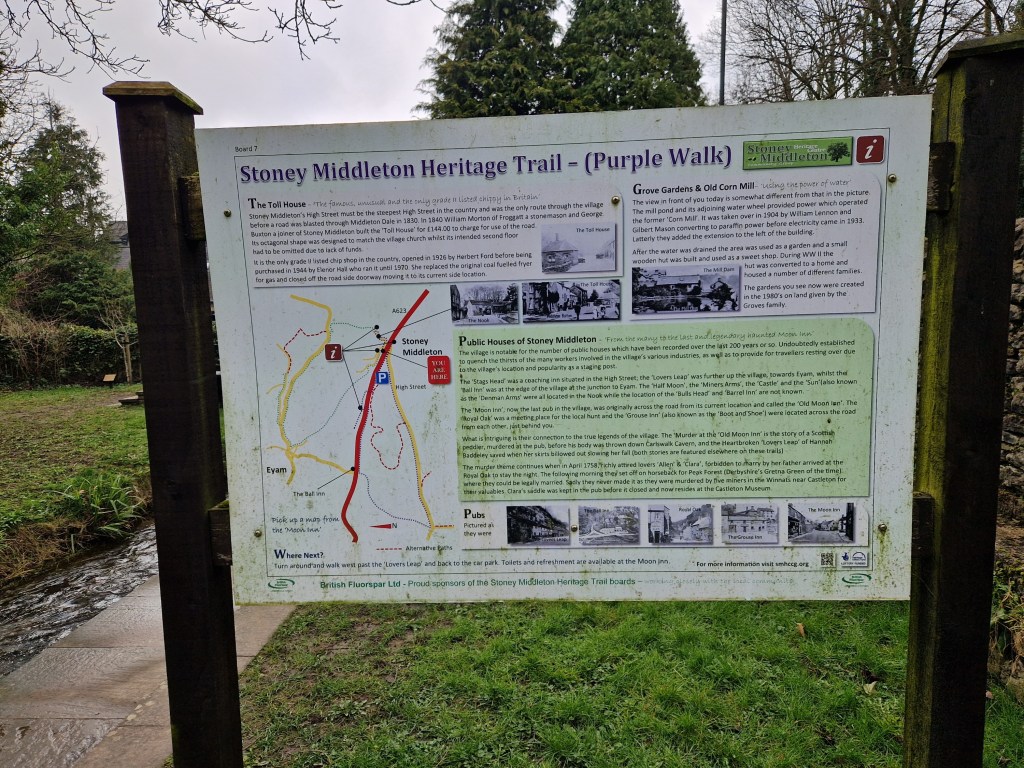
The next shot shows some houses across the road from the chip shop, illustrating the precipitous nature of parts of the village.

St. Martin’s church was the next landmark on my walk. The church was open to visitors and I went inside and made a few pictures with my Yashica Mat 124G, which I’ll post on another occasion. The church is quite unusual in that the nave is octagonal, which you can just about make out in the picture below.

On the road past the church is a small building with a spring flowing beside it. The structure is known as the Roman Baths. I didn’t photograph it, but grabbed a quick picture of the plaque outside with my phone camera.
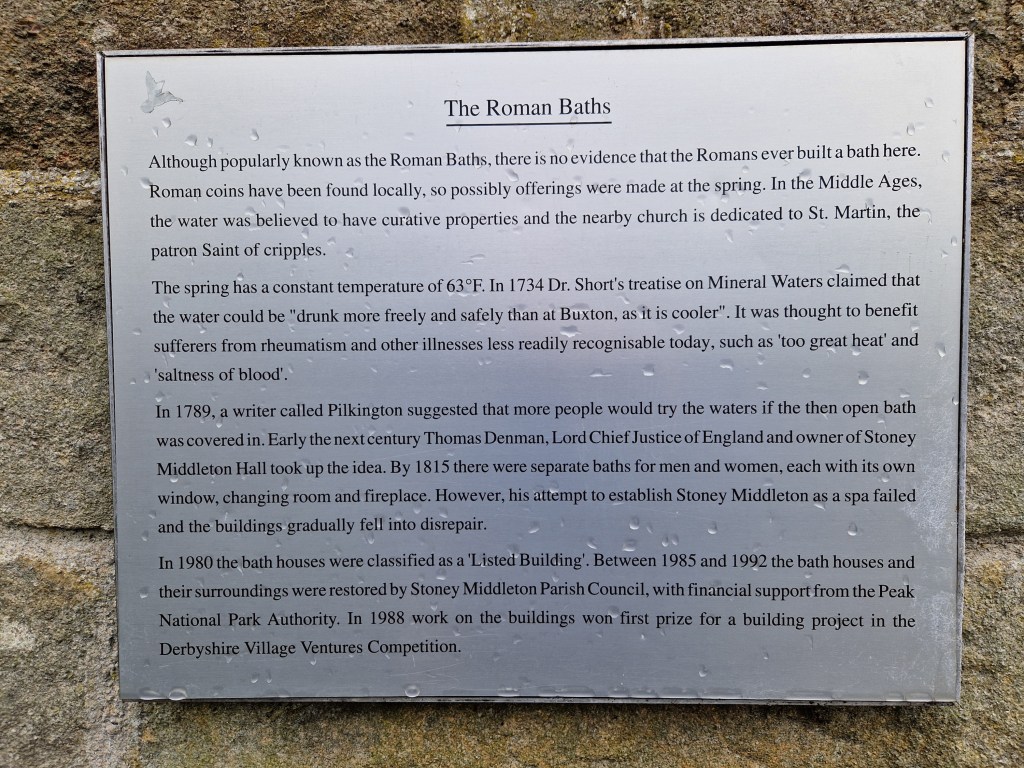
At the end of this road the tarmac ends and I was back onto a track again. Near the bottom is a cemetery containing Commonwealth War Graves. It has a mossy lychgate that made for an interesting picture.

From here the track, and old packhorse trail, ascends quite quickly. It’s rocky and bumpy and soon had my legs aching and my lungs panting. The next photo is looking back the way I came. This section was a bit less steep.

At the top of this track is a road, and there is a footpath through the fields on the other side that continues the ascent. Again, this next shot was a look back the way I had come.

At the top of this path is a wooded area with the trail eventually joining Riley Road. This road runs back towards Eyam and is thankfully downhill all the way, but near the top it passes a field which is the site of the Riley Graves. This small enclosed graveyard contains the gravestones of seven members of the Hancock family who lost their lives as a result of the plague within seven days of one another in August 1666. Elizabeth Hancock buried her husband and six of her children here. After the plague passed, Elizabeth moved to Sheffield with her remaining son.

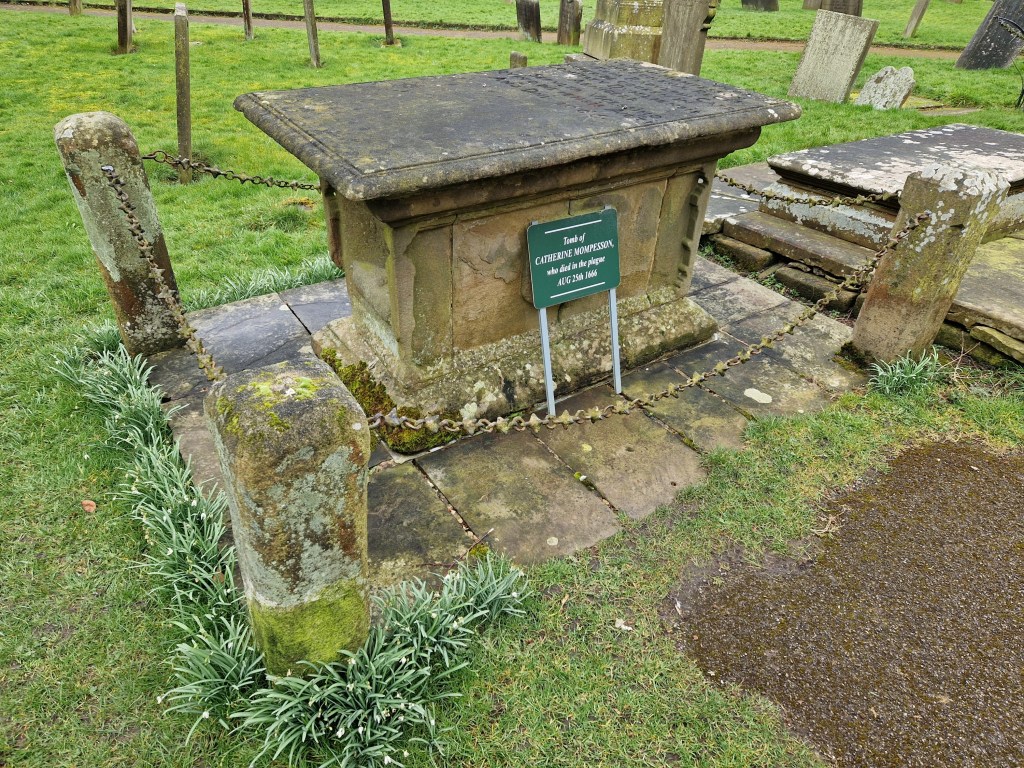
Many of the buildings and places in Eyam have information plaques affixed, providing information on the events of the plague, such as these at The Miner’s Arms and within the parish church graveyard.
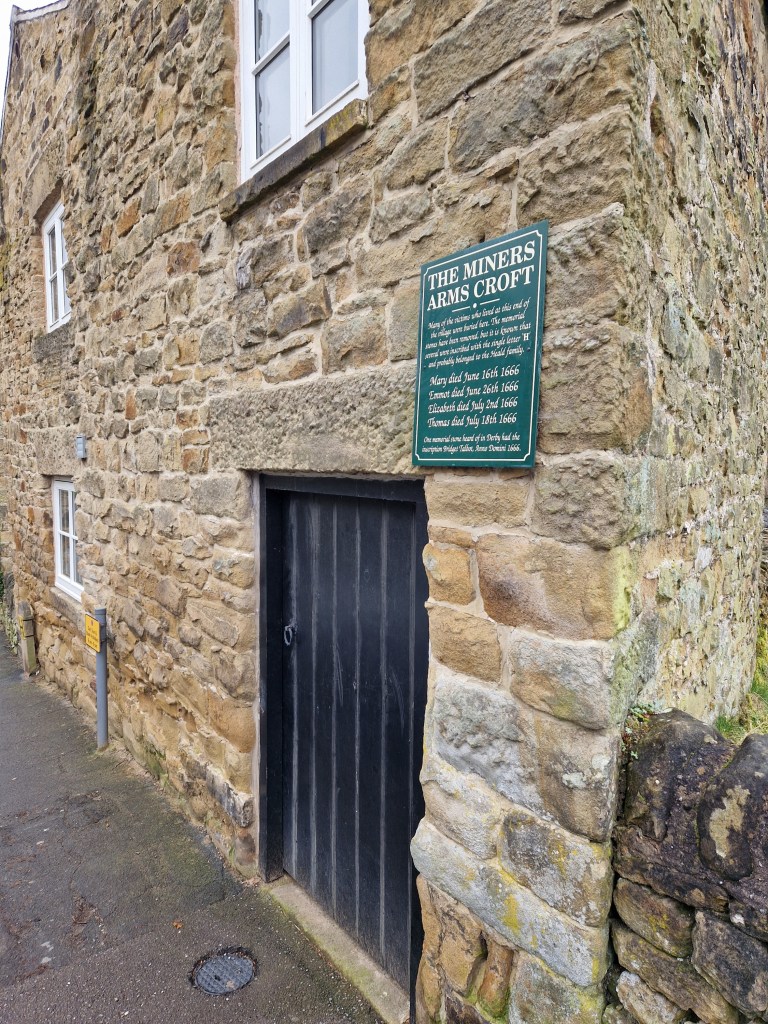
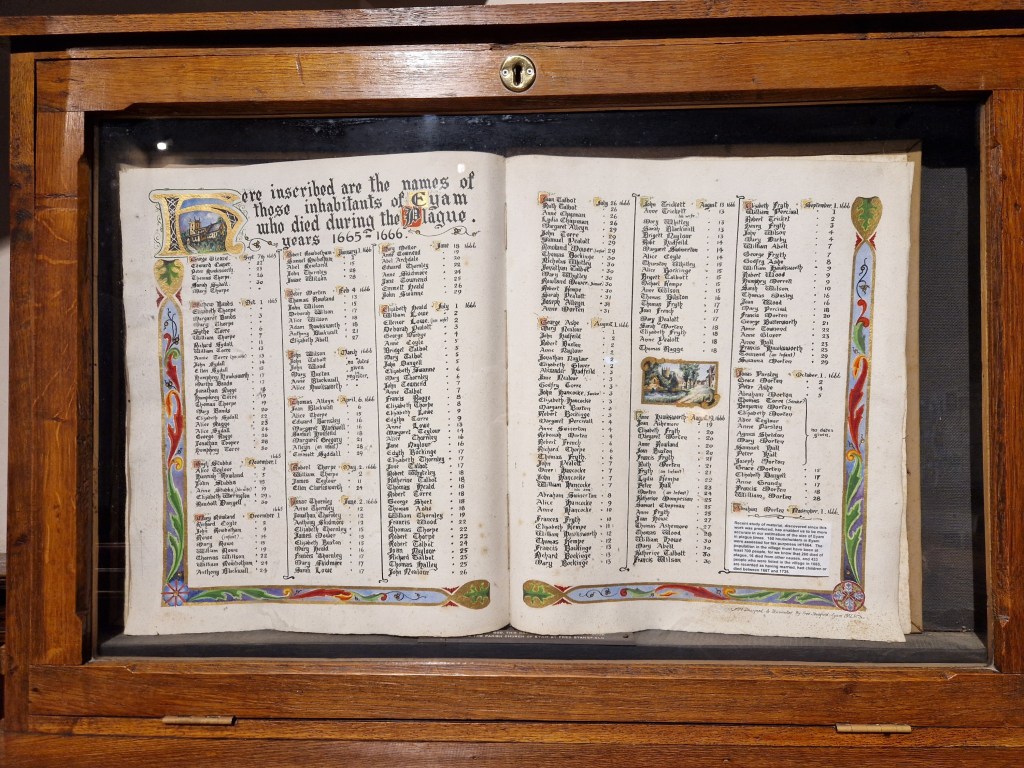
Within the church can be a found listing the inhabitants of the village who fell victim to the plague.
On that sad note I’ll bring this two-part post to a close. I plan on doing a bunch of these walks this year (indeed, I’ve already done three more!), so look out for those soon.
Olympus XA3 & Ilford HP5+ (@800asa). Ilfotec DD-X 1+4 10mins @ 20°
Taken on 9 March 2024
I took this picture on my way home from my autumn walk in the Peak District (which I ‘ve posted about over the past three days). I was driving through Coal Aston, a district that sits about halfway between Sheffield and Chesterfield, and saw how the morning sun was illuminating the front of this church and making vivid the colours of the Remembrance Day poppy displays.

I found a place just down the road where I could park and then walked back to take the photograph from across the street. The lady in the purple jacket walked through the scene as I was focusing the camera, and then stopped to look at the bus timetable at the bus stop, so I got a human element in the picture, which is nice.
Bronica ETRSi, Zenzanon 75mm f/2.8 PE & Kodak Portra 160. Lab developed, home scanned & converted with Negative Lab Pro.
Taken 11 November 2023.
I took a trip out with the Chamonix 4×5 camera last weekend. I had two reasons for doing so. The first was that I had some free time, the weather was nice (even if the skies were a little too clear this time), and I wanted to go out and take pictures. The second reason was to shoot some pictures without my yellow filter to see if I would still get any out of focus areas without it being used.
The answer to the second was that, no, I didn’t, which is a relief. I did get some out of focus areas, but these were ones that I can explain away to camera operator failure. 🙂
I went out to North Leverton Windmill and took five photos there, some of which I’ll publish here in due course. After photographing the windmill I headed over to Sturton-le-Steeple to shoot my final sheet of film, with the idea of photographing West Burton Power Station which sits a mile ot two away, taking advantage of the nearby River Trent.
I did take a picture of the power station but with the Bronica, which I’d also taken out with me, and which had my 150mm lens, giving a better view of the station (one day, I think I’ll go for a walk around the power station, and try to get some nice atmospheric pictures from closer range – there are a whole bunch of public footpaths surrounding the facility).
In the end, I shot my final sheet of Fomapan in the village itself, with the church as the subject, and it has come out quite well. A functional yellow filter might have added some more “pop” to the skies and, annoyingly, the new box of Fomapan I’ve just received appears to have the same issue with white speckles on the negative that I’ve encountered before, which means I now need to try and get a refund and the messing around that will entail. I think I might stick to Ilford film in future, even though the cost is higher.

Chamonix 045N-1. Fujinon NW 135mm f/5.6 & Fomapan 100. Ilfotec DD-X 1+4 8mins @ 20°
Taken 2 September 2023.
This is a church I’ve photographed on a few occasions. While Cuckney hasn’t been a particular destination, it’s a place that I drive through occasionally and the church stands out. It’s a Grade I listed building dating to the 12th Century, although it has been restored a number of times since then. I think it has a pleasingly angular shape. It is also largely unobscured by anything blocking it’s view – many churches tending to be stood amongst trees that can make photographing the entire structure more difficult.


Fujica GW690 & Ilford HP5+. Ilfotec DD-X 1+9 15mins 45secs @ 20°
Taken 27 May 2023.
A mere stones throw from one another, here are Cemetery Road Baptist Church and Lansdowne Chapel.
I’ve noticed that, in certain shots – and particularly when pointing the camera upwards – the blue skies in my pictures take on a deepr, almost petrol-blue tonality. While the sky does tend to be a deeper blue when you look towards the vertical, I’m not sure that explains this change in tonality that I sometimes get. I could probably fiddle with the colours during the edit, but I quite like the richness of it.


Canon Sure Shot Supreme & Kodak Gold. Lab developed. Home scanned and converted with Negative Lab Pro.
Taken 20 May 2023.
Today’s is the last of my photos from the trip to Italy I took over two months ago now. It’s quite a nice one to go out on though. I’d seen this church while walking around the town with my wife, but it was the next street over so I didn’t get chance to get close. On the last full day of the trip though I went for a walk while my wife sat beside the pool reading her book, so took the opportunity to grab a picture.
Over the past few days I’ve been scanning a roll of expired Kodak Elite Chrome that I shot while visiting this year’s Sheffield Steam Rally. I used my Canon Sure Shot Ace and all the pictures are noticeably under-exposed. I never overexpose slide film as it tends to retain its limited exposure latitude, even if it’s lost some of it’s colour tonality, and have generally had well exposed results when shooting other expired E6 emulsions. So in this case I don’t know if it’s the film (it did expire over 20 years ago!), or the camera’s metering – although I’ve had the Ace a few years, this was only the second time I’ve used it, although there were no issues with underexposure previously.
Whatever the case, it will make a good subject for a new Expiry Files post, especially given I haven’t done one of those for ages, despite promising to try and do more of them.

Olympus Trip 35 & Fujifilm 200. Lab developed. Home scanned and converted with Negative Lab Pro.
Taken 7 May 2023.

