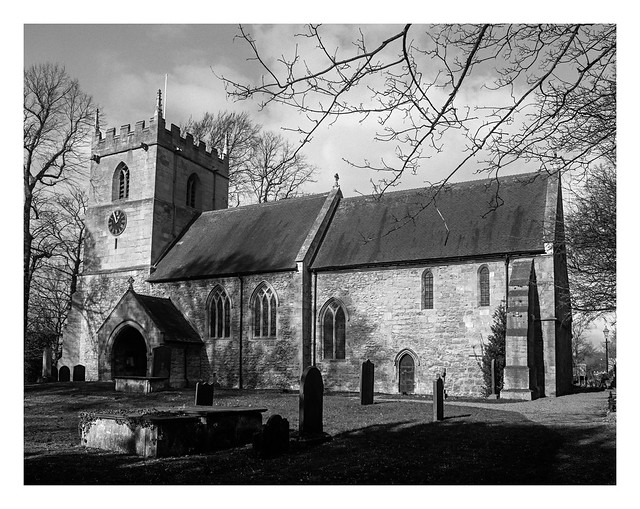
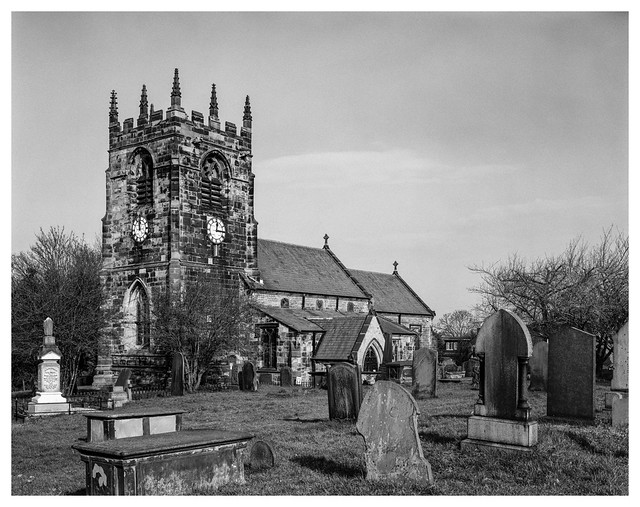
As I’ve been posting pictures of churches over the past few days, I might as well post another. This one wasn’t shot on 4×5 large format, instead it’s a small-by-comparison 6×45 medium format ratio. Despite the smaller negative, the Bronica ETRSi still produces very nicely detailed photographs, such as this one of All Saint’s church in the village of Hooton Pagnell.
I managed to get out and make more photos today. Amazingly, given my usual poor luck when it comes to the weather, it was a beautiful spring day – all blue skies and (later on) fluffly little cumulus clouds. I had a momentary mini panic this morning when I woke to see the lovely conditions but without having a clue where to go to take advantage of them. In the end I decided to visit Newark Air Museum and take some large format photographs of the old aircraft they have there. I exposed 8 sheets of 4×5 and also managed to finish off a roll of 35mm HP5+ in the Canon Sure Shot Supreme that I had in my coat pocket. I’ll try and develop some of the 4×5 pictures tomorrow all being well.
Bronica ETRSi & Zenzanon 75mm f/2.8 PE & Ilford Delta 100. Ilfotec DD-X 1+4 10 mins 30 secs @ 20°
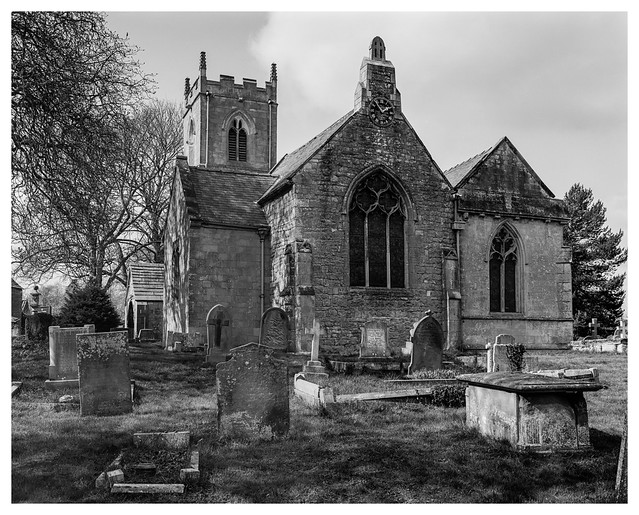
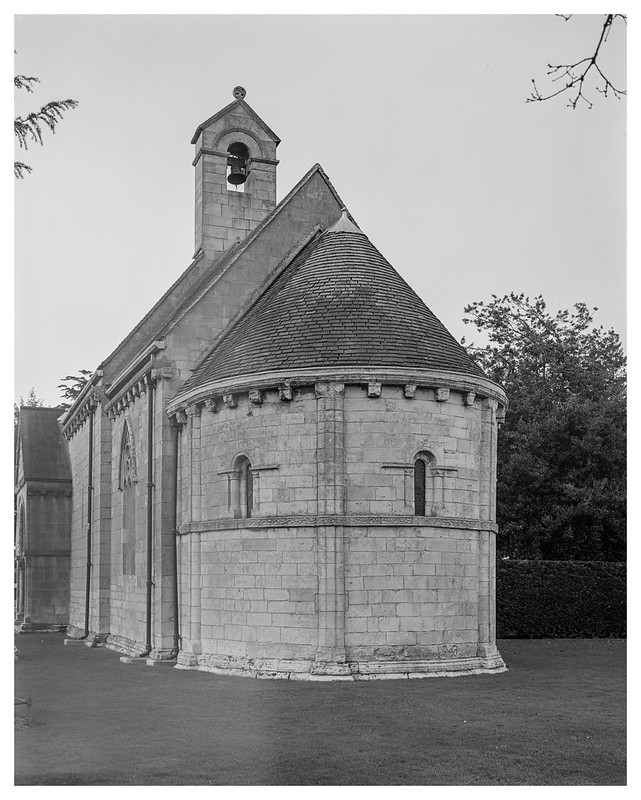
Another church, and another named after St. Peter just a couple of days after I posted a photo of its namesake at Elmton.
Quite a difference in architecture between the two buildings though.
When dust-spotting the scan I spotted a lone pigeon hiding in the scene. Can you spot it? You’ll probably need to click through to Flickr to see the full resolution version in order to find it though.
I’m now very much looking forward to the four days off work that the extended Easter weekend will bring. I’m hoping to do some more photography if the weather remains decent.
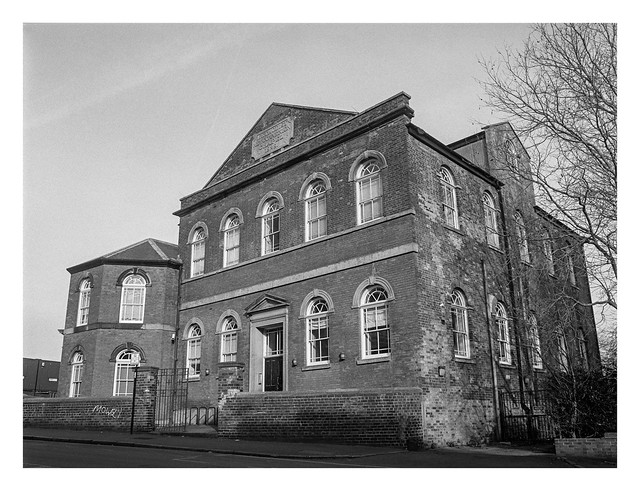
This is the Methodist New Connexion Chapel in Sheffield. I’ve photographed the building before and the area – another part of sheffield where new construction is booming – is rapidly changing to something new. Many of the buildings that were present last time I walked past have now vanished to be replaced by blocks of apartments. But this chapel remains.
The building dates back to 1828, built three decades on from the founding of the church by Sheffield man Alexander Kilham after seceding from the Wesleyan Methodists. Early in the 20th century the church would become part of the United Methodist Church.
Bronica ETRSi & Zenzanon 50mm f/2.8 MC & Ilford HP5+. Ilfotec DD-X 1+4 9 mins @ 20°
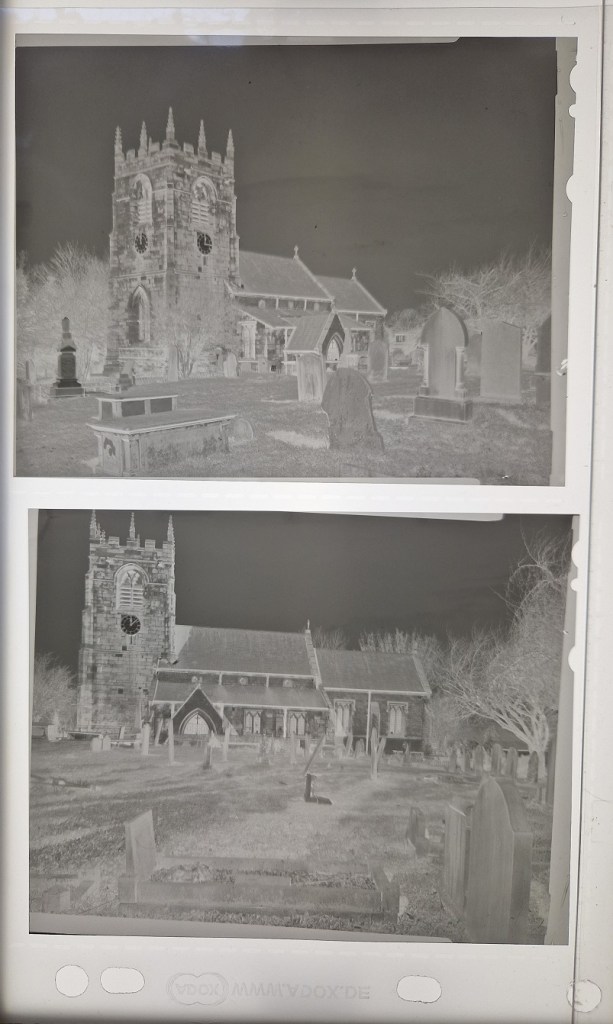
Another couple of shots taken this week and then developed today. The good news is that I’m now fully confident that the light leak issues I had before are now resolved. The bad news is that I think I somehow managed to load these two sheets incorrectly. Not in a significant way, but negatives from both sides of the film holder indicate the the sheet wasn’t aligned properly and the photos are wonky as a result. You can see what I mean in this photo of the negs on my lightbox – if you look at the film border you can see how it’s out of whack:
I’m not sure how I managed to do this and, to be honest, I didn’t even realise it was possible! None of the other sheets I’ve loaded have suffered from this problem so I will have to keep an eye on things in the future. Sadly it means that the side-on picture of the church is spoiled as the wonky frame has chopped the top off the church – this is made worse when scanned as the border isn’t included in the scan.
The other image was retrievable though as I’d not framed the subject so tightly. The good news is that these were really just a couple of final test shots to make sure everything was working ok. I think I’ll make sure not to tightly frame my subjects for the time being though, just to be safe.
Here’s the shot that worked ok. If you click through to Flickr you can see that there’s a lot of detail.
Behind the fence and trees flows the River Don. Across the river stands New Testament Church of God (formerly Holy Trinity Church). The chimney and large brick building to the left of the frame is Aizlewood’s Mill, which I wrote about the other day.
Bronica ETRSi, Zenzanon 75mm f/2.8 PE & Fujifilm Pro 400H. Lab developed. Home scanned and and converted using Negative Lab Pro.
Since taking posession of my Chroma 4×5 camera I’ve exposed 12 sheets of film. Two of those were complete write offs due to, ahem, user error. Some shots have looked good – not necessarily artistically so, but technicaly pleasing (at least given my current level of skill with the camera) – but quite a few have been beset by light leaks. When I developed four sheets the other day I was disappointed to see more light leaks. Two of the shots had significant leaks, the other two less noticeable, but the defect looked very similar to some of the other frames that had suffered similar problems.
My initial though was that there was a problem with one of my film holders, but on sharing the images with some other large format users, they all pointed to the problem being caused by light getting behing the film holder when it was in the camera. One way to test for this is to put a light source inside the camera in a darkened room and see if light can be seen escaping. By doing this I was able to see than no light was getting out behind the film holder but that there was a very fine strip of light visible where the camera back is magnetically attached to the body. The gap appears to be razor thin – a small fraction of a millimetre – but if light is getting out, then light can get in too.
I wondered about trying to finagle a fix – maybe putting strips of tape in the join, or maybe a shaped piece of light seal foam, but then I contacted the guy who manufactures the camera and he very kindly offered to take a look at it and see if he can identify the problem. So I now need to find a sutable carton, pack it up, and get it shipped across to him for a (hopefully!) fix.
So I’ll be shooting smaller formats for now. Not that I was ever going to give up on 135 and 120 in any case.
Here are two of the affected shots from the Chroma. The first one has little impact, but that’s possibly due to the busier nature of the scene. The second shot shows the light leak more noticeably on the left side of the image. Other shots are much more badly affected than these. While I’m disappointed by the light leaks, I can at least see than my ability to get things properly focused with the camera and its movements is improving. Still work to do, but much improved on before. I’m also impressed by just how much detail the 4×5 film can resolve.
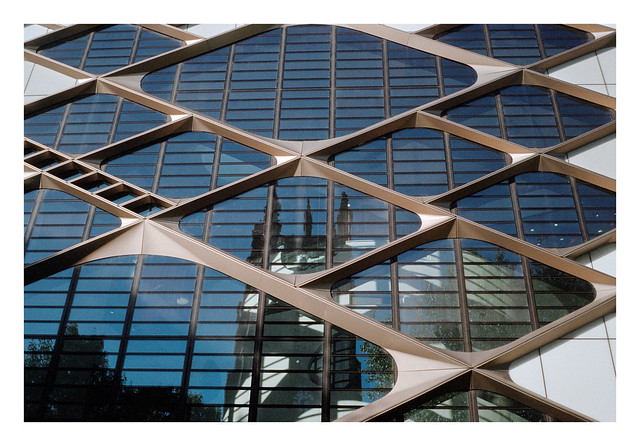
The modern building in today’s picture is The Diamond, a facility owned by the University of Sheffield which houses engineering facilities and lecture halls. It stands on the site of the original Jessop maternity hospital (where my eldest son was born) and parts of the original listed structure still remain, incorporated into the modern architecture.
Reflected in the glass is the tower of St. George’s church, now redundant as a place of worship and acting as a lecture theatre and student accommodation.
Olympus Trip 35 & Kodak Colorplus. Lab developed. Home scanned and converted with Negative Lab Pro.
This small Norman chapel at Steetley, not far from Worksop (although it falls under the parish of Whitwell), is a place I’ve photographed before. I found the place by accident one day while out on a hike, and it was a pleasant surprise to find such a nice building when I wasn’t expecting to. I had a few frames left on this roll of Kodak Gold film and decided to re-visit the chapel to use them up.
The building dates back to the 12th century and has seen its share of history, from the Great Plague, when the population served by the chapel was completely wiped out causing the building to fall into disrepair, the roof collapsing in the process. It was the scene of a skirmish during the English Civil War during the 17th century, and apparently there are still musket-ball holes visible in the masonry (although I didn’t spot these).
The fortunes of the chapel lifted when the coal industry rose in the 19th century, the restoration of the chapel being completed in 1880.
The door to the chapel was unlocked when I visited on this occasion and I was able to explore inside. Unfortunately 200ASA film is not the best choice for the interior of a dimly lit chapel, and the slightly faint patch on the rangefinder of my Olympus 35RC didn’t help the situation, but I was still able to take this rather nice picture of the sunlight pouting through one of the stained-glass windows. I’m very happy with this photo.
Olympus 35 RC & Kodak Gold 200. Lab developed. Home scanned and converted with Negative Lab Pro.







 Steel City Snapper photography