Today was less eventful than yesterday and I didn’t kill any birds (although I’ve probably crushed multiple tiny invertebrates beneath my feet purely in the act of walking around).
It was the annual Classics on the Moor car show in Sheffield today, so I went along and shot a couple of rolls with my Yashica Mat. The camera drew the attention of a number of people, including some other photographers – one who was making street portraits with a Rolleicord.
I’m in a position again of having a lot of undeveloped pictures. The tally is currently: 3 rolls of film scanned and waiting to be uploaded online, four rolls of B&W film to be developed, scanned, and uploaded (2 x 120 6×6 & 2 x 36exp 135), two rolls of 120 6×6 C41 to be developed, scanned, and uploaded, and then three rolls of film partially shot in different cameras (1 x 120 6×6, and 2 x 36exp 135). That’s around 180 photos not including the rolls I’ve yet to finish.
I don’t think there will be a drought of pictures for the blog for a while…
Olympus Trip 35 & Kodak Pro Image 100. Lab developed. Home scanned and converted with Negative Lab Pro.
I decided that I would have a day of photography today. I had to drop my son off at work at 7am so it meant I would have a decent early start, although I wasn’t looking for sunrise shots or anything (a good job, as sunrise was an hour earlier, and it was overcast anyway).
I’d decided to drive to Halifax, a town in West Yorkshire which I haven’t visited before, but which I knew had a bunch of interesting old mills and the like to photograph. The quickest way to get there is to take the M1 north, before heading west on the M62.
The first of the day’s lows came mere minutes after dropping my son at work. As I was driving towards the M1 junction I noticed a car ahead that seemed to be driving a little erratically. It kept suddenly slowing down, and I initially wondered if it had some sort of mechanical fault, but I soon realised the fault was with the driver, who I assume didn’t really know where they were going. The best course of action in this situation would be to find a suitable place to stop, and then take stock of your route. Unfortunately, the person driving this car took a more extreme action. As they got to the roundabout where the slip road to the M1 northbound is located they turned onto the slip road and then came to a complete stop. Vehicles come around this roundabout at quite high speed, many traveling in excess of 55mph, so having a vehicle block one of the lanes on the sliproad could be a potentially catastrophic event. I was able to pull around the stopped car without too much difficulty, but I could already hear angry beeps from cars behind me affected by the foolish driver.
This obstacle behind me, I proceeded on my journey. However, only a few minutes passed before the next low came calling. I was travelling at maybe 65mph when I saw a pigeon fly from the side of the motorway and land about thirty feet in front of my car. At the speed I was going there was nothing to do to avoid it and, even though I saw it begin to take flight, I hit it with an awful thump and the poor thing went tumbling across a couple of lanes of the motorway, trailing feathers. I felt horrible. I don’t like harming animals, and to have killed one in this way, even though I couldn’t avoid it, made me feel very sad and guilty. This wasn’t a good start to the day, and most definitely not a good start for the unfortunate pigeon.
After a somewhat subdued but uneventful remainder of the journey, I arrived at my destination. As with many towns that grew during the industrial revolution, there are a large number of old mills and factory buildings. Although most have now been repurposed for things like accommodation, office space, and retail use, they are still impressive and interesting structures, and there were plenty of things to photograph. Added to the buildings, there is a network of high overpasses in the area that curve above the valley floor like something out of Mega City One, making for a bunch more interesting photo opportunities. The weather wasn’t as I had expected (sunshine and clouds), instead being largely overcast, but I think these conditions probably suited the black and white photography I was doing.
After shooting a couple of rolls of film I decided to go find a cafe and get a drink and, as I was walking through the town centre, I noticed a police car besides which an agitated looking man and woman was speaking to the officer and gesturing to the building behind them – a jewelry shop occupied the ground floor, and above were another three floors of unknown use. I heard to woman talk about a fire, and what sounded like there being a gas cylinder in the room. Within a minute smoke had begun to emerge from a first floor window. More police arrived and started to make people retreat from the scene, saying there was a danger of explosion. Some people were still approaching the scene and were told in no uncertain terms to “get back!”.
Soon a huge amount of smoke began to emerge from the windows, reeking of whatever was burning in there, for a short period reducing visibility down the entire street, and the orange glow of flickering flames could be seen behind the smoky glass. Shortly afterwards a fire-engine turned up and soon a fireman was spraying water through the first floor windows. After a few minutes of this, the smoke started to diminish and more fire-officers entered the jewelry shop on the ground floor, having to rip open a security shutter to gain access. After watching for a while longer (and having taken a few photographs) it seemed like everything was under control and I decided to move on and find the cafe I was looking for.
Luckily, this was the extend on the bad event that happened during the trip (although I’d have preferred it had none of them occurred).
There was something good that happened on the way home though…
Rather than take the quickest route back, I decided to take a more circuitous way on the hope that I’d find something interesting to photograph with the two remaining shots on the roll of film in my camera. After ignoring the demands of Google Maps and instead taking random diversions that looked like they might lead somewhere interesting (or at least somewhere I’d never been before) I, by chance, arrived at Castle Hill just outside Huddersfield, Castle Hill is the site of a Bronze Age hill fort, but more prominently, the 100ft tall Victoria Tower. I’ve seen the tower from afar before, but never been close to it, and today I was able to not only photograph it, but also climb to the top (or as high as you’re allowed to go at least).
The pictures from today will appear here in due course once I’ve developed and scanned them all. Loads of stuff still to come before then though.
Anyway, in lieu of those, here are some completely unrelated pictures of the rocky coastline at Lloret de Mar…
Olympus Trip 35 & Kodak Pro Image 100. Lab developed. Home scanned and converted with Negative Lab Pro.
When I go on a holiday, I like to take time to wander round and explore the places we visit. Sometimes, in a place like Barcelona, there is far more to be seen than can possibly be experienced in a short stay. But even in more tourist-focused locations such as Lloret de Mar, there are still things to be found. Sometimes these are relatively everyday locations that are made exotic by unfamiliarity, and sometimes they are just unexpected.
In my mind, I had the basic layout of the part of the town where we stayed mapped out as gradually sloping downhill until it reached the beach (separated from the town by a promenade, road, and a long strip of hotels and restaurants). What I didn’t realise was that there was a tall hill smack bang in the middle of this. The hill is no doubt readily apparent from a higher vantage point, but once you’re amongst the buildings then it becomes easily obscured. Until you stumble over it on a random walk through the streets.
I first noticed it when I spotted a large flight of steps between a couple of buildings. It was a very hot day and I considered taking another route, but the curious part of me decided there might be something worth seeing at the top, so up I climbed. I didn’t count them, but there were quite a lot and the first picture below if the view looking back down.
The first thing I spotted at the summit was a row of houses draped with vivid swathes of red flowers. I don’t know what this plant is, but it certainly made for an attractive subject for a picture.
Despite being near the top of the hill, I didn’t find any vantage point where I could take in a view (other than down mostly curving streets). I guess you need to enter one of the buildings to take advantage, such as the tall stacked platter of a structure in the image below.
It was odd that, even when I knew the hill was there, it was still quite easy to miss, even from the beach – where it was apparent, but kind of blended into the taller, more-distant background hillsides.
Olympus Trip 35 & Fuji Superia 100 (expired 2008). Lab developed. Home scanned and converted with Negative Lab Pro.
The final batch of pictures from my Yorkshire Sculpture Park visit. As previously, I’ve added a little information about the artworks below each picture, but you can find out more at the park’s website.
Seated Figure by Sean Henry
Sean Henry makes detailed and life-like sculptures of anonymous figures, often in casual poses and deep in thought. They are usually based on members of the public or actors, and scaled either up or down, so they are never actually life sized. Seated Figure is a monumental 3 metres tall. The artist uses clay to model his works in the studio, before they are cast in bronze. (taken from the YSP website)
This piece can be seen from miles and has a commanding position looking out across the landscape from the top of a hill.
Charity by Damien Hirst
Charity is based on the Scope charity collection boxes that used to be common on British streets. It features a young girl wearing a calliper and cradling a teddy bear. It has a donate box asking people to ‘please give generously’. Hirst’s interpretation questions outdated ways of depicting disability and seeking charity. (taken from the YSP website)
The charity boxes that inspired this piece were a common sight when I was younger, although not with the additional flourish added by Hirst, which features the collection box pried open by a crowbar. I was amused and happy to note that crows had taken up residence within the open collection box and were carrying nesting material in there as I watched.
The Virgin Mother by Damien Hirst
Damien Hirst’s The Virgin Mother stands at 10 metres tall and is the tallest sculpture at YSP. A powerful presence in the landscape, it is partly inspired by the historic sculpture Little Dancer of Fourteen Years(c.1881), by Edgar Degas. Hirst deliberately makes the materials look different than they are, for example The Virgin Mother is bronze painted to look like plastic. (taken from the YSP website)
This is a striking piece of sculpture and my picture doesn’t really give a sense of scale, with a full grown adult barely reaching the figure’s calves. It’s also slightly disturbing with the figure appearing intact from her left profile, only to reveal tissues, muscles, bone, and a fetus in her womb. Where her left hand crosses the demarcation between outside and inside, the fingers are severed.
Two Large Forms by Henry Moore
The colossal sculpture is impressive in both scale and composition, appearing very different from every angle and continuing the theme of points that almost meet, which appears in much of Moore’s work. (taken from the YSP website)
I’d originally intended to get the whole sculpture in frame when I took this shot, but I liked how the child gave a sense of scale to the piece, so moved the viewpoint.
Yashica Mat 124G & Kodak Tmax 100 (expired 2008). Ilfotec DD-X 1+4 for 7 minutes @ 20°
More pictures from my Yorkshire Sculpture Park visit. Again, I’ve added a little information about the artworks below each picture, but you can find out more at the park’s website.
Wall Dale Cubed – Sean Scully Made for YSP, Wall Dale Cubed uses 1000 tonnes of Yorkshire stone from a local quarry and was constructed over many weeks. Importantly to the artist, this colossal work is built in the same way throughout, which connects to ancient stone walls in Ireland, so that ‘when looking at the outside of the block, one can feel the inside without being able to see it’. (taken from the YSP website)
Galaxy was a Memory, Earth is a Souvenir by Kimsooja Kimsooja developed this elegant and towering conical sculpture in collaboration with scientists at Cornell University. The nanopolymer in which its panels are covered enhances the refractive qualities of light, giving an iridescent effect similar to that which occurs naturally on the wings of a butterfly or a beetle’s shell. It is responsive to changing light conditions and brought to life by sunlight on its surface. (taken from the YSP website)
The structure apparently has a mirrored floor which make it look like it pierces the earth below, although I didn’t walk close enough to it to see this aspect.
Peter’s Fold by Andy Goldsworthy
In Britain, folds have been made for hundreds of years as animal pens and Goldsworthy has developed the traditional fold to make contemporary sculptures. Peter’s Fold was built using drystone techniques by master wallers who have worked with the artist for many years. The Yorkshire sandstone was sourced from Hillhouse Edge Quarry in nearby Holmfirth. It is built around a common lime tree with distinctive epicormic growth, which occurs when dormant buds beneath the bark become active. (taken from the YSP website)
I decided to take the picture from a low vantage point on the grass. Unfortunately, due to the way TLR cameras work, I didn’t spot a stray blade of grass in front of the taking lens which resulted in a blurred smudge on the image. I’ve attempted to remove this and not done too bad a job (although you can probably see the joins if you look closely…)
Tree Stump by The Tree
This isn’t an actual artwork, but this lone tree stump surrounded by daffodils looked pretty photogenic, so here it is, in amongst it’s more famous fellow park residents.
Yashica Mat 124G & Kodak Tmax 100 (expired 2008). Ilfotec DD-X 1+4 for 7 minutes @ 20°
Back in April I took a trip to the Yorkshire Sculpture Park. The venue features indoor gallery spaces, but also a significant landscaped outdoor park dating to the 18th century. Throughout the park are an large array of sculpture and artworks of varying styles, types, designs, and sizes.
On this visit I took my trusty Yashica Mat 124G and a (potentially less trustworthy) roll of expired Kodak Tmax 100 film that had been sat in the freezer for several years. As you can see, there was no need to worry about the condition of the film, which has produced lovely results.
I shot the whole roll at the park and will post the pictures over the next few days. I’ve added a little information about the artworks below each picture, but you can find out more at the park’s website.
Djinn – Bharti Kher
This huge, 5-metre tall bronze sculpture is very striking. It forms part of a series titled Intermediaries that take South Indian golu dolls as their starting point. These small, colourful clay figurines that are displayed in homes as part of the Navaratri festival depict gods and goddesses, animals and people.
Riace Figures – Elizabeth Frink
There are three of these figures gathered together, titled Riace II, III, & IV (although only two of them feature in my picture – I don’t know which ones).
The Riace figures are inspired by the 5th century BCE bronze sculptures that were rediscovered in the sea off the coast of the Riace region of Italy in 1972. Frink said ‘the original figures are very beautiful, but also very sinister, and that is what they are supposed to be’.
Buddha – Niki de Saint Phalle
The black and white picture, while pleasing, doesn’t really do justice to the bold colours that make up the mosaic surfaces of the figure.
Sitting – Sophie Ryder
Known as the Lady Hare – which Ryder describes a companion for the Minotaur – the work combines a female body with the head of a hare, a mystical creature in folklore.
Yashica Mat 124G & Kodak Tmax 100 (expired 2008). Ilfotec DD-X 1+4 for 7 minutes @ 20°
Religion isn’t really my thing but I do enjoy photographing religious artifacts and buildings – I probably fall under the umbrella of being a “cultural Christian” in that regard – although I find other religions artifacts equally interesting.
In the UK we have a wealth of churches dating back centuries, chock full of amazing architecture, artworks, stained glass windows and so forth. Even the more modern buildings, such as the brutalist architecture churches built in the post-war years, are interesting – sometimes even more so.
Most of the time any photographs I make of churches are of the exteriors. This is usually because many churches are not freely accessible, either to prevent theft or vandalism (sad, I know), or, in the case of grand cathedrals, require admission fees to wander around inside.
Sometimes though, particularly in villages out in the country, churches are still open and it’s possible to enter, enjoy their interiors, and make photographs. I took a few pictures inside a church at Tickhill last weekend that was open when I wandered past by chance. The picture of Mary and Jesus below is at Lincoln cathedral, but is outside, so I could make a picture without having to go inside.
I don’t mind paying an entrance fee if I know that there is likely to be something of interest to see and, importantly, I know I have sufficient time to wander at my leisure. I didn’t have the latter during this trip to Lincoln, unfortunately.
On another note, this weekend saw the 2025 Sheffield Steam Rally, so I went along today – as I do most years – and returned with a crop of exposed film (mostly medium format), so there will be traction engines to come at some point…
Yashica Mat 124G & Lomography Color Negative 400. Lab developed. Home scanned and converted using Negative Lab Pro.
These four photos were all taken around Leeds Combined Courts Centre. I found the brickwork and the architecture made for interesting photographs, and the nice weather didn’t hurt where the expired slide film was concerned, either.
Something good that happened today…
I’ve had a busy day at work, mostly taken up with meetings. Sometimes days like this can be frustrating because there’s insufficient time between calls to get on with the work I need to do. While that was still the case to an extent, all the calls I was on felt productive, and I came away from them feeling like something had been achieved, which is good.
Olympus OM-10 & G.Zuiko 35mm f/2.8 on Kodak Elite Chrome 200 (expired 2004) . Lab developed. Home scanned and converted with Negative Lab Pro.
My wife and I spent the weekend just gone in Barcelona to visit the Christmas markets and just wander round the city. It’s the first time I’ve traveled overseas so close to Christmas and I was a little concerned that we might get caught up in a mass of travelers going home for Christmas, but everything went very smoothly and, while Barcelona was pretty busy, the travel was not.
We had a very nice time just wandering about the place, not doing anything in particular other than visiting shops and markets and eating nice food. We visited the Sagrada Familia as there was another Christmas market there, and I did consider going inside the cathedral, but I would have needed needed to book tickets in advance and there were none available to buy on the day as it was fully booked. My wife isn’t particularly interested in visiting cathedrals anyway, and I would have felt a little guilty if I was dragging her around the place while I took photos and admired the architecture, so I wasn’t too concerned about missing the opportunity. Maybe I’ll get another chance one day.
I shot a roll of colour 35mm film while there, but it will be after Christmas before that gets developed, but took some more photos with my Ricoh GRIII, including the one posted here today, so will share some of those once I’ve gone through them all.
This large star can be found in Plaça Sant Jaume in Barcelona, Spain. It is titled Origen and was created by Xevi Bayona and Àlex Posada. It projects light from the points of the star onto the facades of the buildings in the plaza.
On the penultimate full day of our holiday in Dubrovnik, we decided to take an excursion to Kotor in the neighbouring country of Montenegro. Kotor is a World Heritage Site set deep in a vast fjord-like tidal bay surrounded by mountains. We had two potential days when we could have made the trip, but chose the second as the weather seemed ok at the time of booking.
The weather was not ok…
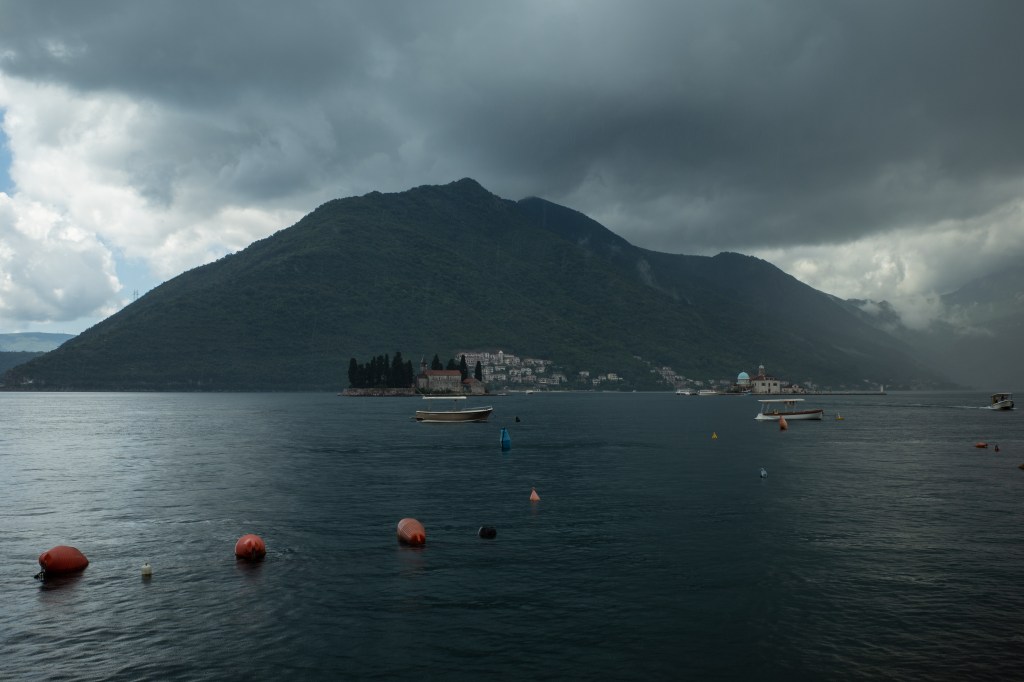
There were two stops on the trip (well, four if you also count the toilet break at a service station, and the quite long stop while passing through the border), the first being Perast – a small village beside the bay – where we had a short boat trip to the Church of Our Lady of Škrpjela, which sits on a small man-made island. Unfortunately, as soon as we got off the coach the heavens opened with a torrential downpour that continued throughout the stop. While we had a waterproofs with us, they were jackets and provided no cover whatsoever for our legs and feet and before we even got inside the church our shoes were soaked.
I posted this picture already during the holiday, but here it is again for some context – the church we visited is on the island at mid-right, the one with the blue dome.
We got wet again after leaving the church, although thankfully the small boat we used for the crossing had a roof. The boat’s roof did not protect us on the walk back from the jetty to the coach however.
Thankfully, by the time we arrived at Kotor itself the rain had stopped, and it stayed dry for the rest of our visit, but the wet feet and damp clothing persisted and took some of the shine off the trip.
We had an affable tour guide inside the walled city, and our group of soggy day-trippers followed him dutifully around the crowded and narrow streets of the town while he pointed out various sights, explained the history, and suggested which restaurants might be good places for lunch.
Kotor is apparently quite famous for the number of cats that live there, and as well as seeing them everywhere you looked, there was a wide range of cat-related merchandise available from almost every shop.
Three live cats, and one sculpted kitty are lurking in this scene…
I shot both colour and black and white film during the visit, sometimes of the same subjects.
The rough cobbles of this steep street were treacherously slippy under the soles of my (wet) trainers!
The entrance to the walled city.
Kotor is a destination for cruise ships and there were three of them moored when we visited, which probably explained why the place was so busy!
High above the city is a line of walled fortresses. We didn’t even think of climbing this trail with our wet feet, but it looks like quite the climb!
Remnants of the wet weather obscure the mountain tops.
On the whole, while Kotor is certainly an interesting destination, visiting it while soaked through (literally) dampens the enthusiasm somewhat.





 Steel City Snapper photography