There are several entrances to Rother Valley Country Park, most of them for pedestrians only – this one included. Car owners are not left out however, although they do have to pay to enter if they visit in their vehicle, and during the warmer months hundreds of them will fill up the car parks and line the far side of the lake.
This entry is just off the Trans Pennine Trail and is a reminder of the parks prior industrial heritiage, passing under a disused railway bridge that used to carry part of the rail network which transported coal from the colliery that used to cover much of the area.
Nikon F80 and Nikkor 70-200mm f/4 ED VR on Fomapan 400 (@320asa). Ilfotec DD-X 1+4 for 9mins @ 20°.
Last month I wrote about how I was unsatisfied with the quality of the Tamron 28-200mm lens I had and how I’d traded it in for a Nikon 70-200mm.
So far I’ve shot the Nikkor on a few occasions and the results have been noticeably sharper than those from the Tamrom, which is good. The downsides that I also discussed (size, weight, and lack of flexibility mostly) have also been borne out, but I knew this would be the case, and the improved image quality win out.
I’ve already posted a digital picture I took with the lens, but these are the first film shots I’ve shared on the blog. They were taken during a walk around the local country park, which has a healthy population of waterfowl.
Nikon F80 and Nikkor 70-200mm f/4 ED VR on Fomapan 400 (@320asa). Semi-stand in Rodinal 1+100 for 1 hour @ 20°.
The first of these two pictures featured in my favourite shots of 2025 post, but the second hasn’t been shown before.
As mentioned yesterday, these shots are taken from a short roll loaded from my recently acquired bulk loader. I chose Fomapan 400, in a shorter 17m roll for this first time out, mostly because it’s pretty cheap compared with something like HP5+ and wouldn’t be a bankruptcy risk if I somehow messed things up but, also, partially because I’m curious about trying different development methods with Fomapan 400 – a film which I often find to be underexposed or very contrasty when I’ve shot it a box speed before but which gave me some good results when I tried semi-stand development with some 120 reel film.
I tried the semi-stand approach on two occasions with the 120 variant, the first time with great results, but with the second giving me some noticeable bromide drag. I’m unsure why the results were different as I used the same methodology on both occasions, but they were.
For this roll of 35mm Foma 400 I used 1-hour semi-stand again (in Rodinal 1+100), but instead of 30secs of inversions at the start, plus a single inversion at 30 minutes, this time I gave the tank a single, gentle inversion at the 15, 30, and 45 minute marks. For this roll, at least, there are no signs of bromide drag, so I’ll try the same method on my next attempt.
The results are very grainy, but I expected this and it’s not something I mind – it adds some grit to the images – but the tonality is good (though this might also be partly due to shooting it at 320asa instead of the 400asa box speed) without the heavy contrast I’ve seen in the past when using regular development in Ilfotec DD-X.
But, anyway, the first roll of self-loaded film was mostly a success (it did come off the spool at the end, requiring me to remove it from the camera in a changing bag) and I have another, longer roll waiting to be shot in my F80. I’m looking forward to the results from that too.
Minolta X-300 & Minolta 50mm f/1.7 MD on Fomapan 400 (@320asa). Semi-stand in Rodinal 1+100 for 1 hour @ 20°.
The branches of the leafless tree, which stands on the bank of the main lake at Rother Valley Country Park, reminded me of something. At first I thought the curved, whip-like branches looked like tentacles, but then it struck me that it looks like some sort of vascular structure, like a brain with the tissue missing. Repetition in nature.
A further trio of pictures taken on a Boxing Day walk on the Trans Pennine Trail. I was fortunate to enjoy three misty days straight after Christmas, all on days when I wasn’t at work so could take advantage of them.
Jumping back to December for some more B&W Yashica Mat 124G images. I posted a couple of shots from this roll already (including a couple of pictures of woodland shelters), but the two shown today are of part of the bridge system that criss-crosses the Trans Penine Trail near Rother Valley Country Park.
It’s quite interesting to look at historic maps of the area and see the network of railway lines that served the coal mine that used to exist in the area. Wandering through the birch woodland that now covers a lot of the area, it’s quite easy to stumble over old track-beds and entire bridges surrounded by thick overgrowth.
It’s been a while since the last one of these posts, but with a shorter gap than before – 7 months this time, as opposed to the 17 month gap between the last two Expiriment posts.
This time, the subject was a roll of Kodak Vericolor HC which had expired in 1992. I have no idea of the entire provenance of the film before I got it, although it’s been in my freezer for about three years now.
Kodak describes Vericolor HC as follows:
KODAK VERICOLOR HC
Professional Film
This improved color negative film has greater sharpness and finer grain than KODAK VERICOLOR II Commercial Film, Type S.
This film is ideal for commercial illustration, industrial applications, low-level aerial photography, environmental portraiture, and other applications that call for increased contrast. It may also be used for any copy work that needs increased contrast, and for outdoor portraiture under low-contrast lighting conditions, such as on cloudy days or in deep shade.

FEATURES
•	Extremely fine grain, extremely high sharpness, and high resolving power
•	Built-in dye mask
•	Balanced for exposure by daylight, blue flash, or electronic flash
•	Designed for processing in Process C-41 chemicals

BENEFITS
•	Produces excellent-quality high-contrast prints even with a high degree of enlargement
•	Makes excellent-quality color reproduction possible without supplementary masking
•	Allows exposures from 1/ 10 second to 1/10,000 second without filters
•	Can be processed with KODACOLOR and other KODAK VERICOLOR Films
I took a different approach when shooting this time. Usually I only have a single roll of a particular expired film and tend to take a chance and shoot the whole roll with the same settings, without any bracketing. This going-for-bust approach risks disaster if I misjudge the settings, but the reward is a full set of different images if it works well, rather than a curtailed set of identical compositions taken at different shutter speeds.
This time though, I decided to take the cautious apoproach. The primary reason for this being that I have an entire pro-pack of the film so using one roll as a sacrifice would mean I can shoot the other four knowing what settings will work well. In order to still maximise the number of different compositions, I chose to shoot the roll with my Bronica ETRSi, which gives me 15 shots per roll of 120 film. I decided to shoot each composition at three settings, allowing me five different compositions from the roll.
I didn’t see any point in shooting any of the shots at box speed, so planned on shooting each composition at one, two, and three stops of overexposure. As the film is rated at a box speed of 100asa, I chose to set my light meter to 64asa as a baseline, take a reading for the composition, and then shoot two additional frames with an increase of one stop of exposure for each. That was the plan, at least…
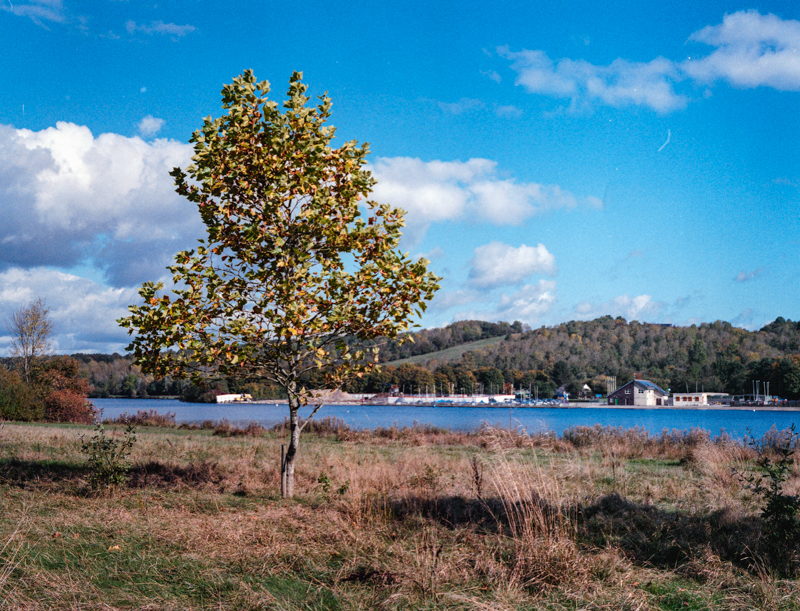
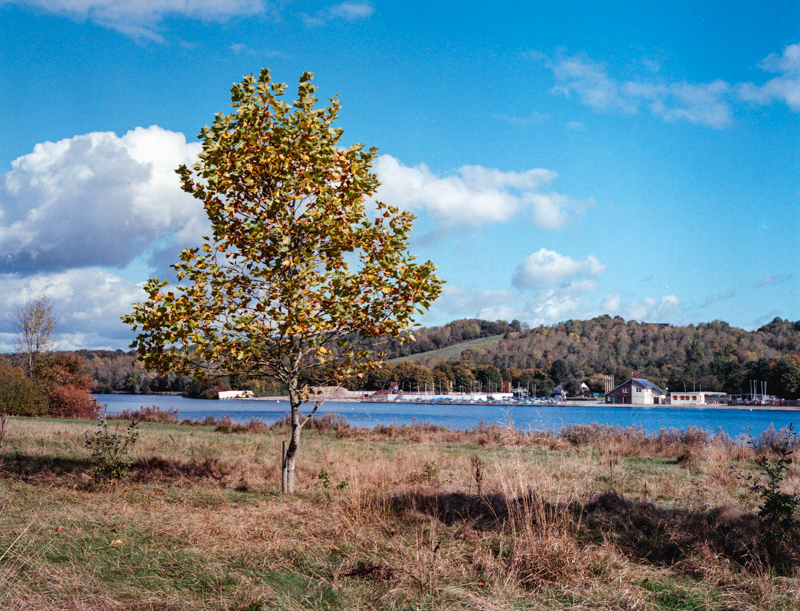
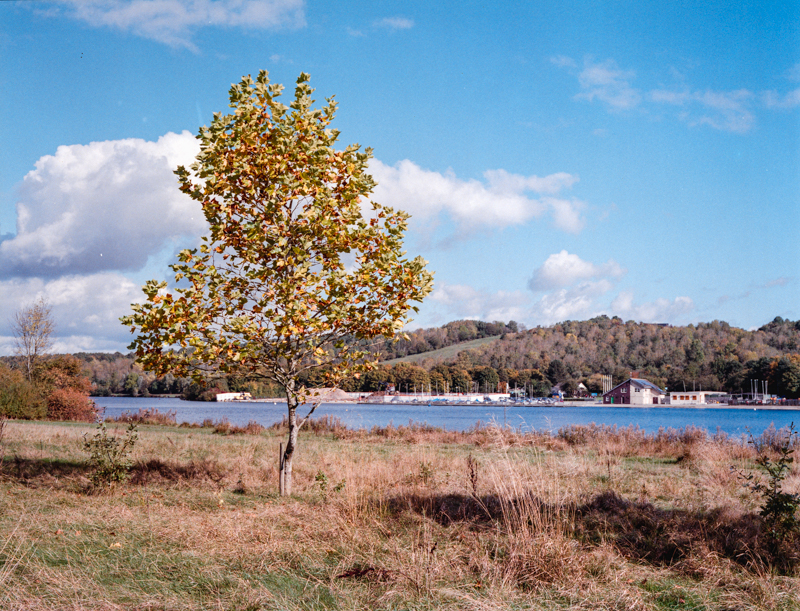
This plan worked ok for the first shot, and the results can be seen below, withe the first image shot at the settings given for 64asa, and the following two images with a stop more exposure over the previous one:
Fot this first shot, the results were all good. The middle image (effectively shot at 32asa) is the one I prefer. The first doesn’t show any major issues with underexposure, although the sky is a bit deeper, and the third, while clearly brighter, is still very acceptable (and I would have been perfectly happy with it if I didn’t have the others to compare it to).
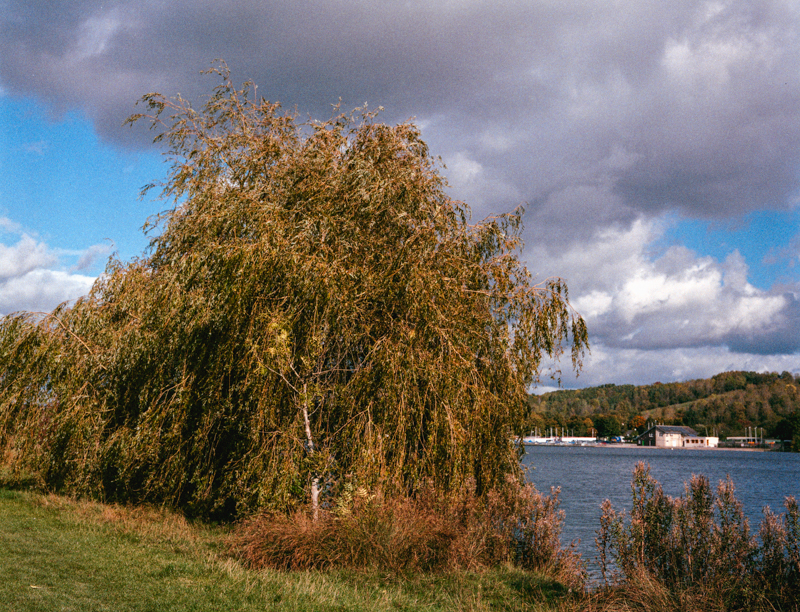
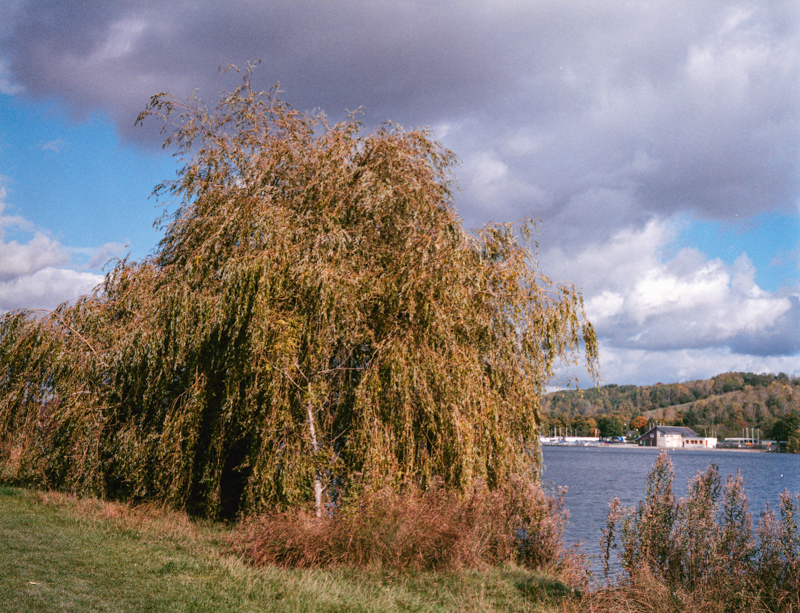
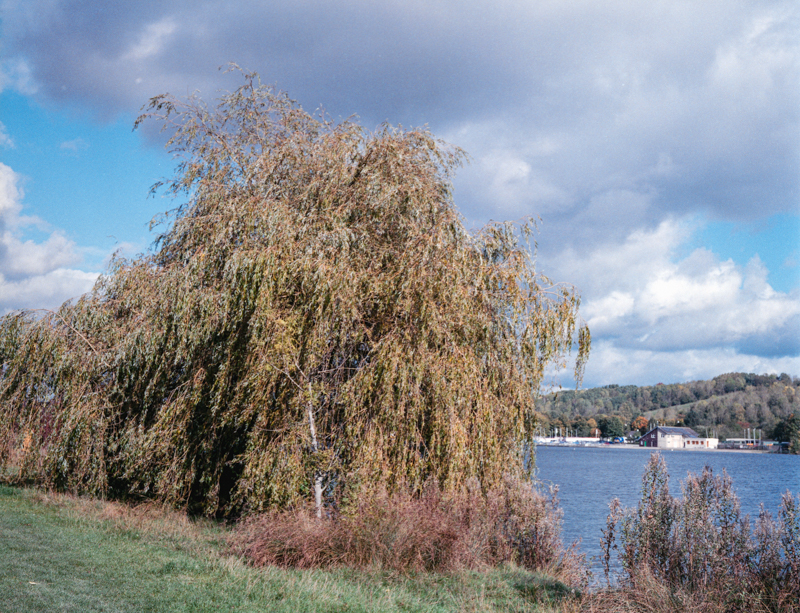
The results were similar for these shots of a willow tree:
Again, the middle image is the best exposed, I think.
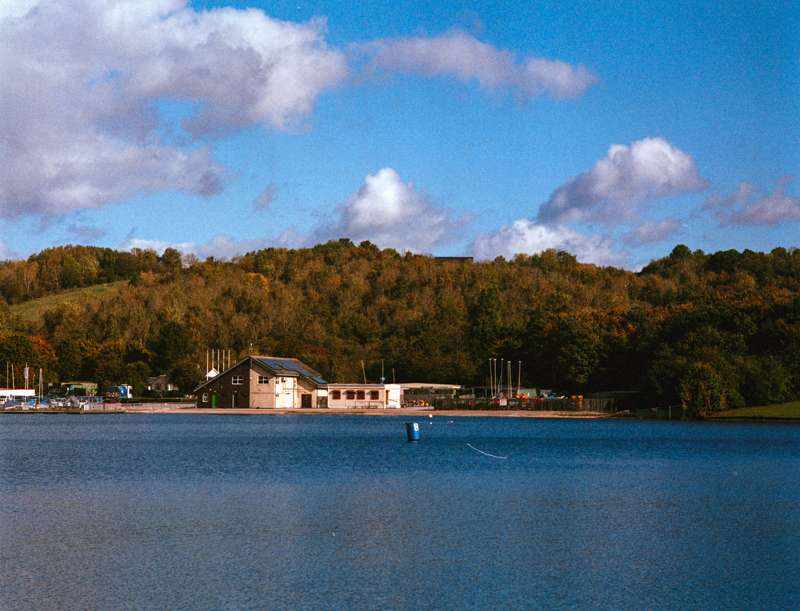
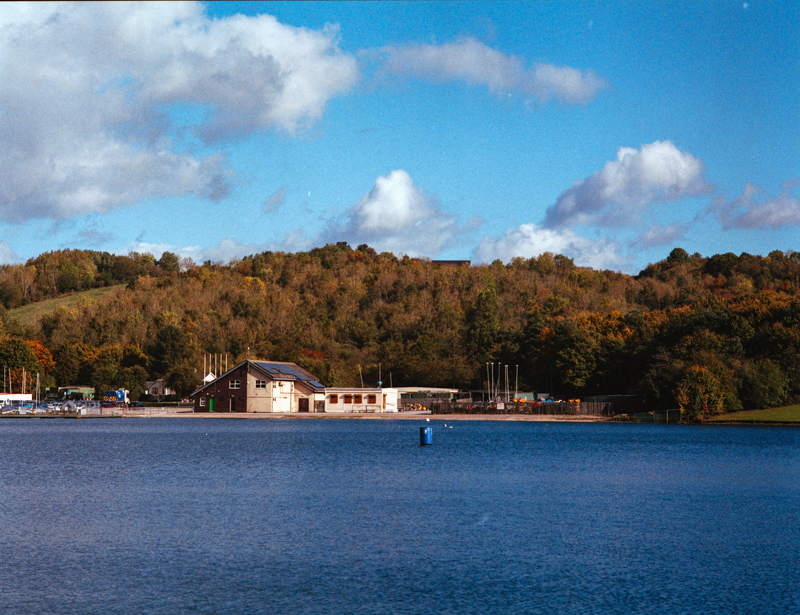
The next six shots had an issue – not only did I tamper with the process by changing lenses, I also managed to somehow mess up the metering – shooting each shot at box speed, then one and two stops over for both these compositions. While this was an error, it just means that the best exposed image is now number three, with the fist shot in each sequence being at actual box speed for the film. It clearly shows problems rated at box speed in terms of underexposure.
—
For the final composition I realised my error and got back on track. The middle shot again being the best exposed.
Beyond the issues with underexposure and some small spotty defects in the emulsion, the results are pretty outstanding for a film that expired over thirty years ago. The colours still look very nice too.
I feel confident that, if I meter for 32asa, that I can expect pretty good results from the remaining four rolls I have, although I’ll perhaps overexpose a little more in dim conditions.
Overall outcome: Success!
Expiriment #6 coming soon (I do actually have some more expired film I’ve shot recently, so this might actually be true)…
Bronica ETRS1, Kodak Vericolor HC (expired 1992). Shot bracketed and lab developed for box speed.Home scanned and converted with Negative Lab Pro.
Taken on 11 November 2024
I’ve uploaded the images above directly to my blog, but if you want to see the ones with the best exposure at higher resolution, they can be found here on my Flickr account.
I’ve been finding it a bit of a struggle to come up with things to write on the blog recently, resorting more frequently to posting images only with no contextual dialogue. As I’ve now been posting for over 2,000 consecutive days, I’m loathe to break that streak (although what it would matter if I did, I do not know. The sky would hardly come crashing down…), but something will have to give, at least for a while.
So I’ve given myself permission to post nothing apart from images for a while, so I can hopefully recharge my batteries a little. I might still have things to say here and there, and this method of posting might actually free myself to write a few more longer posts without the daily pressure, but we’ll see. For now though, I will have a week or two of image-only posts. I’m hardly short of pictures to share – I’ve not even started on the shots I made during a trip to Dubrovnik at the end of May, from which I came back with almost five rolls of 35mm film, and I’ve shot several other rolls since then too (three rolls have been posted off for development today even)!
I will hopefully be back posting my usual nonsense after this summer break. Speak to you then!
Here’s a lone tree to keep you company in the meantime…
Despite my hopes and promises of doing one of these posts each month, I seem to have failed miserably when it comes to doing so – the last post in this (very occasional!) series was back in November 2022.
I did shoot another roll of expired film last summer but I was unhappy with the results and ended up converting the pictures to black and white. While they looks pretty nice after the conversion, these posts are aimed to be about keeping to the original results from the film used with a minimum of post processing. Converting to monochrome was a step too far.
No such worries with the next roll though, some 120 format Kodak Portra 400NC that expired in 2007. 2007 doesn’t feel like that long ago but it was prior to the global financial crisis and is fast approaching twenty years ago!
Portra 400NC was discontinued by Kodak in 2010, when the current range of Porta films (160, 400, and 800) was introduced. Kodaks description of 400NC was: “Offers fine grain, low contrast, and colors and skin tones that look real and natural in a variety of lighting situations.” There is a brochure online on Kodak’s website which covers the full rang of (as was) Portra films from this period. There’s a strong hint that it was aiming for the wedding photography market…
I don’t photograph weddings and, even if I did, there’s no way I’d risk a seventeen year old expired roll of unknown provenance on such a once-in-a-lifetime event. For the sort of subjects I normally photograph however, I was willing to take the risk.
Despite the limited number of shots, I decided to shoot it with my Fujica GW690 6×9 medium format camera, giving me just eight potential pictures from the roll. The first outing was to my favourite seaside haunt of Mablethorpe. Normally when I visit Mablethorpe I will wander around all day making photographs. However, this year, I took my dad along for a day out, so knew from the outset that I wouldn’t be shooting as much. In the even I only used three frames on this outing, and one of those was a misfire when the camera was in my bag! I’ve since started to avoid winding the film in the GW690 after taking a shot to prevent this expensive mistake from reoccurring. Unfortunately, the Mk I GW690 that I own doesn’t have the shutter button lock that the later models do.
So the first two shots from the roll were of beach chalets / huts that stand along the beach promenade. The weather on the day was bright, but a layer of thin high-level cloud, robbed the light of contrast. Nevertheless, for outdated film the results were pretty good.
The second batch of shots – the remaining five on the roll – were shot one misty morning at Rother Valley Country Park. While I find the park a little uninspiring due to over-familiarity, cold misty morning usually provide some nice pictures, and this occasion bore that out.
The first shot is a little dull perhaps, but the light was nice. It’s just a suburban street I walked on my way to the park. You can just make out the mist hanging over where the lake is in the middle of the shot though. There’s a line of pylons that run between the houses and the park. The towers are out of frame, but the powerlines themselves can be seen.
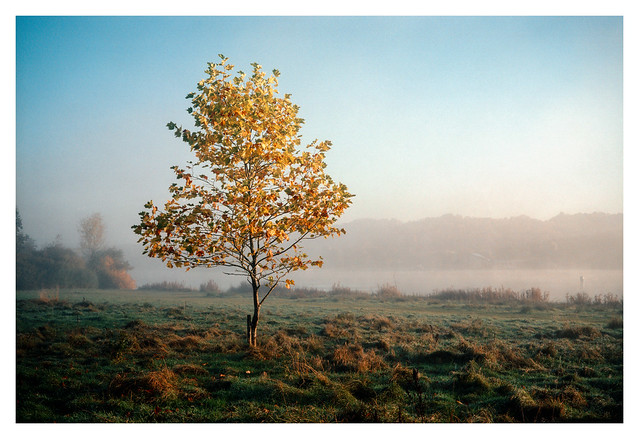
The next shot is one of my favourites from last year, a beautifully autumnal scene of a small maple tree, it’s leaves turning but not yet fallen, nicely separated from the background by the mist. I’m not sure if the colours are true to life, but they look gorgeous, so I’ll take that as a win.
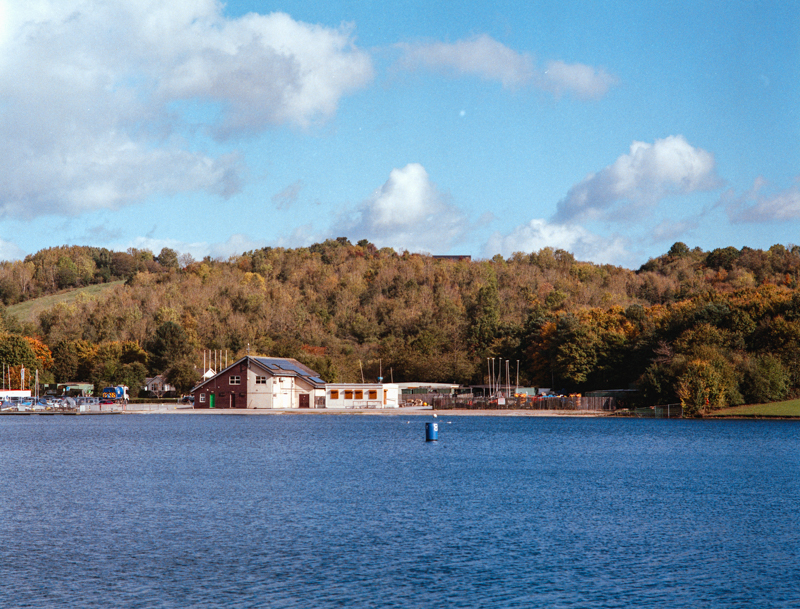
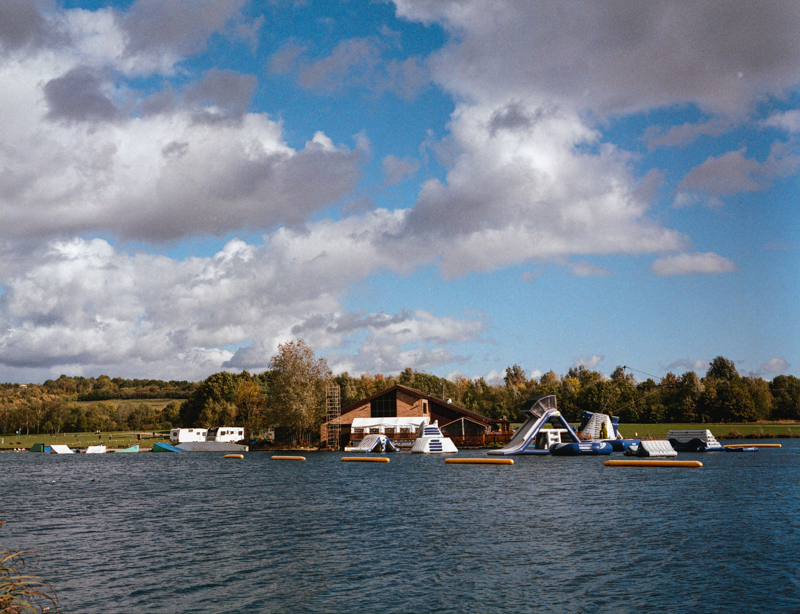
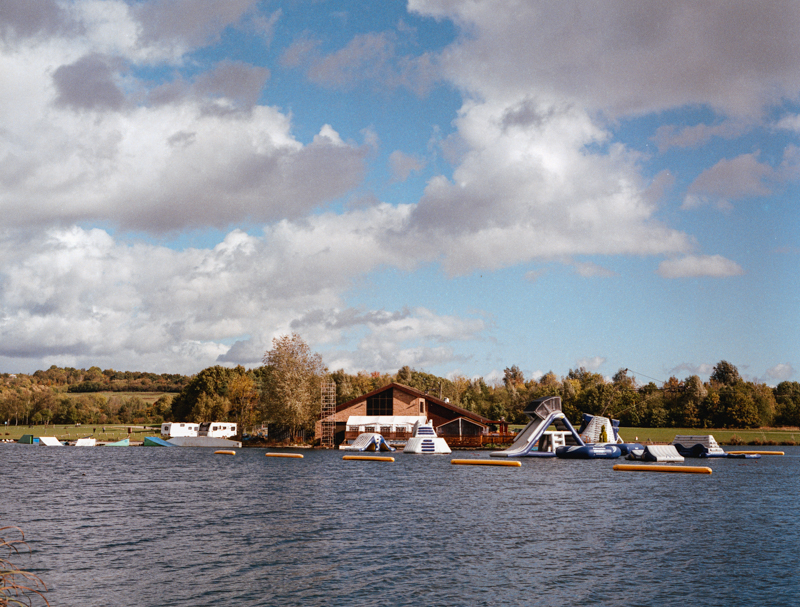
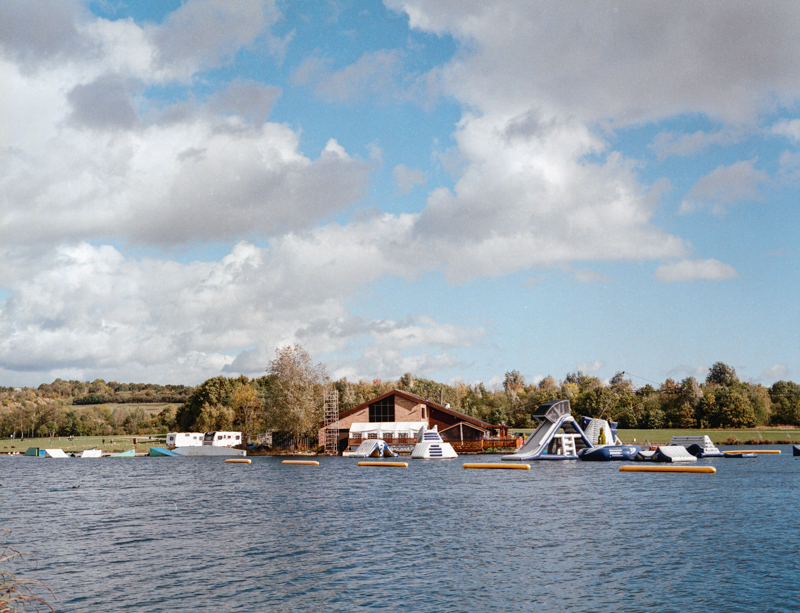
The mist was already burning off under the gaze of the morning sunshine when I took the next picture. A simple landscape scene of the lake with the boating centre on the far bank. There’s still enough mist left to provide some pleasant atmosphere to the photo though.
I took another photo very similar to the one above which had a couple of swans in the frame, but the one above is the best, I think.
The last shot is another lone tree, but this time I shot directly into the light. It’s not as good as the other tree picture, but I do like the way the tufts of dew and cobweb covered grass are illuminated at the bottom of the frame. The lens of the GW690 shows no signs of flare, even in this challenging scene.
So, apart from a wasted shot, this was another expired film success. When I shoot old colour film I’m not really expecting accurate colours, just pleasing ones, and this delivered on that.
Overall outcome: Success!
Expiriment #5 coming soon (Yeah, I know…)…
Fujica GW690, Kodak Portra 400NC (expired 2007). Shot at 160asa and lab developed for box speed.Home scanned and converted with Negative Lab Pro.







 Steel City Snapper photography