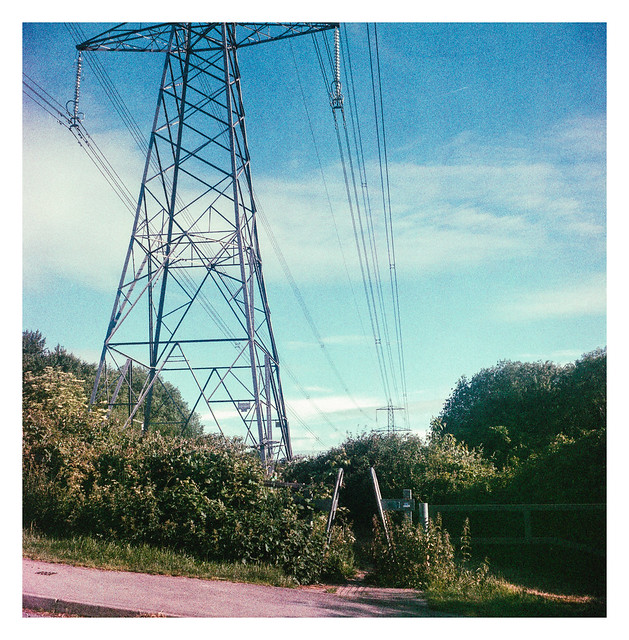
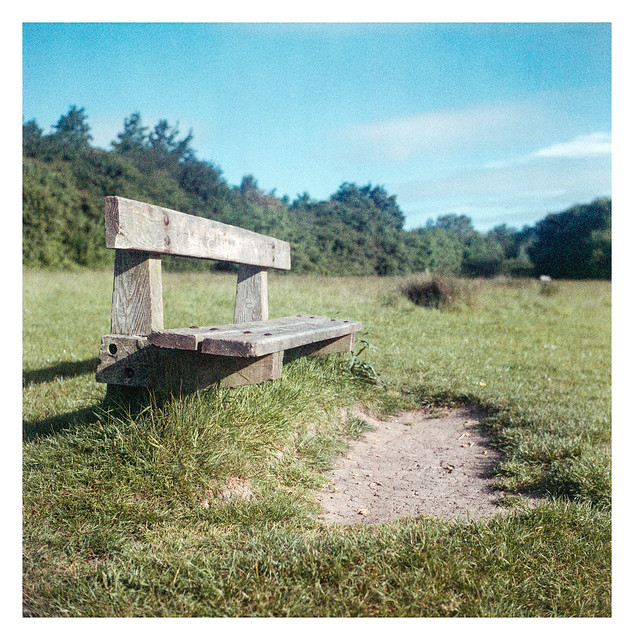
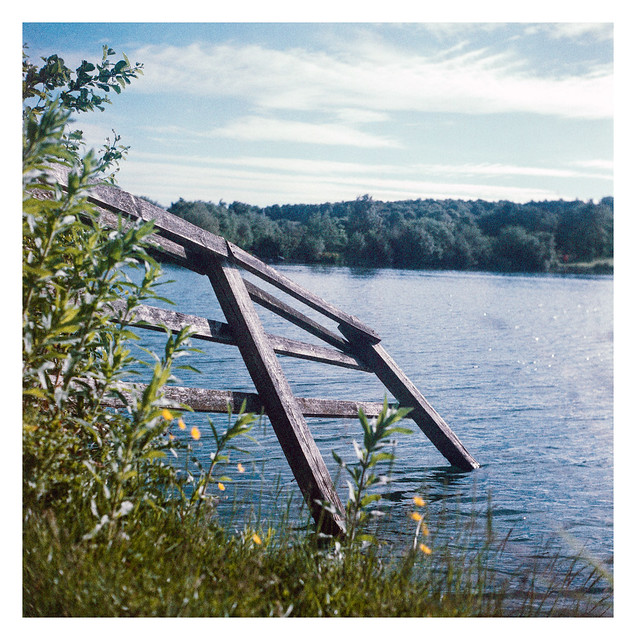
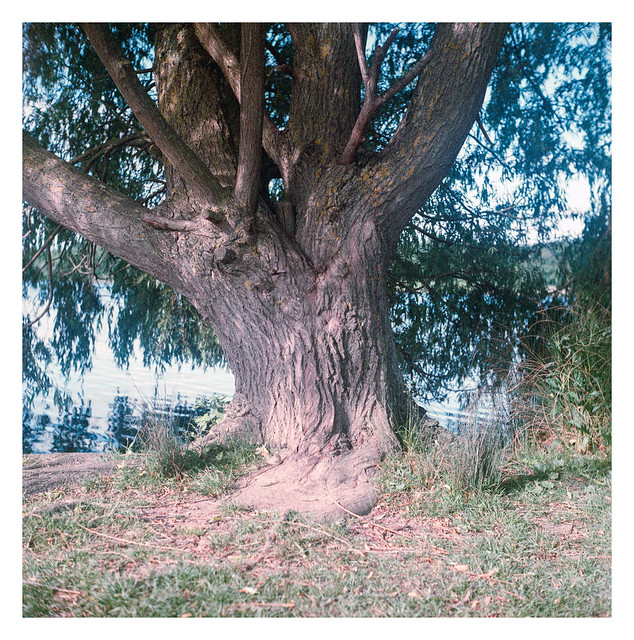
Using a new film camera for the first time often brings me a sense of apprehension. Will it work as expected? Where should I test it? How much effort should I put into the pictures?
Even when buying a camera from a trusted source, there’s still a risk of some sort of fault. Most film cameras are getting long in the tooth – some very much so – so I tend to avoid travelling too far afield when using one for the first time. That way, even if there is a fault, I’ve not wasted too much time and, should I want to, I can probably re-visit the location to recreate the shots if necessary. The same goes for the time and effort spent composing a picture. Do I really want to wait for the perfect light, the perfect moment, when the picture might be blighted by a mechanical fault of some variety?
With regards the location aspect, the camera I used to take the pictures shared here today (and in the coming days) did let me down. It had a shutter issue which caused missed frames that I described in a previous post. As a result, I missed a number of photo opportunities at a location that I don’t travel to often (and the hike I did was one I’ve never undertaken before, so that was all new sights to me). This was obviously disappointing.
In terms of spending time on composing and timing shots with a new camera, I still try to do my best. I know that some people will test gear by shooting test cards or a fixed scene, but the thought of using a whole role of film on that sort of efficient and controlled testing doesn’t inspire me. I’d rather try to get pictures I’ll find artistically pleasing, even if there’s some risk that they might be lost.
I now have a replacement for the faulty camera, but I’ve yet to test it. I’m planning to do so this weekend. While I will still try to get the best shots I can, I’m certainly not risking a trip to a more distant location this time, so the new camera will see first light on a visit into town, or maybe in my local area. If all goes well, then it can become a trusted travel companion.
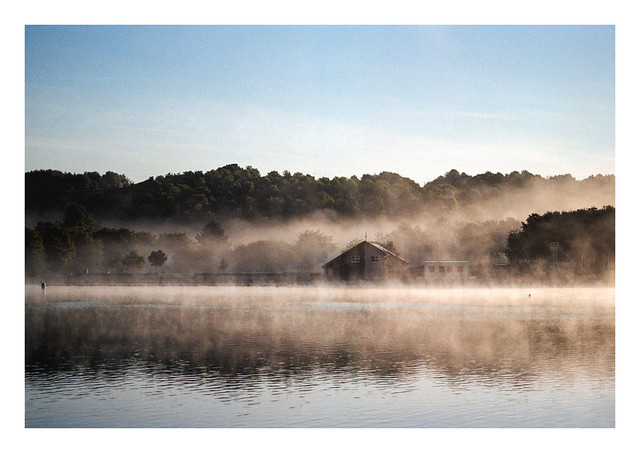
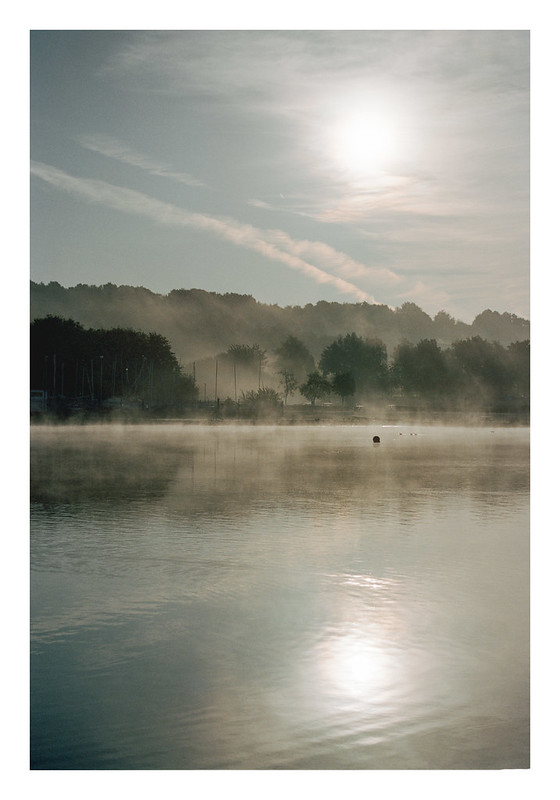
The two shots shared today were the first two on the roll and before I had realised there was a fault. I shot them on a walk in the local area during my lunch break, so only had time for a couple. Maybe if I’d had more time I’d have discovered the fault earlier and saved myself the later disappointment.
Rother Valley Country Park lies within walking distance of my home. It can be quite photogenic but familiarity has bred, if not contempt, then a certain boredom towards it’s possibilities. Like most man made lakes and reservoirs (the lake used to be an open cast coal mine) there’s a certain artificial feel to the place. I guess that over time this will lessen and the place will feel more an more part of a natural landscape (although it’s now been over forty years since the park first opened).
Despite my lack of inspiration, it’s still a great place to go if the conditions are good, especially mist or ice, as it gives it a distinct atmosphere and look that isn’t present at other times.
The two shots published here were taken on a frosty morning in late November last year just as the sun was rising, and I stood stepping between feet to keep warm while I waited for the sun to rise and start to cast light on the scenery. It was worth my time though, I think.
The second shot has been cropped. The top of the frame featured the lines of the cable-powered waterski circuit that occupies this end of the lake.
Canon Sure Shot Z135 & Kodak Gold. Lab developed. Home scanned and converted using Negative Lab Pro.
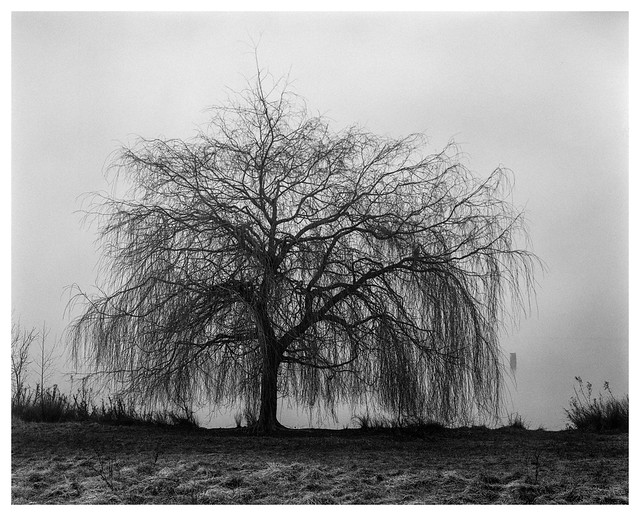
Following on from yesterday’s post about me testing my newly repaired 4×5 camera, here’s the second of the two photos I made while out. Again, this is nothing special, and mainly a test shot. It’s a little out of focus at the top of the frame, but otherwise ok. Had I spent more time I would have corrected the focusing.
I’ve photographed this willow tree on a number of occasions (see here, here, and here) and I think it would be a good subject for a more carefully considered large format shot if I pick the conditions right.
A few weeks ago I decided to walk to the nearby country park and was greeted by the never-disappointing sight of early morning mist on the surface of the lake.
Nikon F80, Nikkor 28-80mm f/3.5-5.6 D & Kodak Portra 160. Lab developed, home scanned, & converted with Negative Lab Pro.
This is the second in my series of expired film shoots. You can find a link to the others at the bottom of this post.
This second roll is a little younger than the last one I shot, but not by a huge margin, and it’s still over thirty years beyond it’s expiry date. It’s also a colour film, a fact that I’ve found can more adversely affect the resulting photographs. I find that expired black and white film is generally far more forgiving than colour. There are a number of things that can go awry with either format but, in general, it’s much easier to overlook a change in tonality in black and white than it is in colour. The reason is in the name: colour. While most people probably can’t tell if a greyscale tone is not totally accurate, they are far more atuned to when colours don’t look right, and expired colour film can bring a whole range of potential colour defects to bear on an image, with deterioration of the different dye layers resulting in a range of colour changes that the human eye easily picks up on.
An increase in grain is another thing that can occur with expired film and, again, is something that is less of a problem in black and white than colour. Sometimes grainy colour images can look great – look at Anton Corbijn’s colour pictures as an example – but in my own work, additional grain and colour noise in colour photographs tends to look muddy and unattractive.
Taking these things into consideration, I generally have a lot more trepidation when shooting expired colour film, and the faster the film, the worse these things can become as the addtional sensitivity can increase the possible deterioration.
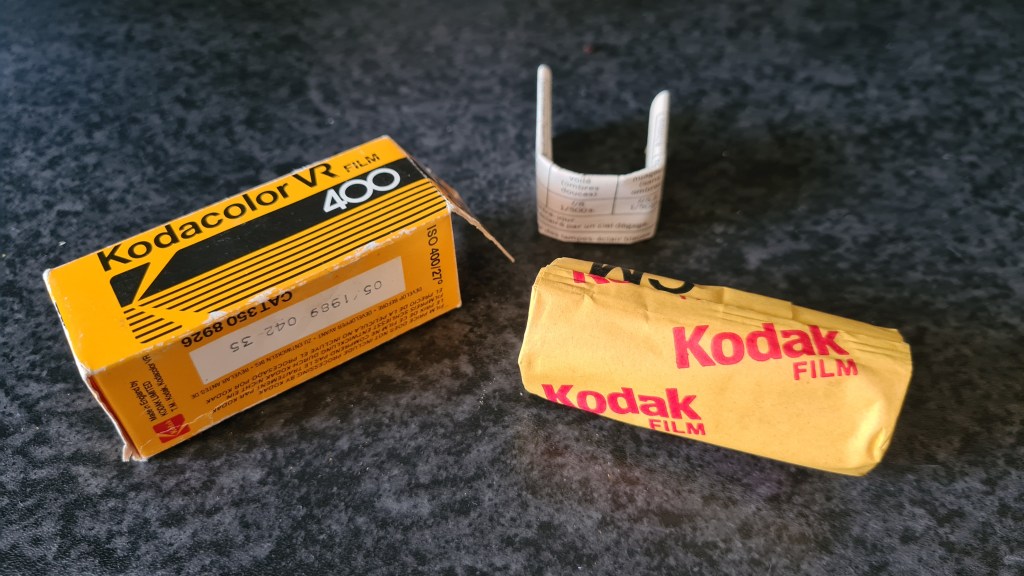
For this installment I chose a roll of Kodacolor VR 400 which expired in May 1989, so 33 years past it’s recommended best when I shot it. As I don’t know how the film has been stored throughout it’s life I used the generally accepeted rule of thumb to overexpose it for one full stop for each decade of expiry and metered it at 80asa.
As with the last roll of expired film I shot, I decided to use my Yashicamat 124G again. This time though I decided to stay relatively close to home for the shoot and headed out to the local country park, which is about ten minutes away by foot. The weather was nice and bright but as I was shooting at 80asa I took my tripod with me in the event I needed to use slower shutter speeds. I managed to forget a cable release but, thankfully, none of the exposures was slow enough to be impacted by any camera shake from my pressing the shutter button with my finger.
All the shots were made either on my way to the park, at the park, or on the way home, all in the space of an hour or so.
As I don’t develop my own colour film as yet, I took the exposed roll to my local lab. I had a momentary pang of disappointment when I was told that it might have to be developed in B&W chemicals if there was a risk of the old film contaminating their C41 chems, but I was happy to discover colour negatives when I collected the developed film the next day.
The negatives were scanned at home on my Epson V550 flatbed scanner and converted to positive images with Negative Lab Pro. The scans had some noticable colour shifts but this was easily recovered in the conversion process. The resulting images are vibrant with good, albeit perhaps not completely accurate, colours. There is increased grain, most notably in the shadow areas but given the age of the film, nothing too bad.
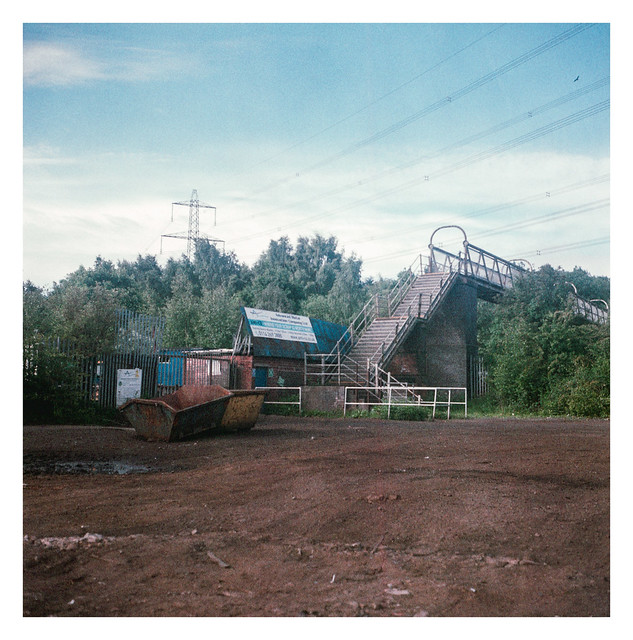
I was very pleased with the results and managed to get twelve very useable images, with a few that I especially like – the shot of the steps being my particular favourite.
The first shot on the roll and perhaps the one that most noticeably shows the worst of the colour shifts.
I tried to shoot with wide apertures where possible, mostly because I don’t tend to shoot that way with te Yashicamat much, but usually like the look when I do.
More use of a shallow depth of field.
I’ve photographed this short stretch of fence in the water on several occasions. It always tends to produce a picture I like.
The water here was a lovely aquamarine to my eyes but it hasn’t been captures well in the photograph unfortunately.
Another favourite from the roll. The greens of the grass look lush and the shallow depth of fiels makes the image pop.
I like this one, but it would have worked better with a shallower depth of field I think. Even at 80asa however, the light was too bright to open the aperture too much without busting the camera’s maximum 1/500sec shutter speed.
I wasn’t sure about this when I took it, but I think the contrast between the bright orange of the plastic netting and the organic greens of the reeds works well.
My favourite from the roll.
I love the richness of the brown soil in the foreground of this picture.
Overall outcome: Success!
Expiriment #3 coming soon…
Yashicamat 124G, Kodacolor VR 400 (expired 1989). Shot at 80asa and lab developed for box speed.
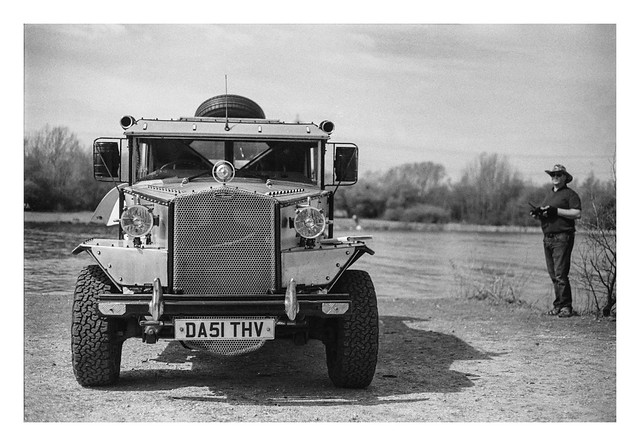
A few weeks back I went for a walk around Rother Valley Country Park with my dad. While walking around the northerly of the two main lakes I spotted this intersting looking vehicle.
Wandering closer with the aim of getting a photograph or two the owner noticed me and came over for a chat. The truck is a customised Land Rover that has been named Sprocket the Hotrod. It’s currently fashioned into a pickup configuration and there are plans to add a similarly designed trailer.
This custom Land Rover Was parked beside the lakeside Grabbing attention
I’m absolutely shattered this evening. I’m having a bit of a stressful week at work – nothing bad, just something I’m working on that I’ve not done fully before and I’m focussed on trying to make the best job of it that I can, which is taking a bit of a toll. Plus, on the physical side, I completed week seven of Couch to 5K today – the last of the 25-minute runs. Two more weeks to go, and three 28-minute runs for the next week. I always feel a sense of achievement when I complete one of the runs, but I wasn’t in the mood today, and it took effort and willpower to not stop moving.
Another grainy HP5+ photo today.
Geese on the water So serene on the surface Liquid hides effort
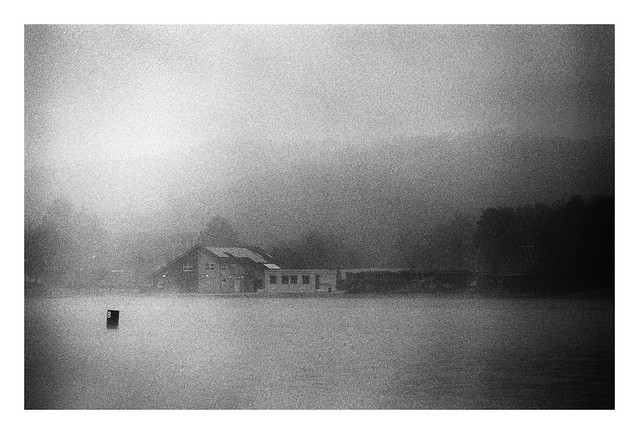
A bit of a mystery about today’s photo, which depicts a foggy morning at Rother Valley Country Park. The puzzle is in regards to the graininess of the image. It was shot on Ilford HP5+ rated and develoed for 800asa. I’ve shot HP5+ pushed a stop before (and pushed by much more in fact) and not encountered the amount of grain that is present in this shot (and a few other misty, low-contrast scenes made on the same roll of film). Even more curious is the fact that it’s only a handful of frames affected – most of the images show smooth and unobtrusive grain.
My thoughts are that it could be the way the scanner handles this type of scene (or perhaps my settings). I tried scanning the picture with both Silverfast and Vuescan and received similar results from both. It would be interesting to see if the grain is present on the negative itself, but I don’t have a loupe to use and haven’t bothered trying to use my digital camera and macro lens.
Despite the unexpected and unplanned look of the image, the grain gives it a very pleasing atmosphere, so I’m not disappointed by the result.
Golf ball sized film grain Appearing out of the fog It’s a mystery
The path beneath the bridge in the background of this photo leads to Rother Valley Country Park and the signs in the foreground identify the southern route along the Trans Pennine Trail. As the lockdown continues so I become ever more familiar with this area close to where I live. The next announcement about restrictions is scheduled for Monday when we may find out when some of them may start to be lifted. I’m not expecting a full return to freedom, or even an immediate losening of the rules, but it will be good to have more information at least.
Freedom to exercise But no more than once a day Like a gilded cage
The final snowy Holga shot today, unless I make more We have had a snow warning for the coming weekend…
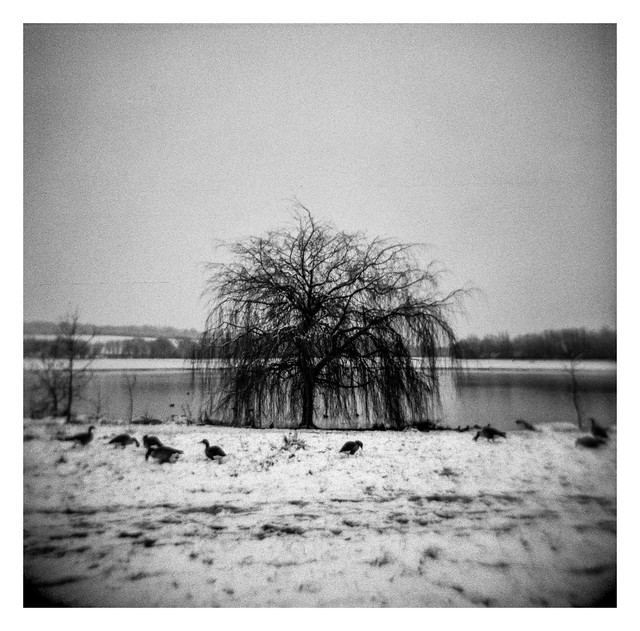
This water-side willow tree has featured a number of times previously in the blog. It (and a couple of other trees) tends to make a nice point of interest on this section of the lakeside, which is otherwise a little bland.
The ground here, despite it looking nice and snow-covered in the photo, gets very waterlogged, and I had icy mud pouring across the toes of my boots as I walked. Good job they’re waterproof! The geese were a little wary of my presence, and quite a few of them skedaddled out of the scene before I made the picture, but I still got enough of them in the frame, I think.
A snowy lakeside Geese forage in the wet earth My boots are soaked through