I’ve noticed that WordPress (or possibly Flickr) seem to have altered something this week and I now have to use a different URL to embed my pictures. I used to use the Flickr share URL and paste it straight into my posts, but now I have to use the URL in the browser address bar. Anyone else had anything similar?
This former Great Northern Railway (GNR) signal box has been around for quite some time. It was built in 1873 and is the second oldest GNR signal box still standing and is now a Grade II listed building.
Apparently the signal box designs used by GNR were relatively unstandardised and almost every one built in the 1870s is different in some way.
Yashica Mat 124G & Lomography Color Negative 400. Lab developed. Home scanned and converted using Negative Lab Pro.
The spiky looking bridge in the first picture below provides an alternate route across the railway tracks in Lincoln when the level crossing barriers are closed. It crosses the same road where yesterday’s blog photograph was taken. The bridge was nicely backlit and I noticed some lovely silhouettes of pedestrians crossing. Unfortunately, when I got in a position to take the picture they’d all left or were walking at the far side of the bridge where they couldn’t really be seen. After waiting 15 minutes to see if the scene would replicate itself, I eventually left to find other pictures to take. I did take the shot of the signal box before I left the scene though (another picture of the signal box may make an appearance in a future post…).
The main railway line through Lincoln crosses a number of busy roads, necessitating the use of level crossings. While level crossings are quite common in the countryside, and probably in some other towns and cities, there are relatively few of them in Sheffield (five according to this website), where I live – although, that being said, there is one only a mile from where I live.
Which makes the situation in Lincoln quite novel for me. Level crossings are the only real place where you have an opportunity to take photographs of railway lines while actually on the tracks (without trespassing) as long as the barriers are raised, and in Lincoln this makes for interesting compositions like the one in today’s picture.
Not being a close follower of heritage railways, I wasn’t aware that one passes through Bury. My last visit in 2023 didn’t bring me especially close to the route, but this year I had only been in the town a short while when I heard the distinct sound of a steam locomotive and spotted pillars of smoke puffing into the air not far from my hotel.
It was later in the evening when we all met up at a pub called the Trackside Bar that the railway became properly apparent. There were a lot of people there all dressed up to the nines; tuxedos, ballgowns, tiaras, the works. And outside the bar, which is an old railway station building, was the platform where a large steam locomotive stood, attached to a train of vintage carriages. After a while the poshly-dressed people boarded the train and it exited the station.
The following morning after breakfast, I decided to re-visit the station – a stop on the East Lancashire Railway heritage line – and was able to take the following pictures. I was with someone else from the group visiting Arcade Club, so didn’t take as many pictures as I might have had I been there alone, but the one’s I got are quite nice.
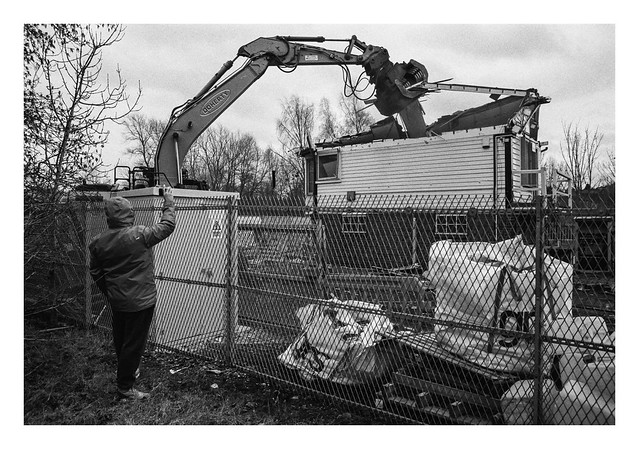
I detailed the events on the day the signal box at Beighton Station was demolished in this post here: The end of an era. At that point I’d not developed the roll of film that I shot when recording the event. So, today, here are the pictures from the weekend of the demolition, plus a photo made a week or so later showing how it now looks.
On the day before the demolition took place, fencing was erected around the area and the road had been closed to all but foot traffic and bicycles.
There were a considerable number of contractors around, all in bright orange hi-vis clothing. Some from Network Rail, but also from a number of other companies involved in the work.
The following day, Sunday 15 March, the mesh fencing had been replaced by something more sturdy. As the work took several days to complete, these small cubicles were placed at either side of the tracks, presumably as shelter for overnight workers or security guards.
A truck delivers the large metal skip into which the remains of the signal box would be loaded.
Still intact, but only for a few seconds longer…
Spectators and workers gather to see the event unfold.
The demolition begins.
Some people moved down the side of the signal box to get a better view.
The roof has gone completely.
The claw does its work.
The upper section has almost gone now.
Still sheathed in plastic, the new warning signs await their work to begin.
The upper part of the signal box has now gone completely. Work continued to remove the brick lower section and remove the frame from the building, but I didn’t stay to photograph that.
And here’s how it looks now that work has been concluded. No signal box any more. There is apparently a radar-controlled system now in place to detect anyone on the crossing. The barriers cannot lower until it is clear.
The photo today is the view north from the bridge depicted in yesterday’s blog post. No trains were forthcoming (although I didn’t hang about to be fair).
Today I crossed a hurdle in my Couch to 5K running plan. After suffering my calf injury on my first attempt (on week 1, day 3) I rested the sore leg for a couple of weeks before starting afresh. My progress so far has been steady with no further injuries, and no failed attempts at any of the runs – I am running at an embarrassingly slow pace though!
This week say me reach week 5 of the plan, one which I had felt some apprehension about. Week 5 (as is week 6) is a transition week where you move from shorter runs interspersed with brisk walking, to longer runs, culminating in a full 20-minute run on the third day. A few short weeks ago the thought of running for twenty minutes straight seemed impossible – even running for 90 seconds felt like an achievement – but, gradually, as the weeks passed and my fitness and stamina improved, I began to feel more confident about it. The second run of this week was two 8-minute runs broken by a 5-minute brisk walk, so not too much of a difference, and I managed that session without any real difficulty.
So, late this morning, after my breakfast had had time to digest, I did my warm-up, got dressed in my running gear, and headed out. After the 5-minute warm-up walk I began to run at my usual slow pace, a podcast my companion for the duration. Every so often – at five, ten. fifteen and, finally, eighteen minute intervals, the Laura’s voice on the C25K app let me know my progress, finally declaring that I had finished and that I should be proud of the achievement!
And I am. I’m not quite there yet – the final goal is to be able to run for a full 30-minutes non-stop – but it feels within reach now. Just a few more weeks to go.
My legs are aching But now it’s in a good way Feeling fulfillment
Killamarsh is a village in North-East Derbyshire with a population of around 10,000 so it seems hard to believe that, at one point, the place had three seperate railway stations serving it. To the east was Upperthorpe & Killamarsh station, the the west was Killamarsh West station, and between them the appropriately named Killamarsh central.
Only one active railway line remains – the line that served Killamarsh West, although there are no longer any stops and the station on that line has been long removed and, if there are any remains, they are out of bounds to the public. I’m uncertain if anything remains of the eastern station.
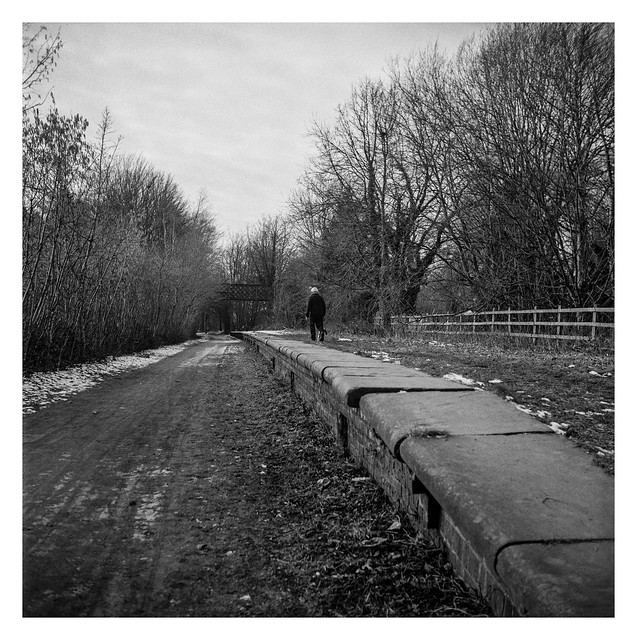
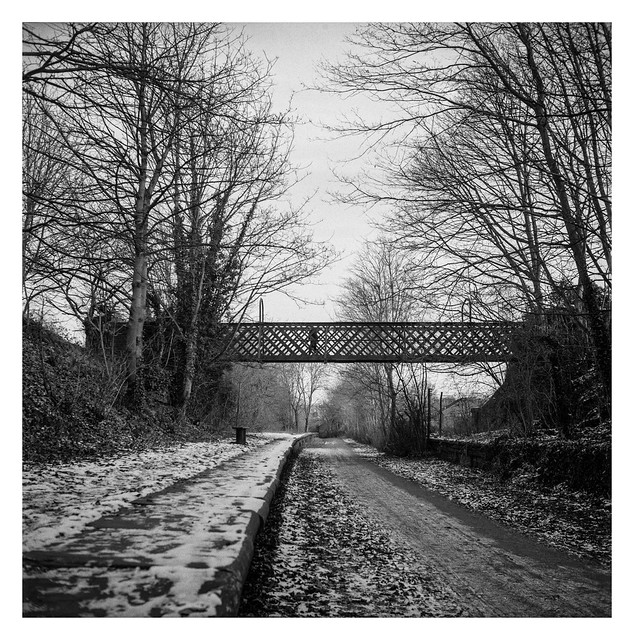
As for Killamarsh Central, there ramain the northbound platform and the pedestrian footbridge, both of wich can be seen in the two photos shared today. The first looking south towards Renishaw and Chesterfield, the second north towards Beighton.
The station originally opened in June 1892, remaining active for the next seventy-one years when it finally closed in the summer of 1963, although the line remained in use until 1983 when the track was lifted. The track bed now forms the route of the section of the Trans Pennine Way that runs between Beighton and Chesterfield.
Line for rail travel Both for goods and passengers Falls to memory
Part of the network of disused and dismantled railway lines that used to run where the Trans Pennine Trail and Rother Valley now reside. This metal bridge is derelict with much of it’s bed missing and it’s brickwork coated with graffiti. It makes for interesting photographs though.
I’m unsure of when it was constructed but it appears to have been after 1910 and before 1945 from examining old maps of the area. While I suspect that, from an environmental angle, it left something to be desired, I expect it would have been an impressive and dramatic sight to behold steam locomotives about their business in the area.
Steam locomotives Steam and smoke filling the air Passed this way before
A familiar scene for anyone who’s followed my blog for a while – the Beighton Station signalbox. I think I’ve mentioned before that the signalbox is scheduled for demolition due to signalling and the level crossing now being controlled remotely. A local effort was made to try and save the signalbox but this appears to have fallen through with the proposed cost to move it to a new location being in the region of a quarter of a million pounds.
At the same time however, I’ve heard that plans to reopen Beighton Station are moving forward, the idea being (I believe) to have a tram-train service that runs between Sheffield and Chesterfield, with Beighton being one of the stops. I don’t expect that it will be much of a station in the traditional sense – most likely a couple of platforms, some bus-stop-style shelters, and a car-park to allow park-and-ride services for commuters. I think it will be a good thing to have though and can imagine it being especially popular in the warmer months if it used as a means for people in other parts of the city to get access to the nearby Rother Valley Country Park.
I’ll be sad to see the signalbox go though.
An old signalbox Its functionality gone To another place