
Yashica Mat 124G & Fujifilm Pro 400H. Lab developed, home scanned and converted with Negative Lab Pro. Converted to B&W in Lightroom.
Taken on 18 May 2024

Steel City Snapper photography
35mm, medium format and large format film photography (with the odd bit of digital every now and then…)
Yashica Mat 124G & Fujifilm Pro 400H. Lab developed, home scanned and converted with Negative Lab Pro. Converted to B&W in Lightroom.
Taken on 18 May 2024
A decent amount of my photography focuses on subjects that most would probably not find attractive – brutalist architecture, factories, modern office developments, rundown parts of town, even the odd dead pigeon and ashtray have featured.
But I like the picturesque as much as anyone else and will photograph it when it presents itself. We have an abundance of small towns, villages, hamlets and the like throughout the UK and, due to the relatively compact nature of our island, you’re never too far from one. Even the more humdrum of them will have plentiful opportunities for photograph hunting.
The National Parks, in particular, are jam packed with lovely little places to find and explore. The downside is that they can attract crowds of sightseers. While this isn’t a problem for the businesses that cater to them, it can mean that it’s difficult to get a photograph without someone standing in (or suddenly entering, just as you press the shutter!) the frame. For this reason, I prefer to visit such places mid-week if I can, or during the wintertime when tourist numbers are much reduced, but sometimes a crowded sunny weekend is the chance I get, and it’s better to make the most of it than grumble. There’s a certain charm to having tourists in a picture too, I suppose.
The scene below is in Castleton, a village in the Peak District National Park, famous for its castle and also a number of caves and caverns that have public entry and guided tours. Speedwell Cavern even features a subterranean boat ride!

Yashica Mat 124G & Fujifilm Pro 400H. Lab developed, home scanned and converted with Negative Lab Pro.
Taken on 18 May 2024

Yashica Mat 124G & Fujifilm Pro 400H. Lab developed, home scanned and converted with Negative Lab Pro.
Taken on 18 May 2024
Back on the 26th September 2021, I wrote a post marking my one thousandth day of consecutive posting. Today, a little under three years later, marks the two thousandth.
I always find milestone posts like this to be difficult. They’re the sort of thing that would normally be celebrated – in that way that we humans seem to like celebrating things that reach a certain, nicely shaped, number. I’m quite a modest person though, so shouting out about my achievements isn’t something I relish or feel particularly comfortable about. I would probably have had greater success in some aspects of my life had I “bigged myself up” a little more, but I’ve always felt that my achievements should speak for themselves, and not be reliant on too much self promotion.
So here I am, having posted without fail for the last two thousand days, and instead of a party, it’s more of an acknowledgement. I reached a big number, and tomorrow I will surpass it (and why will my two-thousand-and-first post be less worthy of celebration anyway?).
It might be nice if I had some sort of special “2,000th post” image that I’ve saved for the occasion, but I don’t, so I’m going to use a picture I took on a trip to Castleton back in May. It shows a gap in a drystone wall part way up Cave Dale. It feels somehow optimistic in tone – a gateway to whatever might come next, I suppose.

Yashica Mat 124G & Fujifilm Pro 400H. Lab developed, home scanned and converted with Negative Lab Pro.
Taken on 18 May 2024

Nikon F80, Nikkor 50mm f/1.8 AF-D & Ilford HP5+ (@800asa). Ilfotec DD-X 1+4 10mins @ 20°
Taken on 29 March 2024
A quick grab shot of a biker with very furry headgear. I was spotted taking the picture and rewarded with a thumbs up. 🙂

Nikon F80, Nikkor 50mm f/1.8 AF-D & Ilford HP5+ (@800asa). Ilfotec DD-X 1+4 10mins @ 20°
Taken on 29 March 2024
I’ve posted before, at least once, about revisiting locations and taking the same pictures I always do. The same subjects, and often the same compositions. Some scenes just catch the eye, like this view up the River Wye at Bakewell. Seen before here and here (and probably other times too)

Nikon F80, Nikkor 50mm f/1.8 AF-D & Ilford HP5+ (@800asa). Ilfotec DD-X 1+4 10mins @ 20°
Taken on 29 March 2024
Part one of this walk ended as I passed through a small area of woodland that marked the turning point where the circular route began its return back towards the starting point. Perhaps the most well known landmark on this leg of the journey is Robin Hood’s Stride, but before I got there I took a small detour to Nine Stones Close (also known as The Grey Ladies), a small neolithic stone circle that stands beside a tree in a nearby field.

There’s something fascinating and a little eerie about stone circles, both in their age, and the limited understanding we have as to why they were constructed, but also – in large part – the fact that they feature heavily in a number of fantasy / sci-fi movies and TV shows I’m fond of, notably the 1979, John Mills starring, Quatermass series, The Children of the Stones, and the Doctor Who story, The Stones of Blood. All heady material for the youngster I was back when all three aired.

After admiring the stone circle (you can see some more photos I took here), I set off back towards Robin Hood’s Stride, first passing a couple of lone trees, one dead, one alive.


Robin Hood’s Stride is a gritstone rock formation, notable for the two pinnacles at the eastern and western end. The pinnacles are named “Weasel” and “Inaccessible” and legend has it that Robin Hood was able to jumped between them in, hence the name of the formation. All I can say, is that Robin Hood must’ve had some sort of Olympian-level jumping skills as the two pinnacles are around fifty feet apart!
Unfortunately, when I arrived the sun was to the south, backlighting the rocks to a degree, so I wasn’t able to photograph the whole structure in the best light. I took several other close-up shots of part of the formation though, including some carved graffiti that has been there quite some time.


I climbed to the top of the formation, although it was tricky with my backpack, tripod, and walking poles, but there were nice views. A couple were up there already, eating their lunch.

The view back towards The Grey Ladies was a nice one, though probably not done justice by the XA3 on this occasions. The stone circle can be just made out in the centre of the frame if you look closely.

After a drink of water, and a careful descent, I took another short detour from my route, this time to another rock formation named Cratcliffe Tor. This is a popular spot for climbing and bouldering, and there were signs of this in evidence with dusty powder marks on the stones where people had sought places to get a grip.

Cratcliffe Tor is also the site of a hermitage dating to the 14th century. The small cave is now fenced off as it was being used as a shelter for climbers, but behind the fence it is just possible to make of a crucifix carved into the rock. You can just about see it on the second picture below about a third of the way from the top right of the image.


After visiting the hermitage, I made my way back to my route and began a descent down the hillside east of Robin Hood’s Stride, passing a bench bearing the name of someone called Hillary.


Looking back up the hill, the rock formation can still be seen above the trees. Another name for the location is Mock Beggar’s Mansion as, from a distance in the right light, it looks a little like a turreted house.

In the hilly Peak District countryside, the descent soon turned back to ascent, and I followed a steeper-than-it-looks lane past a couple of houses on the final stretch back to Elton.

A footpath branched away from the lane, taking me through a number of muddy fields. To my right the path was bordered by a fence and trees. A rope swing hung from one.

Another tree had seemingly absorbed a cable as it had grown, resulting in a shape in it’s trunk that reminded me of someone sucking spaghetti!

To the north, Robin Hood’s Stride and Cratcliffe Tor could still be seen peeping out of the ridge line.

I reached the brow of the hill I was climbing and could now see the houses and Church of Elton come into view.

As I walked back through the village to where my car was parked, I passed a man cleaning his car with a jet spray. He turned it off as he saw my approach, but I cheekily asked if he wouldn’t mind spraying my feet with it to remove the thick clods of mud attached to my boots. He was amused by the request, but I soon had clean (wet) boots again. 🙂
Olympus XA3 & Ilford HP5+ (@800asa). Ilfotec DD-X 1+4 10mins @ 20°
Taken on 26 March 2024
Another digital shot today. As mentioned yesterday, I’ve been out all day today meeting up with some film photographer friends. We met up in the village of Castleton in the Derbyshire Peak District and spent the day wandering the village and surrounding area. We were all shooting film, but I also had my Ricoh GRII with me, and took the photo you see here today. The picture here today is of Cavedale, a gorge just to the south of the village. Up at the top on the left is the keep of Peveril Castle, which we climbed to earlier in the day.
I shot a roll of 120 Tri-X, plus most of a roll of 120 Fuji Pro 500H and 35mm Ilford HP5+. The HP5+ was shot using my new 28-300mm zoom lens, so it will be interesting to see how those turn out (and if I’ve managed to mess any of them up…). I’ll post any worth sharing once I have them developed and scanned.

Ricoh GRIII
Taken on 18 May 2024
Apologies to anyone expecting the second part of my post covering the walk between Elton and Robin Hood’s Stride. That should be here tomorrow – I got waylaid today, unfortunately.
Here instead is another photo taken during the walk but which didn’t feature in the first half of the post published yesterday.
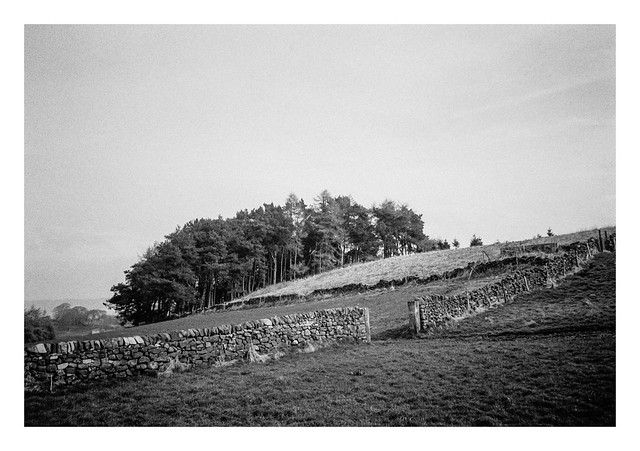
Olympus XA3 & Ilford HP5+ (@800asa). Ilfotec DD-X 1+4 10mins @ 20°
Taken on 26 March 2024

