Film photography · Medium Format · Photography

Further expired Ektachrome photos

A few further shots from the roll of expired Ektachrome I posted about yesterday.

This first shot has had the most tweaking of the ones presented here today and it still has more residual purple tones than the others. I had to take care to not reduce the colour of the foxgloves while removing the tint.

Ferns and foxgloves

The next shot is of the Wilkin Hill Outdoor Centre, or rather the former outdoor centre as it appears to have been abandoned for quite some time. It does appear to have a new roof though, so perhaps it’s under development.

Outdoor Centre

The final two images are of Agden Dike, one of the main water sources that feeds Agden reservoir. The expired Ektachrome has performed remarkably well on the first shot, giving a broad range of tones with only a few issues on the brightest sunlit silver birch trunks in the background.
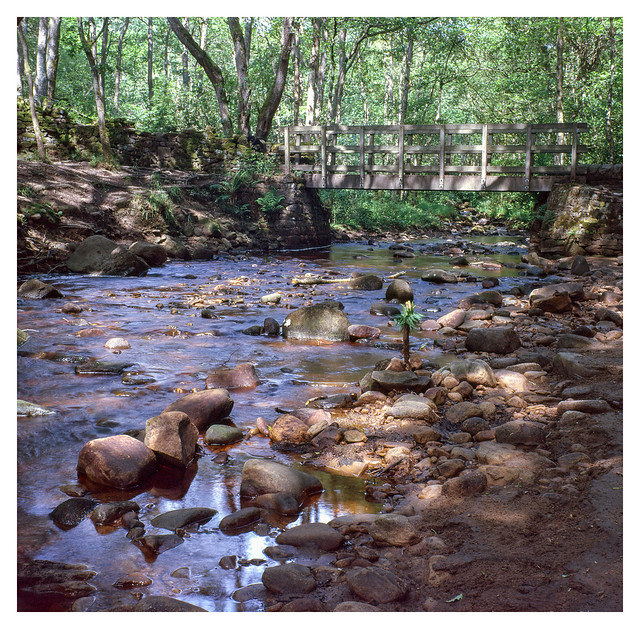
In the shade by the water

The last photograph here is probably my favourite from this roll. I’m unsure if someone has placed this branch and fern into the river (it looks wedged in by rocks) or if it’s actually a small tree-stump that a fern has colonised. Whatever the case, it looks like a miniature palm tree. I’m pretty happy that I was able to focus accurately with a narrow aperture and up-close with the Zeiss’ uncoupled rangefinder focus. It isn’t a problem on more distant subjects and with the wider apertures I normally choose with this camera, but manually transferring the focus from the rangefinder to the lens in a shot like this takes care, and I’m glad to have gotten it pretty much on the nail.

The world's smallest palm tree

Zeiss Mess-Ikonta 524/16 & Kodak Ektachrome E200S (expired 2003).

Taken on 22 June 2020

Film photography · Medium Format · Photography

Surprisingly nice expired Ektachrome from 2003

A few photos today from my hike around Dale Dyke reservoir that I posted about a few weeks ago. I mentioned in that post about taking the Zeiss Mess-Ikonta 524/16 on the hike along with the Yashica Mat 124G. I’d loaded it with a roll of Ektachrome E200S that had expired back in 2003. I can’t remember where exactly I’d gotten the film from now, but I had no idea as to how it had been stored. I shot the first of the rolls with my Holga back in October last year. That roll had a severe purple cast. I was able to remove it to a large extent but it left nasty purple speckles in the shadow areas. While I would be shooting this second roll in a camera with more control over aperture and shutter speed, I was still not holding out high hopes for the film.

On a walk to a reservoir

I decided to over-expose it a little given it’s age. Normally I follow the 1-stop per 10-years of expiry rule of thumb, but I’ve heard that E6 film works differently to colour negative film in this regard, so I decided to shoot it at 80asa. My mistake here was that I’d forgotten I was shooting a roll of E200S, and not E100, so I was in actual fact over-exposing the roll by more than a full stop. Thankfully, this worked out ok and probably produced better results than my original idea.

Bridge to the dam wall

When I received the developed transparencies there was still a noticeable purple cast when I scanned them, but colour correction in the scanning software, plus some further work in Lightroom managed to remove the bulk of this. There’s still a hint of purple to the results, and the deep shadow areas have a little purple speckling, but it’s barely noticeable when compared to the first roll I shot through the Holga. On the whole I’m really pleased with the results I got and it’s encouraged me to shoot some more of the E6 film I have in the fridge.

The three shots here were hand-held.

Rhododendrons by the reservoir

Zeiss Mess-Ikonta 524/16 & Kodak Ektachrome E200S (expired 2003).

Taken on 22 June 2020

Film photography · Medium Format · Photography

Sun-dappled monochrome woodland

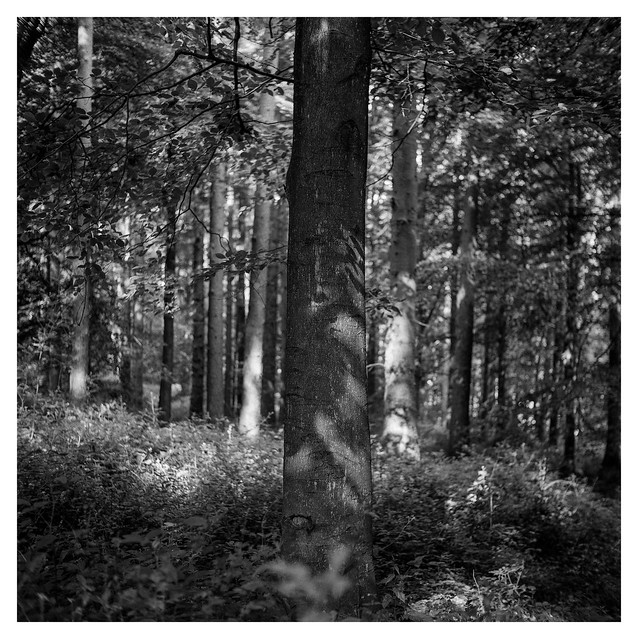
Making black and white photographs in woodland, or any other place featuring large areas of green foliage, can sometimes be tricky. Without well defined subject matter I find tht such scenes can become a mass of mushy grey textures. Differing shades of green that are easily discernible to the eye merge into less defined shades of varying brightness.

So I think a clearly defined subject is important, either seperated by brightness, contrast or texture, or isolated in some way, such as it’s placement in the composition, or by using a shallow depth of field to add separation.

I think the photo today uses a bit of both techniques. The trunk that is the point of focus is isolated here by the light that falls on it (or rather doesn’t) – there’re splashes of sunlight, but overall it is darker than the background where more light is falling. I also opened the aperture to throw the tree into focus while leaving everything else softer.

I’m happy with how the shot turned out – I have a number of similar photos from other outings that didn’t work as nicely!

in the shady forest

Yashica Mat 124G & Fomapan 100. Ilfotec DD-X 1+4 8 mins @ 20°.

Taken on 22 June 2020
Film photography · Medium Format · Photography

Powerlines, foxgloves & ferns

A couple more photos from my Dale Dyke reservoir hike, both featuring one of my regularly shot subjects: power lines.

These were the third and final shots from the roll respectively. I’m really happy with the first shot – the foxgloves add some nice, distinctive foreground interest.

Foxgloves and the transmission of power

I like the composition of the second image, but the foreground ferns are out of focus. I can’t remember if I’d opened the aperture deliberately to get a shallow depth of field, or if it was an accident – it’s not a shot that really benefits from a narrow depth of field if I’m honest.

Cresting the hill

Yashica Mat 124G & Fomapan 100. Ilfotec DD-X 1+4 8 mins @ 20°.

Taken on 22 June 2020

Film photography · Medium Format · Photography

Crossing the Loxley

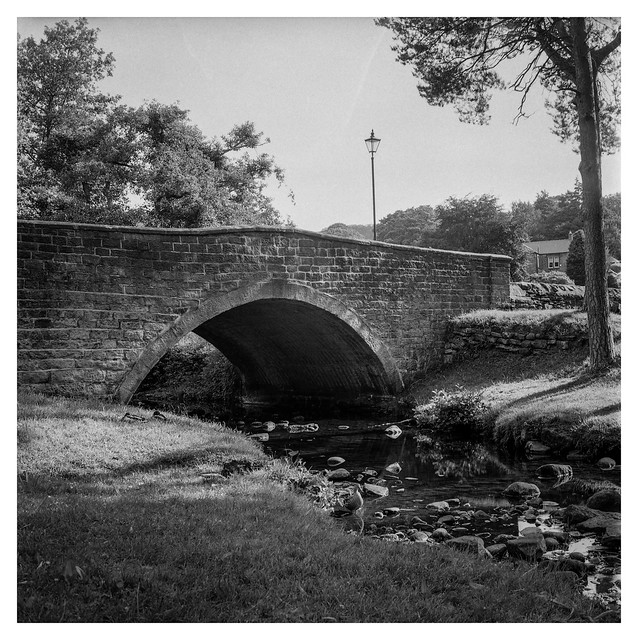
This photograph was the first shot from the roll of Fomapan 100 that I posted about yesterday. The scene looked lovely in the morning sun when I arrived at Low Bradfield around 8am, so I plonked the camera on the tripod, framed up the shot, and fired the shutter. When I returned back to the village a few hours later after my circuitous walk there were quite a few people in this area and the shot would have been more difficult as a result.

There are several ducks in the scene. Can you spot them all? 🙂

Crossing the Loxley

Yashica Mat 124G & Fomapan 100. Ilfotec DD-X 1+4 8 mins @ 20°.

Taken on 22 June 2020

Film photography · Medium Format · Photography

Low Bradfield to Dale Dyke reservoir

I had a day off work last week and decided to go for a hike and make some photographs. I took my Yashica Mat 124G loaded with a roll of Fomapan 100 (plus a roll of HP5+ in case I needed more shots), and the Zeiss Mess-Ikonta 524/16 loaded with a roll of 2003 expired Ektachrome E200. I carried the cameras and other bits in a shoulder bag and the tripod in my hand. There aren’t any of the Zeiss shots included here bacause a) I haven’t had the developed negs back yet and, b) they might be rubbish as I suspect I might have overexposed them all!

I decided to drive to Low Bradfield, a village on the northern outskirts of Sheffield. Above (and below) the village are a series of reservoirs – Strines; Dale Dyke; Agden; and Damflask. My walk took me up the valley to Dale Dyke reservoir (famous because it catastrpophically failed in 1864, killing 244 people in what was known as the Great Sheffield Flood), then across the valley bottom below the dam wall. From there I climbed the northern side of the valley and dropped down to Agden reservoir on the other side, following the eastern edge of the water and descending back to my starting point. The total distance is a little under 8km.

All the photos featured here are from the first half of the walk – from Low Bradfield to Dale Dyke. There are others from this sequence that I’ll probably post in future.

This is the second shot on the roll. It’s on the first footpath I took out of Low Bradfield.

Forming part of the wall

A structure close to the edge of the reservoir, possibly some sort of pumping station or water testing facility.

A place in the trees

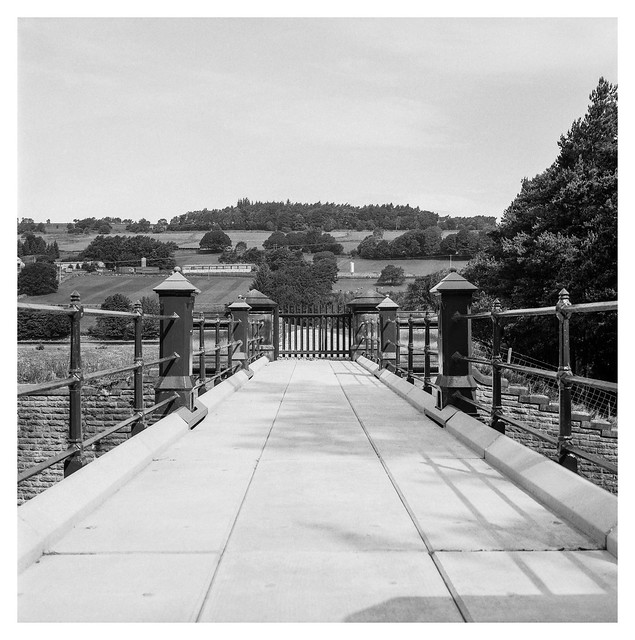
A view across the spillway bridge and the dam wall with the northern side of the valley in the distance. The spillway bridge is a nicely decorated iron affair and I’ve seen some attractive pictures of it. However, as it wasn’t obvious as to how I would find a suitable vantage point, and as the spillway was dry, I didn’t take any photos of it apart from this one.

At the dam wall

A series of stone steps that descend down to the water at the base of the spillway. I used a wider aperture here to narrow the depth of field (most of the other shots – apart from the last – were shot at f/11 – f/16.

Descending through trees

The next  is of the calm waters a little downstream from the base of the dam wall where low hanging branches dip down towards the water. The result wasn’t quite what I envisioned, but there’s something about those leaves at the top of the frame that I find really attractive.

Branches reflected at water's edge

I’m still getting the “dust” problems with the Fomapan 100 that I mentioned previously  here. This roll used water as a stop-bath which, while making some improvement to the situation, hasn’t resolved it completely, so it still took quite some time to clean up these images in Photoshop. I’ve not had issues with lab-developed Fomapan 100, so I’m wondering if it’s something else in my developing process, or perhaps an iffy batch of film?

Yashica Mat 124G & Fomapan 100. Ilfotec DD-X 1+4 8 mins @ 20°.

Taken on 22 June 2020

Film photography · Medium Format · Photography

Uninspired

I had the day off work today and had planned a trip out into the countryside. Alas, the weather had other plans and the day was one of those with a solid sheet of blank grey sky. To make matters worse it also kept raining. Not proper, people-with-umbrellas rain though, but the fine, almost mist-like, rain that just hangs about in the air and gets onto every surface – especially cameras and the front elements of lenses!

So I changed my plans and drove into town instead. Today would be my first trip into the city centre since the non-essential retailers were allowed to open their stores last Monday (and only the second time since lockdown began in March!). Although early, I’d expected more people and traffic that there was – having seen pictures of crowded streets and shops in the media, I thought there might be something similar afoot – but there were very few people about. More than my previous, pre-shops-re-opening visit, but still not many – not even many people travelling into work. The largest groups of workers I saw were construction workers, of whom there were a significant number apparent around town.

Today’s trip was different to the last though in one simple way – I was uninspired. Whereas on my previous visit last weekend I saw photographs everywhere, today I saw few, and the ones I made (I shot around half a 36 exposure roll of HP5+) felt for the sake of it rather than anything I expect to be good when they are developed. Usually, shooting a full roll of film is no problems, but today I left defeated.

It was the first outing for my newly acquired Olympus OM-2 too and perhaps getting to grips with the slightly different fuctionality when compared to my familiar OM-1, had an impact on my photograph making. I’m hoping I might get to finish the roll over the weekend (and I have an extra day off on Monday too) and that the next outing will see me in better spirits.

Today’s photographs are from the dust-spotted Fomapan roll of doom that I’ve spoken about in recent posts. It took me ages to get rid of all the speckles, so I hope someone likes them. 🙂

A gap in the crops

Rainy day lane

Yashica Mat 124G & Fomapan 100. Ilfotec DD-X 1+4 8 mins @ 20°.

Taken on 6 June 2020

Film photography · Medium Format · Photography

Dust-spotting pain

I mentioned yesterday how I’d spent ages dust-spotting some Fomapan 100 negatives. A number of people replied to the post, so I thought I’d give a bit of a follow-up today.

I’ve now completed the chore. Well, on the photos I intend to upload, at least. It was an absolute pain in the backside. It would seem that I’d clear all the spots, only to then notice just as many secondary spots, and each image took a good half-an-hour at least of clicking away to remove them – and even then I’m sure there are many that I’ve missed. But I think I’d gone past caring by that point!

As I’ve not had the same problems with dust spots on any other rolls recently (I always dust the work area carefully before scanning and, while some dust always sneaks in, I rarely get lots of it), I began to wonder if it was something to do with the either the film specifically, or perhaps my development. All my home developed films have been processed in Ilfotec DD-X, then Ilford stop-bath and rapid fixer. The developer is always freshly prepped for a one-shot use and, while the stop-bath and fixer get re-used, they should both be fine for a little while yet (they’ve had around 10 rolls through them). A roll of HP5+ that was developed after the roll of Fomapan shows no signs of the same problem.

fomapan 100 problem
An example of the issue. This is an enlargement of one of the frames that shows clearly the speckling of white spots.

So I decided to look at the last roll of Fomapan 100 I shot – this was a couple of months back – and found that it too had the same issue with dust. I decided to search online for “white spots on Fomapan 100” and it led me to a few places where people would report similar problems – sometimes going so far as to describe it as a “Milky Way” effect. I’m not sure I would go that far, but I got the gist. One post had some example pictures whic matchen mine very closely in terms of the spotting problem. It seems to be an intermittent issue.

I’ve now come to the opinion that I might have a bad batch of Fomapan 100, which is a bit of a pain as I bought ten rolls of it! I guess I’ll have to try another roll and see what it gets me. While the film is still useable, the post-processing required to get rid of the spots is not something to be relished.

Oh well, there are worse things happening in the world, so I’m sure I can live with this minor inconvenience.

Here’s one of the shots from the roll that has had a lengthy clean-up applied.

Down through the field to the railway line

Yashica Mat 124G & Fomapan 100. Ilfotec DD-X 1+4 8 mins @ 20°.

Taken on 6 June 2020

Film photography · Medium Format · Photography

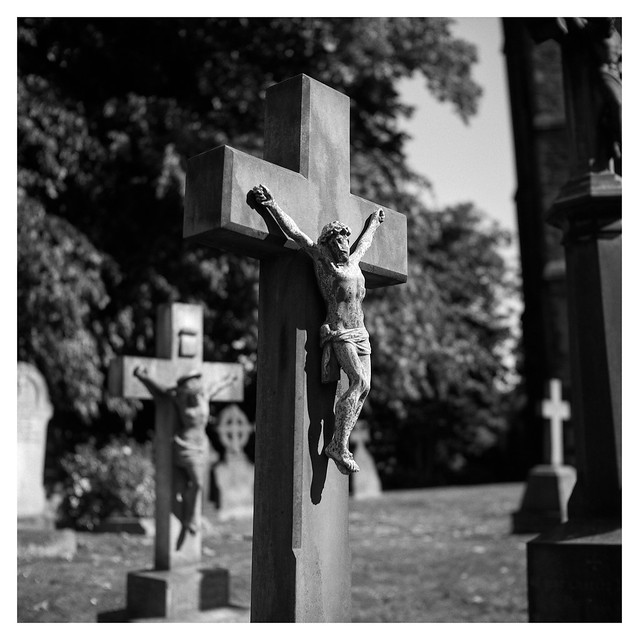
Crucifix

Having just spent the best part of an hour getting rid of thousands of annoying dust specs on some Fomapan 100 negatives, I’m about done for the evening. Therefore this will be a succinct post where I just add this photo of a gravestone with crucifixion design. It was one of several in the churchyard, making it look like some sort of miniature recreation of Golgotha or something.

Crucifix

Yashica Mat 124G & Ilford Pan-F Plus. Ilfotec DD-X 1+4 8 mins @ 20°.

Taken on 25 May 2020

Film photography · Medium Format · Photography

Daisies?

I made a few photos of these flowers. They were beside the footpath I took on a walk a few of weeks ago – this one with the Holga, and a few others with my F80 and a macro lens. I’ve yet to have the F80 shots developed as I still have a couple of frames left on that roll, but I suspect they’ll look quite different to this Holga photograph which has given me a somewhat unexpected, but nontheless pleasant, low-key result.

Although I’ve titled the post (and photograph) “Daisies”, I’m not actually sure if that’s what they are. While the look of the flowers is the same, and the colours match, these are far larger than the daisies that sprout in our garden if I’ve not mowed the grass in a while. I’m sure they must be some relation though. Great Auntie Daisy perhaps? 🙂

Daisies

Holga 120N & Shanghai GP3 (expired). Ilfotec DD-X 1+9 10 mins @ 24°.

Taken on 31 May 2020