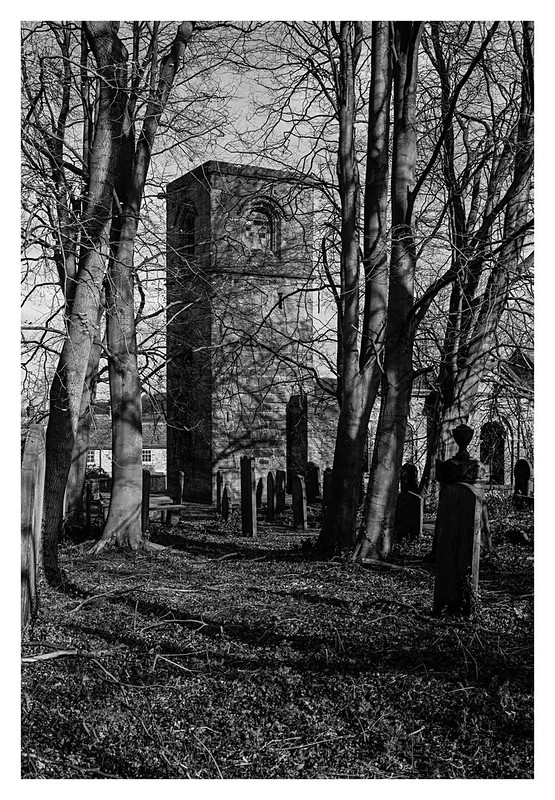
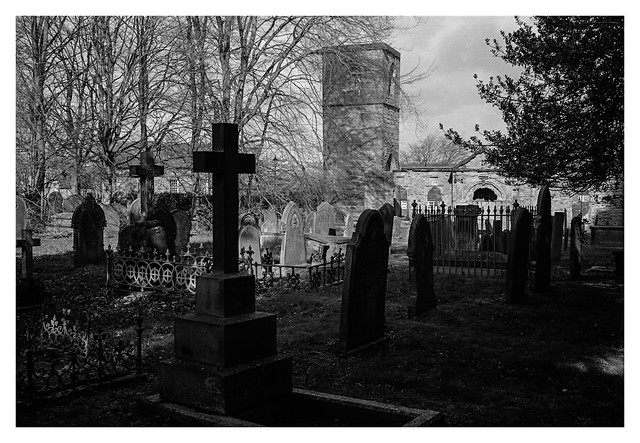
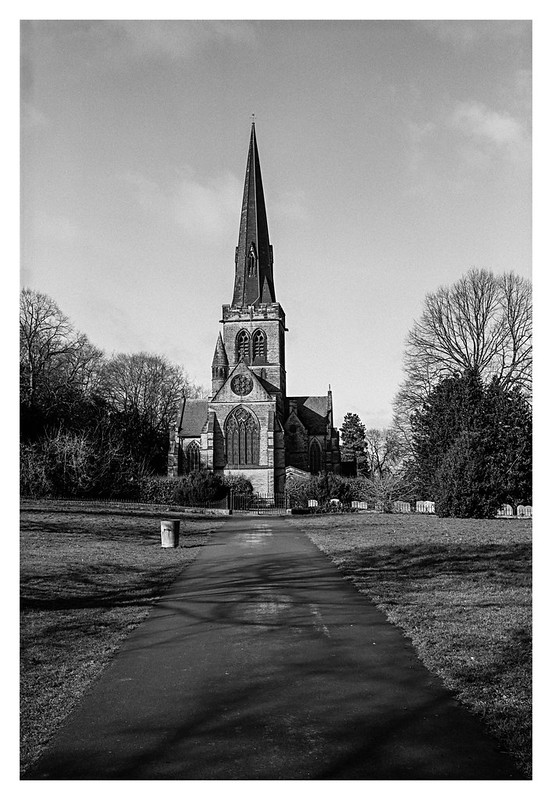
As a direct follow on from yesterday’s post, which showed the new Holy Trinity church – that’s if something nearing one-hundread-and-fifty years old can be considered new I suppose – today’s post shows the old church that preceded it.
The old church tower predates the new one by four or five hundred years, with the rest of the structure having been rebuilt in 1684. The construction is of sandstone and the centuries have taken their toll with the masonry being quite worn by erosion in places, particularly the decorative stonemasonry elements such as carved figures.
This is Holy Trinity church at Wentworth. The church was built by William Wentworth-Fitzwilliam in the latter part of the 19th century, and consecrated on 31 July 1877. It’s quite an imposing building, its steeple visible from miles around. I remember the first time I saw it years ago, viewed from the road to Hoyland to the north, and feeling my gaze drawn to the structure, a huge spike pointing to the heavens, and thinking that it felt like the location from an M.R. James ghost story.
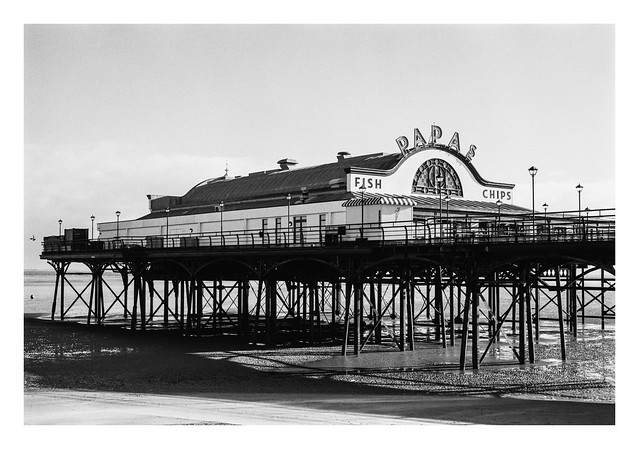
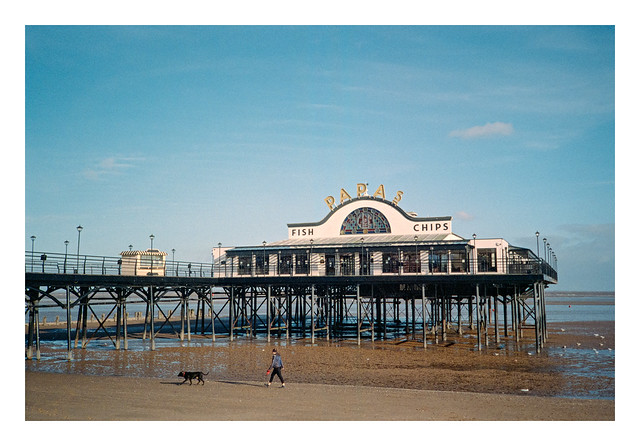
Papa’s has been featured on the blog before, back in 2019. It’s one of those subjects that presents itself as a great photo opportunity, with lots of detail and interest, set against the backdrop of the beach and sea beyond. I had fish and chips the day I visited when making the previous post. I had fish and chips again on this occasion, but it was much colder this time around so instead of eating them on the pier, I walked back to my car parked a short distance away on the promenade and ate them while I sat and looked out at the incoming tide.
There is something comforting about eating in the car like this. It reminds me of when, as a child, we would sometimes drive to a place named Sandilands not far from Mablethorpe in my grandparent’s car. My grandma would always stay in the car, but grandad would come down on the beach with us (us being some variant of my sister, my cousins, and myself) where we would collect the big white pebbles that were scattered around, and which my grandad placed on the ground around the base of their caravan as decoration. When it got cold, we would go back to the car and eat snacks and watch as the sea came in.
Olympus OM-2N, Zuiko Auto-S 0mm f/1.8 & Ilford Delta 100. Ilfotec DD-X 1+4 12mins @ 20°. / Olympus XA3 and Kodak Colorplus (expired 2012 and shot at 100asa)
Along the promenade at Cleethorpes I passed these two rubbish “bins”. One, south of the pier, jauntily named “Hammy the Haddock” (although Hammy sounds more like a pig’s name). The other, to the north of the pier didn’t have a name that I noticed, but as it’s a repressentation of our planet, I assume it’s called “Earth”.
It’s possible that there may be more of these designs further down the promenade to the south, but I didn’t walk much beyond Hammy on this visit. They are nicely designed pieces of functional street furniture and I can easily imaging children (and even adults) being excited to put their rubbish into either one rather than dropping it on the ground.
It’s contents might not be as edible as Pizza Hut’s… But who knows? Has anywone done a comparison. I mean, wooden frames and cloth seats might not sound as good as a hawaian or a meat-feast, but perhaps it’s a yet-to-be-discovered delicacy?
Enough of this nonsense!
It’s quite a simple picture, just a shed stood in the sunshine, it’s deckchair innards waiting patiently for the warmer weather and the visitors it will bring. I like it’s simplicity though, just an angular block of white painted planks with the winter sunshine adding some nice contrast. Of the three photos I loaded to Flickr today, this one got the least likes so far, but it’s the one I like best. There’s no accounting for my taste I guess…
The big wheel that stands on Cleethorpes beach has features in a number of photos on the blog recently, often in the distance. Today there a couple of closer shots.
The obvious thing to note about the structure is that the seats have been removed while the ride is closed over the winter months. Without these though it presents a cleaner profile against the blank backdrop of the blue sky day.
Cleethorpes has a fairly long, straight run of beach with the pier stood maybe about halfway along its length. The pier, and the big wheel and helter-skelter that stand not too far away are prominent landmarks wherever you stand on the shore.
Being situated at the end of the Humber estuary, the beach at Cleethorpes is aluvial in texture, the sand being a dark muddy brown as it’s probably made up in a significant part by deposits from the estuary. The upper parts of the beach are sandy in a more traditional way and I wonder if this sand has not been artificially placed there for tourists. On the day I visited there was an excavator spreading sand around the upper part of the beach down past the pier. I have a photograph of that too, so I might post it on here at some point.
Well the weekend seems to have flown by as swiftly as usual. Much like the gull in today’s photo.
I don’t tend to photograph wildlife generally, but there were a bunch of thse gulls flying around so I made the effort to catch one on film. It was a single attempt on 100asa film using a slow-ish manual focus telephoto zoom (although I think I had it opened to it’s max aperture of f/4), so I’m pleasantly surprised at the result!
This signpost sits beside an old wrought-iron footbridge over the River Don in Sheffield. The destinations are mostly areas of the city, but with a few places further afield. The sign pointing to Wales refers to the village of Wales to the east of the city, rather than the nation to the west of England. Interestingly, a variety of measurement types are used on the signs.
Someone on Flickr asked me what a “rod” was, so I looked it up. Today’s bit of trivia (and something I didn’t know before) is that a rod is equivalent to sixteen and a half feet. There are four rods in a chain, forty rods in a furlong, and three-hundred-and-twenty rods in a mile.