I’m feeling a bit frustrated at present. Nothing to do with my photography, but all to do with my ears. Which are blocked.
I have a problem with blocked ears, and have done for years. Every so often they will get clogged up and I need to put in drops and visit the GP to get them cleared out. This is the case at present. I visited the nurse last week to have them syringed (after a couple of weeks of putting in olive oil drops), and had been really looking forward to getting my hearing back. Unfortunately, my ears were so clogged that the drops had only penetrated part way and the procedure left further wax deeper in my ear. On top of that, after I came out of the GP’s my hearing gradually became worse through the day – my right ear wasn’t too bad at first but in the evening I tried watching some TV programmes on the iPad with headphones – trying to listen to the TV in the living room as fruitless, with all the sound becoming a bit of a mush and any dialogue being very difficult to make out – and while the headphones on the iPad worked ok at first, after a while I felt my right ear gradually close up with whatever was still blocking much of it. So that was that.
I’m now putting drops in several times a day in preparation for round two with the nurse later in the week. Sigh.
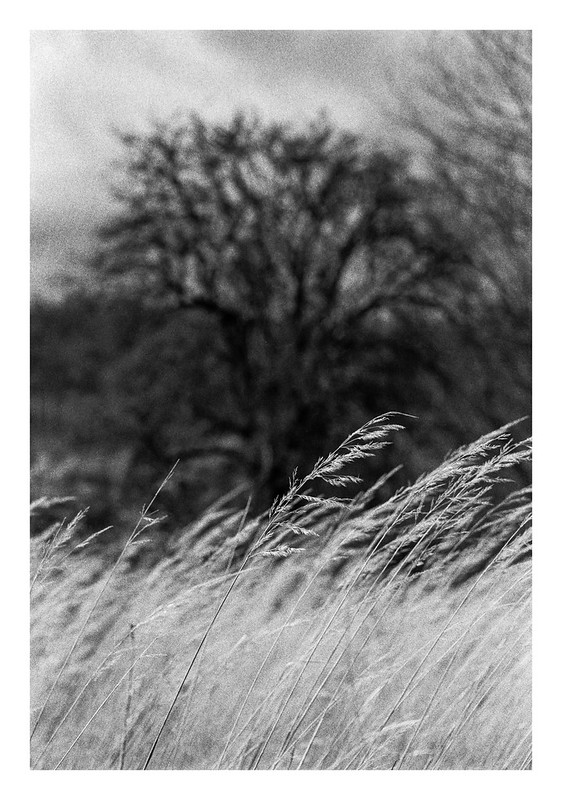
That had nothing whatsoever to do with photography, but a photo you shall get nontheless. Not of the inside of my ears thankfully, but some dried grasses that I photographed a few weeks ago.
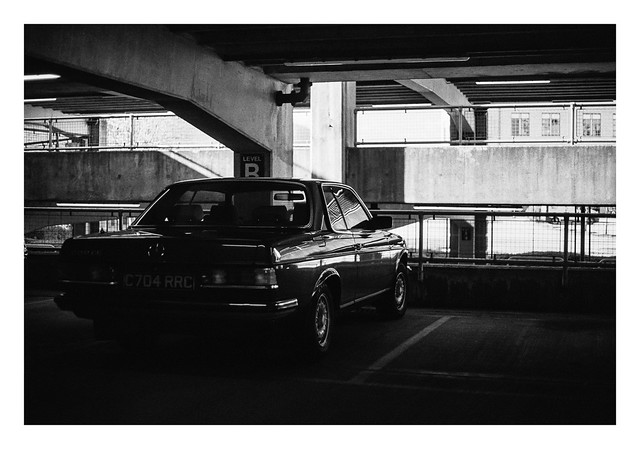
After arriving back at the carpark following a walk the other week, I saw this old Mercedes in one of the other bays. I liked the low key look it had, with subtle reflections from the bright shafts of light coming from the centre of the building, but wasn’t convinced that the picture would turn out ok. I was wrong I think, and it turned out better than I might have hoped given the conditions and slow shutter speed used.
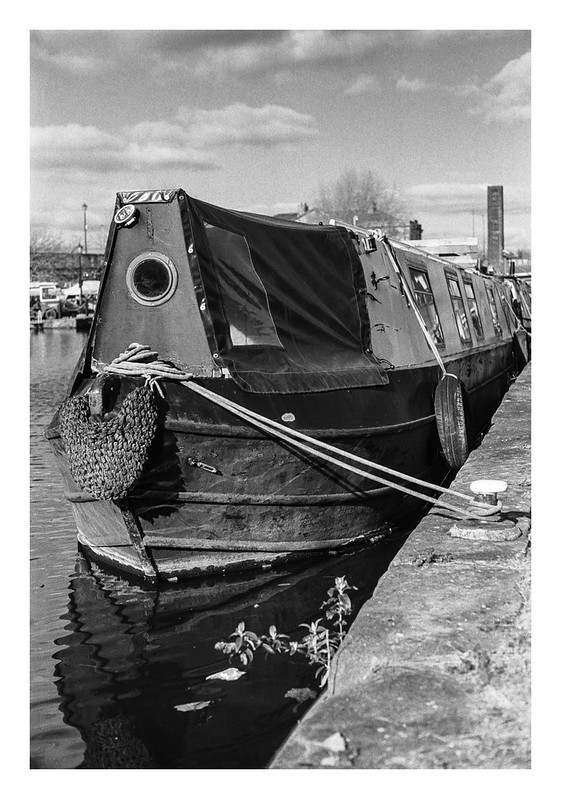
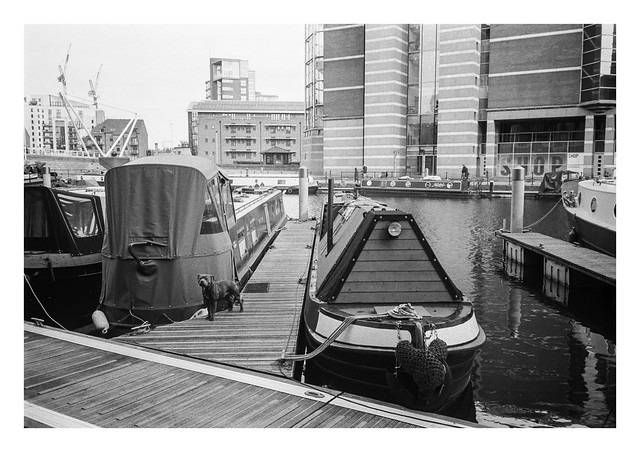
Time seems to have gotten away from me today and I don’t have time to write much. Still, the fires of the blog need to be fed and the fuel today will be these two photographs of canal narrowboats. A lot of the narrowboats at Victoria Quays seem to be permananent fixtures that I’ve never seen move – basically floating homes – and I’m sure that I’ve photographed many of them on more than one occasion.
These two shots came out quite nicely though, I think.
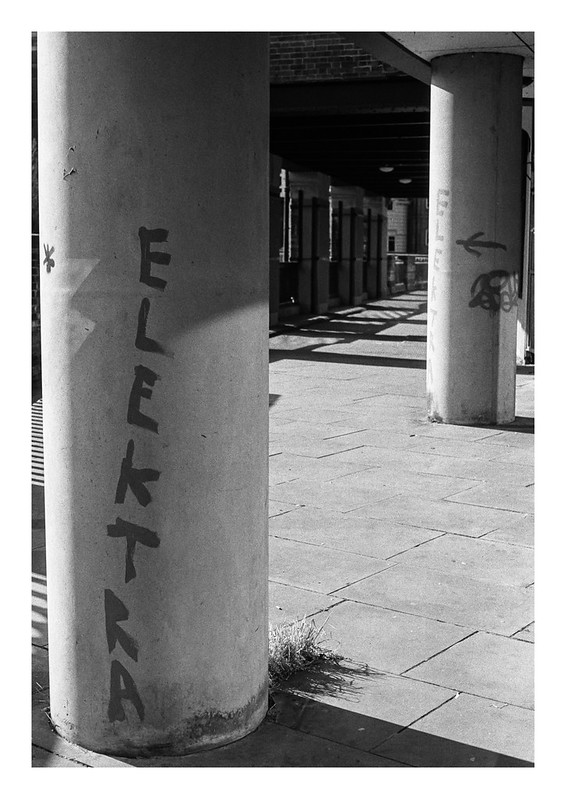
Sandwiched between the River Don and Blonk Street is the I Quarter (formerly Hancock & Lant) Tower. I’m not sure where the I Quarter name comes from – maybe the developers? – but Hancock and Lant was a furniture store established in the 1930s that used to have its showroom in the same location. They moved address at some point to, I believe, Queen’s Road, but I’m not sure if they are still trading.
The access to the store was via a very narrow road that ran between the building and the river, with a small area where, if you were lucky, you could find a parking space. I say road, but that doesn’t really illustrate just how narrow it was for vehicles, and there was always the fear of getting trapped down there as there was no way that anything other than a bicycle would have been able to squeeze past any othe vehicle. Today’s photographs show this location, although it is no longer accessible from this end by motor vehicles due to the concrete support columns of the I Quarter building.
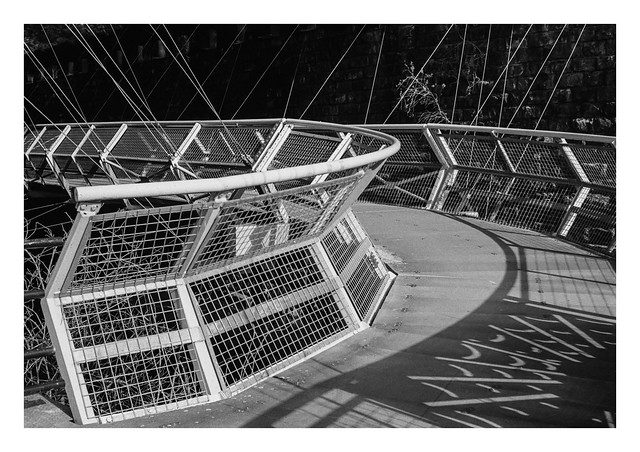
I guess that, if you’re afraid of arachnids, the Spider Bridge might not sound all that appealing. There are a couple of huge spiders there too, lurking in the shadows above the walkway (out of shot), but they’re made of metal and don’t actually move about all that much (unless they sense fear!!!). There are probably hundreds of other, normal spiders on the structure too, as there are on pretty much any structure, but they won’t harm anyone and will probably remain completely unnoticed unless you go loooking for them.
The Spider Bridge forms a part of the Five Weirs Walk in Sheffield, carrying the footpath along a suspended section – which looks like it’s hung by thick strands of web – under the arches of a disused railway viaduct with the dark waters of the River Don flowing beneath. When there has been heavy rainfall, and the river is in spate, I expect that walking this bridge might be quite an exciting experience!
A quick post today, but beefed up with three photographs rather than the usual one. All three were taken at Leeds Dock beside the Royal Armouries museum (after I left the museum).
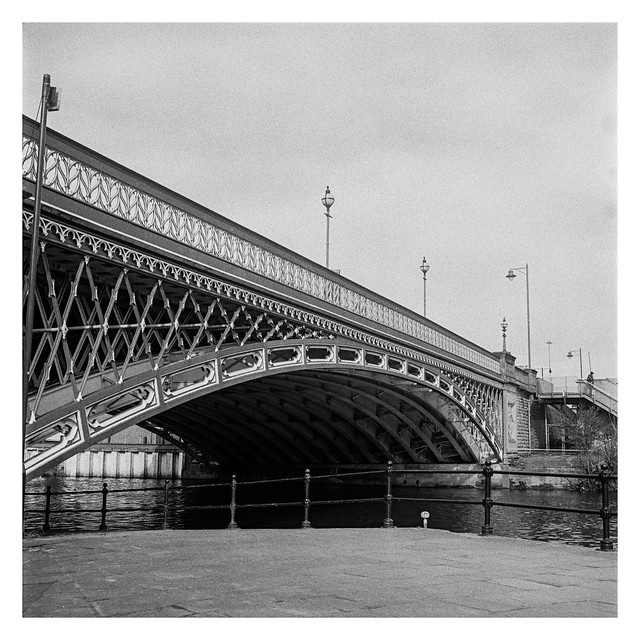
This is the same bridge that featured in yesterday’s post (and also the post about Retropan 320 the day before).
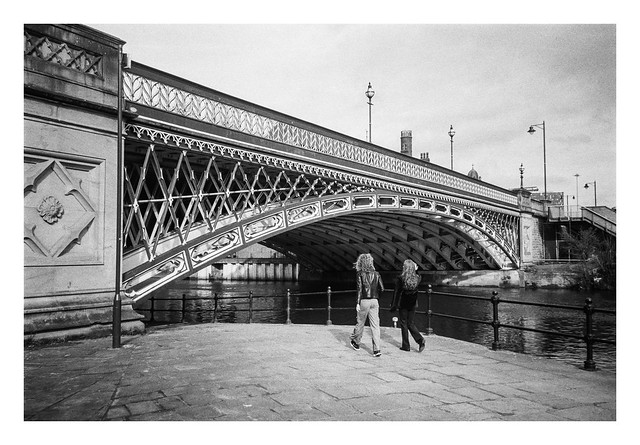
This is my favourite of the three pictures – the wider angle and format shows more of the bridge’s structure than the 6×6 Yashicamat photo did, plus the people in the shot are well placed in the frame, have well timed gait, and also similar hairstyles, all of which contribute I think.
I’m pretty happy with how this picture turned out. It was a spur-of-the-moment effort quickly taken when I spotted the girders and their reflections as I walked beneath this bridge over the River Aire in Leeds.
Apart from framing the photo as I wanted, my only real concern was that there might be some camera shake due to lack of light and my inability to control shutter speed or aperture on the little Olympus XA3. There was a railing just out of frame and so I leant on that to give a little extra stability. I was happy to see that the shot came out well, and better than I actually anticipated.
A while back – last year I think, although it could have been 2020 – I got in touch with the film manufacturer Fomapan. I’d had some issues with a batch of Fomapan 100 that I’d bought which was resulting in a lot of small white speckles on the scanned negatives. This wasn’t dust, but some problem with the film that was becoming apparent when it was developed. A bit of reasearch online produced a number of other reports of the same probleM, some with the same batch number as the rolls I had, so I got in touch with the company to ask if they could do anything to help.
They provided some instructions on how the issue with the problem batch might be addressed, and confirmed that there had been an issue with some rolls of the film that had been produced. Unfortunately, I didn’t have any luck after following the special instructions and the next roll still showed the same speckles, albeit slightly lessened. In addition, Fomapan also sent me a few rolls of film to recompense me for my troubles, some Fomapan 400, and also a roll of Retropan 320.
I’d never shot Retropan before so was curious as to what it might produce. Unfortunately, thanks to the pandemic and various lockdowns, the film languished in the freezer for quite some time, awaiting its day in the sun. That day came a few weeks ago when I took a trip to Leeds for the day with my wife and her sister. They hit the shops while I went off to make photos (and also visit the Royal Armouries museum). I burdened myself with choice on the day, having three film cameras, plus my little Ricoh digital compact. The film cameras included the Yashicamat 124g (with the Retropan), my Olympus XA3 (with some HP5+), and the newly acquired RETO Ultrawide & Slim (with some Agfa Vista Plus 200 – some of the shots which have already been seen here on the blog recently).
I wasn’t massively enthused about shooting the Retropan, even though trying a new film usually means at least some excitement is to be had. Most of the photos I’d seen online from other people had a bit of a flat look about them, which isn’t something I tend to favour. I also looked into what speed to shoot the film at, having had issues with underexposure when shooting other Foma films at box speed in the past. The general concensus was to overexpose it by at least a stop, with one person suggesting that 80asa was the sweet spot. In the end I opted to shoot it at 125asa and develop it normally.
The experience of shooting the film went without hitch, and developing was likewise straightforward. The film felt quite thin, but went onto the spiral without any problem. As with other Foma films, I pre-washed it before developing and got the usual witches brew of green liquid when I poured the rinsing water away.
The photos are actually quite nice. Not the look I tend to go for, but there’s something there in the tonality that I find quite pleasing. There’s lots of grain present, but also good detail, and using my usual post-processing settings as a starting point soon got the scans where I was happy with them.
So, would I buy a roll with my own money and shoot it again? Honestly, probably not. I’d go for one of the other Foma line instead. But I wouldn’t turn down a roll that came my way for free. 🙂
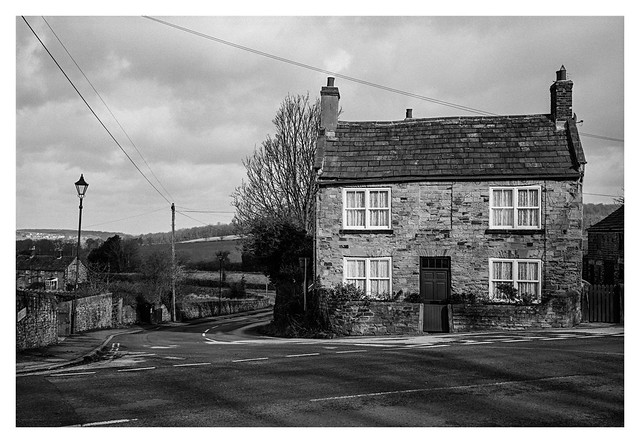
I took quite a while to get the composition how I liked it for this photo. Not a long time, but longer than my usual “there’s a photo! click” method. I saw there was a picture to be had but there were distractions / potential interest points at either side of the frame, so I spent a few minutes moving left, right, backwards, and forwards to get just what I wanted into frame – all the while being conscious that I was stood in a road and that cars might be approaching from my rear.
The right of the frame had a parked car which I wanted to avoid in the shot, but the left had some interesting street furniture that might have added to the photo, plus it showed the curve of the road at the side of the house to better effect. Unfortunately, positioning myself to get the stuff at the left in frame also meant that other unwanted things crept into view as well, so in the end I went for this version.