Another lone Velvia 50 autumn photo today – probably the last of these single images with a group of pictures realted by theme tomorrow and then, if I have time, the remaining decent photos from the roll as a kind of autumn blowout.
Nikon F80, Sigma 105mm f/2.8 OS HSM & Fujichrome Velvia 50. Lab developed & home scanned.
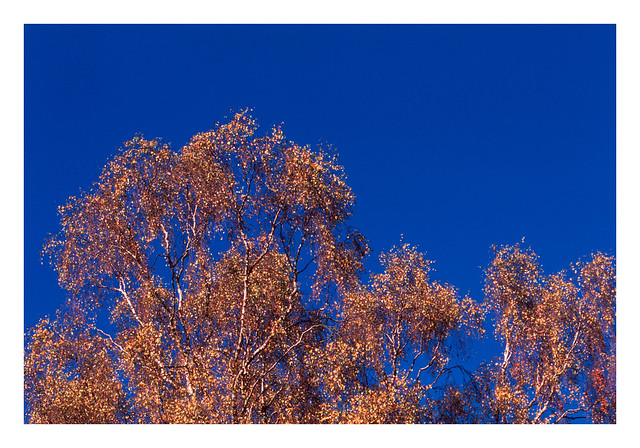
There was a lot of bracken in this area, but this plant stood alone and was catching the sun. I wish I’d done a better job of checking my corners and moved that encroaching frond at the bottom-right of the picture though…
Nikon F80, Sigma 105mm f/2.8 OS HSM & Fujichrome Velvia 50. Lab developed & home scanned.
A few years ago I bought myself a roll of Fuji Velvia 50 as a treat. At the time I think it cost me in the region of about £11 for the roll, which seemed expensive. Little did I know…
Anyway, moaning about the price of film aside, the reason I bought it was to try and photograph some autumn colour. Unfortunately, when that autumn came around I either didn’t have the time, or the conditions weren’t right, and so the season passed. I kept the fim in the fridge though, thinking it would keep until the following year. But I didn’t shoot it again. And then covid arrived and limited my ability to shoot it even further. In the subsequent time I actually picked up a few more rolls of Velvia 50, albeit expired, and I’ve shot a couple of of those (although, given its cost, it always feels like a “special occasion” sort of film), but none of it during autumn. This year though, I had my chance – I booked a week of work for the first week of November which, this time, would be unperturbed by pandemic related lockdowns.
I went out a couple of times during the week to do some photography – the first trip to Bakewell (images to come at a later date), and then, later in the week, a visit to Padley Gorge and its surrounding environs. It was there that I finally shot the full roll of Velvia 50. I’ll probably share most of the worthwhile results in a seperate autumal-themed post, but there are a few that I like enought to post individually, or in small sets, today’s picture included.
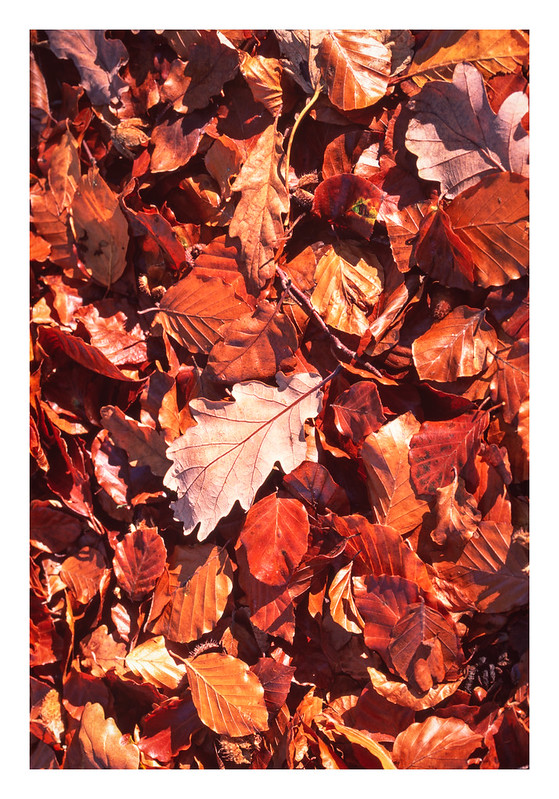
This was the first day of the season that I had encountered frost – I had to scrape the car windows before heading out and, although I didn’t set off too early, there was still a little frost left on the ground when I arrived (although it was quickly steaming away where the sun hit it). Just across the road from where I parked my car there were numerous fallen leaves right beside the footpath, all with a light frosting of ice, and the one shared here today grabbed my attention. I was very glad to have taken my Sigma macro lens, and used it for almost every shot on the roll, even the non-macro stuff. It’s a very nice lens and one I should make better use of.
Nikon F80, Sigma 105mm f/2.8 OS HSM & Fujichrome Velvia 50. Lab developed & home scanned.
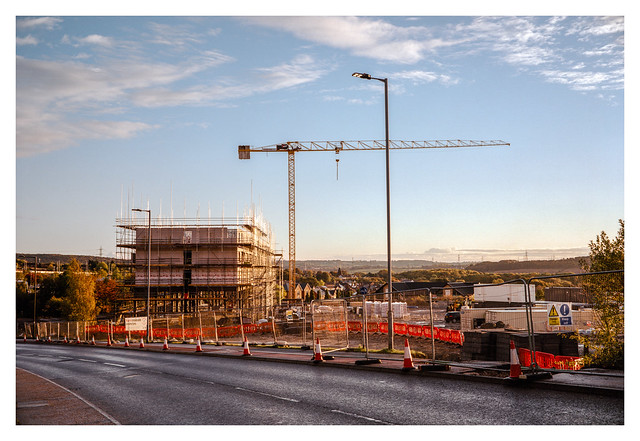
This area has been massively developed in the last decade or so. It sits just to the west of the site of the old Orgreave coking plant – famous for the “Battle of Orgreave” which took place between striking mineworkers and the police back in the early 80s. Pretty much all signs of the previous industry have now disappeared, replaced by a large housing development and a modern industrial park, but construction still continues in the area, with further homes and also new business units being built.
I’m not sure what the structure in today’s photograph will be when completed, although it has the feel of a small hotel, perhaps to accomodate visitors to all the new businesses in the area. Whatever it will be, I felt there was a picture to be made.
Fujica GW690 & Kodak Portra 400. Lab developed. Home scanned and converted with Negative Lab Pro.
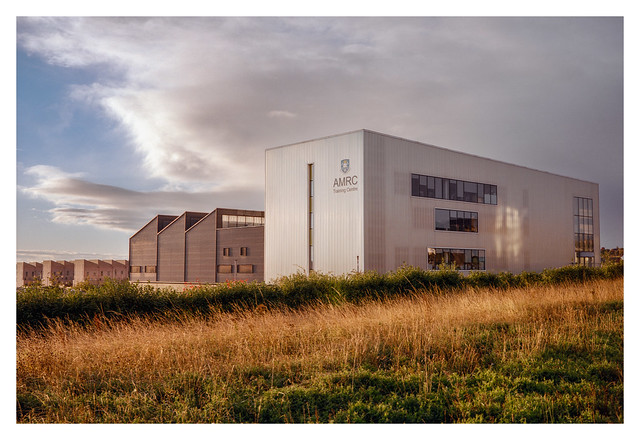
Despite the rain that soon arrived, I think I fell pretty lucky with the weather and light on the morning I took the photos I’ve been publishing the past few days. The incoming cloud added a lot of interest to the skies and, because the sun was in another part of the sky, everything was lit beautifully meaning blocky industrial structures like this training college were transformed.
Fujica GW690 & Kodak Portra 400. Lab developed. Home scanned and converted with Negative Lab Pro.
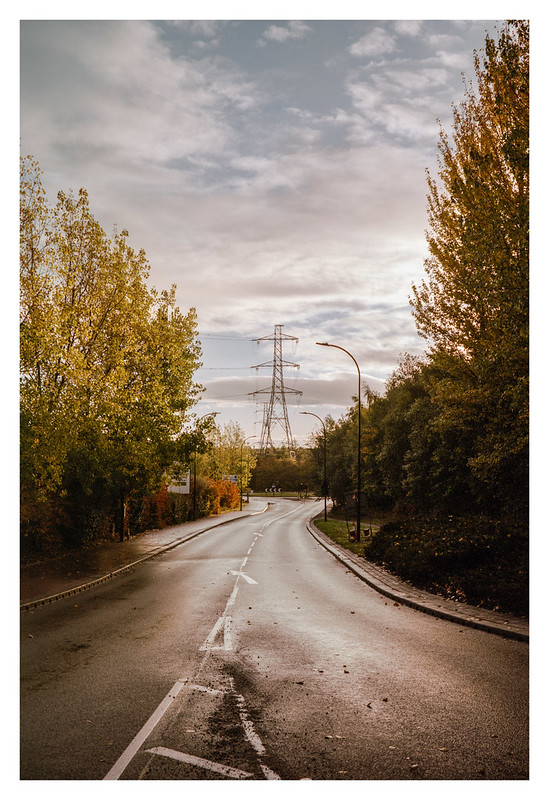
Just a few metres from the picture in yesterday’s post but facing the opposite direction, the morning sun was beginning to be snuffed out by cloud-cover when I took this photo. The trees are not glowing as much as they had been when I’d driven past on mornings with clearer skies. Nontheless, there’s still a hint of autumn in the leaves and I like the damp road and it’s slightly reflective surface. And it has a pylon. 🙂
Fujica GW690 & Kodak Portra 400. Lab developed. Home scanned and converted with Negative Lab Pro.
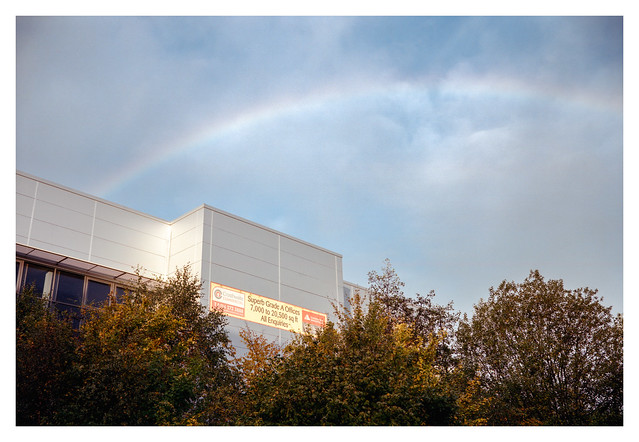
On the morning I took this, I’d hoped for clear skies and an autumnal golden-hour, but this was somewhat scuppered by a fast approaching band of rain. But because the wet weather was approaching from the west, it made for an attractive rainbow, and the front of this otherwise mundane office building was thus transformed.
Fujica GW690 & Kodak Portra 400. Lab developed. Home scanned and converted with Negative Lab Pro.
I’m back with the third of my expired film adventures. When I started this series (and I use that term in a loose sense) I think I might have mentioned doing one every month and, for the first two at least, I was true to my word. But it’s now been almost five months since the last entry, so apologies to anyone who was waiting with baited breath. I do still intend to keep doing these though, and hopefully more frequently.
This roll is the youngest one featured to date, being a sprightly nineteen years over its expiry date of 2003. It’s another colour film, this time both in 135 format, and also, I think it’s fair to say, a consumer grade stock. I have actually shot another roll of this previously and you can see some posts containing the results here. I shot the previous roll at box speed and, while I got some nice results, they were somewhat grainy and more than a little vivid, so for this roll I decided to overexpose by a stop and shoot it at 100asa.
But first a little background on the film, and how I got it.
Truprint were a mail order photo processing outfit where you wuld post your rolls of film out in a special envelope and then, a couple of weeks later, you would receive a set of prints AND a free roll of film to shoot more. The Truprint brand was still in business as a photo printing outfit up until fairly recently until it was bought out by Snapfish. Truprint provided a variety of films in the usual 100, 200, and 400asa varieties but these were, I believe, re-branded stocks from other manufacturers. The Big Film Database shows Agfa and Ferrania as the most likely originators of the film stocks used by Truprint. The roll I shot here was Truprint FG+ – a 200asa film, and one which appears to have been manufactured by Ferrania. Although the Big Film Database doesen’t specify this, other sources seem to indicate this particular stock was Ferrania Solaris.
I got hold of my two rolls from a lady who had found them in their fridge in her garage and who had asked online if they would be of any use to anyone. She told me they had always been in the fridge since purchase, which was a good sign, and was the main reason I chanced shooting the first roll at box speed.
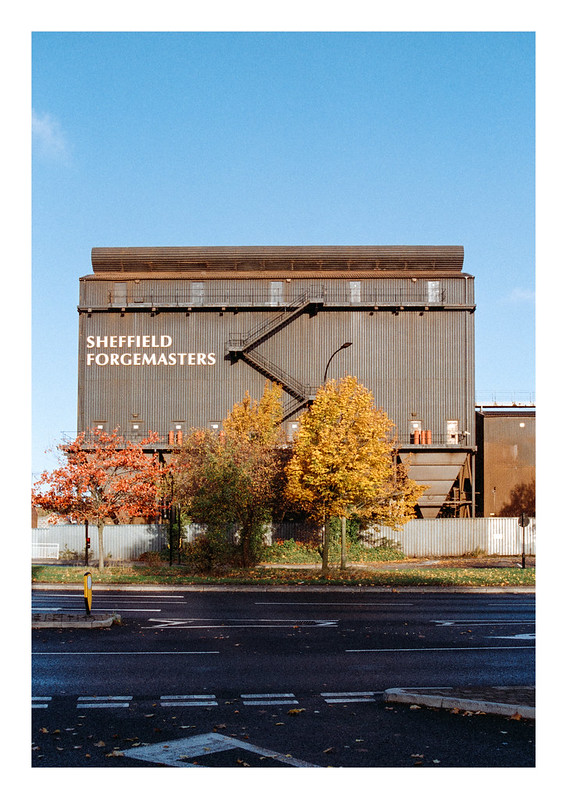
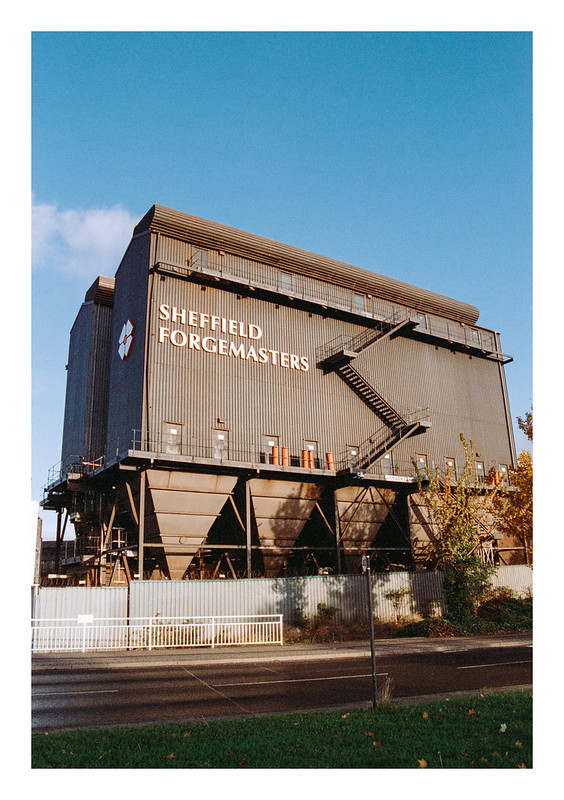
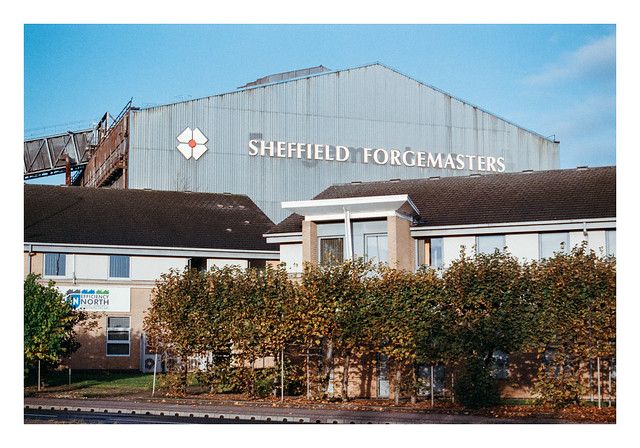
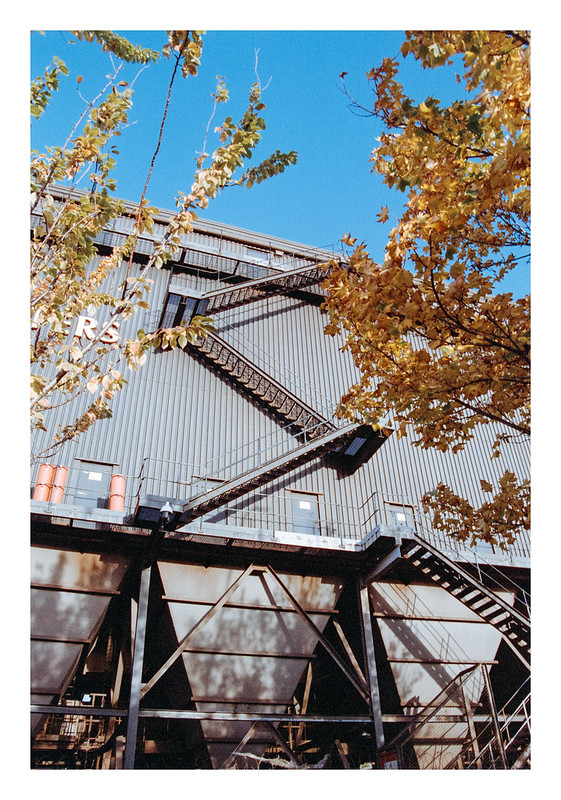
I decided to shoot this second roll partially for some multiple-exposure photography I was attempting, for which I didn’t want to risk wasting a more expensive roll of film, but as I had no intention of using the whole roll for this purpose, I also went out on a sunny autumn morning to shoot a bunch of other frames of whatever subject matter I could find. I ended up in the Attercliffe area of the city – a former industrial area home to Sheffield’s once vast steel industry, but which has now become home to service businesses, retail, and entertainment outlets (although there is still a lot of industry in abundance, including steel foundries). Most of the pictures feature Sheffield Forgemasters, a heavy engineering firm that has been in existence since 1805. In the 1980s the company attracted controversy for it’s part in the Iraqi Supergun Affair, and in 2021 was nationalised because of it’s importance to the nation’s defence industry.
So, on to the results.
This roll came out very nicely indeed, possibly due to the overexposure, or perhaps it had just fared better than its companion roll. Whatever the case I would not be disappointed with these if they had come from a fresh roll of film – the grain is minimal and the colours look natural with just a hint of warmth (and that might just be in the way I processed the pictures in Negative Lab Pro and Lightroom). I’m very happy with the photos and would happily shoot more Truprint FG+ (if I had any).
Autumn had arrived when the photos were made, and the colours reveal themselves well on the film – helped by the nice sunlight I had on the day.
More autumnal shades beside Sheffield Forgemasters.
Sheffield Forgemasters is a looming presence in this part of the city.
Another industrial building in the area. Not part of Forgemasters, I believe this might be a scaffolding supplier now.
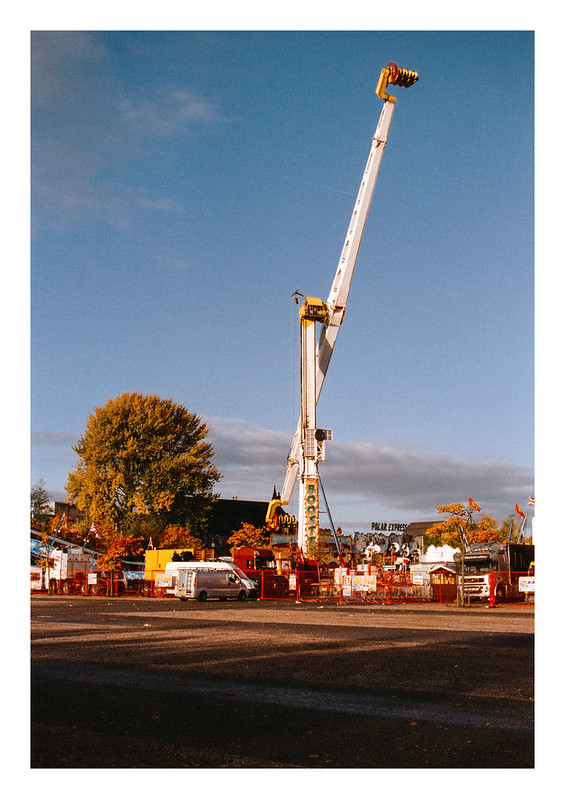
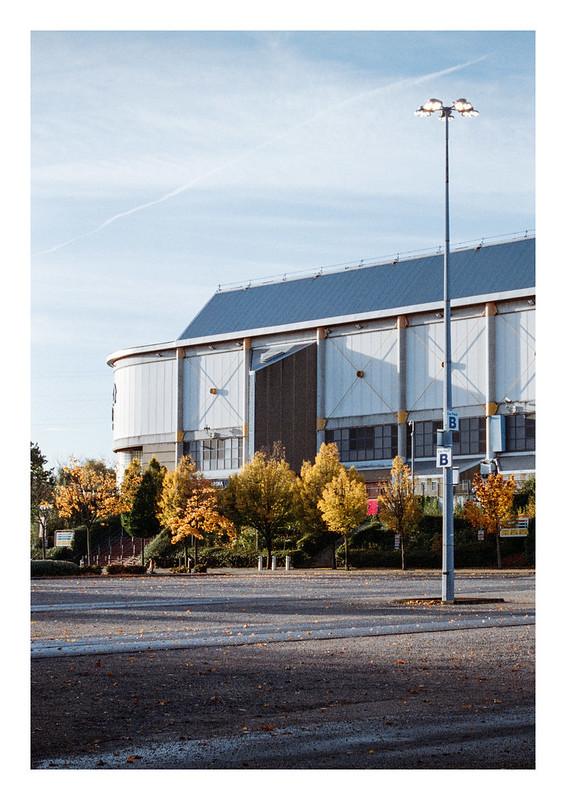
One of the main entertainment facilities in Attercliffe is the Arena – currently the Utilita Arena, but it has gone under a number of sponsored names since construction though it is often known locally as the Don Valley Arena. There was a funfair taking residence in part of the carpark on the day I passed.
The arena itself.
Overall outcome: Success!
Expiriment #4 coming soon (I hope…)…
Nikkon F80, Nikkor 28-80mm f/3.5-5.6 D, Truprint FG+ (expired 2003). Shot at 100asa and lab developed for box speed. Home scanned and converted with Negative Lab Pro.
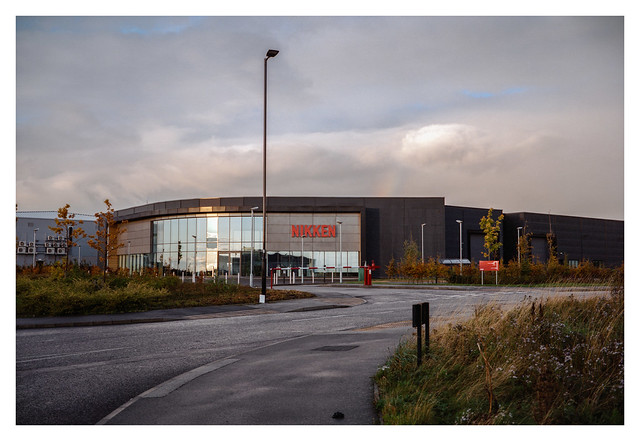
I took a series of pictures around some out-of-town industrial estates a few weeks ago. On the day I took this I arrived around sunrise with a mostly clear sky, but with heavy rainclouds fast approaching. This made for some pretty nicely lit scenes, many featuring a rainbow. You can just see a hint of a rainbow in this picture above and to the right of the Nikken sign. I like the splashes of red in this image, as well as the trees showing a hint of autumn tones.
Fujica GW690 & Kodak Portra 400. Lab developed. Home scanned and converted with Negative Lab Pro.