I posted some pictures the museum and bandstand a few weeks back, but those shots were in black and white and shot on my Fujica STX-1. But I also took some medium format colour pictures of the same scenes (though different compositions) with my 1950s Zeiss folder. So here they are.
Zeiss Mess-Ikonta 524/16 & Fujifilm Pro 400H. Lab developed. Home scanned and converted with Negative Lab Pro.
These follow on directly from the pictures in yesterday’s post, each being taken withing Weston Park.
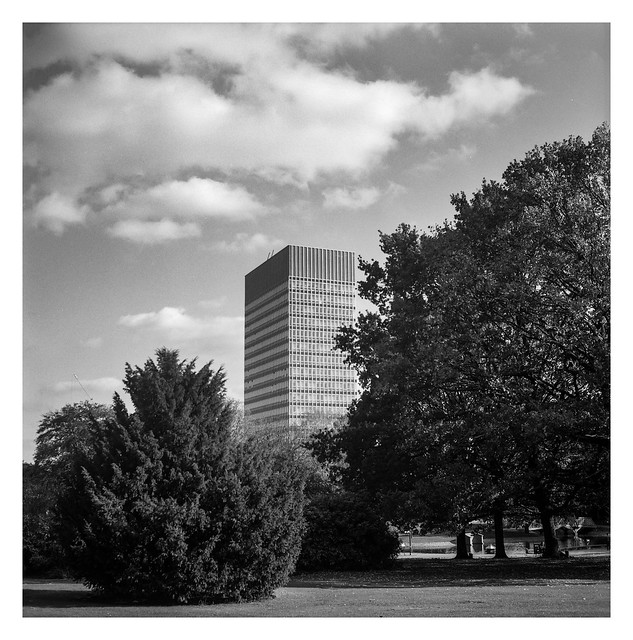
The first is the wooden bridge that crosses part of the duck pond. There were few ducks around this part of the water and it was undisturbed by any breeze, so it looked somewhat stagnant, giving it an almost frozen-over look. You can also see the University of Sheffield Arts Tower at the right of the frame.
The Arts Tower is something I always seem to come away with at least one photo of when I’m in this area. It’s the second tallest building in the city at 256 feet tall (although, because of it’s position on the hilly Sheffield terrain, it’s actually much higher than it’s rival). Sheffield doesn’t have that many tall buildings (although the number is increasing) – and the ones we do have aren’t that tall in the grand scheme of things – especially compared to it’s closest city neighbours Manchester and Leeds, but neither of those are as hilly as Sheffield either, where the impact of skyscrapers is lost amongst the terrain.
Fujica STX-1 & X-Fujinon 50mm f/1.9 FM on Agfa APX 100. Ilfotec DD-X 1+4 10.5mins @ 20°.
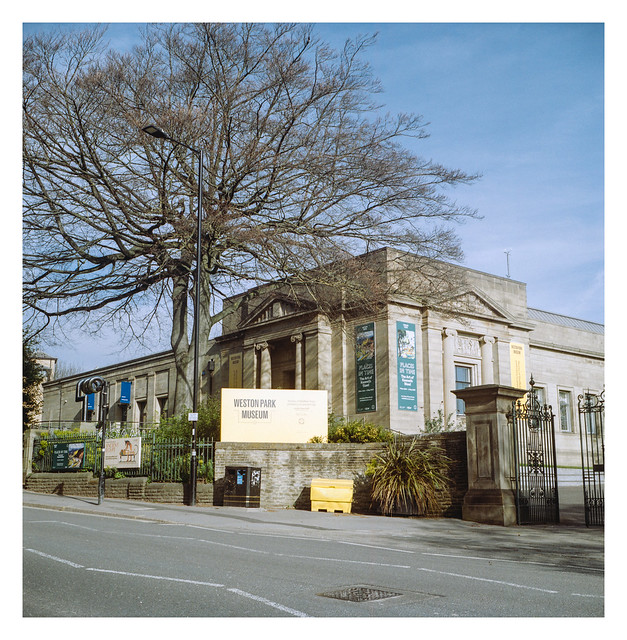
Weston Park Museum first opened 150 years ago, originally in Weston House before the building was extended with a neoclassical design. The building houses both the museum and the Mappin Art Gallery (named after a Rotherham businessman who bequeathed his collection to the gallery).
The gallery was partially destroyed during the Sheffield Blitz in WW2 and, while the museum remained open to the public through the 50s and 60s, the art gallery was not reopened until 1965.
The Weston Park bandstand is the last surviving bandstand in the city and was built in 1900.
These pictures, and those to follow in the coming days, were all taken with the Fujica STX-1 that I bought on a whim as part of a job-lot of not-working cameras from eBay.
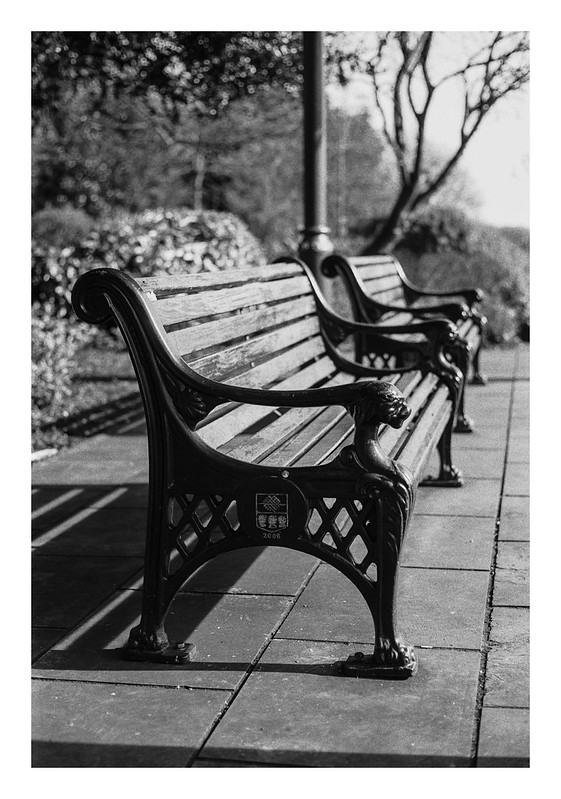
Fujica STX-1 & X-Fujinon 50mm f/1.9 FM on Agfa APX 100. Ilfotec DD-X 1+4 10.5mins @ 20°.
I’m feeling quite tired today for some reason and can’t think of much to type for the blog, so I’m going to use that as an excuse for this shorter post. Hope you like the picture of the benches. Despite the title… NOBODY IS ON THE BENCH!!!! 😀
The coming days will see a series of photographs made with my recently acquired Olympus OM-1N (a replacement for my faulty OM-1. You can read about how I came about it here, should you wish).
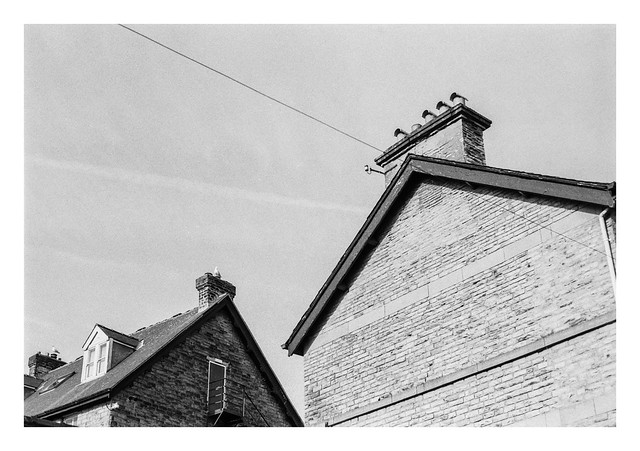
The camera appeared to be in full working condition, but needed new light seals, so this was its first outing after I’d replaced those. As I didn’t want to chance a roll of something expensive on an untested camera, and as I have no cheap bought-for-£1 Agfa Vista Plus left, I used the cheapest, but fresh, stuff I had to hand – some Agfa APX 100. As far as I’m aware this is just re-branded Kentmere 100 these days (although I think it used to be re-branded Fomapan 100 previously). The last time I shot some of this I developed it with Ilfotec DD-X and got some quite overdeveloped negatives (probably my fault). This time I decided to use some Adox Adonal instead and got better results.
My old OM-1 had been converted to meter properly with a 1.5v cell, but this OM-1N still expects a 1.3v cell. I do have Wein cell that I could use but, again, as the camera was untested I didn’t want to crack open an expensive battery so I used a 1.4v zinc-air battery instead. I’m not sure how much this will have affected the metering but, on the whole, the shots came out quite well exposed with perhaps a little over-exposure present. The good news is that the camera worked perfectly.
Posted here today are three shots from the start of the roll. More to come this week.
Weston Park was the first municipal park in the city of Sheffield and formed from the grounds of Weston Hall. The hall itself would become Weston Park Museum incorporating the Mappin Art Gallery. The museum opened in 1875 and was extended thirteen years later.
The museum contains permanent exhibits on the local archeology, natural history, art, and social history, as well as regular temporary exhibitions.
The building was severely damaged by a bomb during the Second World War and the art gallery remained closed to the pubic in a damaged state until 1965.
As I type this, it’s a lovely evening outside. Just the other day, on the journey home from our coach trip, I commented to my wife on how nice the early evening light was and that I should really make a better effort to take advantage of it through the longer days of the summer. However, no matter how nice it looks, the effort required to get myself up and out after a day at work means I rarely do so. I must try harder! I am planning on heading out tomorrow to shoot one of the rolls of expired film I posted about last week though, so the photography itch will be scratched, albeit with no guarantee of successful images.
Yashicamat 124G & Lomography Color Negative 100. Lab developed. Home scanned and converted with Negative Lab Pro.
I suffered a wet knee for the sake of getting today’s blog picture, but think it was worth the discomfort and the soft focus on the forground grass along with the faint glimmer of dew give a nice sense of depth to the image. I had some expectation that the photo might be marred by camera shake as I had to hold it slightly off the ground to get the composition I wanted and felt like I wasn’t holding it completely steady, but it turned out nice and sharp. TLR’s – the flippy screens of their day!
Yashicamat 124G & Lomography Color Negative 100. Lab developed. Home scanned and converted with Negative Lab Pro.
Early last month, on a bright sunny day, I took a walk around Weston Park, Crookes Vally Park, and the surrounding areas. I took my Yashica Mat 124G loaded with some Lomography Color Negative 100 film, and my Sure Shot Telemax containing some Kodak Gold (the results from which I’ve been posting here over the past week or so).
This was the first time I’ve used the 100asa Lomography Color Negative variant, although I’ve shot several rolls of the 400asa version and liked the results. As is my current process for medium format colour films, these have been home-scanned as linear tiff files with my V550 using Vuescan, and then converted to positives using the free Grain2Pixel Photoshop plug-in. I found that, while the initial conversions looked pretty good, I’ve still had to tweak them to get them looking “right” – or at least as “right” as my own eyes reckon they should be. Grain2Pixel is a very good piece of software, especially given it is free-of-charge, but I do find that I have to remove colour casts sometimes depending on the film I used. The scanner (Epson V550 for medium format / Plustek 8100 for 35mm) can also make a difference too.
Occasionally, certain frames from a roll produce very odd results – oftem at odds with the rest of the shots from the same roll. I tried using the trial version of Negative Lab Pro to compare with the Grain2Pixel results on some of these and it also went slightly crazy – with colour tones looking very odd. All the shots here today were pretty straightforward to deal with though.
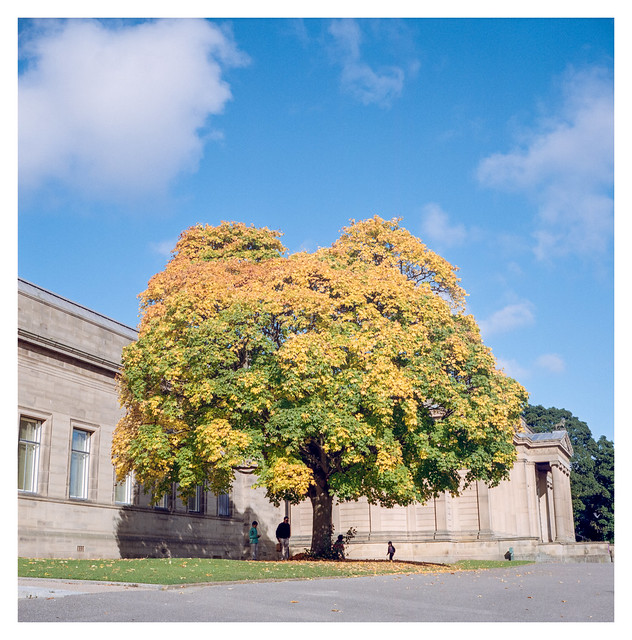
Anyway, the three photos today are all from the Lomgraphy 100 roll, shot with the Yashica, and all three made in Weston Park (with the museum visible in the first, the bandstand in the second, and the nearby Univesity Arts Tower in the third). Autum was underway, but the trees still held onto most of their leaves and a good amount of green at this point.
Yashica Mat 124G & Lomography Color Negative 100. Grain2Pixel conversion.
After something of a bleak half-a-year, I’m hoping that things are finally on the up and that, as a result, I might be able to breathe some life back into the blog. Fingers crossed!
The University Arts Tower in Sheffield is one of the city’s tallest buildings and is visible from far and wide thanks to its hillside position over the city.