A job-lot of pictures today, all from my solo visit to Ciutadella, and all linked by the fact that I took them while walking along the inlet that leads to the city’s marina area. I think I’ve got them in consecutive order, so you can follow the route I took vicariously.
Olympus 35 RC & Fuji Superia 100 (expired 2008). Lab developed. Home scanned and converted with Negative Lab Pro.
There were a few groups of people milling around the area when I went to take this picture. While it was impossible to avoid getting anyone in the shot at all (at least during the time I was willing to wait), I quite like the couple walking away from the shot in this case. They’re unobtrusive and nicely framed between the layers of the fountain.
A couple more shots of the flooded field at Elmton, although without any sign of the church this time.
Appropriately enough, the road that runs past the field is called Spring Lane. The spring itself is a little further up the road to the south east, but I’m not sure if it’s this which feeds the flooded area at the bottom of the field.
There’s something I find fascinating about water courses that takes me back to being a child where I would read Ladybird books or similar, and watch children’s educational programmes about the water cycle. There’s something in me that wants to trace the journey from source to destination. From that tiny bubbling spring all the way to the ocean.
I enjoyed making “boats” out of a twig or a branch and then watching as they navigated the straights, eddies, and rapids of a stream until they would eventually reach a place where I could follow them no longer, but from where I would imagine them making a grand voyage all the way to the sea.
The bottom corner of this field at Elmton floods in wet weather and makes for some interesting picture opportunities, including reflections of St. Peter’s Church.
I guess the shots also continue this week’s molehill theme. 🙂
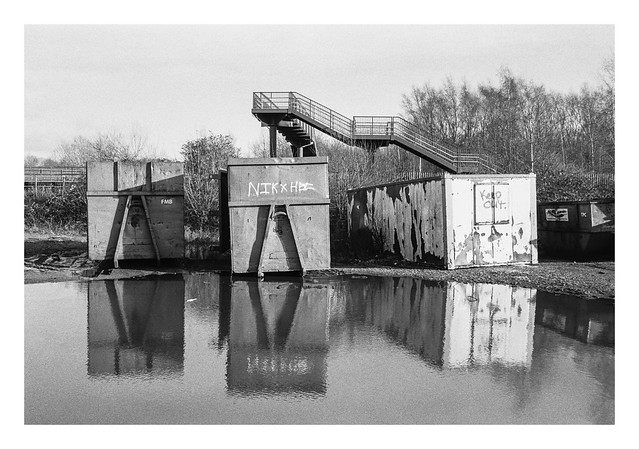
I’ve made a considerable number of shots of these skips recently. Some on this roll, and others on the following couple of rolls too. Part of this is down to lockdown restrictions reducing the number of places I can make pictures, but also because I think there are a number of interesting photos to be had in this location. There are maybe two or three dozen skips of varying sizes on an area of land outside a metal recovery firm and, after rain, large puddles form and create further compositional options. The skips are in a number of different colors and, as is the way with such objects, all have varying degrees of rust, dents, and other interesting patina. It’s an industrial “edgelands” type location that may not be to all tastes, but beauty and interest lies in the eye of the beholder.
Lunchtime walk in snow Approaching the nearby lake The sound of some geese
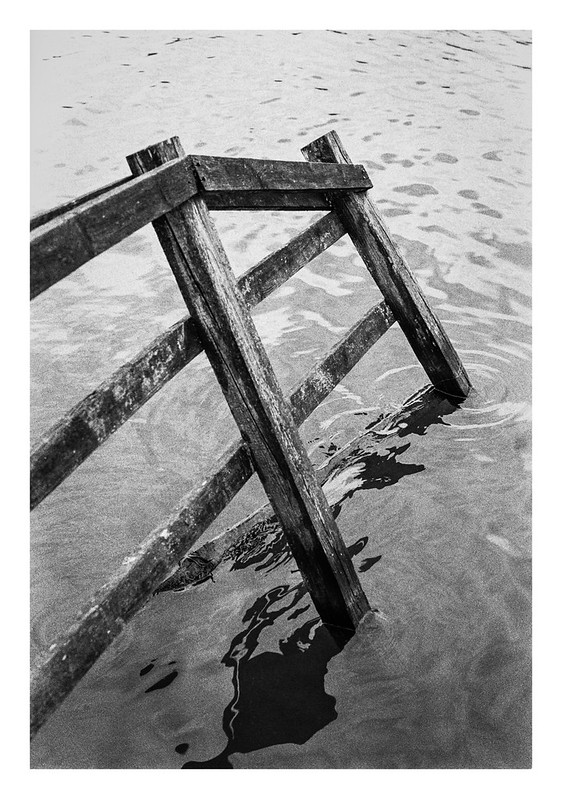
I’ve often wondered what the purpose is (if any) of this short section of fence that extends a few feet into the lake. There’s a gap on the shore (with the remains of a latch where a gate presumably once stood) so it serves no purpose in preventing passage. I guess it could be a holdover from before the lake was there (when it used to be a quarry) and was never removed when it was filled with water and the country park developed.
Whatever the case, it makes a nice subject for the occasional photograph.
A couple of days ago I posted a photo of the Spurn Lightship. Today’s image is a detail shot of that ship’s bow.
I really like the tones I’ve got in this picture, especially the milky quality of the water, but also the relief of the plates and rivets of the vessel’s hull too. Despite the film being pushed to 800asa the grain has remained relatively unobtrusive in the shot as well.
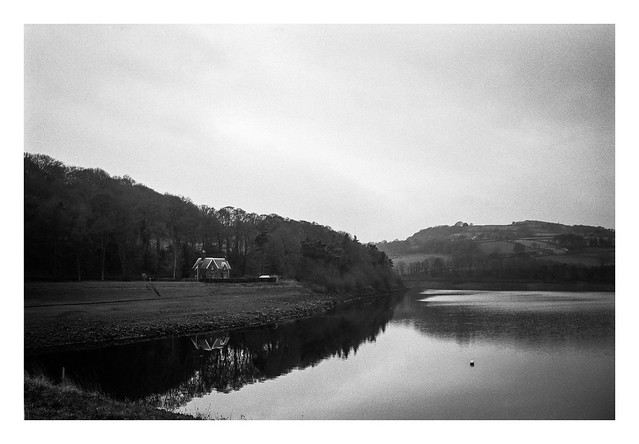
This is another photo dating back to early 2017 and depicts Damflask reservoir to the north-east of Sheffield. It is one of a series of reservoirs in the Loxley Valley and tributaries, the others being Agden, Dale Dyke, and Strines.
Dale Dyke is notorious for having catastrophically burst in 1864, shortly after construction, flooding the valleys downstream and the city of Sheffield, resulting in 244 deaths.
Damflask reservoir is named after the village of the same name that was washed away by the Dale Dyke tragedy.
This is one of those shots that turns out much better than you expected. I took a few shots of the reservoir and reflected trees, but the ones I thought would look best featured some ducks in the middle of the still water. I didn’t really think much about this one until the negatives came back, and it was the best of the bunch.