35mm · Film photography · Photography

A Walk With a Camera – Elton to Robin Hood’s Stride (part 1)

This is the third of these posts, and the second for which I selected a hike from my Ordnance Survey book: Peak District – Outstanding Circular Walks. I was going to be slightly OCD about the routes in this book and do them in order, but I then decided that would be silly and that I should do them in whatever order suited me. In this case, I skipped the second walk in the book because it was a location I’m quite familiar with, and this one is somewhere I’ve never visited before.

The route of this walk is in the Derbyshire countryside to the north of the village of Elton. It’s a short route of just over three miles, with an elevation of 750 feet. While the guide gives an approximate time of 2 hours to complete the walk, because I’m faffing around taking photographs, it took me somewhat longer.

Although Elton isn’t too far, much of the drive there is on smaller roads, so it took about an hour to get there and park up. The weather was a little overcast when I arrived, but with the promise of some brighter spells later. The starting point for the hike is outside the Duke of York pub, across from the village church.
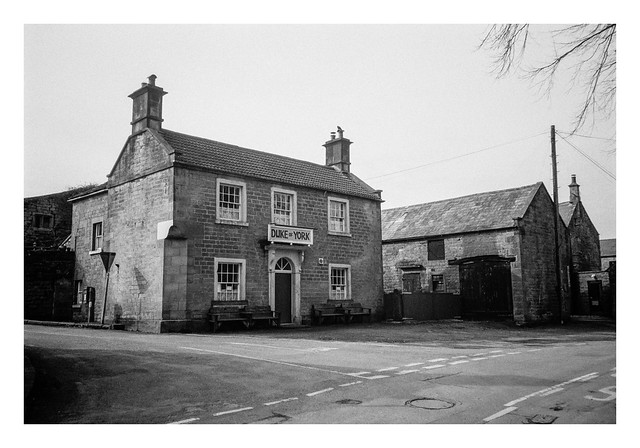
Duke of York

Not long after this, there was a slightly confusing branch of the path in a field that first had me wandering around some farm machinery before wandering off down the wrong fork. It was a little while later, after descending a hill and then crossing a large pool of muddy ground near the entrance to a field that I realised my error. Luckily, re-checking my map, I could see that the narrow road I was now on would curve around and intersect the original footpath, so I stayed on this course. This wasn’t a bad thing as, part way up a hill at a bend in the road, I came across a series of water troughs, fed by a spring.

Troughs

These troughs are called the Burycliffe Troughs and the spring that fills them has never been known to run dry. Until 1940, these were Elton’s main source of drinking water, and men, women, and children would walk here in all weathers to collect water in buckets and then carry them back up the hill to the village. One enterprising farmer would fill urns of water and transport them in a cart, selling them for a penny a bucketful.

A little further up the road I rejoined my original route and broke off into a field to the left. The path led through another field where this tree stood near the ridge of the hill.
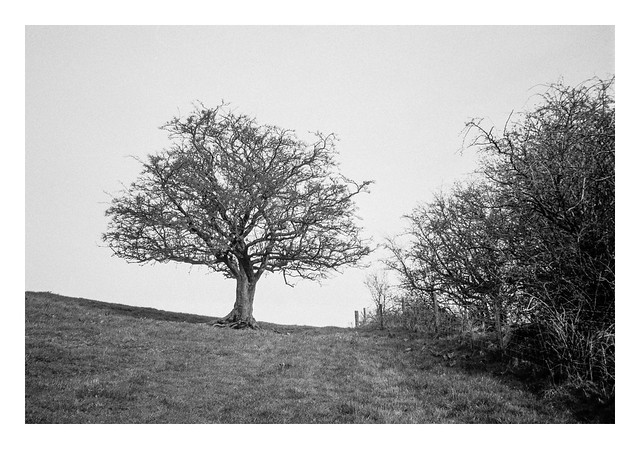
Lone tree

As the path descended, it reached another track, this one leading to a Christian sanctuary / retreat. On the other side of the track a lone piece of farm machinery stood on the grass.

Farm machinery

While crossing the next field I spotted a herd of animals off to my left. I soon realised that these were deer. I took a photograph but it should be noted that the Olympus XA3 is not a useful wildlife camera. You can see the deer in this picture though – they are the black pixels about a quarter of the way up the frame. 😀
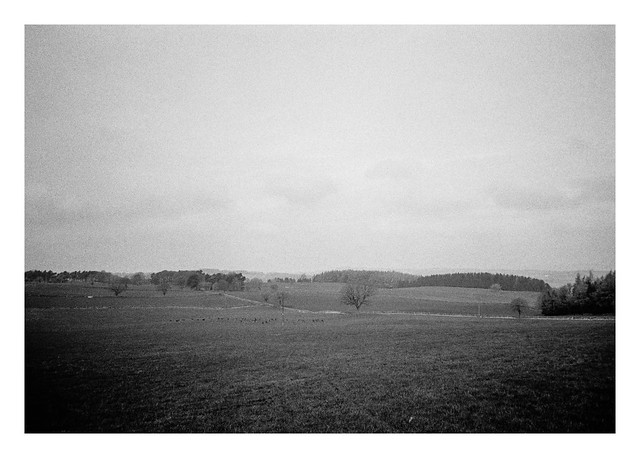
The XA3 is not a wildlife camera

One thing you find a lot of in the Peak District (and, to be fair, a lot of the British countryside) are drystone walls. This arrangement of walls with a lone tree looked like a decent photograph to take.
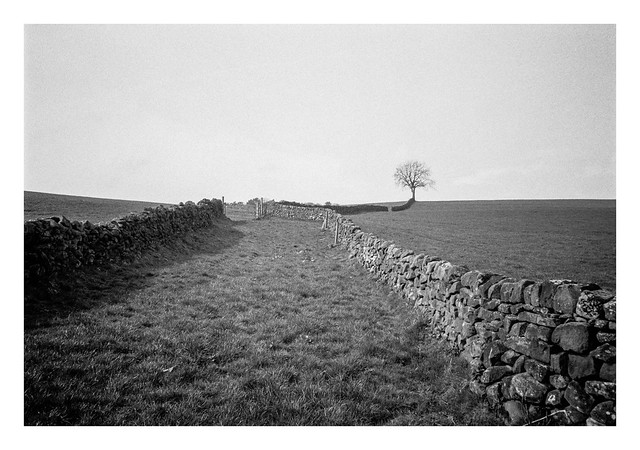
Drystone walls and a lone tree

In the opposite direction, a track led to a farm sitting atop the ridge of a hill.
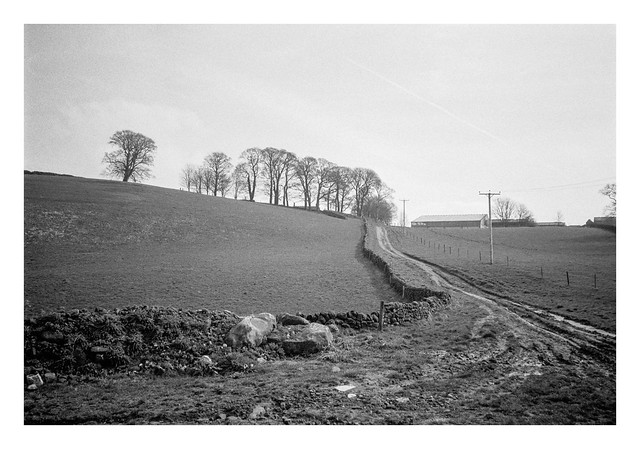
Farm track

A little further along the route, the path I needed to follow crossed a small stream before curving up and to the east through some woodland. There were signs of forestry activity here, and it marked a good place to park myself on a fallen log and take a drink of water. It also marks the place where I’ll leave the first part of this post. In part two there will be stone circles, rock outcrops, and a hermitage!

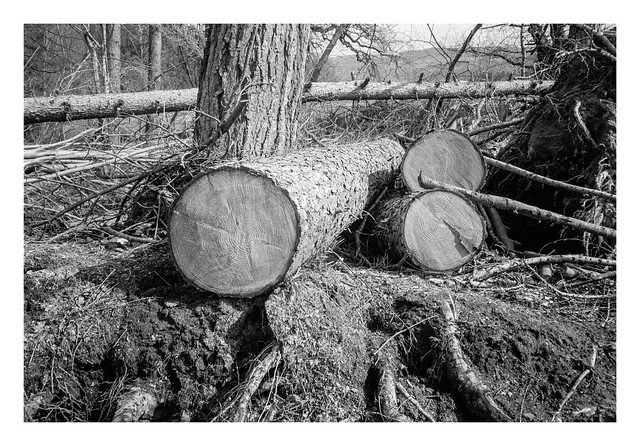
Deforested
Forrestry

Olympus XA3 & Ilford HP5+ (@800asa). Ilfotec DD-X 1+4 10mins @ 20°

Taken on 26 March 2024

35mm · Film photography · Photography

A Walk With a Camera – West Stockwith to Misterton (Part 1)

This is the second of my “Walk With a Camera” series, and a hike I plucked from the routes available on the excellent Ordnance Survey app. West Stockwith is a location I’ve had earmarked for a visit for a while, so finding a circular walking route on the app sealed the deal, and I set off on a pleasant Sunday in March to see what I might find.

The route is an easy one, being less than five miles in length and with an uphill elevation of only 85 feet.

West Stockwith is a village in Nottinghamshire which sits beside the River Trent. It’s sister, East Stockwith, sits on the opposite bank, although there is no easy way to travel between them. A ferry used to operate, but the service ceased in the 1950s. A journey south to Gainsborough, where the closest bridge stands, is the quickest route.

West Stockwith also marks the location where two other waterways join the Trent. The River Idle would form part of my route on the westbound leg of the walk, and the Chesterfield Canal would return me back east to where I started. These waterways once provided industry for the village, but traffic along them in modern times is leisure based.

As the River Trent is still tidal at this point, there are a number of barriers in place to allow water levels to be managed and to allow passage for boats. This entrance sluice is the final barrier before the River Idle enters the Trent.

Entrance sluice

After photographing the sluice gate, I set off along the footpath that follows the Idle to the west. The initial part of the footpath squeezes past a riverside property and is not immediately apparent. This Google Streetview image shows the entrance under the arch beside the blue door.

A little further upstream beyond the sluice is a pumping station which not only helps manage the water levels on the Idle, but also provides passage for river traffic. Indeed, the whole stretch of river between the pumping station and the sluice can act as a single large lock allowing multiple boats to traverse between the Trent and the rest of the Idle at the same time.

Pumping station
Pumping station-2

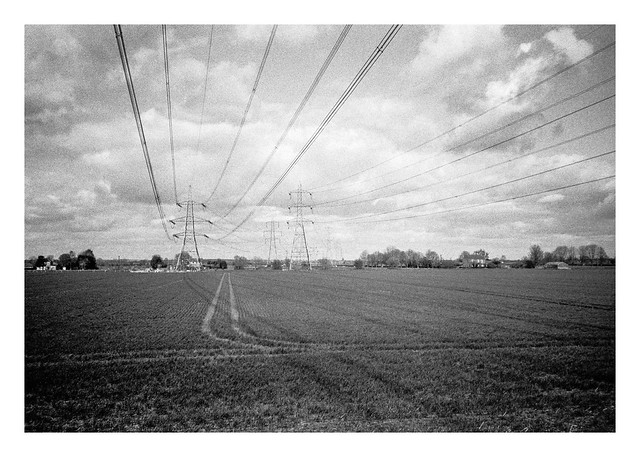
Past the pumping station, the footpath follows the river from atop an earthen flood bank, the river to the south and open fields to the north. A series of powerlines cross these fields, running from West Burton and Cottam Power stations to the south (although both are now scheduled for demolition, at least in part).

Pylon field

Before too long the sight of two large chimneys comes into view on the far bank of the river.

Pump house

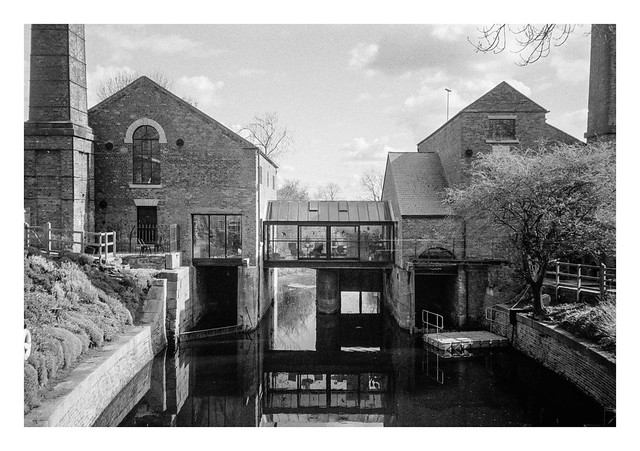
A short while later, there is a bridge across the river which then took me back east a short distance before I turned south along a lane that passes the building with the chimneys. Once a pump house, this is now a posh-looking residence named the Pump House Art Studio that is available to rent for short stays. The water flowing beneath the structure is not the River Idle, but a man-made channel named the Mother Drain.

Pump house-2
Pump house-3
Pump house-4

The lane heads southwards through a couple of 90-degree bends, dips under a railway bridge, before entering the eastern side of the village of Misterton. After passing an interesting looking residential home, the route of the walk heads further into Misterton before turning off the roads and back into some fields to the north of the village. The path skirts the village for a while before re-entering it at it’s north eastern side and onto a pleasant looking road.

A road in Misterton

Walking south down this road brought me to a junction with a saddlery on one of the corners. I don’t see many saddleries in the city where I live, so it was worth a photograph, especially with the horses head stuck on the front of the building. Being a Sunday afternoon, the place was closed, but I can imagine there being an interesting display behind the shuttered window.

Saddlery

Across the road from the saddlery is the village church, which is where I’ll continue in part 2…

Olympus XA3 & Ilford HP5+ (@800asa). Ilfotec DD-X 1+4 10mins @ 20°

Taken on 24 March 2024