35mm · Film photography · Photography

Anticipation is a good thing?

As of today I have seven rolls of film waiting to be scanned. All 35mm rolls, all 36 exposures except for a single bulk-rolled short roll that just has 15 shots. So somewhere in the region of 230 pictures yet to scan.

I addition I also have three rolls that have been scanned, but not yet post-processed. Again, all 35mm, but this time two 36 exposure rolls and another short roll, which bumps the total up to around 320 images in total.

I have another 36 exposure roll in one of my cameras with perhaps two or three frames remaining, so when that is finished and developed I’m at nearly 360 photographs.

Usually my dev>scan>process workflow is much quicker, but I’ve been holding back recently, in part because I’ve had a bunch of already processed shots to upload and so wasn’t in a rush, but also because of something I saw in a YouTube video I watched a while back from Sean Tucker. The video is all about how to choose your best images and in part refers back to one of his earlier videos where he interviewed landscape photographer Rachel Talibart who explains her approach to reviewing her images.

She says that, often, after a day of photography, she returns home on a high about the pictures she’s taken and can still be tripping about the experience for some time afterwards. This mood, she says, is not the best for objectively assessing the photographs she’s taken. Because she’s still tripping on the experience, the photos will often be a disappointment and no match for the fresh memories of the experience. She also finds it very difficult to edit the photographs while still on the high.

Looking at the photos straight away distorts her appreciation of the images. She’s often looking for something very specific and can discount the images that don’t meet this preconception. As a result she can miss good pictures. However, if she looks at them later – six months, a year, two years, the good images she might have overlooked initially present themselves much more readily to her now more objective eye.

I’ve recently been looking back through older, mostly digital, images and found this to be the case, finding pictures that I did nothing with that are actually, to me at least, quite good and more than worth revisiting.

So, while I have a glut of film pictures, I’m trying to take a similar approach and waiting to scan and process them. I still have an idea what is on most of the rolls I’ve shot, but many of the individual frames have faded from memory so when I come to scan them they will appear fresh to my eye and, hopefully, I’ll be able to objectively assess them and see which are good.

This obviously comes down to my own subjectivity in terms of what I do and don’t like, but I’m looking forward to see how this technique works. At the very least, the anticipation I feel is making me very much look forward to revisiting the scenes I felt worthy of a picture back when I photographed them.

Ironically, some of the photos I have been uploading recently are more recent ones that have jumped the queue, including this slightly apt picture…

Almost quarter past one

Nikon F80 & Nikkor 24-120mm f/4 ED VR on Fujifilm Acros II. Ilfotec DD-X 1+4 9mins @ 20°

Taken 15 August 2026.

35mm · Film photography · Photography

Well, why not… Photographing the same scene over and over

I often put my car in a car-park beside Victoria Quays when I go for a walk around town. It’s slightly inconvenient for the town centre, being further away from the shops etc., but has the considerable benefit of being much cheaper than the car-parks that are more central.

One of the exits from the car-park takes you right to the canal-basin and remaining wharf buildings (now all home to modern offices and other businesses) and there is always a fleet of canal boats moored there, many of which make for nice pictures. Likewise, the straddle wharf and other warehouses are also nicely photogenic. As a result I’ve taken many pictures at this location, often of the same subjects (especially the aforementioned straddle wharf).

Two canal boats

It’s not the only location that receives this regular photographic attention. The Kelham Island area of Sheffield has featured on the blog on numerous occasions, and constant readers will know that I take a trip to my favourite seaside town, Mablethorpe, every autumn.

Rosie

While I enjoy visiting and photographing these places, I do tend to notice that I photograph the same things over and over again, even though there are undoubtedly countless other subjects and compositions to be had. I wonder if people see these pictures and think, “Oh, it’s that thing again…”?

But conditions can change and shine a whole new light (both figuratively and literally) on these subjects. Different times of day, different weather, different seasons, all can make for new ways of seeing things, I feel, and so I’ll no doubt be here with yet more pictures of the Straddle Wharf, the Mablethorpe Rock shop, and the chimney-stack at Kelham Island heritage museum.

At the wharf

Olympus OM-10, Zuiko Auto-S 35mm f/2.8 & Kodak Gold. Lab developed. Home scanned and converted with Negative Lab Pro.

Taken on 3 May 2025

35mm · Film photography · Photography

Wharf buildings

The canal basin at Victoria Quays is another place I’ve photographed on multiple occasions. This is because 1) There are many interesting subjects to photograph, and 2) It’s right beside a car park with cheap rates that I often use if I’m exploring this part of town.

There are probably other pictures of these buildings on my blog already, but these are two new(ish) ones, which turned out nicely.

Grain warehouse
Wharf

Yashica Mat 124G & Kodak Tri-X. Ilfotec DD-X 1+4 for 8 minutes @ 20°

Taken on 2 February 2025

4x5 Large Format · Film photography · Photography

Victoria Quays

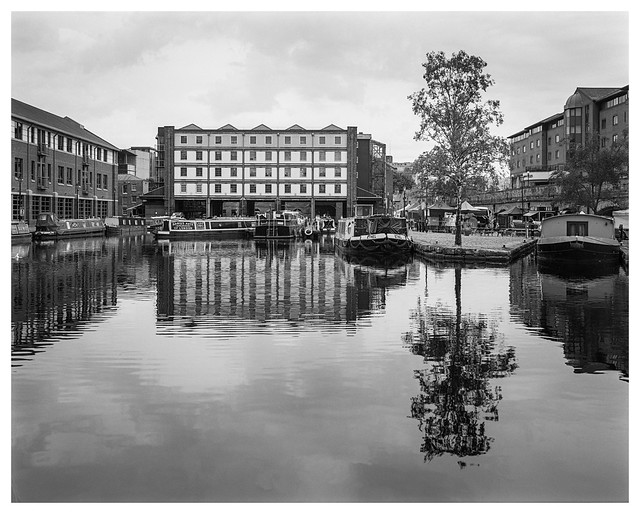
I’ve photographed the straddle wharf at Victoria Quays on many occasions, but this is the first on 4×5 large format.

I still need to learn more patience with the format as, although this is a picture I’m happy with, there’s still a little softness in the upper part of the image where the front-standard must have had a slight bit of tilt in play. It only affects the roofs of the buildings and the upper branches of the tree, and everything through the middle of the scene is sharp from edge to edge. It would have been preferable had the tilt been reversed and the softeness had affected the water, where it would have had little noticeable effect. The soft focus is only really noticeable at magnification and I doubt you can see it in the smaller res version published here.

I didn’t rush this picture (I have one that I did to show in the next day or so though, so don’t worry, you’re not missing out!), but I also didn’t spend enough time fine tuning the focus. I think I might consider buying a more powerful loupe – the 4x magnification model I have is very good, but perhaps a 6x would better ensure I don’t miss the detail?

Victoria Quays

Chamonix 045N-1. Fujinon NW 135mm f/5.6 & Ilford HP5+. Ilfotec DD-X 1+9 15mins 45secs @ 20°

Taken 8 July 2023.

35mm · Film photography · Photography

Narrowboats

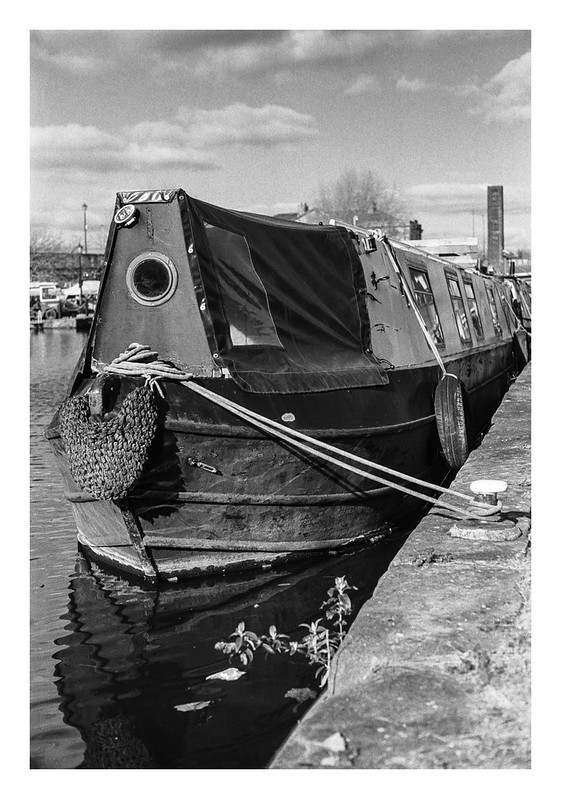
Time seems to have gotten away from me today and I don’t have time to write much. Still, the fires of the blog need to be fed and the fuel today will be these two photographs of canal narrowboats. A lot of the narrowboats at Victoria Quays seem to be permananent fixtures that I’ve never seen move – basically floating homes – and I’m sure that I’ve photographed many of them on more than one occasion.

These two shots came out quite nicely though, I think.

Porthole
Narrowboat mooring

Olympus OM-2n, Zuiko Auto-S 50mm f/1.8 & Ilford HP5+. Ilfotec DD-X 1+4 9mins 20° .

Taken on 6 March 2022