Empress Elisabeth of Austria, also know by her nickname Sisi (or Sissi – it seems to be spelt both ways) was Empress of Austria and, then, Queen of Hungary from her marriage to Franz Joseph I on 24 April 1854 until her assassination in 1898.
So why is there a statue of her outside a casino hotel in Funchal? Well, it’s because she visited twice, first in 1860 to 1861 to seek a reprieve from respiratory illness. The villa in which she stayed was eventually demolished, and the casino stands on the same site.
She visited again in 1893-94, but this time stayed at Reid’s Palace Hotel (which still exists and was just down the road from the hotel in which we stayed).
People leave flowers in the hands of the statue in remebrance.
Olympus Trip 35 & Fujifilm Across II. Ilfotec DD-X 1+4 9mins @ 20°
This was taken in the beautiful Monte Palace gardens on the mountainside above Funchal. There will be more pictures to come from this location which I shot with my trusty Olympus Trip 35, but I’m currently wrestling with a daunting backlog of images, so it might be a while…
Standing beside the river Trent on its east bank, this statue is named The Pilgrim Woman.
On 10 May 1608, a group of Separatists, mostly women and children, escaped Gainsborough to find religious freedom. They left town along the River Trent on a small barge called The Francis, heading for Stallingborough near Immingham. Their plan was to meet a bigger ship there that would take them to Amsterdam in Holland where they would be able to worship freely. A few years later in 1620, they traveled on to America aboard the Mayflower.
Although not visible in my picture, the plinth upon which the statue stands is engraved: “Steering our Future Informed by Our Past“.
Bronica ETRSi, Zenzanon 150mm f/3.5 MC / Zenzanon 150mm f/3.5 MC & Lomography Color Negative 800. Lab developed, home scanned & converted with Negative Lab Pro. Converted to B&W in Lightroom.
Religion isn’t really my thing but I do enjoy photographing religious artifacts and buildings – I probably fall under the umbrella of being a “cultural Christian” in that regard – although I find other religions artifacts equally interesting.
In the UK we have a wealth of churches dating back centuries, chock full of amazing architecture, artworks, stained glass windows and so forth. Even the more modern buildings, such as the brutalist architecture churches built in the post-war years, are interesting – sometimes even more so.
Most of the time any photographs I make of churches are of the exteriors. This is usually because many churches are not freely accessible, either to prevent theft or vandalism (sad, I know), or, in the case of grand cathedrals, require admission fees to wander around inside.
Sometimes though, particularly in villages out in the country, churches are still open and it’s possible to enter, enjoy their interiors, and make photographs. I took a few pictures inside a church at Tickhill last weekend that was open when I wandered past by chance. The picture of Mary and Jesus below is at Lincoln cathedral, but is outside, so I could make a picture without having to go inside.
I don’t mind paying an entrance fee if I know that there is likely to be something of interest to see and, importantly, I know I have sufficient time to wander at my leisure. I didn’t have the latter during this trip to Lincoln, unfortunately.
On another note, this weekend saw the 2025 Sheffield Steam Rally, so I went along today – as I do most years – and returned with a crop of exposed film (mostly medium format), so there will be traction engines to come at some point…
Yashica Mat 124G & Lomography Color Negative 400. Lab developed. Home scanned and converted using Negative Lab Pro.
Back in September I decided to visit the town of King’s Lynn, in Norfolk. I did this for no other reason than I had never visited the place before and that I thought it might be an interesting place to take some photographs. It was, and I’ll be posting some of the results over the next week or so.
I didn’t get the best weather on the day – it being largely overcast through the morning – although it did brighten up in the afternoon, so the light was a little low for the first part of the day. This didn’t really harm the Tri-X I had loaded, although I was effectively shooting it at 200asa because I had a yellow filter fitted to the camera, but I did wonder how the roll of Delta 100 in the other camera I took would fare. More on that in another post though.
This roll of Tri-X was also the first I’ve ever developed using Rodinal. I’d previously shied away from using this developer with faster films, having heard tales of “golfball”-size grain but, having read some posts by Andy on his S.H.O.U.T photography blog about his experiences with Rodinal, I decided to see how I would get on.
I think the results are, on the whole, pretty good. There’s more grain that I would have seen had I developed it in my usual Ilfotec DDX, but nothing outrageous, and the tonality of the negatives is good.
I’m not sure I would rush to develop 135 Tri-X in Rodinal, but I’m not averse to using it for Tri-X (or perhaps HP5+) again in future. It’s certainly a more cost effective option.
Anyway, the photo today is of a statue of King’s Lynn born George Vancouver (22 June 1757 – 10 May 1798) a British Royal Navy officer best known for his exploration of the American north-west coast. The city of Vancouver, Vancouver Island, and Mount Vancouver are all named after the man, as is another Mount Vancouver in New Zealand! He also named a number of other locations after his friends, colleagus and fellow officers, including Mount St. Helens, Puget Sound, and Mount Rainier.
That’s the top of the custom’s house behind his head, and not some sort of fancy hat he’s wearing.
I liked the juxtaposition between the foreground statue and the background building in this scene. The figure looks defiant, as though holding back the looming structure in some way. The low angle makes him look larger than he might otherwise appear.
Brick by brick, stone by stone, build him till he’s fully grown. Fetch more water, fetch more sand, biggest person in the land. Empire State Human – The Human League
Today’s picture is of Conisbrough Castle with a war memorial in the foreground. I’ve had to tidy the image up somewhat as it had some noticable scratching (as did most of the roll of film) caused by the squeegee. I think I’ve managed to successfully remove most of the marks on this frame, although some of the other shots are something of a lost cause. I shan’t be using the squeegee again I don’t think.
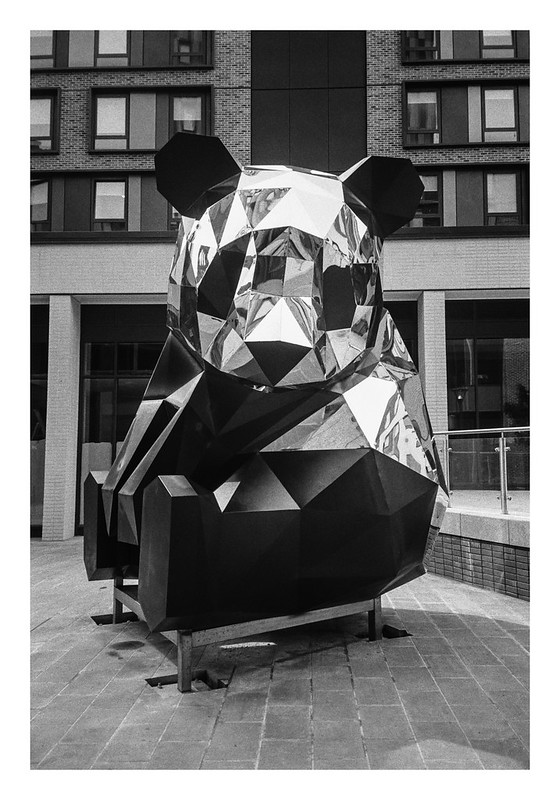
New Era Square is a recently completed development to the south of the city centre, just the other side of the ring-road that circles the middle of town. It consists of three building surrounding a pedestrian plaza and has been dubbed in the local press as “Sheffield’s Chinatown”, and “Sheffield’s very own version of New York’s Times Square” apparently, although the latter would seem a little on the ambitious side.
One of the features of the development is a family of three eye-catching panda statues. A public campaign sought names for each of the trio from the readers of the local paper, The Star. The final names chosen were Little Mester, who sits on a bench – named in reference to the small cutlery workshops which used to be numerous in the city; Coe Coe, a small panda climbing one of the building columns – named after Sebastian Coe, the Olympic athlete who lived in Sheffield as a boy; and Hendo, the largest of the three pandas which was mounted on the roof of one of the buildings for a while, but who now sits in the plaza, and is named after Sheffield’s much-loved local delicacy, Henderson’s Relish (or Hendo’s as it is generally known).
I don’t have a close-up photo of Coe Coe, but he can be spotted in one of the images featuring Hendo and Little Mester if you look carefully.
Not Winnie the Pooh Nor Baloo. But pandas are A type of bear too
Today was my annual trip to the seaside town of Mablethorpe. I wasn’t sure I’d get there this year what with the pandemic, but managed to sneak in a visit before the Covid cases rise to the extent we can’t travel again (although I hope that doesn’t happen!).
I don’t want to say much about it today because I only got home about half-an-hour ago; I’m very tired from the walking and driving; and I want a shower! Assuming no disasters, there will be photos from the trip in upcoming blogs.
Anyway, here’s a random image of a statue, a sign pointing to a church (I didn’t photograph this one!), some houses, and a bloke looking at me and probably wondering what I’m doing…
Is he looking at me, or just in my general direction?