I had three or four un-shot frames of film following my the trip to Hull and I wanted to shoot them so I could get the roll of film developed. Four frames isn’t really worth a specific trip, so I decided to shoot them one morning after dropping my son off at work.
I thought the signal box at Kiveton station would be a decent subject as it’s not that far from where I was, even though I’ve photographed it before. Then, because I didn’t want to end up driving for miles, I took some shots of the M1 motorway. All three have turned out ok, although how interesting you find the motorway pictures I’ll leave to you.
I also shot a single frame of colour film on another subject, but I’ll post that another time.
Nikon F80 & Tamron 28-300mm F/3.5-6.3 Di VC PZD on Kodak Tri-X. Ilfotec DD-X 1+4 @ 20° 9mins.
This former Great Northern Railway (GNR) signal box has been around for quite some time. It was built in 1873 and is the second oldest GNR signal box still standing and is now a Grade II listed building.
Apparently the signal box designs used by GNR were relatively unstandardised and almost every one built in the 1870s is different in some way.
Yashica Mat 124G & Lomography Color Negative 400. Lab developed. Home scanned and converted using Negative Lab Pro.
The spiky looking bridge in the first picture below provides an alternate route across the railway tracks in Lincoln when the level crossing barriers are closed. It crosses the same road where yesterday’s blog photograph was taken. The bridge was nicely backlit and I noticed some lovely silhouettes of pedestrians crossing. Unfortunately, when I got in a position to take the picture they’d all left or were walking at the far side of the bridge where they couldn’t really be seen. After waiting 15 minutes to see if the scene would replicate itself, I eventually left to find other pictures to take. I did take the shot of the signal box before I left the scene though (another picture of the signal box may make an appearance in a future post…).
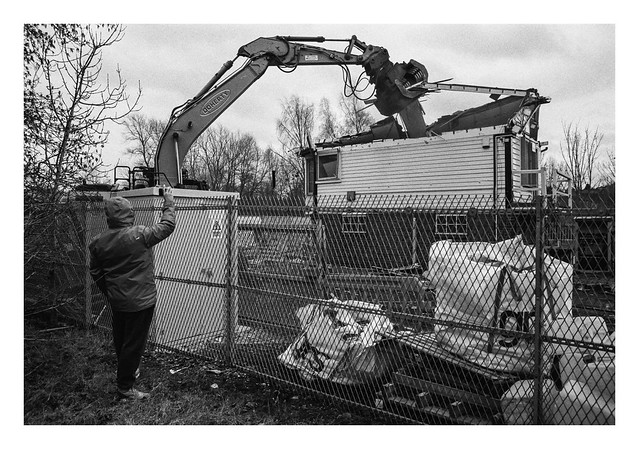
I detailed the events on the day the signal box at Beighton Station was demolished in this post here: The end of an era. At that point I’d not developed the roll of film that I shot when recording the event. So, today, here are the pictures from the weekend of the demolition, plus a photo made a week or so later showing how it now looks.
On the day before the demolition took place, fencing was erected around the area and the road had been closed to all but foot traffic and bicycles.
There were a considerable number of contractors around, all in bright orange hi-vis clothing. Some from Network Rail, but also from a number of other companies involved in the work.
The following day, Sunday 15 March, the mesh fencing had been replaced by something more sturdy. As the work took several days to complete, these small cubicles were placed at either side of the tracks, presumably as shelter for overnight workers or security guards.
A truck delivers the large metal skip into which the remains of the signal box would be loaded.
Still intact, but only for a few seconds longer…
Spectators and workers gather to see the event unfold.
The demolition begins.
Some people moved down the side of the signal box to get a better view.
The roof has gone completely.
The claw does its work.
The upper section has almost gone now.
Still sheathed in plastic, the new warning signs await their work to begin.
The upper part of the signal box has now gone completely. Work continued to remove the brick lower section and remove the frame from the building, but I didn’t stay to photograph that.
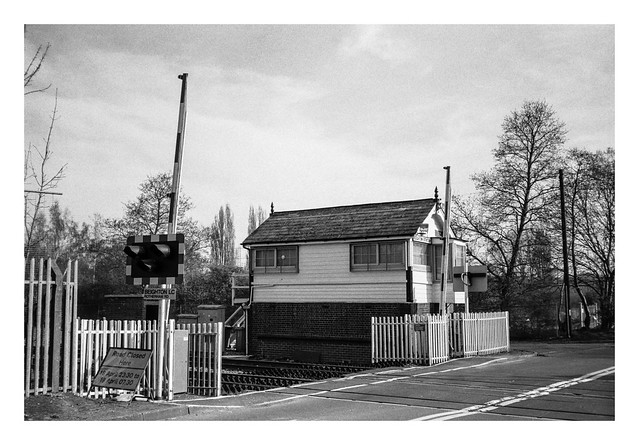
And here’s how it looks now that work has been concluded. No signal box any more. There is apparently a radar-controlled system now in place to detect anyone on the crossing. The barriers cannot lower until it is clear.
Today marked the end of the road (or should that be rails?) for the Beighton Station signal box. It’s demolition has been planned for some months now and, despite campaigns to save it, it was demolished this morning.
My wife and I walked down yesterday afternoon so I could make a few photos while it was still intact, although surrounded by wire fencing. A conversation with one of the contractors on site revealed that the demolition was planned for today at 8am. So, my alarm set for seven, I rose this morning, fed the cat, and drove down to see the event take place.
I needn’t have gotten out of bed so early as not much was happening. There were a lot of contractors on site – a dozen or more at least, and the method of the box’s destruction – a large CAT excavator with a claw attachment – could be seen parked a little way down the railway tracks. The tracks have been closed to rail traffic for the duration of the activity, and the level crossing is only open to foot traffic. As well as the workmen, there were a few locals there to witness the demolition, at least two of whom I discovered had worked in the signal box in the past. There was a bit of excitement when a large metal skip was delivered to take the remains away, but still nothing much was taking place. The box still had the Beighton Station sign affixed which needed to be removed as it has apparently been promised to the local lifestyle centre as a souvenir.
It was quite cold at the location, especially while standing still, so I decided to take advantage of the slow progress and pop back home to grab a quck breakfast before returning. This is where things went off-plan…
Getting back to the car, I turned the key in the ingnition and… nothing. Despite the car having started perfectly an hour or so before, the battery was now almost completely dead. The radio would come on, but the engine wouldn’t turn over at all. My choices were not to either go back to the demolition and sort the car out afterwards, or call the breakdown service to get it back on the road again. As today was Mother’s Day here in the UK and we were planning to go out for something to eat at luchtime – don’t get excited, the lockdown restrictions meant that the day would be celebrated by my wife, our sons, and I treating ourselves to a drive-thru burger while sat in the car. These plans meant that I needed to get the car sorted out as soon as possible. The breakdown company stated that it would be 2-3 hours and that I would get a call twenty minutes before the recovery vehicle arrived. My plans of seeing the demolition of the signal box slipping away, I decided to walk home, get some breakfast and wait for the call.
The walk home took about 10-15 mins and then, liteally a minute after getting there, I received a text saying the breakdown recovery vehicle would be with me in 10 minutes! Not having time to get any breakfast, and thankful that we have two cars, I asked my wife to drive me back down to where the other car was parked. The recovery vehicle arrived at exactly the same time we did, and I crossed the road to speak to the driver. After popping the bonnet, he ran some tests on the car battery which revealed itself to have a faulty cell, necessitating a replacement. The options were to get one fitted there and then, or to be towed to a garage or branch of Halfords to get the work done. Given the paucity of time available to me I decided to let the recovery service replace and fit a new battery as this would get me back on the road straight away.
Soon I was back home and munching a hasty breakfast of granola before heading back to the signal box to see if work had begun (or, knowing my luck, that I had missed the whole thing). When I got there I was pretty much right on time though. While I’d missed the removal of the Beighton Station sign – which I’d hoped to record with a photo – the excavator was only just about to start its work.
I spent the next half-hour making photos of the gradual demolition. There were more people around by this time, many of them making photos or recording video, and I made a couple of dozen images of the scene until the building was down to its lower brick section. My time running short, and the roll of film at an end, I decided to head back home.
I have a busy week ahead, so doubt I’ll get to develop the film until next weekend, but I’ll be sure to post a series of pictures depicting the day’s events once I have the negatives scanned. In the meantime, here’s a picture of the box I made back in November 2016.
Beighton Station box A witness to many years I bid you farewell
Olympus 35RC & Dixons branded 200asa film (expired June 2004). Grain2Pixel conversion.
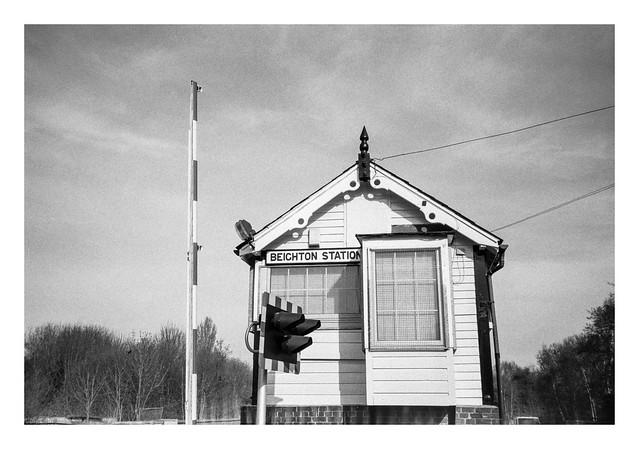
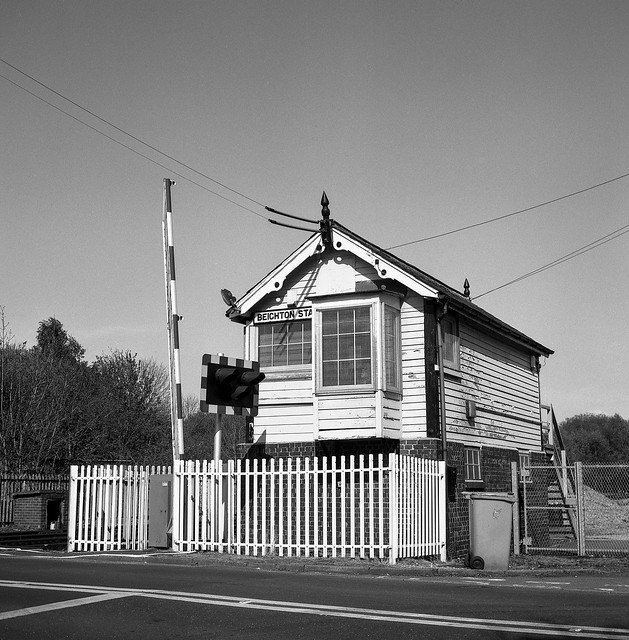
This is the signal box at Beighton Station, not far from where I live. Although it’s named Beighton Station, no station has been present since the 1950s when passenger services ceased. There have been recent rumblings about building a new terminal suitable for tram-train services however.
The signal-box is currently scheduled for demolition in 2021, much to the displeasure of locals who see it as a landmark, and there are campaigns looking to try and save it.
More photos of the signal box can be found in my blog posts here, here, here, and here.
Four photographs today that I made at Shireoaks railway station a few weeks ago. My wife popped into a nearby shop, so I decided to finish my roll of HP5+ at the nearby empty station.
It was a hot afternoon and the wrong time to be making photographs. The wrong time if you base everything you do on “rules” that is. It’s generally accepeted that midday is not the best time to make photos. This time of day, particularly in mid-summer, means the sun will be high overhead casting harsh illumination onto scenes. The light will be very bright, with harsh highlights and shadows. But is this always necessarily a bad thing?
It’s all very well seeking out golden hour, when the light can be undoubtedly beautiful, and I’m a great lover of low sunshine and the warm light and long shadows it provides, but sometimes it isn’t possible or desireable to catch these conditions. And what if you want a photograph to depict bright midday conditions?
While these photos are of a mundane scene – a small, modernised, rural railway station devoid of travellers – they record the time I was there perfectly. Maybe there will be better images to be had in different light or circumstances, but these provide a visual record of my memories of the time. and looking of them I can feel the heat of the platform, the smell of warm concrete, the whole sense of a hot day. I’m glad they were taken in the “wrong” light.
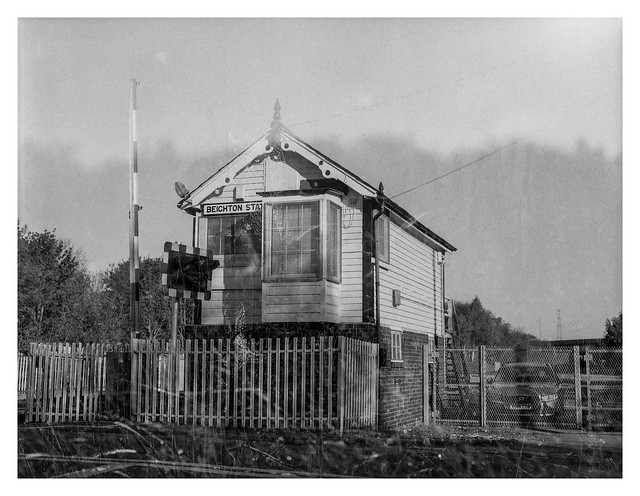
A few weeks back I wrote a post about how I’d messed up with my Bronica and made an accidental multiple-exposure (it really doesn’t feel that long ago – I could have sworn I wrote the post a week back at most!). Anyway, the gist of it was that I’d accidentally switched the multiple-exposure lever on instead of the mirror lock-up when taking a long exposure. This resulted in me unknowingly making several exposures on the same frame of HP5+.
I had low hopes for the result and expected it to be a complete write-off. However, it isn’t… Surprisingly, the photograph has turned out interesting (in an obviously imperfect way).
The main subject is the signal box in the village that I’ve photographed on a number of occasions before. However, the other shots have resulted it being overlaid with foliage and cobwebs. It now looks oddly reminiscent (to me, at least) of something you’d find in Stephen King’s story, The Mist, where a secret government experiment opens up a rift to another dimension. From it flows a mysterious mist and within it are…things.
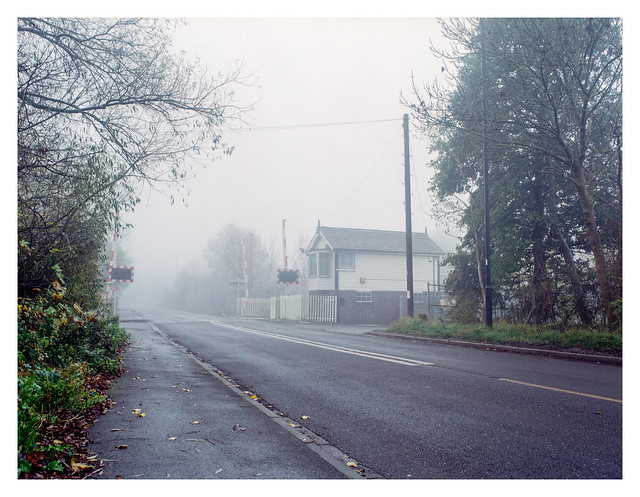
When your movements are limited, as they are during the coronavirus lock-down, you find yourself passing the same places more often than you usually would.
While there are undoubtedly plenty of alternative routes I can take while out exercising, even giving the restricted radius I can stay within on foot, I’ve found myself passing the signal box and level crossing at Beighton Station a number of times in the past week or two. It was only a little over a month ago that I last posted a photograph of the same location in fact.
Perhaps this weekend, when I’ll hopefully have a little more time to spare, I might allow myself a longer walk and venture someplace different for a change.
Today marked the first time that I’ve loaded a roll of 120 film into my developing tank. Mt previous experience consists only of the tow 35mm rolls I’ve loaded and developed (and a few tests with a sacrificial 35mm roll). While both of those produced successful outcomes (today’s photos amongst them), loading the film onto the spirals was not straightforward, with both rolls requiring several attempts in the changing bag.
With that in mind, I was expecting the roll of 120 HP5+ to be a bit of a headache given its broader width and potential to flex more, but I needn’t have worried. It loaded easily and the whole task took me about 5 minutes from putting my hands in the bag. Of course I’ve yet to develop the film, so I maybe shouldn’t count my chickens just yet, but all being well, I’m pretty happy with how it went.
I’ve also changed the blog theme today. I think the new one has slightly larger images as standard, which is good. I’ll see how it goes though, and I might change it back if I decide I’m not keen.
I’m still loving the Yashica Mat 124 G and, as I had a brief window of time before attending an appointment I’d taken the day off work for on Wednesday, I decided to go out. I only had around 90 minutes to spare, so didn’t venture far, but there’s a variety of footpaths and tracks in the area that would offer some opportunities for photographs, plus the weather was nice and bright which might make for some contrasty shadows even though the sun was riding fairly high by this time of the morning.
I decided to waste no time by walking to the area I planned on visiting and instead drove the car the mile or so to where I planned to start my walk. I parked up in a small lay-by close to the railway crossing – my first intended subject being the signal-box that stands beside the crossing. As I got there I though my luck was in as the alarm began to ring and the barriers descended indicating a train would shortly pass. I got my shot set up to feature the signal box at the right of the frame and the yet-to-arrive train on the left. Focus was nailed; composition was set; All I needed was the train to arrive. I waited. And waited. I noticed some curious looks from a lady in a car waiting at the crossing as she looked at the bloke staring into the top of the old-fashioned-looking camera. I waited some more and then, suddenly… the barriers raised. Bah! No train. It had not been my intention to shoot a passing train, but it would’ve been a nice addition to the picture had it arrived. Still, at least I got my shot (well, two of them actually) of the signal box.
I then walked up the small road that runs parallel to the railway tracks. This leads to a scrapyard, although it’s not really a scrapyard in the traditional sense of it being a load of old junked cars anymore. It used to be, and I remember hunting for and finding a replacement wing-mirror for my first car at the very same place about twenty-five years previously, but these days it’s more of a recycled metals place and I don’t think there are any junked cars there any more. A pity, as they would make for interesting photo opportunities. Still, I took my next shot on the lane – there was a distant electricity pylon rising between a couple of trees where the road curved up ahead, and that made for frame #3.
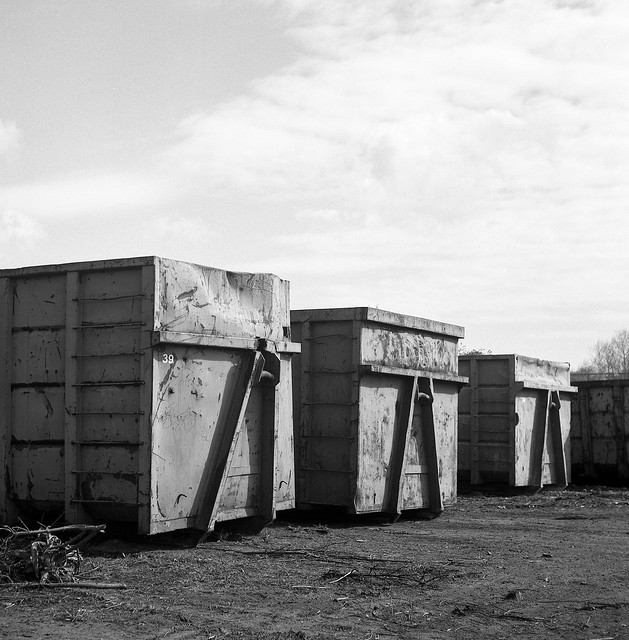
I’d intended the next shot to be of a footbridge spanning the railway lines, but there were a bunch of parked cars and vans next to the bridge that I felt spoiled the shot, so I instead turned my attention to the rows of waste-metal skips that are lined up outside the yard. I presume that these are dropped off from recycling depots and then returned later but, whatever the case, there a quite a number of them. I noticed three of the same design all in a row with some nice bright light on them, so that was shot #4.
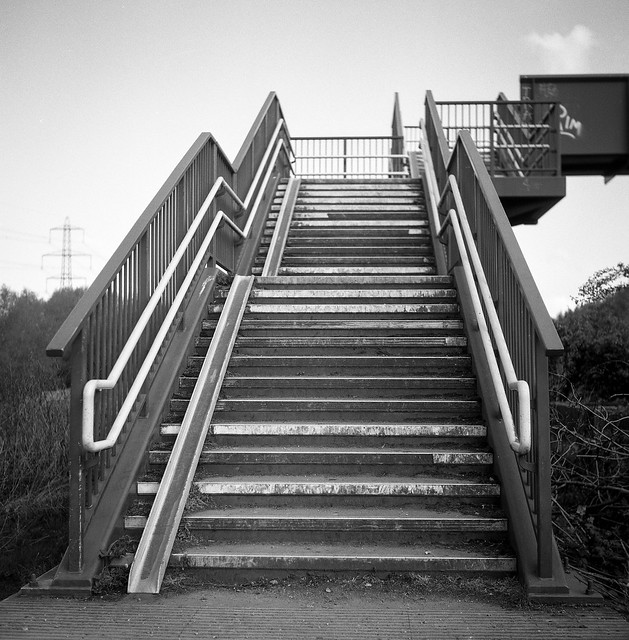
Shot #5 was of another footbridge, this one spanning a second set of railway lines (the two set join a little farther up the valley) and I attempted to get a shallow depth of field shot focussed on the foot of the steps. Alas, even with a roll of Ilford FP4+ in the camera, the light was too bright to drop below f/8 at the camera’s maximum shutter speed of 1/500 sec. The shot’s still quite nice (in an industrial style) though.
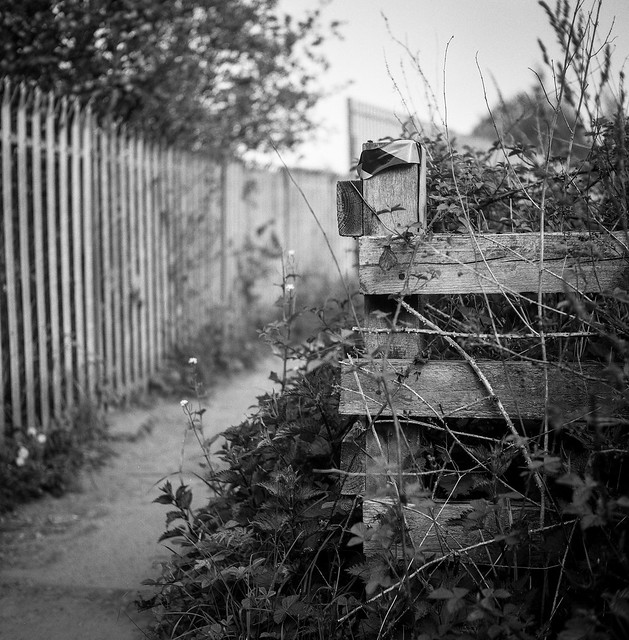
At the other side of the bridge, the path forks. Straight ahead takes you to the country park, to the left the path crosses the Rother via a narrow passage on the stone railway bridge. At the edge of the bridge I noticed a fence overgrown with brambles and nettles and decided to make it #6. The #7 was a wide aperture shot of the near-side of the path across the bridge and #8 was the same path from the opposite side. A bit of stray vegetation got into the shot here and spoils this one a little, although I’d be lying if I were to claim it would’ve been great otherwise.
Shot #9 was of a cluster of directional signs poking from the undergrowth at the far side of the bridge. One of the signs looks to have had an encounter with fire at some point in its existence! Shots #10 & #11 were of the chain link fence the adjoins the right side of the path in my direction of travel – the other side is bordered by a more significant aluminium fence that separates the track from the set of railway lines.
At the end of the path I walked up the small rise that leads to the viaduct carrying the A57 across the valley (including the river and both sets of railway lines), but took the road back down into the village before getting to the pedestrian-free zone, looping me back to my start point.
I had one final frame remaining of the twelve and decided that a wooden gate in a field close to where I’d parked the car would make a decent final shot. I think the gate was shot at f/8.