Film photography · Medium Format · Photography

A trip to Spurn Point (part 1)

Spurn Point is a location I’ve wanted to visit for a long time. It’s a spit of land that extends from the Holderness coast in Yorkshire into the mouth of the Humber estuary. It is a slender piece of land three miles in length, widening at it’s southern tip, but being less than 50 metres wide at it’s narrowest point.

At times during its recorded history, storm tides have breached the neck, cutting off the tip and forming an island. The last breach was, I believe, back in 2013 which destroyed the single road to the tip making it passable only by foot or all-terrain vehicles (such as a Unimog truck that ferries tourists to the lighthouse and back).

Road to the lighthouse

The Holderness coast, and Spurn, are subject to significant coastal erosion (spurn being the beneficiary of the material eroded from further up the coast) and this has affected the geography of the location over time with various settlements lost to the sea in past centuries.

Spurn has been used for a number of purposes over it’s history, including coastal defence, lifeboat station, and the location of lighthouses and traffic control for shipping passing in and out of the Humber. It is now owned and managed by the Yorkshire Wildlife Trust and attracts a large number of visitors keen to experience the creatures, particularly birds, that make their homes there.

Behind the dunes

There are two lighthouses still standing on Spurn, both now decommissioned – Smeaton’s high light, and Walker’s low light. The Walkers lighthouse stands in the mud flats to the west of the strip of land, it’s light aparatur removed and replaced by a water tank. Smeatons light stand on the land of the spit and is open to tourists, and you can climb the narrow staircase to where the light was once installed. Other noteable structures include the lifeboat crew houses, which are also empty, the tall shipping control tower with its still active radar, the old lifeboat jetty, and various structures remaining from wartime.

The old lighthouse at Spurn

I made pictures with three cameras across four rolls of film, so I’m going to split them into batches. This first set were shot with my Fujica GW690 (Texas Leica) on Fomapan 400. Sadly, the pictures were affected with a defect giving a lot of white speckles on the final images. This was also compounded by bromide drag when I developed them, although I’ve Photoshopped the worst of this away. Despite these setbacks, they still have a certain charm to them, I think.

Lobster pots

Fujica GW690 & Fomapan 400. Rodinal 1+100. 1 hour semi-stand development.

Taken on 24 August 2025

Film photography · Medium Format · Photography

Askham and bromide drag

These two pictures were taken on the same mini-road trip as the ones I shot in Eaton (such as this). I’d finished the roll of Kentmere 100 and switched to Fomapan 400 at this point. I took three photos at the village of Askham, and then shot the rest on a later outing (yet to feature on the blog).

Sadly, after developing and scanning the pictures I was presented with disappointing results.

Firstly, the images all displayed fine white speckles of the sort I’ve encountered before with Fomapan films. They are probably unnoticeable when viewing the images here on the blog, but are scattered liberally across the entire results – far too many for me to remove with Photoshop (I would need the patience of a saint!).

Secondly. despite using the same semi-stand technique used previously (and successfully) on another roll of Fomapan 400, this roll showed very noticeable signs of bromide drag. I’ve been able to mitigate the worst of this with Photoshop, but it’s still faintly visible in both these pictures if you look carefully (it was much worse before editing). I’m not sure what caused it on this occasion when there was no sign of it at all the last time, but I may take some additional precautions the next time I semi-stand Fomapan (an additional inversion or two at 15 minute intervals, perhaps…).

Despite all this, I do still like the pictures, especially the way the clouds are rendered.

The road to Askham
St. Nicholas' Church, Askham

Fujica GW690 & Fomapan 400. Rodinal 1+100. 1 hour semi-stand development.

Taken on 2 August 2025

Film photography · Medium Format · Photography

A barn(?) and a phonebox

I think this building is a barn, but my understanding of farm architecture is limited. It stands in the small village of Eaton, right beside the main road through the settlement. A phone box stands in front of it, although it’s now been converted into a mini-library. I missed the focus on the phone box shot slightly (the point of focus ended up on the planet just behind it – I love the photos I can achieve with the GW690, but it’s rangefinder patch is not the easiest to see), which I’m a bit miffed about.

Village barn
Telephone

Fujica GW690 & Kentmere 100 (@400) Rodinal 1 hour semi-stand development. 1+100 in 500ml of water, with a couple of extra ml of developer added.

Taken on 2 August 2025

Film photography · Medium Format · Photography

Bridge across the Idle

This brick-built bridge crosses the River Idle to the west of the village of Eaton in Nottinghamshire. It’s quite a pleasant scene and there is a bench in the spot upon which a couple were sat before I took my photo. It would be a nice place to sit with a book.

Bridge across the Idle

Fujica GW690 & Kentmere 100 (@400) Rodinal 1 hour semi-stand development. 1+100 in 500ml of water, with a couple of extra ml of developer added.

Taken on 2 August 2025

Film photography · Medium Format · Photography

Approaching sheep

I had to work fast to get the sheep in shot before they became obscured by the gate. As soon as they saw me they began to bleat and make an approach. Perhaps I look like a farmer. Or maybe they’re used to passersby giving them treats. I had no sheep snacks upon me, alas.

A field of sheeps

Fujica GW690 & Kentmere 100 (@400) Rodinal 1 hour semi-stand development. 1+100 in 500ml of water, with a couple of extra ml of developer added.

Taken on 2 August 2025

Film photography · Medium Format · Photography

The first shot

On the day I went out and made this batch of pictures, I started in a poor frame of mind. I was feeling grumpy and a bit depressed about stuff, so most of the first part of the day just involved me driving aimlessly about, too annoyed to spot potential compositional opportunities, much less take any photos.

This was the first shot I took during the outing (it was shot just before, and just down the road from, the picture I posted yesterday), and while it didn’t completely clear my low mood, it did get me started with some photography. The first shot is often the one that unclogs the gears, and I was able to then finish off the rest of the roll (albeit only eight frames with the GW690) and even make a start on another.

I’d started out thinking I was just wasting my time, but by the time I got home I felt much better about things.

Logs, corn, and electricity

Fujica GW690 & Kentmere 100 (@400) Rodinal 1 hour semi-stand development. 1+100 in 500ml of water, with a couple of extra ml of developer added.

Taken on 2 August 2025

Film photography · Medium Format · Photography

Forbidden lane

Unlike yesterday’s photograph, this was a location that I’d never passed before. It’s not a lane that can be traveled as, although you can’t see it in my picture, it’s blocked off with a metal gate. Looking on Google Maps, it’s possible to see where the track leads (to a farm) and that there are two other entrances to the same track. For some reason I find “mystery” roads like this interesting, or rather I like to know where they might lead (it’s very often a farm though…).

Anyhoo, despite the lack of access, it was a scene I felt would make a good photo, what with the leading lines of the track and power wires.

Forbidden lane

Fujica GW690 & Kentmere 100 (@400) Rodinal 1 hour semi-stand development. 1+100 in 500ml of water, with a couple of extra ml of developer added.

Taken on 2 August 2025

Film photography · Medium Format · Photography

Giving the Holga some light

My Holga has sat unused (but not unloved) for quite some time. I almost always like the lo-fi results that it produces, so I really should shoot it more often, but I guess having a bunch of different cameras means that some of them have to wait awhile to get their time in the sun (or overcast).

Fellow blogger Dave Whenham posts Holga pictures on a fairly regular basis, and it’s from reading his posts that the urge to Holga took hold.

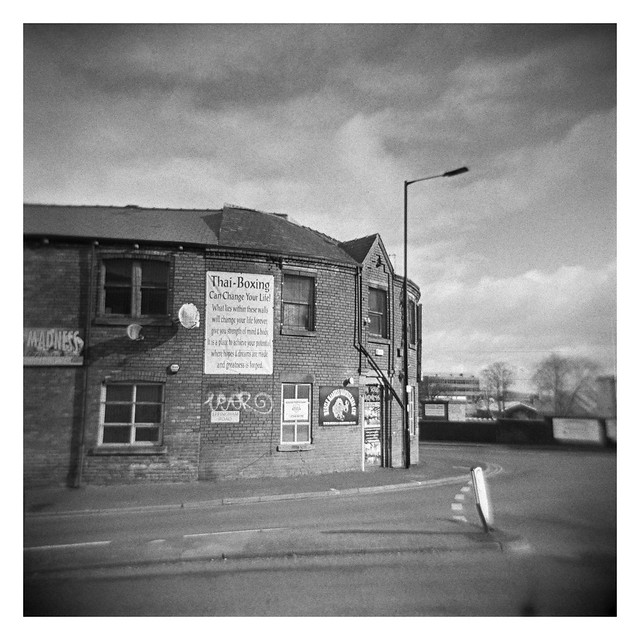
Here are the results from a roll of Fomapan 400 I shot back in March. Apart from one picture that I wasn’t happy with, it’s the full roll. I don’t think this represents my most successful outing with the Holga, and there’s some element of shooting stuff because it was there rather than being more careful in my choice of compositions, but there are a few that I really like, such as the Thai Boxing gym, the underpass, and the church.

I’m also very pleased with the results of the semi-stand development. I sometimes find that Fomapan 400 needs more light (something you can’t particularly control with the Holga), but the Rodinal has pulled out a full range of tones from every image. I’ll certainly semi-stand Foma 400 again in the future.

Bunting and marquees
Milk flat
Milk float
ERF
ERF and canal
Thai Boxing
The Hope Centre
Under and out
St. John's Park church
Near the bottom of the Parkway
What remains of the Durham Ox

Holga 120N & Fomapan 400. Rodinal 1+100. 1 hour semi-stand development.

Taken on 28 March 2025

35mm · Film photography · Photography

I finally photographed this derelict farm building

I’ve seen this building on numerous occasions when driving through the area and on this day I finally found myself well placed (and equipped) to photograph it.

It might look like it’s out on the open plains somewhere remote, but is right on the edge of Whitwell and it’s only the gentle curve of the land that allows this illusion of space.

I took a number of pictures of the building (and the tree to the right of frame – which featured in yesterday’s post) using different focal lengths and am happy with all of them. I did have another shot which is zoomed out a little further than the third shot below which I think I liked best of all, but I managed to beat the lens’ vibration compensation and introduce some camera shake. A shame.

One thing I didn’t notice until I processed the scans is that there is a solitary figure sat on the corner of the wall of the structure. You can make them out better if you click on the images and view them larger in Flickr. They were some distance away, so I wonder if they noticed they were being (unknowingly) photographed?

Out on the plains
Derelict
Beneath a cirrus sky

Nikon F80, Tamron 28-300mm F/3.5-6.3 Di VC PZD & Agfa APX 100. Rodinal 1+100 (+2ml) semi-stand 1 hour @ 20°

Taken on 8 March 2025