
Nikon F80 and Nikkor 28-80mm f/3.5-5.6 AF-D on Ilford Type-517. Ilfotec DD-X 1+4 14.5mins @ 20°.
Taken on 14 March 2026

Steel City Snapper photography
35mm, medium format and large format film photography (with the odd bit of digital every now and then…)
Nikon F80 and Nikkor 28-80mm f/3.5-5.6 AF-D on Ilford Type-517. Ilfotec DD-X 1+4 14.5mins @ 20°.
Taken on 14 March 2026

Nikon F80 and Nikkor 70-200 f/4 ED VR on Ilford Type-517. Ilfotec DD-X 1+4 14.5mins @ 20°.
Taken on 14 March 2026

Nikon F80 and Nikkor 28-80mm f/3.5-5.6 AF-D on Ilford Type-517. Ilfotec DD-X 1+4 14.5mins @ 20°.
Taken on 14 March 2026

Nikon F80 and Nikkor 70-200mm f/4 ED VR on Ilford Type-517. Ilfotec DD-X 1+4 14.5mins @ 20°.
Taken on 14 March 2026

Nikon F80 and Nikkor 28-80mm f/3.5-5.6 AF-D on Ilford Type-517. Ilfotec DD-X 1+4 14.5mins @ 20°.
Taken on 14 March 2026
A couple, their dog, and two crows enjoying a morning stroll on the beach.

Nikon F80 and Nikkor 28-80mm f/3.5-5.6 AF-D on Ilford Type-517. Ilfotec DD-X 1+4 14.5mins @ 20°.
Taken on 14 March 2026
Looking south-east from the cliffs atop Scarborough’s south bay. You can just make out the staircase I posted a couple of shot of recently at lower left. Further down the coast is the arc of the former South Bay Bathing Pool and from there the cliffs continue towards Bempton and Flamborough Head.

Nikon F80 and Nikkor 28-80mm f/3.5-5.6 AF-D on Ilford Type-517. Ilfotec DD-X 1+4 14.5mins @ 20°.
Taken on 14 March 2026
I chatted with this couple for a few minutes. They told me how much they’d enjoyed their stay in Scarborough and had been surprised that it was much bigger than they expected. I’d planned on photographing this scene before I spoke with them, but thought their semi-silhouettes would add to the picture. And they do.

Nikon F80 and Nikkor 28-80mm f/3.5-5.6 AF-D on Ilford Type-517. Ilfotec DD-X 1+4 14.5mins @ 20°.
Taken on 14 March 2026
After many weeks of mostly overcast and rainy weather, I finally got a nice day yesterday where I had the opportunity to go out for a day of photography.
I decided to visit Scarborough, mostly because I’ve recently been looking at Paddy Summerfield’s The Holiday Pictures book and it gave me the urge and inspiration to go an make pictures at the coast.
Scarborough is appoximately 2-hours by car, so not too far, but not somewhere I can pop along to whenever I feel like it, so it was a bit of a mini event. Although it was overcast most of the way there, as I got closer the skies began to open up and I was rewarded with a lovely morning when I arrived.
I had a couple of cameras with me: my Minolta X-300 containing dome Kodak Gold, and my Nikon F80, which I’d loaded with Ilford Type 517 film I had a roll in the camera, plus a spare, and also a roll of expired Tri-X should I get through all the rest.
I spent a happy morning taking pictures in the great light and covered several miles, walking form the cliffs of the south bay, all the way to the north bay and back again, stopping only for a bottle of water and, on the way back, to treat myself to well-earned fish and chips. I finished the Kodak Gold, and both rolls of the Type 517. By midday the clouds had rolled back in and the best of the light was gone, so I headed back home.
Today I had the opportunity to develop the film after my dad visited, so I got stuck in, looking forward to the pictures. I’ve shot Type 517 previously and was very pleased by the way it looked, and was hopeful for similarly nice results. It was not to be…
As soon as I took the films from the reels I was very disappointed to see significant light-leaks on many of the frames. The first roll less affected, but the second with dark stripes on almost every negative, in the same place on each frame and covering the image and the rebate. I wracked my brain to try and think what might have gone amiss, especially as both rolls were affected.
Because the F80 takes the film all the way back into the cassette, I have to use a film retriever to pull it back out to get it onto the developing reels, and it seemed a little more difficult than usual to insert the tongue of the retriever into the light traps on both cassettes, and my first thought was that I’d somehow introduced light in the process (although it’s never happened before). My other (worse) thought, was that the camera had developed a fault which might be more costly to resolve.
However, it seems that neither of those is the cause. While searching online I found this post where someone had had almost identical problems, albeit when shooting some bulk-rolled film. The light leaks in the pictures they shared are almost exactly the same as what I had experienced:
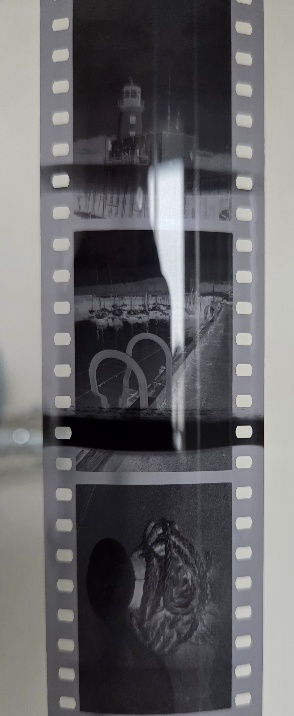
Thankfully, the post also responds with the identified cause, namely that the labels on their bulk rolls were semi-translucent and, because the camera they’d used has a small window in the back to see what film was loaded, light had piped around the label, into the camera, and onto the film.
I suspect that this is what has happened with my type 517 rolls. While I can’t say for certain that the labels are conducting light through my F80s rear film window, it seems likely given the similarities. I also note that the Type 517 cassettes are reflective metal, which might also lead to the problem. The last time I shot it, without any problems, I used my aforementioned Minolta X-300, which has no film window.
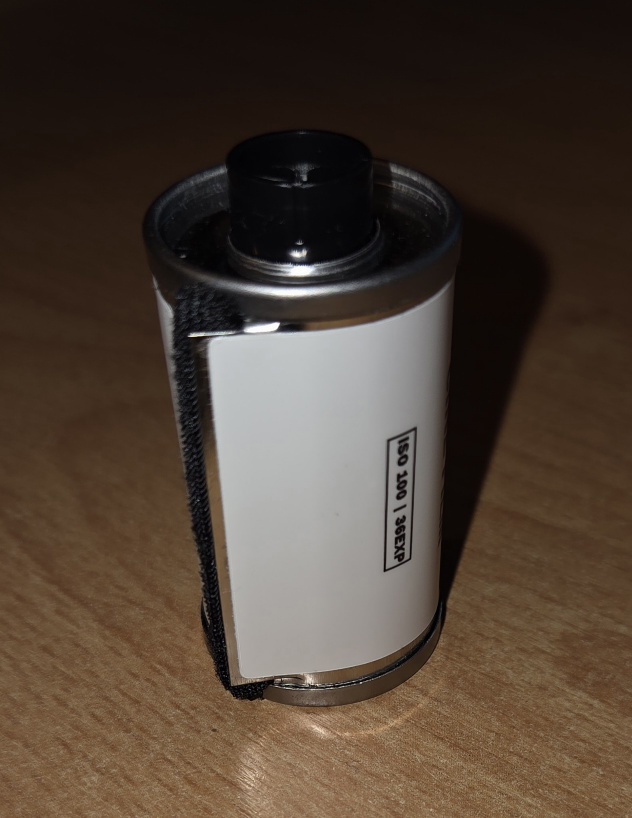
I’m hopeful that this has gotten to the bottom of things and that I can shoot the film (and my F80) with confidence in future, either by only shooting it with suitable cameras, or by taping over the F80’s film window. It’s still been a painful experiece though – there are a lot of nice pictures that have been ruined (although I’m hoping I might be able to save some of them by way of some artistic cropping…), plus it was a long way to got to have spoiled pictures.
I do still have the roll of Kodak Gold to get developed though, and I’m going to give the F80 a test run with some bulk-rolled Fomapan just to put my mind at ease before shooting it again on anything that involves a lengthy journey! These things happen, and there’s not a lot I can do about it other than try to avoid a repeat occurrence.
I’ll share pictures from the day when I have them developed, but more stuff to come before then. In the meantime, here’s an older picture I took in Scarborough a few years ago.

Pentax Espio 140M & Fuji Superia 100 (expired 2008).
Taken on 13 July 2019

Olympus 35 RC & Fuji Superia 100 (expired 2008). Lab developed. Home scanned and converted with Negative Lab Pro.
Taken on 1 October 2025

