
Olympus OM-10 & G.Zuiko 35mm f/2.8 on Ilford FP4+. Ilfotec DD-X 1+4 @ 20° 10mins.
Taken on 2 August 2024

Steel City Snapper photography
35mm, medium format and large format film photography (with the odd bit of digital every now and then…)
Olympus OM-10 & G.Zuiko 35mm f/2.8 on Ilford FP4+. Ilfotec DD-X 1+4 @ 20° 10mins.
Taken on 2 August 2024
Following on directly from yesterdays Ingoldmells post, todays piece features photos from Skegness (or Skeggy for short. Or, amusingly, SkegVegas).
It took about 20 minutes to drive to Skegness from Ingoldmells, a trip I punctuated with a visit to a fish & chip shop for some dinner (dinner is what we call lunch in my part of the world. The evening meal isn’t “dinner”, it’s “tea”, but not the drink. Sorry to cause confusion!). After that a short drive into the centre of the town to get parked.

As a child it felt like Skegness beach was huge. It seemed you had to walk through a veritable desert of sand before you would reach the se. These days however, it laps around the end of the pier, and the pier isn’t even as long as it once was! I expect this is a result of the work that has been carried out to combat coastal errosion in this part of the Lincolnshire coast. Mablethorpe, for isnstance, used to have groynes all along its beach, but these are now buried beneath feet of sand that has been dredged from offshore. I guess it makes for a nicer beach, but it also seems to have lost some interest in the process.

When staying at my grandparent’s caravan in Mablethorpe, we would occasionally have a day trip to Skegness. Skeggy is much bigger than Mablethorpe and has a lot more entertainments, including the pier, and a good sized funfair in Bottons Pleasure Beach. I think, for my grandma, the much greater selection of shops was also undoubtably a lure.

On the day of my visit I walked along the promenade area above the beach before venturing onto the sand to take a few pictures of the back of the Pleasure Beach. From there I wandered to the pier, back through the Pleasure Beach itself, and then onto the main road that runs between the beachside entertainments and the town itself.


While the weather had improved a bit by the time I arrived in Skegness, it was still largely overcast, and I was disappointed that I didn’t get the sunshine and blue skies that I think would have made the colour film work better. As always here in the UK, you get the weather you’re given though, and it’s a case of making the best of it.

One of the things I like about the seaside, is the architecture – the arcades, the food stalls, the touristy stuff. It’s kitschy and sometimes a little worse for wear, but it has a special charm to it and I sometimes wonder if there’s a school of architecture dedicated to designing such structures?
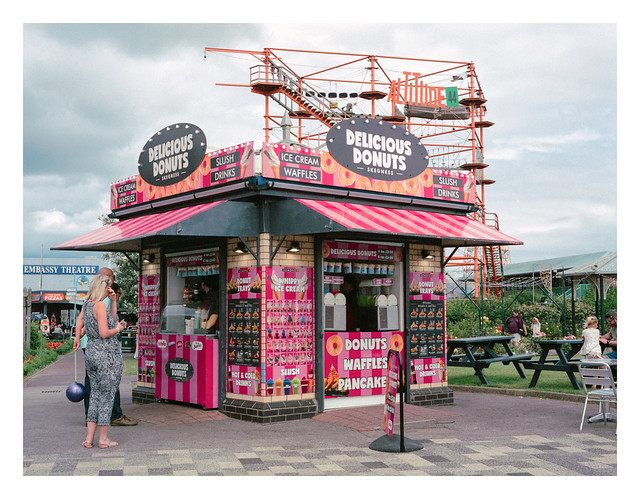

Nobody was enjoying this Altitude attraction when I was there. Maybe the wind was too high or something? Someone was “enjoying” the log-flume though. 🙂


Bronica ETRSi, Zenzanon 75mm f/2.8 PE and 50mm f/2.8 MC lenses, and Fujicolor Pro 400H. Lab developed. Home scanned and converted with Negative Lab Pro
Taken 28 July 2023.
Back at the end of July I took a daytrip to the seaside, visiting the Lincolnshire coast resorts of Ingoldmells and Skegness. The two places are just a few miles apart, with Ingoldmells just north of Skegness.
It was the popularity of Skegness – a town that took on the somewhat telling catchphrase “It’s bracing!” – that led to the creation of Ingoldmells (pronounced Ingamells) as a resort, although the settlement had been there for centuries, with the parish church dating to the 12th century. In 1936, Billy Butlin opened his first Butlin’s holiday camp in the village, although it would soon close temporarily due to World War II when it became a shore establishment of the Royal Navy, given the designation HMS Royal Arthur.

Post war, the area developed further into a holiday location. East Lindsey District Council estimates there being nearly thirty-five thousand caravans across the East Lindsey Coasy, incorporating Skegness, Ingoldmells, and the towns further north such as Mablethorpe, with an economic value of over half-a-billion pounds!
It seemed slightly grim that some of the caravan parks were surrounded by barbed-wire topped fencing and, at one point when I ventured into an area to get a picture of caravans with the roller-coasters in the background, I was quickly approached by a member of staff enquiring what I was doing, so I guess some people must get up to no good sometimes.

Ingoldmells is dominated by caravan parks with the focal point being the seafront area and the Fantasy Island theme park which has a variety of rollercoasters and other rides for thrill-seekers young and old. Fantasy Island also has an open air market, with a variety of vendors, all dwarfed by the park’s two big coasters.

The seafront and nearby streets are home to a varety of arcades, food outlets, and seaside bucket-and-spade shops.

I didn’t get the best weather on my visit, it being overcast for the most part (although it did brighten up a little in the afternoon when I moved on to Skegness) and even a little rainy, which is not my favourite scenario for shooting colour film.
At some point while I was there I sheltered from the drizzle and I must’ve disturbed a spider’s nest as, for the next hour, I would occasionally feeling something crawling on me, each time it being a small money spider. Being concered about the extent of this “infestation” I even put my phone into selfie mode so I could check that I didn’t have a swarm of the things crawling unnoticed on me. That might have been embarrassing / horrifying, depending on your feelings about arachnids!


Bronica ETRSi, Zenzanon 75mm f/2.8 PE and 50mm f/2.8 MC lenses, and Kodak Gold. Lab developed. Home scanned and converted with Negative Lab Pro
Taken 28 July 2023.
Back to the Blackpool photos for a few days, with a couple of types of thrill rides (although I gues the second could be a bit less thrilling unless you don’t like heights).
Typing the title for this post made me wonder – is the structure in the second photo actually a “Ferris Wheel”, or is it a “Big Wheel”? And is there a difference?
A quick search online brought this interesting page from the National Fairground and Circus Archive, which gives a overview of the history and development of such rides and states that the proper name is Ferris Wheel, even though George Washington Gale Ferris wasn’t the originator of such rides. His biggest claim to fame – at least in terms of building Ferris Wheels – probably came with the construction of the wheel that took his name at the 1893 World’s Columbian Exposition in Chicago, a construction that stood 264 feet tall and could carry 160 riders. It was intended to be an equal to the Eifel Tower.
The fairground ferris wheels that are commonly seen at travelling funfairs (as well as permanent fairs) are known as Eli Wheels, named after the Eli Bridge Company which manufactured them.


Yashicamat 124G & JCH Street Pan 400. Ilfotec DD-X 1+4 9mins @ 20°
Taken 1 July 2023.

