My plan for today had originally been to meet up with a bunch of other photographers for a wander around a midlands heritage museum. Alas though, due to the continuing hot weather, it was decided it was best to postpone until later in the summer. So, with time on my hands, I decided to drive instead to Newark where I knew there was an exhibition on featuring the work of a photographer whose work I enjoy: Paul Hart.
The Gathered Leaves exhibition is in the newly opened Vibrant Matter gallery, and details can be found here. While there were some framed prints from artists featured, the exhibition was focused on publications rather than prints – you can see where it got it’s title – and I browsed most of what were on display as well as having a nice chat with the owner, Daniel Rapley, whose work was also on display (in the shape of experimental images formed from found photographic images, creating a colourful and eyecatching display of overlaid scenes. There was a feeling of Christopher Nolan’s Inception in some images, where inverted cities loomed above foreground figures). While there were a number of photography books present, the scope was wider, and there were publications dealing with more experimental art, design, and typography.
After my visit to the gallery I wandered around Newark taking pictures of my own, finally finishing a roll of Kodak Pro Image that’s been in my Olympus XA-3 for a couple of months now, as well as starting on rolls of Portra 160 (which I’d forgotten was in my camera bag – not sure how long it’s been cooking in there. It’s a good job Portra doesn’t cost much, eh..?), Ektar (in my Yashica Mat 124 G), and some expired Ilford Delta 400 in my Olympus OM-10). I took a new camera bag with me which has space for more stuff. I’m not sure if that is a good or bad thing just yet…
Newark is a nice place to wander around. The architecture is pretty, with lots of charming red-brick buildings, a colourful market square, the River Trent, and the ruins of a castle (although it is currently undergoing some sort of renovation so could only really be viewed from across the river).
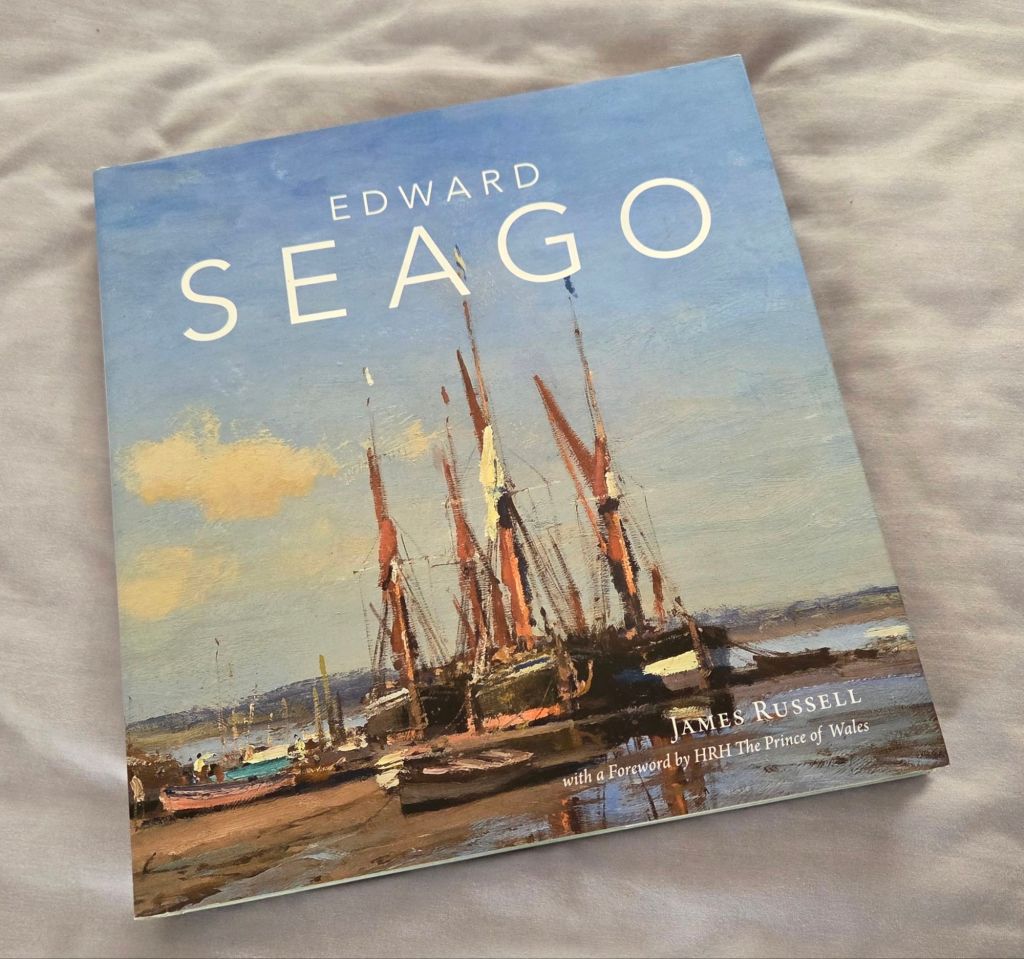
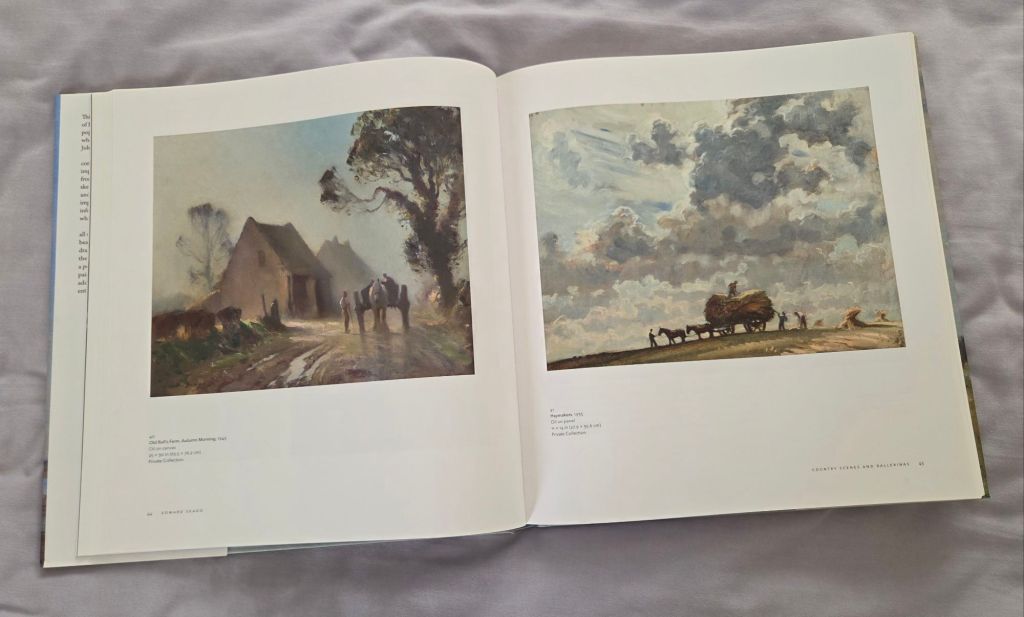
I also bought myself a new book from a used book seller in the market. They had a few photography books, but none that really interested me, so I bought a book on the life of Edward Seago which is full of his beautiful paintings. I first came across his work while admiring the work of fellow blogger -N- on her Ink, Yarn, and Beers blog. She’s posted about being inspired by Seago’s work on more than one occasion, and I thank her for bringing it to my attention. Go check out her blog and her lovely paintings.
Because all my pictures from Newark today were shot on film, I don’t yet have any to show, so here’s a picture from a previous visit back in 2022. I shot a very similar image today!
According to the sign, this is Newark’s famous floating pub. I’m not sure of it’s sphere of fame – I’d never heard of it until I visited Newark the other week – but I expect it’s well known to locals and those able to visit it with greater ease.
Whatever it’s fame, it was an attractive subject for some photographs and I’m really happy with how these turned out, even considering the shortcomings of the camera I used.
Reto Ultrawide & Slim & Kodak Gold. Lab developed. Home scanned and converted with Negative Lab Pro.
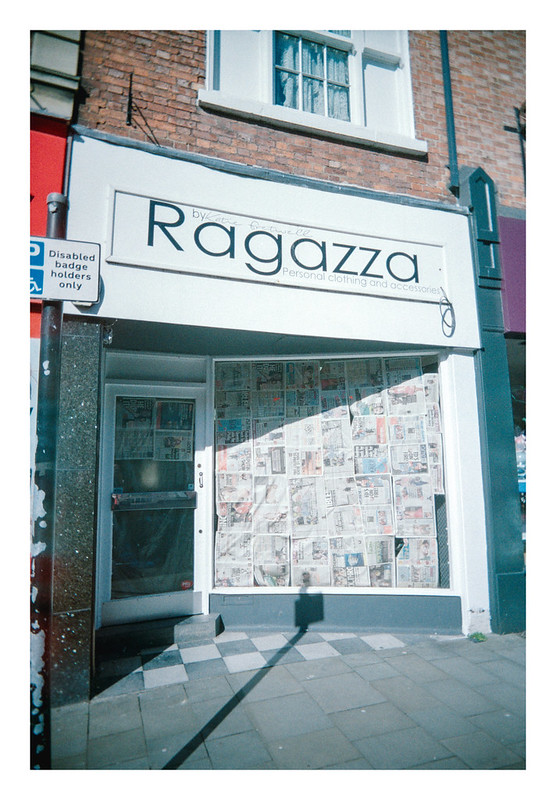
From a shop window full of slippers in yesterday’s post, to one full of newspapers in today’s. It would appear that Ragazza has seen better times. It’s sad to see businesses like this – much better that they be thriving. Nontheless, I thought it made for an interesting photograph.
Reto Ultrawide & Slim & Kodak Gold. Lab developed. Home scanned and converted with Negative Lab Pro.
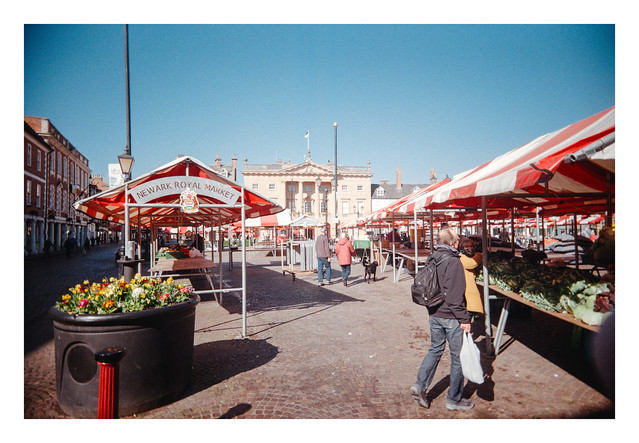
Two different apsect of Newark market here today. A couple of pictures from outside in the market square where the red and white striped awnings on the stalls glowed vibrantly in the bright sunshine. The third shot taken inside the market hall in a shady, but nicely lit arcade. I’m quite pleased with the interior shot given the somewhat basic (and un-changeable) settings of the camera used – fixed f/11 aperture and 1/100sec shutter speed. The shadows are a little muddy but, on the whole, it’s an appealing photograph, I think.
As is seemingly the RETO UWS’s remit, one of the shots has been photobombed by my fingertip.
Reto Ultrawide & Slim & Kodak Gold. Lab developed. Home scanned and converted with Negative Lab Pro.
Away from pictures of Flamborough now and, for a few days to come, on to some photos from a trip to Newark I took with my wife last month. Newark is a market town in Nottinghamshire, about thirty or forty miles from home. It sits on the River Trent and has the ruined remains of a castle. They have an English Civil War museum there which I would quite like to take a look around, but that will have to wait for a future trip.
The town centre hasn’t yet been fully homogenised by all the same chain stores that you find everywhere else, although they are certainly making inroads. As a result it’s quite a nice place to wander around for a few hours. I’m not a big fan of shopping unless I either have something specific I want to buy, or it’s a shop full of stuff I find particularly interesting, so a lot of the day was spent with my wife browsing inside the shops while I stayed outside and took photographs of whatever I found interesting. This suited me just fine. 🙂
The only film camera I had with me on the day was the RETO Ultrawide and Slim, in which I’d loaded a roll of Kodak Gold. I was chancing things a bit by using a 36exp roll – I’ve heard the slightly flimsy film advance on the camera can struggle with rolls longer than 24exp, but I’d decided to risk it. The film advance definately seemed to be getting harder to turn as I approached the end of the roll, but there were no catastrophic failures thankfully. I do wish I’d taken a different camera though. While the RETO UWS is fun to use, having seen the results, I can’t help but wish I’d used something with a bit more fidelity for a trip like this. I also managed to get my fingers (and even the camera strap) into the frame on several shots, a much worse ratio than my first roll through the camera where I think it only happened once.
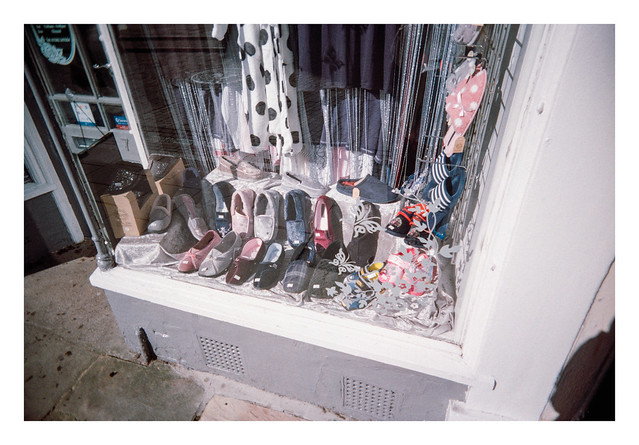
Today’s picture is kinda random, but I liked the arrangement of these colourful slippers in this shop window. While my finger didn’t get into the frame on this occasion, my shadow has crept in at bottom right.
Reto Ultrawide & Slim & Kodak Gold. Lab developed. Home scanned and converted with Negative Lab Pro.
I had a longer post planned today about my experience with a film stock I’ve not used before but, as time is ticking on and I have that chilled out Friday feeling, I think it will have to wait until the weekend.
Instead one of my shorter form posts, this time with another of the RETO Ultrawide & Slim pictures from my first test roll.
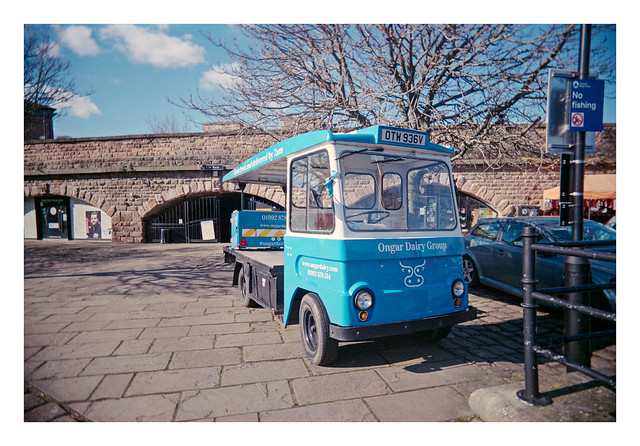
When I was young most people would have their milk delivered by a vehicle similar to this. Electric powered milk floats whirring around the early morning streets, crates of glass milk bottles clinking about on the back, stopping for the white-coated “milkie” to deliver each home’s order to the doorstep where it would wait to be fetched inside. Sometimes, on cold days, the milk would freeze and the foil tops would be pushed off the bottles by the expanding ice. Sometimes greedy birds would peck at the foil to get at the rich cream at the neck of the bottle (none of the homogenised stuff that we get today back then).
Reto Ultrawide & Slim & Agfa Vista Plus 200. Lab developed.
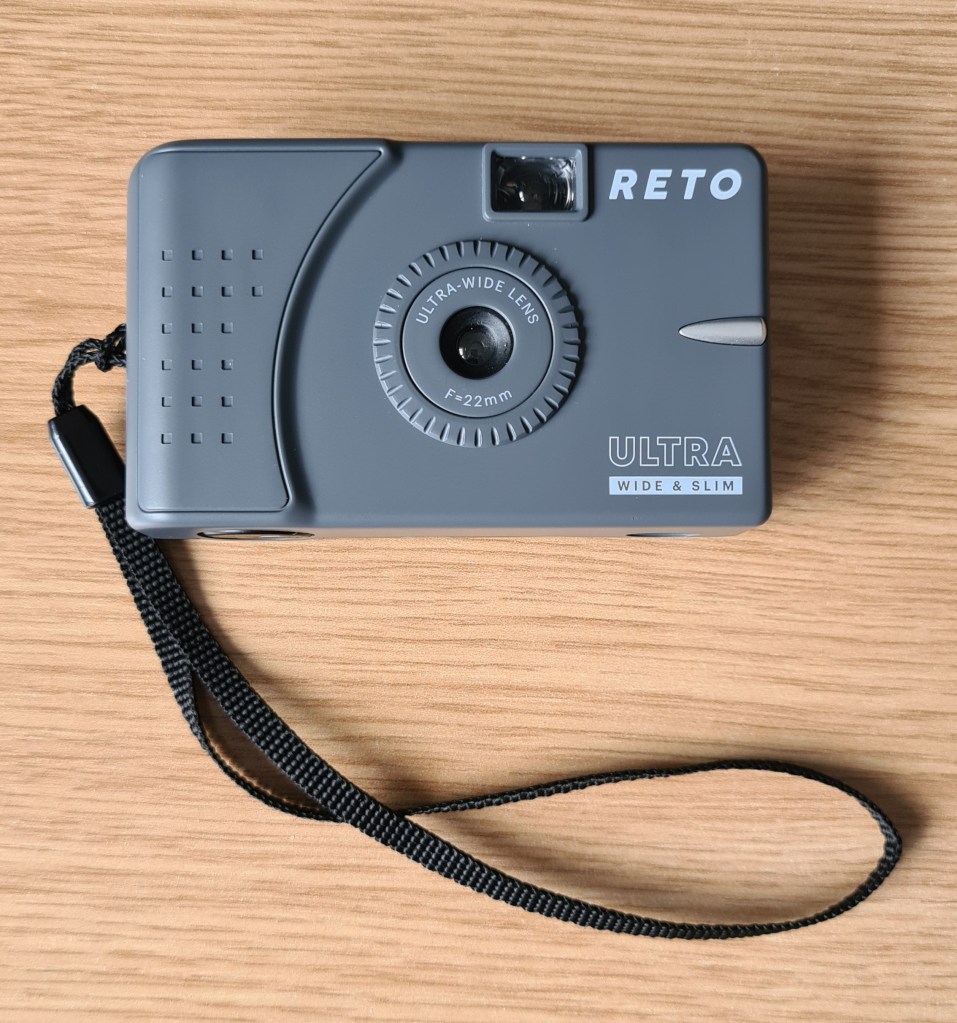
A month or two ago I became aware that a new film camera was about to launch. As with most new film cameras these days, this was not to be an SLR, rangefinder, or fully-featured compact point and shoot, but something rather more basic in the shape of the Reto Ultrawide & Slim.
There have been a number of other back-to-basics cameras launched in the last year or two, but these have mostly been in the form of re-useable disposable cameras (if that makes sense – basically the same features as a standard disposable film camera, but with the facility to re-load with normal rolls of 35mm film. More cost effective and flexible in the long term, and also better for the environment.).
This wouldn’t have been possible without the 22mm lens.
In terms of build, the Reto Ultrawide & Slim (UWS) is probably no more advanced than the aforementioned cameras. It’s almost completely made of plastic, including its lens. But in this case, it’s the lens that matters because, while most other cameras of this ilk use 35-40mm focal lengths, the Reto UWS packs a very wide by comparison 22mm lens, making it something of a stand-out amongst it’s competitors.
This one managed to find its way into Flicke Explore!
The camera itself is not a new design. It’s a clone of the Vivitar Ultrawide & Slim which was released back in the 1990s, manufactured by Chinese company Sunpet and marketed under the Vivitar brand. The Reto version isn’t even the first clone and another version produced under the Superheadz brand was also available for a while. Despite the different variants, all the cameras appear to be identical in terms of functionality, with the only differences being cosmetic.
In terms of specs, the camera uses the aforementioned 22mm lens – this is an uncoated 2-element design fixed at f/11 and constructed of resin. The shutter is likewise fixed to a single speed of 1/125 sec. The focus is fixed and reaches from 1m to infinity. Controls on the camera consist of a shutter button, a film-advance wheel, a film-release button, the rewind crank, and a switch to open the camera back for loading and unloading the film.
The fixed aperture and shutter speed are likely to dictate the film you choose to shoot. On bright days then a 200 or even 100asa film is probably fine (all the shots here are on 200asa colour negative film), but faster film will be a necessity when the light isn’t as good, probably going beyond 400asa in the conditions we often find here in the UK.
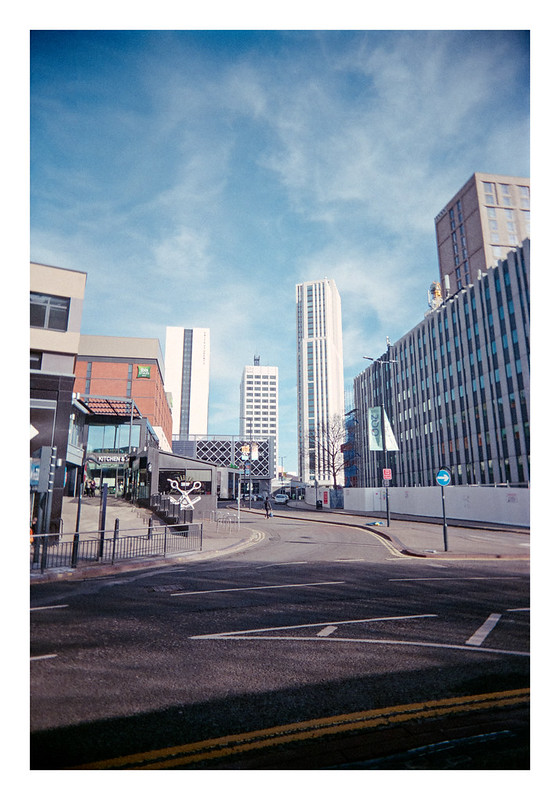
The person exiting frame left was definitely not visible in the viewfinder when the shot was made.
The build quality of the camera isn’t something that inspires confidence. The almost fully plastic build is very lightweight (the camera feels like it would blow away in a light breeze) and I’ve seen a number of places advising that it’s best to limit film to 24exp rolls as longer lengths can put unwanted strain on the advance mechanism (which I presume is also mostly plastic). I guess that time will tell as to how well it’s construction fares – so far I’ve put two rolls through mine, a 24exp roll and then, being the daredevil that I am, a high-risk 36exp roll. Neither posed any problems, although I could feel the tension (literally!) when winding on the final few frames from the longer film.
In terms of use, there’s not a lot to say. Loading film is easy – the rewind ratchet is a very simple design and is basically held in the camera by a plastic lug, but it works well enough. The shutter button is responsive and the shutter itself makes a quiet but satisfying click when fired. The advance wheel also works well, with the caveat that it did feel much tighter towards the end of the 36exp roll of film I shot, and I expect this might be a potential point of failure. Rewinding the film is likewise straightforward. The door release switch works fine, but I find that it doesn’t spring the door open and I have to pick at it with a fingernail to get inside.
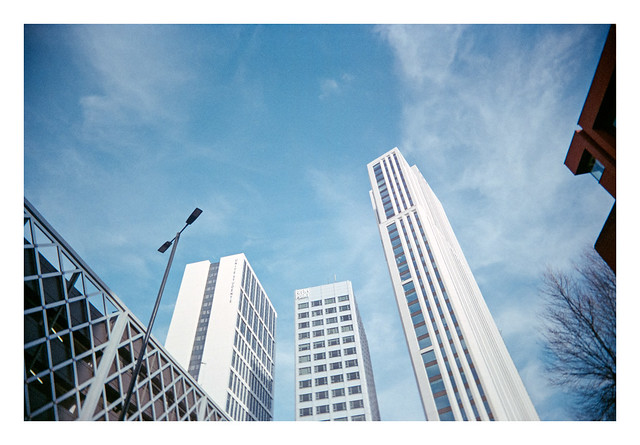
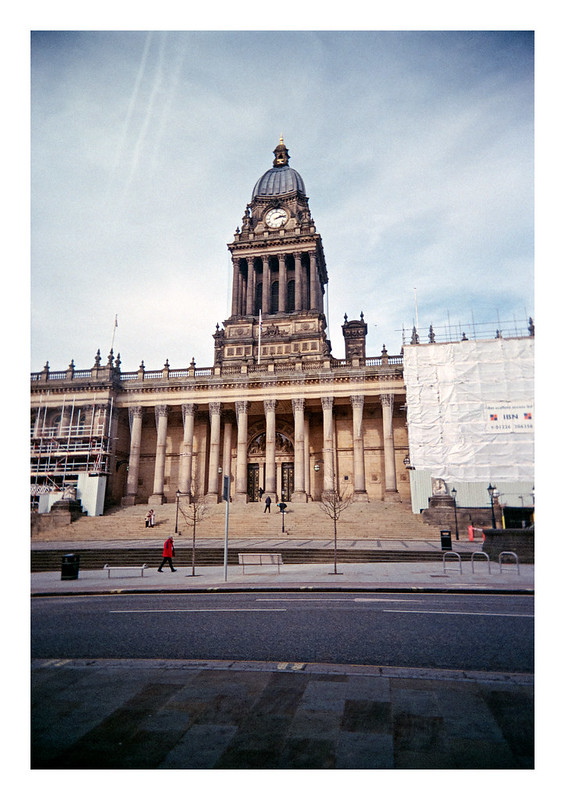
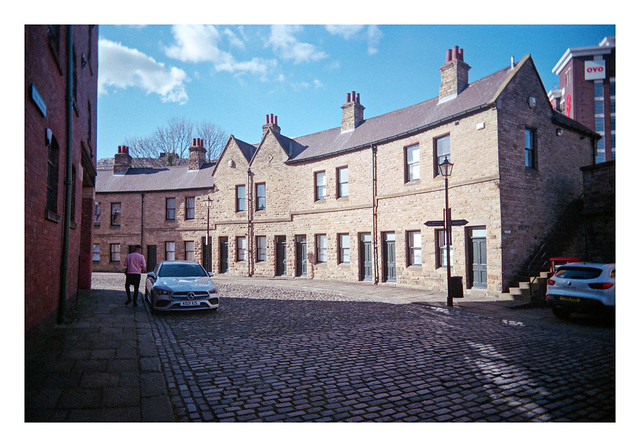
So, most importantly, what are the photographs like? Well, that will always be a subjective opinion, but in my case I’m very happy with them. The lens has some notable shortcomings in the amount it vignettes (although nothing like as much as a Holga 120 or something like that), and also the drop off in sharpness at the edges of the frame. Both these things could also be said to add charm to the resulting images though. In the centre of the frame the lens is plenty sharp enough and equals some more advanced and fully featured point-and-shoot cameras I’ve used. It’s the 22mm focal length that is the big draw here though. Coupled with the f/11 aperture and deep depth of field, it can allow interesting compositional choices to be made and I expect that I will continue to use it for this reason.
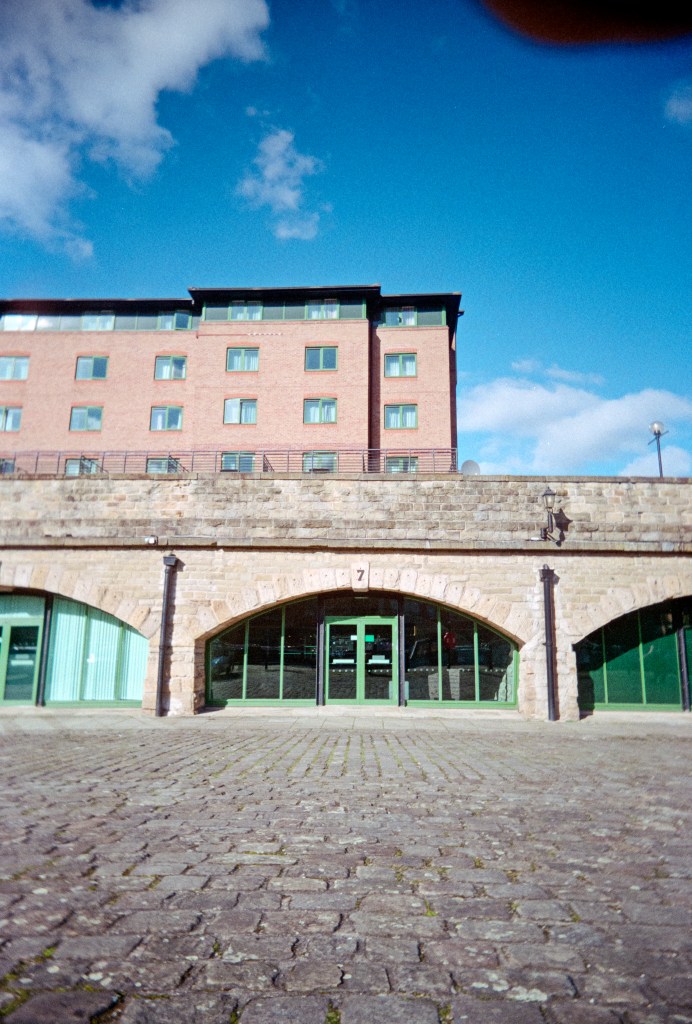
Beyond the build quality there are a couple of other downsides to be aware of however. The first is the viewfinder. While it’s bright and easy to use, even for a spectacles wearer like myself, its coverage does not represent the full field of view of the lens, meaning that it’s very easy to get unwanted elements creeping into the edge of your compositions. This includes fingers! The lens is also very prone to flare apparently, although I deliberately chose my shots to try and minimise this. I have also found that the first roll of film I had developed had scratches on a number of frames but, giving the benefit of the doubt, I’ll wait to see if it’s repeated on the next roll before laying the blame on the camera for this. The scratches were rectified easily enough in Photoshop.
Finger alert!!!
Is the camera worth buying? Again that’s a very subjective question. If you live for crisp, sharp, high quality results with a range of controls and features to aid your photography, then probably not. If you enjoy the simple creative options that ‘toy’ cameras such as this offer, then you’ll be fully in your element. At £30 it’s relatively cheap to buy (although that doesn’t mean it’s actually worth that amount) and problably more affordable than the older Vivitar version which seemed to have been fetching much higher prices due to its popularity. I’m so far happy with mine and glad I bought it.
There are undoubtedly a lot of reviews and first impressions of this little camera popping up online, but here are a couple from my fellow bloggers Jim Grey and adventurepdx that are worth reading.
Reto Ultrawide & Slim & Agfa Vista Plus 200. Lab developed.