Empress Elisabeth of Austria, also know by her nickname Sisi (or Sissi – it seems to be spelt both ways) was Empress of Austria and, then, Queen of Hungary from her marriage to Franz Joseph I on 24 April 1854 until her assassination in 1898.
So why is there a statue of her outside a casino hotel in Funchal? Well, it’s because she visited twice, first in 1860 to 1861 to seek a reprieve from respiratory illness. The villa in which she stayed was eventually demolished, and the casino stands on the same site.
She visited again in 1893-94, but this time stayed at Reid’s Palace Hotel (which still exists and was just down the road from the hotel in which we stayed).
People leave flowers in the hands of the statue in remebrance.
Olympus Trip 35 & Fujifilm Across II. Ilfotec DD-X 1+4 9mins @ 20°
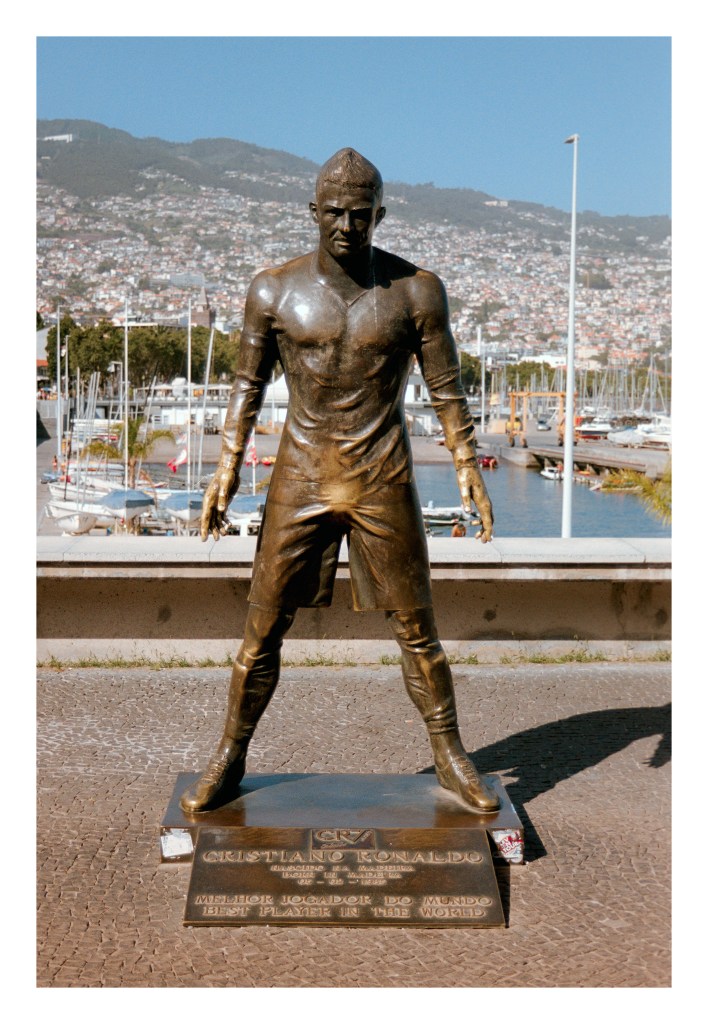
As mentioned briefly yesterday, another draw for visitors in Funchal is the Christiano Ronaldo museum, or – perhaps more specifically – the bronze statue of the man standing outside.
I’m not a big football fan and mostly pay little attention to the game outside of major tournaments, so I can’t really say how good a likeness the statue is. It’s probably closer in resemblance when compared with the much-commented-upon bust of his head that was on display at Funchal airport.
A good likeness or not, the statue is afflicted by the same trend that many such pieces are, namely the need for people to touch them, particularly in places that might be seen as a little risque were it and actual living person (or, indeed animal – the bull in New York’s Wall Street has been similarly fondled), resulting in considerable amounts of brassing. 😀
Apart from walking past a couple of times just to say I’d “been there”, I didn’t venture into the museum (or touch up the statue, for that matter). There were a number of people present having their photos taken with it on each occasion I was there though.
Here he is in all his glory…
Olympus Trip 35 & Fujifilm Across II. Ilfotec DD-X 1+4 9mins @ 20°
Colour shot: Nikon F70, Nikkor 28-80mm f.3.5-5.6 AF-D & Kodak Portra 160 . Lab developed. Home scanned and converted with Negative Lab Pro
Perhaps the most famous activity in Funchal – even moreso that visiting the Ronaldo statue – is the sledge rides.
So, one day during our trip, we decided to have a go. The rides run from a place called Monte, which is high above Funchal (about 550 metres or 1800 feet) and can be reached by a cable-car ride (you can get a bus or taxi too, but where’s the fun in that?). I think my wife might have preferred an alternate mode of transport though as she spent the entire ride up looking at the roof of the car to avoid seeing the drop, clutching my hand tightly whenever the car went over one of the pylons!
Below are a couple of picture of the cable-cars from the station at Monte.
You can go straight to the sledges from the cable-cars, but right outside the station is the entrance to Monte Palace and its beautiful gardens, so we went in there first.
The gardens are glorious, packed with lush vegetation and footpaths that wind around up and down through the steep hillside terrain. There are pools, fountains, ponds and water features dotted around giving the whole place a cool and refreshing feel.
We didn’t go inside the palace (which can be seen in the picture below), but it holds a commanding spot on the mountainside.
The gardens had a large number of birds, including swans and flamingos. There were also large numbers of fish in the ponds, including a number of pools with glass sides in this east-Asian themed section of the garden.
Looking back up to the palace.
After exploring the gardens, we set off to find the sledges. We soon realised we were on the right track when we saw them whizzing past on the road we were climbing.
The Monte Sledges have become one of the most recognisable sights on Madeira, offering a memorable experience that is pretty unique.
The toboggans* first appeared in the 19th century, when people living up in the parish of Monte – about 500 metres above Funchal – used them as a quick way to get down to the city. What started as everyday transport has since turned into one of the region’s best‑known traditions.
* are they toboggans, or sledges? What is the difference? I maybe ought to look it up… [goes and checks online…] Aha! They are actually sledges. Sledges travel on runners, whereas a toboggan runs on a flat base with a curved lip at the front. I have learned something new today!
Back to the story…
Each of the sledges are still made by hand from wicker and wood by local craftsmen. The ride itself is guided by two drivers, called carreiros, dressed in white with straw hats, who steer and brake using the thick rubber soles of their boots.
The route runs down very steep roads for about a mile and takes about ten minutes in total, starting in Monte and finishing halfway down the hill. There’s a definite sense of jeopardy involved, with the sledge at times drifting sideways down the roads and sometimes coming very close to narrow, but deep, drainage channels that run along parts of the route. It’s probably the way my mind works, but it was very easy to picture the whole shebang hitting a pothole and flipping over sideways at speed as we hurtled down the streets!
I’m sure it’s very safe though, and we did reach the bottom unscathed, having enjoyed the ride immensely (the carreiros clearly know their stuff). It’s a very memorable and fun experience, combining the thrills with glorious views down the mountainside into Funchal and out to the expanse of the Atlantic beyond.
At the end of the ride you can buy souvenirs – including theme-park-style photos of your expressions from partway down the hill! The end of the route is still high above Funchal town so a bus or taxi is needed (unless you fancy the walk). The taxis are not cheap, so timing the ride with the buses would have been a good idea.
The best part about the end of the ride though, was seeing how the carreiros get back up the hill again…
Olympus Trip 35 & Fujifilm Superia 100 (expired in 2008). Lab developed. Home scanned and converted with Negative Lab Pro





 Steel City Snapper photography