35mm · Film photography · Photography

A Walk With a Camera – Eyam to Stoney Middleton (part 1)

This year (and hopefully more to come) I’m planning on taking a bunch of walks / hikes with a camera. This is not a particularly new idea – I do this all the time already – but my methodology previously has been more based on random choice. Not quite stick a pin in a map, but certainly unguided insofar as points of interest on the walks I chose. Some of these self-directed walks were good and there were plenty of things to see along the way (and it’s always great when you come around a corner to find an interesting scene before you). But I’ve also been conscious that I might have been missing out on stuff that I would have seen if I’d only gone by a different route.

So the hikes I’m undertaking this year are based on guidebooks, or the recommended walks that can be found in the Ordnance Survey (OS) app that I subscribe to. Some of the walks are quite short – just a few miles – while others are longer, although none are too taxing, and nothing that can’t be achieved within the course of a day out.

I’ve also started to purchase some equipment for these outings. I’ve discovered how uncomfortable the wrong clothing can be in the right conditions. I want to be able to keep warm or cool as appropriate, and be able to stay dry in the UK’s changeable weather, so I’ve been investing in some proper outdoor clothing – base-layers, mid-layers, waterproof shells and the like. I’ll probably have to buy more stuff as the conditions change through the year, but at the end I should have a wardrobe of clothing to suit most conditions that I’ll encounter. I’ve also bought a pair of hiking poles. I wondered if these might have been overkill, but the first time I used them they were a godsend.

One thing I want to buy is a good quality backpack. Not necessarily a photography backpack, but one that will serve that purpose as well as giving me space to carry other provisions. Until then I’ll make do with the backpack I already own.

Anyway, this has been a somewhat lengthy preamble. TLDR – I’m going to go for some walks, take pictures along the way, and write about it here. 🙂

The initial hike I chose is the first walk in my OS Peak District Outstanding Circular Walks book: Eyam and Stoney Middleton.

This first walk sits in the “short walks” category of the book, with hikes of less than 2.5 hours (although I don’t think they accounted for photography in those timings 🙂 ). It’s only 3.5 miles, with a height gain of 660 feet (although, to be fair, that gain is pretty much all in one leg-busting uphill section).

The day of the hike was typically British overcast weather. This isn’t the sort of day that inspires photography to be honest, but I’ve also decided hereon that I will make the best of the conditions I have rather than take my usual approach of moaning about it, so it was on this damp and grey day that I arrived in the village of Eyam to begin my walk.

There is evidence of human settlement at Eyam dating back to the Ancient Britons but it was in the 17th century that the village gained fame. In 1666 the Great Plague of London, an outbreak of Bubonic Plague, took place. During the outbreak a bolt of cloth containing infected fleas was delivered to the tailor in Eyam, resulting in a local outbreak of the disease. Although there is some debate about the numbers affected, nearly three hundred villagers are recorded as having lost their lives as a result. A number of measures were introduced by the village to attempt to halt the spread, including a requirement that families isolate and bury their own deceased members. The most important however, was likely the decision to quarantine the entire village to prevent outside transmission. It is this sacrifice that give Eyam its fame.

I began my walk down Church Street, the main road through the village. It’s lined with houses in a variety of styles, from stone built cottages, through to the grand looking Eyam Hall, which now serves as a wedding venue.

Country campervan
Who lives in a house like this?

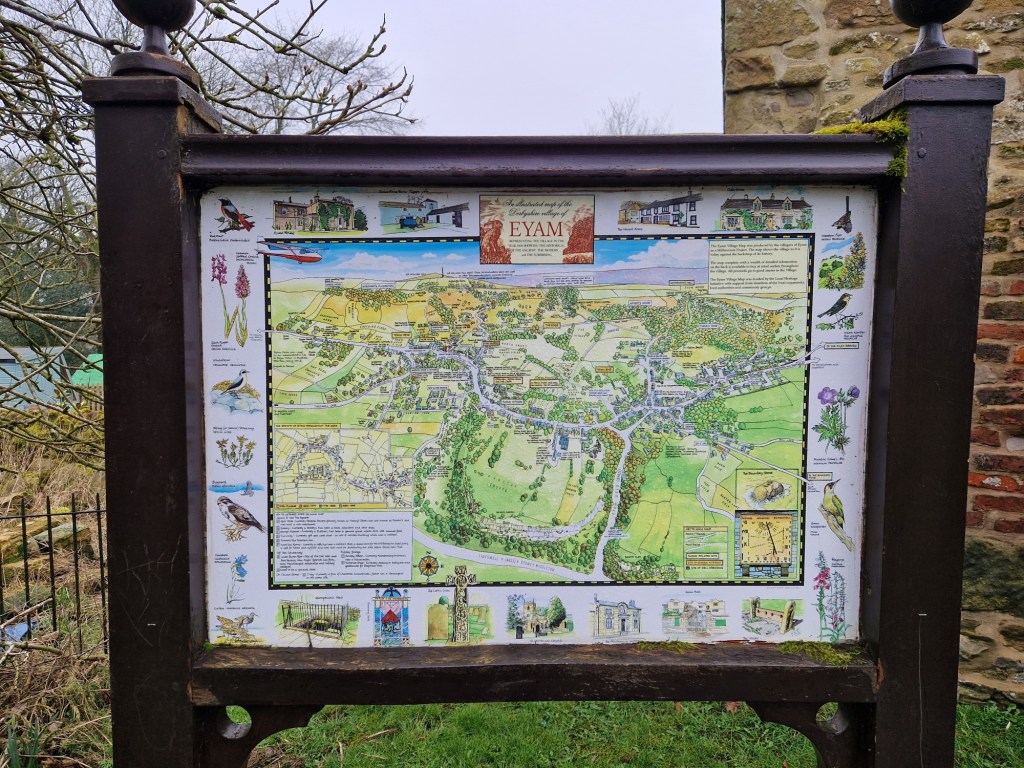
A map, an information board, and a set of stocks sit just to the right of frame in the image above.
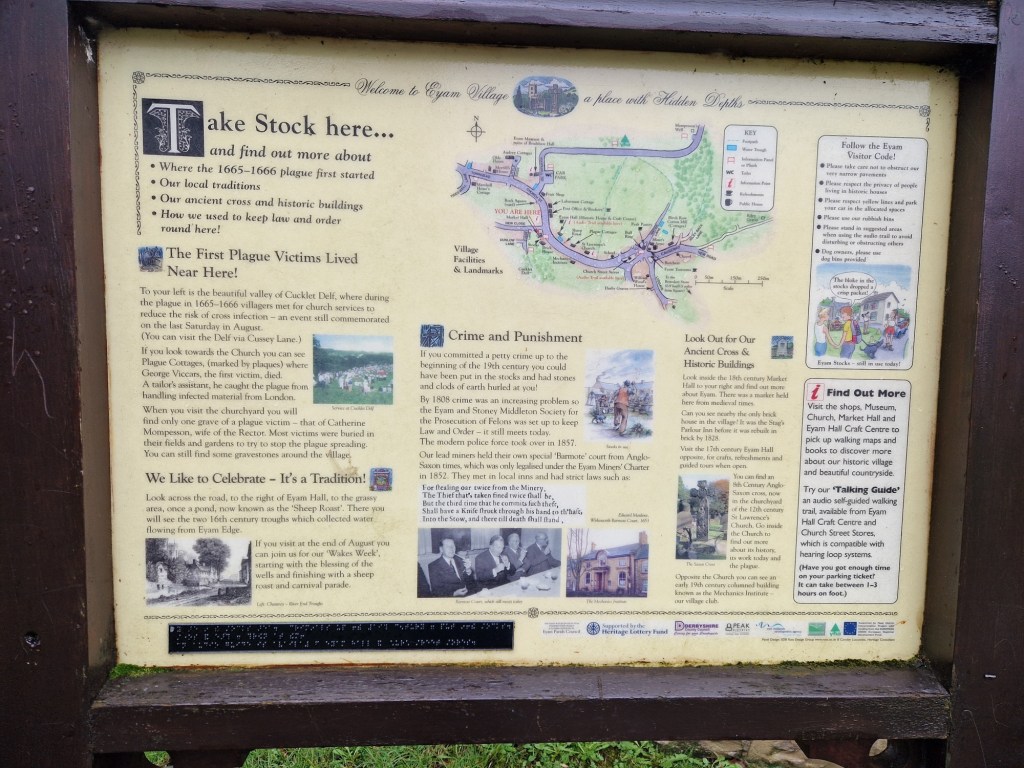
Eyam Hall probably looks nicer in good light, but it’s still an impressive presence on a dull day.

Eyam Hall

A village shop is present and doing business, but what I assume to be the post office was closed.

A local shop for local people
Out of business

The door to the Mechanic’s Institute was open and there was some activities taking place inside (although not mechanics, I don’t think).

Eyam Mechanics Institute

Further down the village I reached the point where I would take a right onto Lydgate and head along the footpath that leads to the neighbouring village of Stoney Middleton.

Lydgate

The footpath was a little muddy on the day, and I was glad of my hiking boots, but it was easy to traverse. Not far out of Eyam I could see the ruin of a farmhouse in the middle of a field.

Gateway to ruin

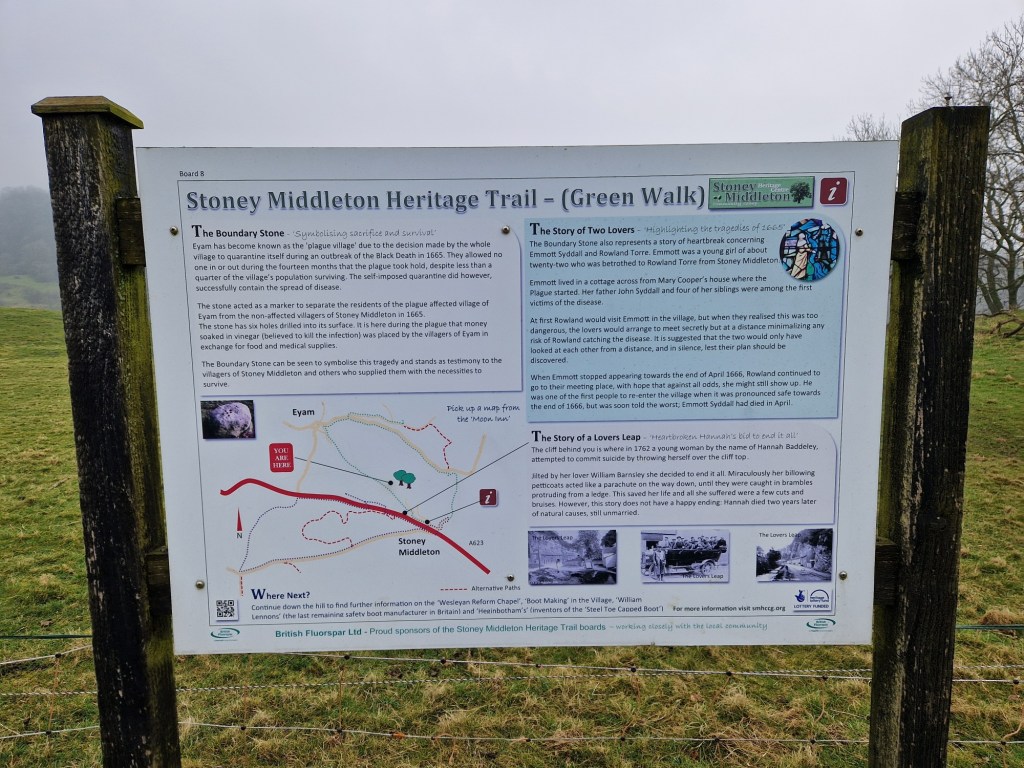
A little further along the track sits the Boundary Stone. This boulder was used to exchange money for goods between the villages of Eyam and Stoney Middleton. There are a number of holes in the top of the stone and these were filled with vinegar in order to sterilise the money.

The Boundary Stone

There are a number of information boards present along this footpath, denoted as the Stoney Middleton Heritage Trail, which contain interesting facts along with some tragic stories.
As the footpath crests the ridge before a steep descent to Stoney Middleton, a tree had fallen. It’s surprising how little of a tree’s structure is underground sometimes, and this one had it’s work cut out to find purchase for so long in the stony soil.

Fallen

I’ll end this first part of the post with a picture of the path down into Stoney Middleton, which you can just see emerging from the murky day at the bottom.

The path to Stoney Middleton

Olympus XA3 & Ilford HP5+ (@800asa). Ilfotec DD-X 1+4 10mins @ 20°

Taken on 9 March 2024

Digital · Photography

Battling the storms of a new PC

I got a new PC this week. It’s not brand new – it’s my son’s old PC – but it’s still vastly more powerful than my old machine. It has the luxury of a solid-state drive being installed meaning it boots up fast and the applications I use are similarly speedy to get going. I swapped out the secondary storage drive for a larger capacity model, so I now have a lot of room to add more pictures too.

It’s not all smooth sailing though. I have my files backed up via a cloud service and it’s taken days to download all the files back onto the new machine. I’ve also had headaches getting Lightroom to play nicely with the catalog I exported from the old machine and, while I have my scanning software installed, as well as Negative Lab Pro, I’m having problems getting Epson Scan to work. A lot of people don’t seem to like Epson Scan very much, but I’ve always found it very effective when scanning B&W medium and large format negatives, so I would like to get it working if possible. I can fall back on Vuescan (which I use for scanning colour negatives and slide film anyway) and do the inversions in Negative Lab Pro, which I’ve tried and had good results, but it means getting used to a different workflow. I’m not sure if I can scan multiple negatives in a batch with Vuescan either (although I haven’t looked into it properly yet).

Anyway, hopefully the storm-clouds of getting everything configured to my needs will soon thin and I can enjoy the benefits of a faster PC.

A rare foray into digital pictures for the blog today, with the shot below coming from my Ricoh GR III. These sorts of clouds are very rare hereabouts, so I had to grab a picture when I saw them. I thought we might be in for a huge storm, but they just drifted by without much fuss in the end.

Stormy weather

Ricoh GR III

Taken on 7 November 2023

35mm · 4x5 Large Format · Film photography · Medium Format · Photography

Twelve favourite photos from 2023

As another year comes to a close it’s time for my annual selection of favourite pictures, one from each month. As is always the case with these things, the list is based on my thoughts in the moment and the selection could easily change if I were to pick them yesterday or tomorrow.

Looking back through the year I was curious as to which camera has been used most for my photography. I thought there might be two or three contenders for the prize but, in actuality, there was a clear lead in the shape of my Bronica ETRSi, which has been used to shoot sixteen rolls of film in 2023. In distant second place was my Yashicamat 124G with six rolls (including one I developed today and have yet to scan), and then a tie for bronze between the Olympus Trip 35, and the Fujica GW690. I wonder which camera will be most used in 2024? Tune in this time next year!

January

Crossing the Moss
Fujica GW690
Kodak Gold
Converted to B&W in Lightroom

I struggled to get colours I was happy with using Negative Lab Pro for this roll. It usually works very well, but this roll was having none of it, so I resorted to a monochrome conversion.

February

Motorway
Bronica ETRSi
Zenzanon 75mm f/2.8 PE
Ilford HP5+
8sec exposure @ f/22
Ilfotec DD-X 1+4 9mins @ 20°

March

Going about their business
Yashicamat 124G
Ilford HP5+
Ilfotec DD-X 1+4 9mins @ 20°

April

St. Peter's Church, Elmton, UK
Chroma 4×5
Fujinon NW 135mm f/5.6
Fomapan 100
Ilfotec DD-X 1+9 12 mins @ 20°
1/30sec @ f/32

May

Venetian scene
Olympus Trip 35
Kodak Colorplus
Lab developed. Home scanned and converted with Negative Lab Pro.

June

Past the lifeguard flag
Olympus OM-1N
G-Zuiko Auto-W 35mm f/2.8
Ilford HP5+
Ilfotec DD-X 1+9 @ 20° 15mins 45secs

July

Skegness lifeguards
Bronica ETRSi
Zenzanon 75mm f/2.8 PE
Kodak Portra 400
Lab developed. Home scanned and converted with Negative Lab Pro

August

Watching the world go by
Bronica ETRSi
Zenzanon 150mm f/3.5 MC
Ilford HP5+
Ilfotec DD-X 1+4 @ 20° 9mins

September

St Peter and St Paul's Church, Sturton-le-Steeple
Chamonix 045N-1
Fujinon NW 135mm f/5.6
Fomapan 100
Ilfotec DD-X 1+4 8mins @ 20°

October

This year's autumn
Fujica GW690
Kodak Portra 400 NC (expired 2007)
Lab Developed.
Home scanned and converted with Negative Lab Pro.

November

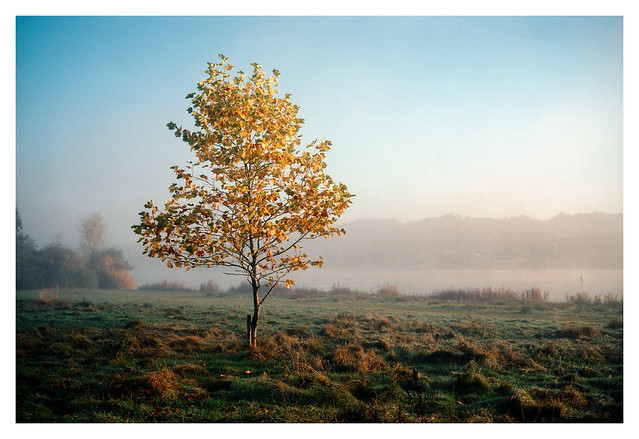
Rother Valley sunrise
Canon Sure Shot Z135
Kodak Gold
Lab developed. Home scanned and converted with Negative Lab Pro.

December

Garden shed
Yashicamat 124G
Ilfotec DD-X 1+4 @ 20° 10mins

I expect that December’s picture might be changed as I still have a bunch of other stuff to develop and scan, and there may be shots amongst those that I prefer.

So that’s another year’s round-up. Now onto 2024! Have a happy New Year everyone.

35mm · Film photography · Photography

Ultramax red

The roll of Kodak Ultramax from which these photos (and those of recent and coming days) have been taken was the first I’ve ever shot of this particular film stock. I’ve been quite surprised at the strong, vivid colour in the pictures. I’m not sure if this is just how the film looks, or if my Negative Lab Pro settings have enhanced the saturation in some way (I’ve not purposely boosted the saturation).

The reds, in particular, really jump out at me, especially in these two pictures of the street-food vendor, Falafel Guys, and the traditional red British phone boxes. There’s even a hint, daresay it, of Kodachrome in those reds and blues.

Falafel Guys

Some of the effect comes, I think, from the vignetting that the Z135 has a tendency to add to pictures, but that’s not all of it. Whatever the case, I have another three rolls of Ultramax waiting to be shot. I’ll not hesitate to use it again.

Red frame white light

Canon Sure Shot Z135 & Kodak Ultramax. Lab developed. Home scanned and converted using Negative Lab Pro.

Taken 14 October 2023.