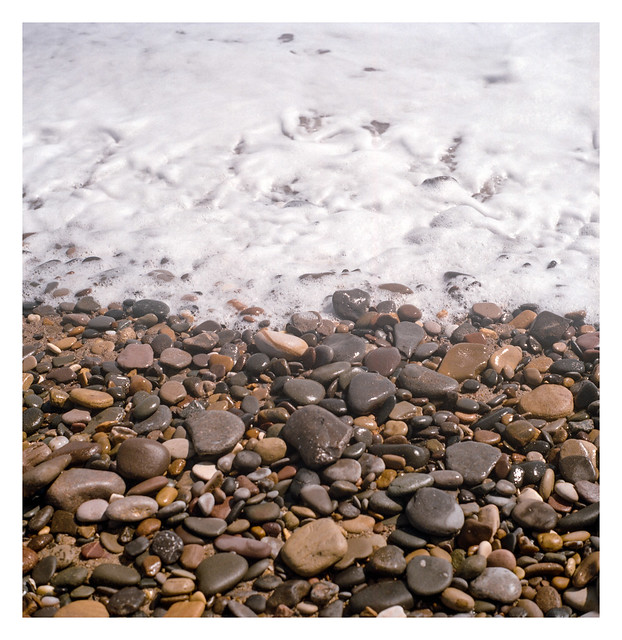
This feels like a seaside picture, but it was actually just a layer of pebbles laid down on a farm track a long way from the sea.

Nikon F80, Nikkor 70-200mm f/4 ED VR & Fomapan 400. Ilfotec DD-X 1+4 9 mins @ 20°.
Taken on 31 May 2026

Steel City Snapper photography
35mm, medium format and large format film photography (with the odd bit of digital every now and then…)
This feels like a seaside picture, but it was actually just a layer of pebbles laid down on a farm track a long way from the sea.
Nikon F80, Nikkor 70-200mm f/4 ED VR & Fomapan 400. Ilfotec DD-X 1+4 9 mins @ 20°.
Taken on 31 May 2026
Switching cameras and film for the next bunch of photos from this trip…
You can just see the north sea in the shot, but I took this one because I liked the weather-vane goat.

A view north from the top of Spurn with rough conditions (although they didn’t seem so bad further down the point). The “promontory” jutting out to sea is actually the remnants or concrete wartime structures that have fallen as the cliffs recede due to coastal erosion.

A few miles out to sea stands a large offshore wind farm, something that has become a common sight from the North Sea coastline.

I wasn’t the only photographer on Spurn Point that day…

I wonder how much time has passed since this section of brick wall fell into the sea? I’m quite impressed at how well it is maintaining its structural integrity. Perhaps it will become a large and intricately patterned pebble some day.

More groyne remnants…


And another view of the remains of man’s efforts to hold back the tides…

Among the other debris, there were a number of lobster pots washed up on shore (or shortly about to)…


There are lots of pieces of chalk scattered across the seaward beaches of Spurn Point. These have most likely been transported south from the exposed chalk cliffs at Flamborough, almost fifty miles up the coast (although the entire Holderness coast is under laid with a bedrock of Cretaceous chalk, this is mostly covered by glacial till).

Nikon F80, Tamron 28-300mm F/3.5-6.3 Di VC PZD on Fujifilm Acros. Ilfotec DD-X 1+4 9mins @ 20°.
Taken on 24 August 2025
Today’s shots were also taken with my GW690, although on a different roll of film: Some Kentmere 400. Unlike the Fomapan 400, there were no defect on this roll, plus I avoided any potential bromide drag by using standard development with regular inversions. I’ve shot a couple of rolls of Kentmere 400 now and both times I’ve found it gives quite bright results and I have to drop the highlights a little. Not sure if it’s a feature of the film, or the way I’m developing it.
The first four shots were taken around the tip of Spurn Point showing the beach and dunes beside the estuary opening. In the shot of the dunes you can just make out an old sea fort dating back to the first world war in the distance. There are two forts: Bull Sand fort, and Haile Sand fort. I think the one in the picture is the former. The structure in the fourth shot is the sea traffic monitoring station. I’m not sure if it’s still manned at all, but the radar is active and the tubular antenna at the top of the building was constantly rotating.


The next four shots are of groynes and other sea defences, or what remains of them at least. These are no longer maintained, with the land now left to natural forces. You can see the battering that the man made defences have taken from the tides. I particularly like the final shot where pebbles have been jammed between the boards of a groyne by the force of waves and resulted in what reminds me of some sort of aquatic abacus.


Fujica GW690 & Kentmere 400. Ilfotec DD-X 10.5mins @ 20°.
Taken on 24 August 2025

Olympus 35 RC on Kodak Ultramax. Lab developed. Home scanned and converted with Negative Lab Pro.
Taken on 24 August 2025
I wonder what this wooden groyne looked like when brand new? And when it actually was brand new? It would be interesting to know how many years of being pounded by waves, pebbles, and sand it took to reduce it to this somewhat broken-toothed appearance.

Yashicamat 124G & Fujifilm Acros. Ilfotec DD-X 1+4 9mins @ 20°.
Taken on 20 June 2022
The beach at Hornsea has a lot of pebbles, no doubt in part because of the coastal erosion that is taking place in the region. Pebbles are interesting to look at, with an endless array of shapes, sizes, colours and textures. The colours are multiplied further when the pebbles become wet, their tones becoming more saturated, fragments of minerals sparkling in the sunlight, and some taking on a crystaline, semi-translucent appearance.

I wondered as I stood there, how long the process of taking a rough chunk of rock and smoothing it to an organically sleek pebble would take. “How long is a piece of string?” might be a suitable retort as, given the range of different types of rock and mineral, plus the fact that the process never ends, each individual piece being constantly weathered until it becomes sand, but it’s still something that I expect will take a considerable duration.
So I was quite surprised to see a large pebble formed out of a section of brickwork, complete with mortar holding the components together. While I’ve no idea when this chunk of masonry began it’s transformation, I expect it’s far more recent than I might have expected. I took a phot of the brick-pebble but it’s on a roll of film I’ve yet to develop. Hopefully, if it has worked out ok, I’ll post it on the blog.

Yashicamat 124G & Kodak Gold 200. Lab developed. Home scanned and converted with Negative Lab Pro.
Taken on 20 June 2022

