As the weather had forecast fog and mist this morning, I set my alarm to get up in time to catch it. As there was very little near home, I decided to head out into the Peak District and visit Padley Gorge.
There was plenty of fog and mist on the journey there, and plenty during the walk from the car to the location, but when I got into the gorge the mist was pretty much non-existent. I guess some microclimate effect was in force because the mist was still visible when I looked up towards the road.
Some fog an mist would have come in handy not only to add atmosphere to my pictures, but also to hide some of the other photographers. And, boy, were there a lot of them. I’ve never seen the place so busy with other people with cameras. Pretty much every direction I looked would reveal someone with a camera, a tripod, or both – often wearing a vivid red waterproof jacket too!
I can’t really complain as I was there doing exactly the same thing, but it did mean that care was required to avoid getting one (or more!) of them into my shots.
While I had my XA3 in the bag, the morning ended up being a digital-only affair, shooting with my Nikon D810 – the camera I bought for scanning my film negatives, but also with the bonus of being a good camera for other uses too, despite it being released 14 years ago. I don’t think I did the best job with it, if I’m honest – I need more practice with it – but I was able to get a few pictures I’m happy with, including the ones in this post.
I already posted a couple of digital pictures from this hike around Damflask reservoir back in August, but the ones shown today are all on film. It’s not the complete set of images from the day as I changed rolls of film partway through the walk and I’ve not yet scanned the others, but I expect they will appear at some point in the future.
We’ve had a long spell of very hot and dry weather through the summer here in the UK (indeed, as has much of Western Europe). Parts of the country were hit by wildfires more serious than would normally be seen in a dry period, and many parts of the nation were placed under drought conditions.
At the time these pictures were taken drought conditions had not yet been imposed by Yorkshire Water, but it’s quite clear by the reservoir levels that insufficient rain had fallen to keep then at a healthy volume (although, looking at an older image I took in 2017 which is very similar to the picture above, the reservoir has been similarly depleted before).
These water gauges give an indication of how the water level has fallen.
This is the spillway from the reservoir for when it overflows. It doesn’t look like much water has flowed over it for some time.
The reservoir would reach the treeline in normal conditions, and the triangular spit of land would be completely submerged.
It will be interesting to revisit in a few months to see if the water has returned to a more healthy level – particularly given we are forecast to have a wet and stormy autumn followed by a cold winter due to this year’s El Nino.
Nikon F80 & Nikkor 24-120mm f/4 ED VR on Fujifilm Acros II. Ilfotec DD-X 1+4 9mins @ 20°
There was some police tape wrapped around this tree when I took a walk around Damflask reservoir a couple of months ago. It was upside down and back to front though.
Nikon F80 & Nikkor 24-120mm f/4 ED VR on Fomapan 400 (@200asa). Ilfotec DD-X 1+4 9mins @ 20°
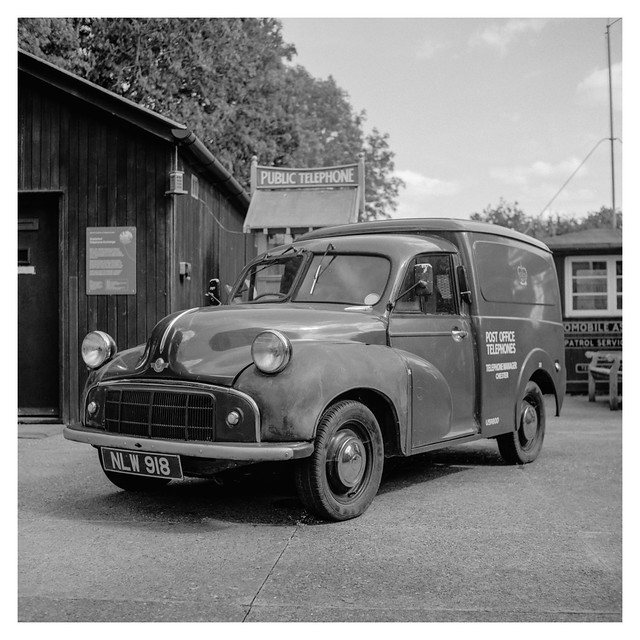
Within the grounds of Avoncroft Museum of Historic Buildings is the National Telephone Kiosk Collection which, amongst other things, includes every type of telephone kiosk used from 1912 to the present day.
I took some photos at the start of the day on 35mm film, and then just before I left on medium format.
Nikon F80 & Nikkor 24-120mm f/4 ED VR on Fomapan 400 (shot at 200asa) AND Yashica Mat 124G on Ilford HP5+. Ilfotec DD-X 1+4 9mins @ 20°
I’ve still got some more images to post from Avoncroft Museum of Historic Buildings to come, but they’re either medium format pictures, or a few that I’ll bunch together in a themed post (a mix of 35mm and MF).
The pictures today didn’t really have a particular story to them though, so I felt it best to just do a big image dump.
Nikon F80 & Nikkor 24-120mm f/4 ED VR on Fomapan 400 (shot at 200asa). Ilfotec DD-X 1+4 9mins @ 20°
One of the buildings at Avoncroft Museum is a tollhouse which was originally located at Little Malvern, Worcestershire. It was built by the Upton-upon-Severn Turnpike trust in 1822 for a total cost of £56 (equivalent to around £6,400 today – if only new houses cost so little now!).
The house was manned by two volunteers – a married couple both dressed in vintage attire and carrying out tasks using the equipment of the day. The lady was in the kitchen, preparing a whole array of baked goods – bread rolls, rock cakes, pies, and a joint of pork to be roasted. While the food wasn’t being prepared for visitors to the museum, we went back to the tollhouse later in the day and were kindly treated to a sample of some of the wares. I had a rock-cake, which was very nice, but one of our party even went so far as to take some of the bread rolls – spread with fresh hand-churned butter – home with him!
The house was fully fitted out with period furniture and appliances, including this wash-stand in one of the upstairs rooms.
Nikon F80 & Nikkor 24-120mm f/4 ED VR on Fomapan 400 (shot at 200asa). Ilfotec DD-X 1+4 9mins @ 20°
As I mentioned in yesterdays post, back at the beginning of August I took a trip to visit Avoncroft Museum of Historic Buildings, which is situated in Worcestershire (that’s pronounced “wustersher” for any non-UK folks that are reading) in the West Midlands.
The trip was a get together of photographers form an online forum that I’m a member of. There were only three of us present – well, four actually, but the other person arrived separately and we somehow managed to miss each other for the entire time we were there!), and after some introductions – it was the first time we’d met in “real” life, we spent a few hours wandering around the place taking photographs.
The museum opened in 1967 to provide a location for the reconstruction of a 15th-century timber-framed house which had been carefully dismantled in Bromsgrove in 1962. The site is an open air collection of now over 30 buildings that have been rescued from demolition and rebuilt on the site. It was the first open air museum in England.
As usual, I spent more time looking for photographs than I did finding out about the different buildings, but I’ve added a few notes about some of the structures below where I have them…
This dovecote was originally located at Haselour Hall Manor, Staffordshire and was constructed in the early 17th century.
The windmill originates from Danzey Green, Warwickshire.
This 16th threshing barn was originally located at a farm in Cholstrey, Herefordshire.
Known locally as the ‘iron church’ or tin church’, this church was built in the parish of Whitbourne, Herefordshire, in 1891. This type of inexpensive kit-built church were built in newly established industrial areas, and isolated rural and coastal locations to promote Christianity and combat non-conformism.
Nikon F80 & Nikkor 24-120mm f/4 ED VR on Fomapan 400 (shot at 200asa). Ilfotec DD-X 1+4 9mins @ 20°
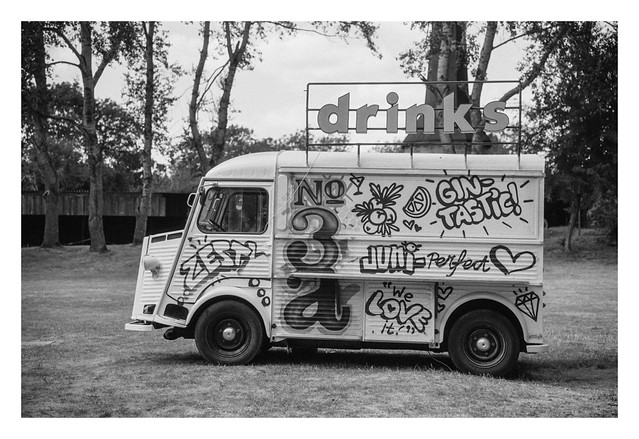
A couple of months back I visited Avoncroft Museum of Historic Buildings and have quite a few pictures to share from the day. However, as I still haven’t had time to sit down properly to pull that post together, here are a couple of shots taken during the visit NOT of historic buildings.
Nikon F80 & Nikkor 24-120mm f/4 ED VR on Fomapan 400 (shot at 200asa). Ilfotec DD-X 1+4 9mins @ 20°
As of today I have seven rolls of film waiting to be scanned. All 35mm rolls, all 36 exposures except for a single bulk-rolled short roll that just has 15 shots. So somewhere in the region of 230 pictures yet to scan.
I addition I also have three rolls that have been scanned, but not yet post-processed. Again, all 35mm, but this time two 36 exposure rolls and another short roll, which bumps the total up to around 320 images in total.
I have another 36 exposure roll in one of my cameras with perhaps two or three frames remaining, so when that is finished and developed I’m at nearly 360 photographs.
Usually my dev>scan>process workflow is much quicker, but I’ve been holding back recently, in part because I’ve had a bunch of already processed shots to upload and so wasn’t in a rush, but also because of something I saw in a YouTube video I watched a while back from Sean Tucker. The video is all about how to choose your best images and in part refers back to one of his earlier videos where he interviewed landscape photographer Rachel Talibart who explains her approach to reviewing her images.
She says that, often, after a day of photography, she returns home on a high about the pictures she’s taken and can still be tripping about the experience for some time afterwards. This mood, she says, is not the best for objectively assessing the photographs she’s taken. Because she’s still tripping on the experience, the photos will often be a disappointment and no match for the fresh memories of the experience. She also finds it very difficult to edit the photographs while still on the high.
Looking at the photos straight away distorts her appreciation of the images. She’s often looking for something very specific and can discount the images that don’t meet this preconception. As a result she can miss good pictures. However, if she looks at them later – six months, a year, two years, the good images she might have overlooked initially present themselves much more readily to her now more objective eye.
I’ve recently been looking back through older, mostly digital, images and found this to be the case, finding pictures that I did nothing with that are actually, to me at least, quite good and more than worth revisiting.
So, while I have a glut of film pictures, I’m trying to take a similar approach and waiting to scan and process them. I still have an idea what is on most of the rolls I’ve shot, but many of the individual frames have faded from memory so when I come to scan them they will appear fresh to my eye and, hopefully, I’ll be able to objectively assess them and see which are good.
This obviously comes down to my own subjectivity in terms of what I do and don’t like, but I’m looking forward to see how this technique works. At the very least, the anticipation I feel is making me very much look forward to revisiting the scenes I felt worthy of a picture back when I photographed them.
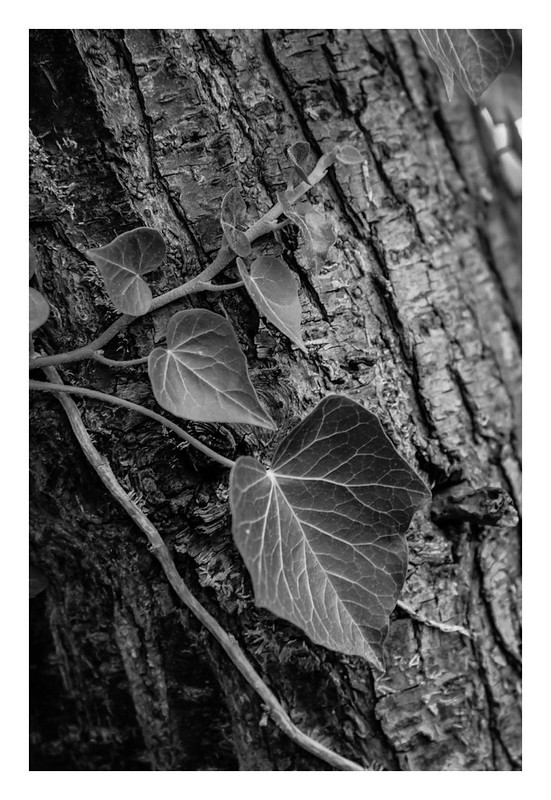
Ironically, some of the photos I have been uploading recently are more recent ones that have jumped the queue, including this slightly apt picture…
Nikon F80 & Nikkor 24-120mm f/4 ED VR on Fujifilm Acros II. Ilfotec DD-X 1+4 9mins @ 20°