The last few from Newark Air Museum…


Yashica Mat 124G & Kodak Tri-X. Ilfotec DD-X 1+4 for 8 minutes @ 20°
Taken on 24 April 2025

Steel City Snapper photography
35mm, medium format and large format film photography (with the odd bit of digital every now and then…)
The last few from Newark Air Museum…
Yashica Mat 124G & Kodak Tri-X. Ilfotec DD-X 1+4 for 8 minutes @ 20°
Taken on 24 April 2025
More from Newark Air Museum…


Yashica Mat 124G & Kodak Tri-X. Ilfotec DD-X 1+4 for 8 minutes @ 20°
Taken on 24 April 2025
I’ve already posted about this trip to Newark Air Museum on the day I visited, where I shared a few digital photos I’d taken. I’ll not go over the events again, but I’ll post some of the film photos I also took during the visit today, and over the next day or two.


Yashica Mat 124G & Kodak Tri-X. Ilfotec DD-X 1+4 for 8 minutes @ 20°
Taken on 24 April 2025
I took a trip to Newark Air Museum today. This wasn’t my first visit (I think it’s my third), and I’ve posted pictures from the previous visits here on my blog, but today was the first time I’ve visited with my dad.
Actually, having said the above, it’s actually my fourth visit, because today was a second trip with my dad following an aborted attempt last autumn when we drove all the way there only to find out upon arrival that there had been a problem with the museum’s water supply and that it was closed as a result.
Thankfully, there were no such issues today (although I did phone them in advance, just to be sure!) and we got to wander around the place at our leisure for a few hours. My dad, now in his mid-80s, served his National Service with the RAF in the late 1950s, and I think he enjoyed looking around the place. During a brief chat with another gentleman of similar age, where he revealed that he’d been in the RAF, the other fella asked if he’s been a pilot! He was not, although he did ride a service-issued bicycle (which he crashed while racing one of his fellow servicemen one day, which resulted in him hiding the damaged bike until he left the service 😀 ).
It was a nice day out and I should try to arrange other such visits to similar places for us both, I think.
I shot a roll-and-a-half of Tri-X with my Yashica Mat 124G while there, but the pictures below are all digital pictures from my Ricoh GR III compact.


Ricoh GR III
Taken on 24 April 2025
I thought I’d throw in another air museum photo before moving onto something new tomorrow.
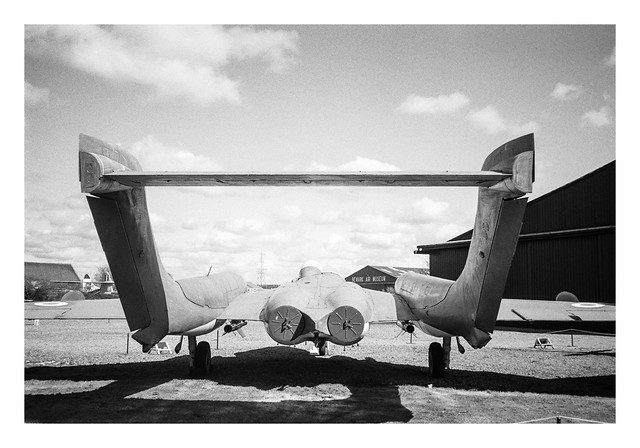
Today it’s the back end of a DeHaviland Sea Vixen, a twin-boom carrier-based fleet defense aircraft that was introduced in the 1950s and saw service into the 1970s before being replaced by McDonnel Douglas Phantoms.
The asymetric cockpit is an interesting feature.
Today I went for a drive out to Rufford Abbey (although most of my time was spent wandering the surrounding Rufford Country Park). It was a nice day and the place was very busy, but I shot a couple of rolls of film with my Texas Leica (the Fujica GW690). The first roll was a little loosely wound when I removed it from the camera, so I’m expecting there may be some light leaks, but I took care to ensure the second roll was tightly wound on the takeup spool before closing the camera back and that came out fine. I shot half the second roll at Rufford Country Park, and the remaining frames at a couple of places I stopped off at on the way home. Pictures to come at some point (although I’ve got loads of other stuff before then!).
Canon Sure Shot Supreme & Ilford HP5+. Ilfotec DD-X 1+4 9 mins 30 secs @ 20°
Taken 7 April 2023.
The cockpit of a SEPCAT Jaguar T2A.

Canon Sure Shot Supreme & Ilford HP5+. Ilfotec DD-X 1+4 9 mins 30 secs @ 20°
Taken 7 April 2023.
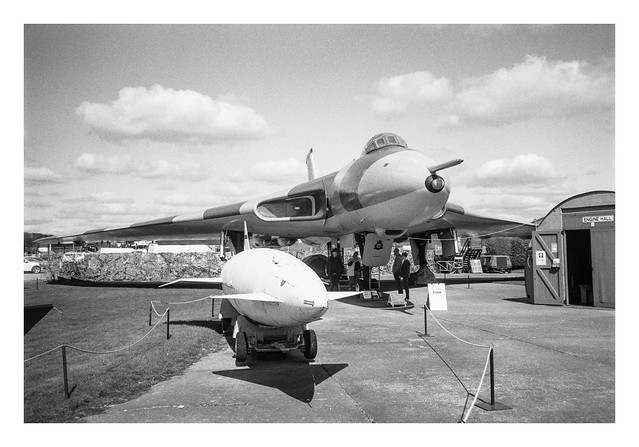
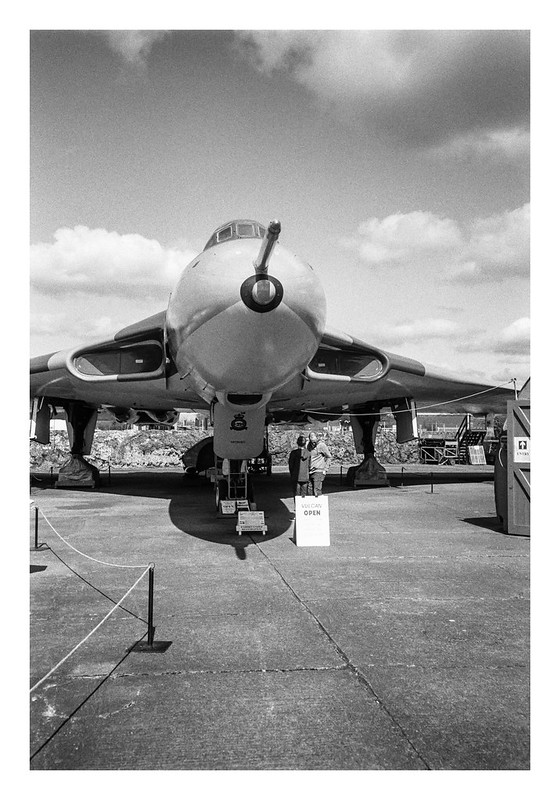
The Avro Vulcan bomber is a truly impressive aircraft. It’s huge delta wings span almost 100 feet and it’s an imposing feeling when you walk beneath. The Vulcan was one of three aircraft that formed to so-called V-Bombers – the other two being the Vickers Valliant (two Vs in one!) and the Handley Page Victor. – Britain’s nuclear capable bomber force from the 1950s to the early 1980s. In the mid-1960s the V-bomber fleet counted almost one-hundred-and-sixty aircraft, with Vulcan making up the largest part with seventy aircraft in service.
Seeing one of these fly is a majestic experience, the noise of the engines and the shape of the huge delta wings was unforgetable and I remeber seeing them in flight sometimes as a child, and was also fortunate enought to see one of the (then) surviving airworthy aircraft making a display flight at an airshown in the 1990s.
Sadly, none of the surviving Vulcans is in airworthy condition any longer, although there are three which are taxiable, and the one pictured here at Newark Air Museum is on static display (although it is possible to go inside the aircraft).
Live long and prosper! (I had to get that in! :))
Canon Sure Shot Supreme & Ilford HP5+. Ilfotec DD-X 1+4 9 mins 30 secs @ 20°
Taken 7 April 2023.
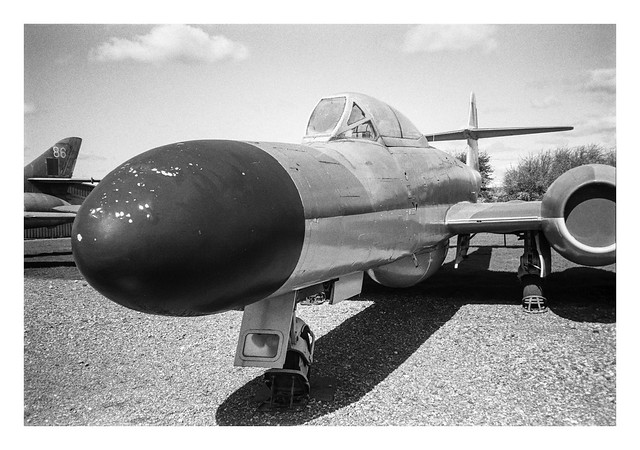
A couple of days back I posted about the Shooting Star (or the Lockheed T-33A, as it was formally known), today I have a picture of a Meteor. A Gloster Meteor NF-14.
The Gloster Meteor was the first British jet fighter, and the only one to see service during World War II. Several versions were produced, and the NF-14 was designed as a night-fighter variant to supercede the DeHavilland Mosquito. The NF-14 entered service in 1954 but was already being replaced by more advanced aircraft just a couple of years later.
Canon Sure Shot Supreme & Ilford HP5+. Ilfotec DD-X 1+4 9 mins 30 secs @ 20°
Taken 7 April 2023.

Canon Sure Shot Supreme & Ilford HP5+. Ilfotec DD-X 1+4 9 mins 30 secs @ 20°
Taken 7 April 2023.
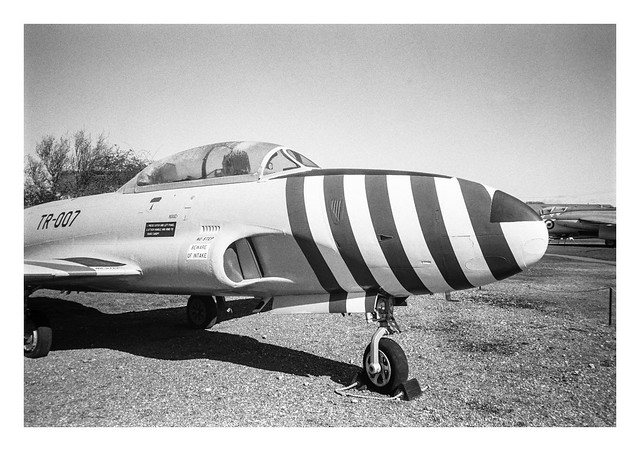
Of all the aircraft at Newark Air Museum, it was the Lockheed T-33A that got the most attention from my camera. Something about those zebra stripes on its nose did it for me a guess.
Although originally put in service as a jet fighter, the Shooting Star (or T-Bird as it was otherwise known) spent much of it’s operational life serving as a training aircraft. Amazingly, despite first going into service in the late 1940s, the Bolivian airforce only retired theirs from service in 2017!
It’s a pretty nice looking machine.


Canon Sure Shot Supreme & Ilford HP5+. Ilfotec DD-X 1+4 9 mins 30 secs @ 20°
Taken 7 April 2023.

