Apologies for another post of few words*. I’ve had to pick up my wife and her sister from the airport today (they’ve visited their other sister who lives in Spain) and the three hours or so of driving has taken it out of me a little, especially as it’s still quite warm at present. At least the route home was quite scenic, and gave me some inspiration,
Today’s photo was made when visiting Photo North in Leeds, amazingly already three months ago!
This 16th century thatched cottage in the village of Old Whittington, which is now a suburb of Chesterfield, was once the location for a plot to overthrow the king of England, James II.
The conspirators were three local noblemen William Cavendish, 4th Earl of Devonshire, John Darcy, fourth son of the Earl of Holderness, and the Earl of Danby. Upon hearing that James had given birth to an heir who would be raised as a catholic, the men plotted to replace James with William of Orange, first taking control of the north before marching south to take the throne.
James fled before William’s approach and the result was a bloodless change of monarch.
Revolution House was formerly an inn named the Cock & Pynot, and the conspirators met there under the guise of a hunting party to concoct their plans. The building was converted to a private residence and, over time, it’s size was reduced. It is now a free-to-enter museum.
Canon Sure Shot Z135 & Kodak Gold. Lab developed. Home scanned and converted using Negative Lab Pro.
Shepherd Wheel is a working museum in the Porter Valley in Sheffield. It’s one of the earliest surviving water-powered grinding workshops in the area. The earliest reference to the wheel is from the 14th century.
The wheel still powers a variety of machinery in the workshop where caraftspeople can be seen putting them to use. It’s fascinating to see the ingenuity of the design, with numerous pieces of machinery powered by a complex series of shafts, cogs, gears, and belts.
I had my Sure Shot Z135 on me when we ventured inside and while this is a capable point-and-shoot (with a flash), I wanted to try and get a picture in natural light. The actual machinery was probably going to be a step to far for the f/3.5 maximum aperture of the camera, but I was able to take this image of some old pots and pans in the light of a window. I’m quite pleased that it came out nice and sharp, and that the film has captured detail in both the highlights and shadows.
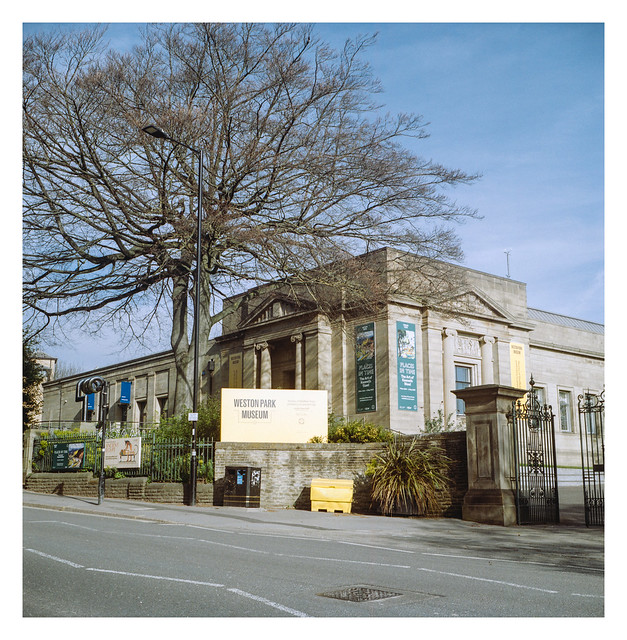
Weston Park was the first municipal park in the city of Sheffield and formed from the grounds of Weston Hall. The hall itself would become Weston Park Museum incorporating the Mappin Art Gallery. The museum opened in 1875 and was extended thirteen years later.
The museum contains permanent exhibits on the local archeology, natural history, art, and social history, as well as regular temporary exhibitions.
The building was severely damaged by a bomb during the Second World War and the art gallery remained closed to the pubic in a damaged state until 1965.
As I type this, it’s a lovely evening outside. Just the other day, on the journey home from our coach trip, I commented to my wife on how nice the early evening light was and that I should really make a better effort to take advantage of it through the longer days of the summer. However, no matter how nice it looks, the effort required to get myself up and out after a day at work means I rarely do so. I must try harder! I am planning on heading out tomorrow to shoot one of the rolls of expired film I posted about last week though, so the photography itch will be scratched, albeit with no guarantee of successful images.
Yashicamat 124G & Lomography Color Negative 100. Lab developed. Home scanned and converted with Negative Lab Pro.
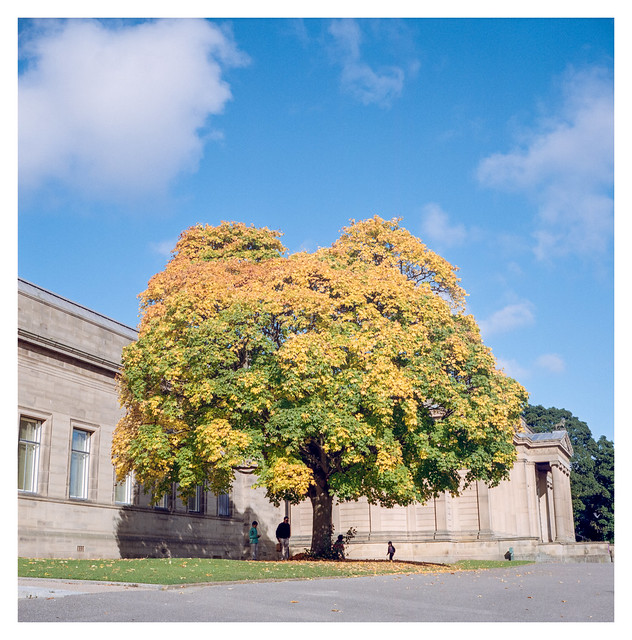
Early last month, on a bright sunny day, I took a walk around Weston Park, Crookes Vally Park, and the surrounding areas. I took my Yashica Mat 124G loaded with some Lomography Color Negative 100 film, and my Sure Shot Telemax containing some Kodak Gold (the results from which I’ve been posting here over the past week or so).
This was the first time I’ve used the 100asa Lomography Color Negative variant, although I’ve shot several rolls of the 400asa version and liked the results. As is my current process for medium format colour films, these have been home-scanned as linear tiff files with my V550 using Vuescan, and then converted to positives using the free Grain2Pixel Photoshop plug-in. I found that, while the initial conversions looked pretty good, I’ve still had to tweak them to get them looking “right” – or at least as “right” as my own eyes reckon they should be. Grain2Pixel is a very good piece of software, especially given it is free-of-charge, but I do find that I have to remove colour casts sometimes depending on the film I used. The scanner (Epson V550 for medium format / Plustek 8100 for 35mm) can also make a difference too.
Occasionally, certain frames from a roll produce very odd results – oftem at odds with the rest of the shots from the same roll. I tried using the trial version of Negative Lab Pro to compare with the Grain2Pixel results on some of these and it also went slightly crazy – with colour tones looking very odd. All the shots here today were pretty straightforward to deal with though.
Anyway, the three photos today are all from the Lomgraphy 100 roll, shot with the Yashica, and all three made in Weston Park (with the museum visible in the first, the bandstand in the second, and the nearby Univesity Arts Tower in the third). Autum was underway, but the trees still held onto most of their leaves and a good amount of green at this point.
Yashica Mat 124G & Lomography Color Negative 100. Grain2Pixel conversion.