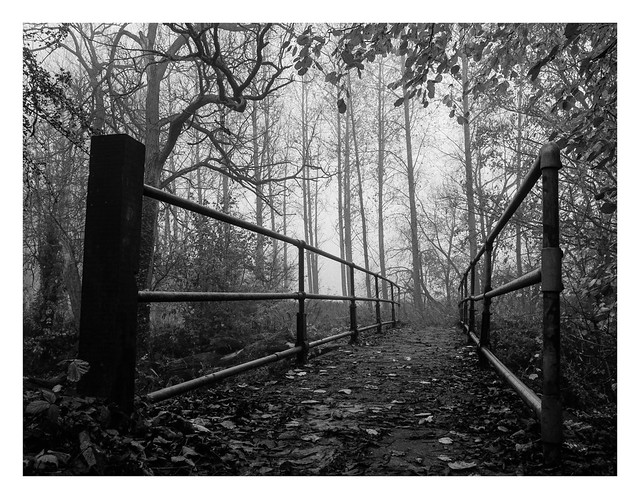
A companion shot to yesterdays trees in the mist. You can see that same copse of trees on the other side of the footbridge, but this shot was made before the ones posted yesterday. I collapsed the tripod down to get the low point of view.
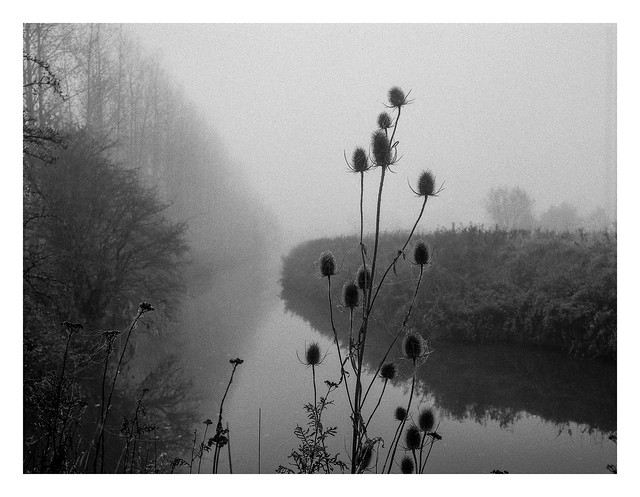
I’ve undoubtedly said this before on here somewhere, but I’ll say it again: Fog and mist are a gift to photography. The diffused light; the sense of calm; the way they hide and obscure distracting detail; and – most of all – the sheer atmosphere (quite literally) that they bring to bear is a wonderful thing to behold.
I do admit to saying this as someone for whom fog and mist are relatively uncommon – at least at the times I’m usually out of bed! I can fully understand the “grass is always greener” sentiment that this bears, and that for those who live in places with regular foggy conditions that this might all be a bit business-as-usual. But for me, well, I love these conditions.
So, when I saw the weather forecast showing this day as having fog, I was up early and out with my camera. I went somewhere I’ve been a number of times before – a walk that takes me across the River Rother, through a copse of trees (it’s probably a plantation as the tress – Poplars I think – are in somewhat orderly rows), and then either up to the Trans-Pennine Trail, or looping alongside the river, then down to Renishaw golf-course, and back around to the starting point.
I’ve photographed these trees on a number of occasions and know that the look their best in a veil of mist. It’s not a large area and on clear days it’s easy to find a distracting background element creeping into the frame. In fog, however, the trees feel like they go on forever.
This was just a grabbed shot made when I noticed the way the buildings at the top of the street were lit by the sunshine. I like how the buildings to either side cast the foreground into shadow, taking us out of the darkness and into the light. The car is nicely placed and is mirrored to an extent by the lone person across the road. And, while I didn’t notice it at the time of making the picture, I’m quite happy about the letting sign that says “Sun Casa”, which also feels like it fits.
I’ve picked up some new cameras this week. Today I collected a box very kindly gifted to me containing a Pentax ME Super, with 50mm, 35mm, 70-200mm and 70-150mm (Tamron adaptall) lenses. Oh, and a teleconverter. There was also a Topcon RM300 with 55mm Topcor lens and a faulty Pentax MG. The ME Super appears to work ok (although I’ve not done much other than dry fire it so far, and the previous owner had not used it at all, so we’ll see). The Topcon appears to work, but the film-advance lever is loose with a long stoke, so will have to see with that one too. It’s also missing it’s battery cover, so it can probably only be used with manual metering of some sort. The MG is in pretty tatty condition so I doubt I’ll do much with that.
Even if the other two cameras turn out to be faulty, the lenses are all hopefully in good working order, so I can use them with my Pentax P30T.
The other camera I got this week was a purchase – one that I’ve been mulling over since the summer when I put some money I’d saved aside. After watching the prices gradually increase, I decided to finally take the plunge and hit the buy button before they went above what I was willing to pay. So I’m now the proud owner of a Fujica GW690. I’m hoping to get time (and weather!) to try it out this weekend. It came with a roll of Velvia already loaded with one shot taken, so I’ll finish that off and hopefully get it developed next week. After seeing what this camera is capable of, I’m looking forward to it. While I was expecting the size – it’s not nicknamed the Texas Leica for nothing – the weight was a little unexpected. Someone else I know had described theirs as a “big plastic box”. I’m assuming that they must’ve had one of the more recent models because the one I have is built like a tank, and weighs about as much too!
Photos will appear here in due course.
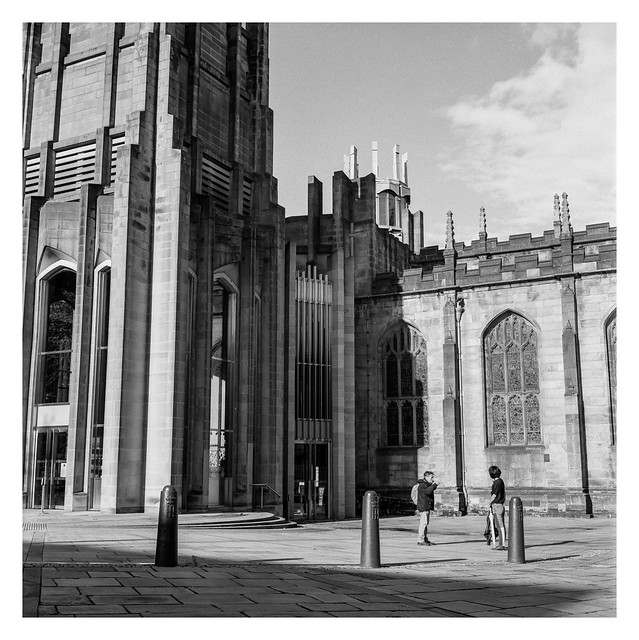
All the photos in today’s blog were made back at the start of the month while walking past the cathedral on a day of lovely sunshine, which granted me some great contrast and shadows to work with.
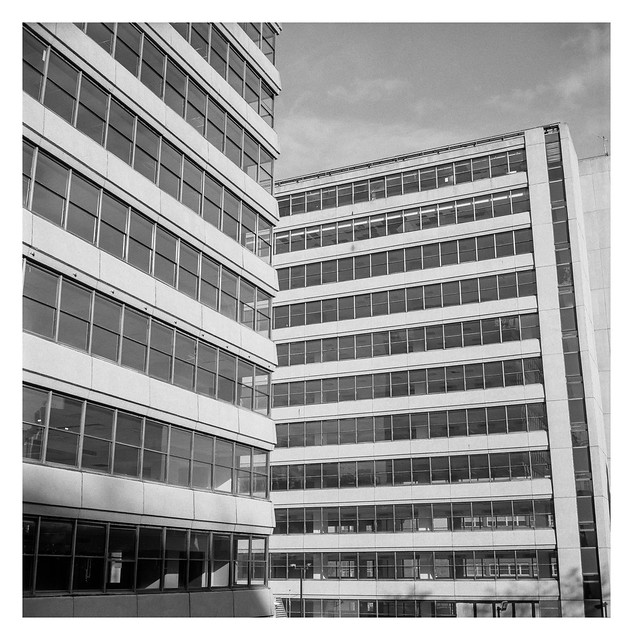
The Pennine Centre is Sheffield’s largest office complex. Construction completed in 1975, having taken two years.
For many years, the structure was the home of the HSBC bank (or Midland Bank in its earlier years), but they have recently cacated the premises to move to new office space in the city centre. The service centre where I used to work did so much business with the bank that some members of staff were permanently on-site.
The building is currently vacant, but expecting new tennants. I spoke briefly with a security guard before making this photo and was impressed to hear that there are several floors of underground parking beneath the structure.
This is a view through the window of The Ship Inn. On Shalesmoor. In Sheffield. And, to continue the alliteration, it is shut.
Many pubs in the UK are closed at present because of stricter lockdown measures currently in place. While the rules differ across the four nations that make up the UK (England, Northern Ireland, Scotland, and Wales), here in England pubs must remain closed unless thay are providing takeaway meals.
This situation will remain in place until early December at least, when the current rules will be reviewed. However, given the desire to allow people to see one another at Christmas – something itself fraught with risk – I don’t expect that pubs will re-open to anything approaching normal rules for a long time.
I suspect there will be fewer pubs come the end of this pandemic.
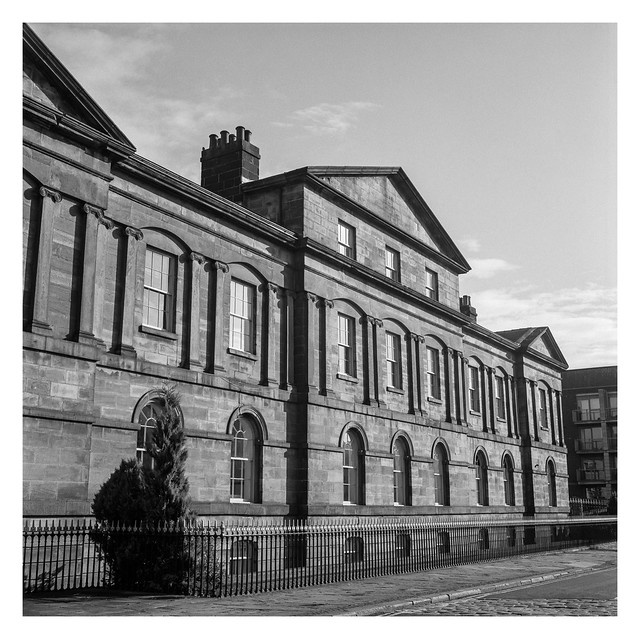
Globe Works is a former cutlery factory situated in the Shalesmoor area of sheffield.
The building has a Grade II listed status and was renovated in the 1980s. The building is now home to a number of businesses, creative endeavours, and start-ups.
The works dates back to 1824 and was one of the largest specialist steel-making facilities in the world at the time, and possibly the first ever custom-built cutlery factory. As well as cutlery, they produced scissors, tools, and even specialised in the manufacture of Bowie knives for the American market.
The building has seen off a number of threats through its history, including a bombing by union activists in 1843, an attempt to remove the listed status by the town planning committee so it could be bulldozed to make way for a road, and, most recently – in 1978 – an arson attack that left the site derelict until the restoration work took place in the 1980s.
This is the corner of The Fat Cat, a pub in Sheffield’s Kelham Island area – somewhere I seem to make a lot of photographs, despite living nowhere near the the place.
The Fat Cat dates back to the Victorian era, being built in 1850. As a result of it’s age, and it’s position close to the course of the River Don, it was affected by the flood in 1864 when Dale Dyke resevoir collapsed catastrophically, killing over 240 people as the water descended it’s course to the centre of the city.
One-hundred-and-forty-three years later the pub was once again engulfed by flood water, this time caused by torrential rain. Three people lost their lives in this event.
The pub has two markers painted on it’s wall denoting the water level of both floods.