Although it was a cold day when I made these photographs in the snow, it was also very bright. And I was wearing dark clothes. This had two detrimental effects.
The first was the sheer amount of light reflected back off the snow. As a wearer of spectacles, I don’t tend to have the luxury of just popping on a pair of sunglasses when it’s bright. I don’t have a pair for my prescription, not do I have any clip-ons (although those just tend to be an annoyance). But without sunglasses, the light bouncing back into my eyes from the floor was verging on painful. I’ve never suffered from snow blindness before, but now know what it must feel like in its onset. Even with my eyes shut the blankness of my eyelids was a glowing red.
The second thing was that it didn’t take me long to become pretty hot and uncomfortable. The light absorbancy of my dark trousers and jacket soon raised my temperature and then this was booster even further by the physical effort of walking through snow (or trying my best to keep balanced on the icy areas). It didn’t take long until I was sweating profusely!
Despite these drawbacks it was a beautiful day to be out. We don’t get snow all that often, so it’s good to take advantage of it when I can.
Bronica ETRSi & Zenzanon 75mm f/2.8 PE & Ilford HP5+. Ilfotec DD-X 1+4 9 mins 30 secs @ 20°
One thing I was particularly pleased about with this roll of snowy scenes was that I managed to expose the majority of them well. Snow can often blow out or be rendered an unattractive grey if not given the correct exposure and recommended guidance if to use exposure compensation to over-expose if you’re using a reflective meter, such as the one built into many cameras.
My Bronica doen’t have a meter though (even the one in my metered prism seems to have carked it!), so I rely on a handheld meter instead, and my preferred technique is to use incident readings – the light falling onto the subject, rather than the light reflecting off it. This has a benefit of giving an accurate reading in these sorts of scenes (well, most of the time anyway). I think a couple of my shots were not metered as well as the others, but even those were retrievable in post processing.
The two below look pretty good though.
Bronica ETRSi & Zenzanon 75mm f/2.8 PE & Ilford HP5+. Ilfotec DD-X 1+4 9 mins 30 secs @ 20°
There will be a number of snowy photographs to come over the next few days – the results of a brief spell of wintery weather where I actually got chance to go out and take advantage of it before it went away. Most of the shots were taken in a rural setting, but this one – in a brief section of my walk that went through a suburban area – turned out particularly nicely, I think.
Bronica ETRSi & Zenzanon 75mm f/2.8 PE & Ilford HP5+. Ilfotec DD-X 1+4 9 mins 30 secs @ 20°
I found this window to be a curious feature, and interesting enough to make a photograph. Because of the location of the house it probably gives a clear view of the road that curves past the rsidence – approaching from the right of frame and then going behind the point of view. Whether there was a practical reason for this beyond giving a nice view, I don’t know.
Bronica ETRSi & Zenzanon 75mm f/2.8 PE & Ilford Delta 100. Ilfotec DD-X 1+4 10 mins 30 secs @ 20°
Apologies for the somewhat curtailed post yesterday. I wasn’t a happy man.
Following a pleasant day out at Newark Air Museum on Friday, I set about developing four of the large format photographs I’d shot. After the process was complete and I saw the images as I hung them to dry I was met with immediate disappontment. There were significant faults on the photographs, taking two seperate forms.
Firstly, the scenes I’d been careful to compose were all out of kilter. Objects that were perfectly framed or centred were no longer in the positions I’d intended when I made the pictures. I can lay the blame for this on two factors: First, the tripod centre column was not tightened fully, so I think I must’ve caused it to rotate slightly when inserting the film holders. Second, because I was having difficulty getting the film holders fully into place, requiring additional force and exacerbating the problem with the untightened tripod.
Secondly, despite me thinking the issues I’d had previously with light leaks were behind me, they clearly are not. Each shot exhibited problems with light leaks. I think the proble lies with the camera rather than the film holders or my technique as the light leaks are identical on each shot, despite using several different holders. Upon developing the other four sheets today I sufferd the same issue, more light leaks in the same configuration, except these are worse as the HP5+ is more sensitive than the Fomapan 100 used in the original four shots, making the effect much more pronounced.
Obviously this was a huge disappointment, and to say I was unhappy is cutting it light. It was a 70-mile round trip, plus entry costs, added to the spoiled film. The worse part is that it was the first nice day I’ve had for ages when I’ve had chance to go somewhere farther afield with a camera. I don’t get as much time to do this as I’d like so to have the time wasted to a large degree (and that includes two one-hour film developing sessions) is probably the hardest part to bear.
To try and be positive, I did have a nice day at the museum and took time to look at the exhibits without a camera in front of my face all the time. I also had my Sure Shot Supreme with me and shot about half-a-roll of HP5+ with that, so those will hopefully turn out ok, meaning it won’t be a complete bust, photographically speaking.
I’ve looked at the Fomapan 100 shots again to day and have managed to Lightroom / Photoshop a lot of the light-leaks form the shots and, with some cropping, got a few pictures that are probably worth posting. But they’re not the shots I intended. Whether I’ll be able to recover anything from the more severely spoiled HP5+ photos, I don’t know. I haven’t even bothered to scan them yet, such is my disappointent.
The photo below wasn’t a disappointment – this was taken at Hooton Pagnell a couple of months back and is the entrance to the church. It was quite a tricky exposure, but one I’ve been fortunate enough to make a good job of. Sometimes things work out ok, thankfully.
Bronica ETRSi & Zenzanon 75mm f/2.8 PE & Ilford Delta 100. Ilfotec DD-X 1+4 10 mins 30 secs @ 20°
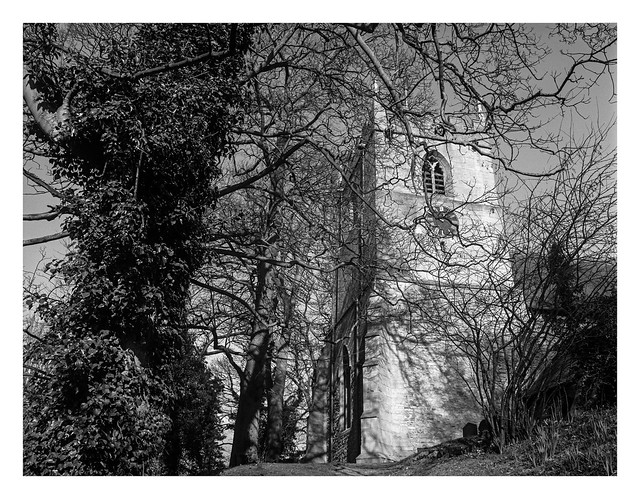
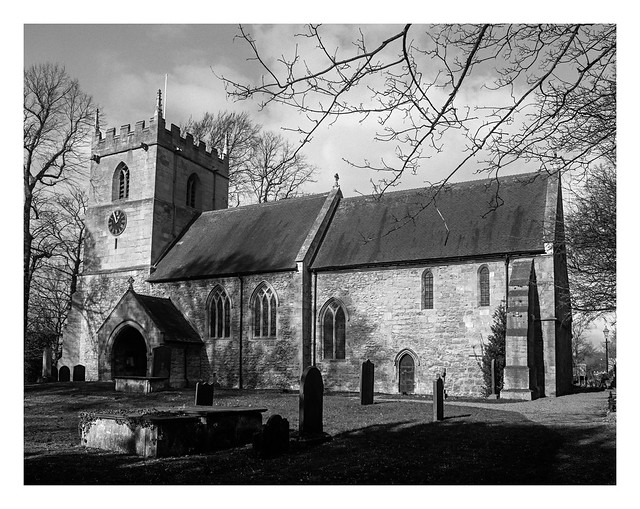
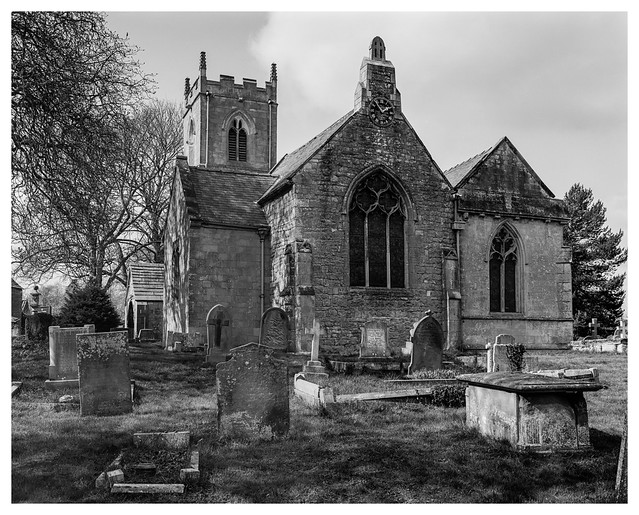
As I’ve been posting pictures of churches over the past few days, I might as well post another. This one wasn’t shot on 4×5 large format, instead it’s a small-by-comparison 6×45 medium format ratio. Despite the smaller negative, the Bronica ETRSi still produces very nicely detailed photographs, such as this one of All Saint’s church in the village of Hooton Pagnell.
I managed to get out and make more photos today. Amazingly, given my usual poor luck when it comes to the weather, it was a beautiful spring day – all blue skies and (later on) fluffly little cumulus clouds. I had a momentary mini panic this morning when I woke to see the lovely conditions but without having a clue where to go to take advantage of them. In the end I decided to visit Newark Air Museum and take some large format photographs of the old aircraft they have there. I exposed 8 sheets of 4×5 and also managed to finish off a roll of 35mm HP5+ in the Canon Sure Shot Supreme that I had in my coat pocket. I’ll try and develop some of the 4×5 pictures tomorrow all being well.
Bronica ETRSi & Zenzanon 75mm f/2.8 PE & Ilford Delta 100. Ilfotec DD-X 1+4 10 mins 30 secs @ 20°
Another church, and another named after St. Peter just a couple of days after I posted a photo of its namesake at Elmton.
Quite a difference in architecture between the two buildings though.
When dust-spotting the scan I spotted a lone pigeon hiding in the scene. Can you spot it? You’ll probably need to click through to Flickr to see the full resolution version in order to find it though.
I’m now very much looking forward to the four days off work that the extended Easter weekend will bring. I’m hoping to do some more photography if the weather remains decent.
This village sits on a hillside, with the road running through the top part of the community being approximately fifty feet higher than the bottom part. While not a huge difference in elevation, it means that nice views across the rooftops and over the landscape beyond can be had.
The first shot shown here today was taken from the high road (which you can see in the picture posted yesterday) looking down onto the lower part of the village. The second picture shows the house at centre left in the first image but from a lower footpath.
Bronica ETRSi & Zenzanon 75mm f/2.8 PE & Ilford Delta 100. Ilfotec DD-X 1+4 10 mins 30 secs @ 20°