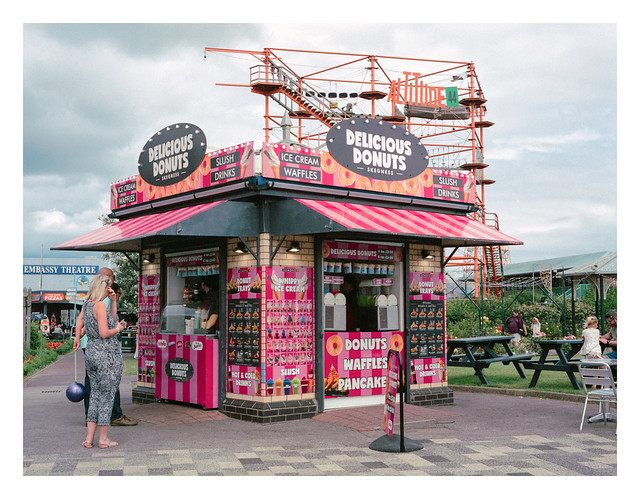
I’ve posted a picture of this ice cream truck before, that picture shot with my large format camera on the same day I took this photo, but the carriage in the second shot was only photographed with my Bronica ETRSi.
I don’t have a clue which type of carriage it is – I did look online, but backed out of the rabbit-hole of potential sunk time before I lost hours to detective work. It’s difficult to know just how old it might be. It could date back to when such things were a primary mode of transport, or it could also be a more recent vehicle, used for displays or special occasions or something, which has been left to decay. Whatever the case, it was interesting to see it there, albeit behind a metal fence that adds little to the picture.
Bronica ETRSi, Zenzanon 75mm f/2.8 PE or Zenzanon 150mm f/3.5 MC, and Ilford HP5+. Ilfotec DD-X 1+4 9mins @ 20°.
Beside the Humber Bridge on the southern bank of the Humber Estuary, there is a car park for visitors. The bank of the estuary here has several benches where visitors can sit and enjoy the scenery, whether that be the spectacle of the suspension bridge, or just the water passing by on its way to the North Sea.
There is also a cafe, The Viking Way Cafe Bar, so named because it stands at the northern end of The Viking Way, a 147-mile hiking trail running from Oakham in Rutland, to the Humber Bridge. As there is evidence that the Vikings excercised control and influence over the lands through which the trail passes, particularly the Lincolnshire Wolds, so the way got its name.
Bronica ETRSi, Zenzanon 75mm f/2.8 PE or Zenzanon 150mm f/3.5 MC, and Ilford HP5+. Ilfotec DD-X 1+4 9mins @ 20°.
Often I will eke out multiple blog posts from each roll of film I shoot. At present, however, I have approaching two-hundred pictures that I’ve mostly either not scanned, or uploaded to Flickr yet, so I guess I have enoungh leeway to chuck our a batch of them all at once every now and then.
These shots are all from the same walk around the edge of town (shot on the day I used the roll of Portra 400 from which I’ve recently shared images of the Cholera Monument and other stuff). There’s no particular theme, although I guess it forms a snapshot of the sort of stuff that tends to catch my eye in an environment like this when I walk around with a camera.
Bronica ETRSi, Zenzanon 75mm f/2.8 PE or Zenzanon 150mm f/3.5 MC, and Ilford HP5+. Ilfotec DD-X 1+4 9mins @ 20°.
I took this picture not fat from the Cholera Monument, which I posted about recently. It’s a view towards Sheffield city centre. I found it interesting to see in the picture a whole host of other locations that I’ve photographed on other occasions.
I’ve photographed the new structure in the centre of the image (with the two red cranes) at least twice (here & here). Just to the left of that you can see The Hubs, which I’ve also taken many pictures of, such as this one, and this one. The “Cheesegrater” car park can be seen behind and to the right of the new construction. At the right edge of the fram can be seen Sheffield Hallam University with th red lettering at the top. On the side of the building you can just make out the “What if?” poem, which you can see here too. Behind the university building in the distance is the university arts tower, which I’ve poasted loads of pictures of, such as this.
There are several other buildings I can see where I have pictures too, some of which I’ve posted on the blog, others which I haven’t. The building in the foreground begind the grass is Sheffield Midland Station, another location where I have lots of pictures from.
Bronica ETRSi, Zenzanon 150mm f/3.5 MC, and Kodak Portra 400. Lab developed. Home scanned and converted with Negative Lab Pro
Granneli’s is a traditional ice cream and sweet shop that resides on Broad Street in Sheffield. The shop has been in business since 1874, opened by Italian brothers Luigi and Charles Granelli (although they had begun the business in different premises three years earlier). It began as an ice cream shop before expending to selling sweets. The ice cream business continues and there are Granneli’s ice cream vans serving a number of areas.
Bronica ETRSi, Zenzanon 150mm f/3.5 MC, and Kodak Portra 400. Lab developed. Home scanned and converted with Negative Lab Pro
Despite having lived in the city for five decades, I’d never visited the cholera monument in Sheffield until the day I made these pictures. I’ve seen the monument on many occasions, it sits on an elevated piece of land next to a small wooded area named Clay Woods just a few minutes walk from Midland Station, and is visble from many parts of the city, and on this day I decided I’d finally take a closer look.
The monument was erected in 1835 to memorialize those who lost their lives in the cholera epidemic that struck the city three years previously. Over four hundred people lost their lives and the majority of them were buried in nearby grounds.
The memorial was partly destroyed by a hurricane(!) in 1839, and has been struck by lightning on a number of occasions, including having it’s top section removed completely following a strike in 1990, and was only completely restored in 2006.
Bronica ETRSi, Zenzanon 150mm f/3.5 MC, and Kodak Portra 400. Lab developed. Home scanned and converted with Negative Lab Pro
I bought myself a new (used) lens for my Bronica ETRSi in July – the Zenzanon 150mm f/3.5 MC. While I had 75mm and 50mm lenses for the camera, I was missing something that gives a bit more reach. The 150mm is around a 90mm full-frame equivalent I think, so a short telephoto and probably decent for portraits (should I ever make any!).
I was slightly wary about the MC designation, which places it as an earlier model, the same as my 50mm f/2.8. The 50mm is decent, but doesn’t feel as sharp as my 75mm, and I wondered if the 150mm would be similar. However, online reviews suggested this was no the case, and the few pictures I’ve made with it certainly look sharp enough. I got quite a good deal on the lens which, although the aperture ring is a little stiff, is otherwise in really nice condition.
The picture today was one of the first I shot with the lens (I had hoped it would have arrived in time for my trip to Ingoldmells and Skegness, but it came on the same day while I was out).
Bronica ETRSi, Zenzanon 150mm f/3.5 MC, and Kodak Portra 400. Lab developed. Home scanned and converted with Negative Lab Pro
Following on directly from yesterdays Ingoldmells post, todays piece features photos from Skegness (or Skeggy for short. Or, amusingly, SkegVegas).
It took about 20 minutes to drive to Skegness from Ingoldmells, a trip I punctuated with a visit to a fish & chip shop for some dinner (dinner is what we call lunch in my part of the world. The evening meal isn’t “dinner”, it’s “tea”, but not the drink. Sorry to cause confusion!). After that a short drive into the centre of the town to get parked.
As a child it felt like Skegness beach was huge. It seemed you had to walk through a veritable desert of sand before you would reach the se. These days however, it laps around the end of the pier, and the pier isn’t even as long as it once was! I expect this is a result of the work that has been carried out to combat coastal errosion in this part of the Lincolnshire coast. Mablethorpe, for isnstance, used to have groynes all along its beach, but these are now buried beneath feet of sand that has been dredged from offshore. I guess it makes for a nicer beach, but it also seems to have lost some interest in the process.
When staying at my grandparent’s caravan in Mablethorpe, we would occasionally have a day trip to Skegness. Skeggy is much bigger than Mablethorpe and has a lot more entertainments, including the pier, and a good sized funfair in Bottons Pleasure Beach. I think, for my grandma, the much greater selection of shops was also undoubtably a lure.
On the day of my visit I walked along the promenade area above the beach before venturing onto the sand to take a few pictures of the back of the Pleasure Beach. From there I wandered to the pier, back through the Pleasure Beach itself, and then onto the main road that runs between the beachside entertainments and the town itself.
While the weather had improved a bit by the time I arrived in Skegness, it was still largely overcast, and I was disappointed that I didn’t get the sunshine and blue skies that I think would have made the colour film work better. As always here in the UK, you get the weather you’re given though, and it’s a case of making the best of it.
One of the things I like about the seaside, is the architecture – the arcades, the food stalls, the touristy stuff. It’s kitschy and sometimes a little worse for wear, but it has a special charm to it and I sometimes wonder if there’s a school of architecture dedicated to designing such structures?
Nobody was enjoying this Altitude attraction when I was there. Maybe the wind was too high or something? Someone was “enjoying” the log-flume though. 🙂
Bronica ETRSi, Zenzanon 75mm f/2.8 PE and 50mm f/2.8 MC lenses, and Fujicolor Pro 400H. Lab developed. Home scanned and converted with Negative Lab Pro
Back at the end of July I took a daytrip to the seaside, visiting the Lincolnshire coast resorts of Ingoldmells and Skegness. The two places are just a few miles apart, with Ingoldmells just north of Skegness.
It was the popularity of Skegness – a town that took on the somewhat telling catchphrase “It’s bracing!” – that led to the creation of Ingoldmells (pronounced Ingamells) as a resort, although the settlement had been there for centuries, with the parish church dating to the 12th century. In 1936, Billy Butlin opened his first Butlin’s holiday camp in the village, although it would soon close temporarily due to World War II when it became a shore establishment of the Royal Navy, given the designation HMS Royal Arthur.
Post war, the area developed further into a holiday location. East Lindsey District Council estimates there being nearly thirty-five thousand caravans across the East Lindsey Coasy, incorporating Skegness, Ingoldmells, and the towns further north such as Mablethorpe, with an economic value of over half-a-billion pounds!
It seemed slightly grim that some of the caravan parks were surrounded by barbed-wire topped fencing and, at one point when I ventured into an area to get a picture of caravans with the roller-coasters in the background, I was quickly approached by a member of staff enquiring what I was doing, so I guess some people must get up to no good sometimes.
Ingoldmells is dominated by caravan parks with the focal point being the seafront area and the Fantasy Island theme park which has a variety of rollercoasters and other rides for thrill-seekers young and old. Fantasy Island also has an open air market, with a variety of vendors, all dwarfed by the park’s two big coasters.
The seafront and nearby streets are home to a varety of arcades, food outlets, and seaside bucket-and-spade shops.
I didn’t get the best weather on my visit, it being overcast for the most part (although it did brighten up a little in the afternoon when I moved on to Skegness) and even a little rainy, which is not my favourite scenario for shooting colour film.
At some point while I was there I sheltered from the drizzle and I must’ve disturbed a spider’s nest as, for the next hour, I would occasionally feeling something crawling on me, each time it being a small money spider. Being concered about the extent of this “infestation” I even put my phone into selfie mode so I could check that I didn’t have a swarm of the things crawling unnoticed on me. That might have been embarrassing / horrifying, depending on your feelings about arachnids!
Bronica ETRSi, Zenzanon 75mm f/2.8 PE and 50mm f/2.8 MC lenses, and Kodak Gold. Lab developed. Home scanned and converted with Negative Lab Pro