35mm · Film photography · Photography

At water’s edge

A job-lot of pictures today, all from my solo visit to Ciutadella, and all linked by the fact that I took them while walking along the inlet that leads to the city’s marina area. I think I’ve got them in consecutive order, so you can follow the route I took vicariously.

Returning to port
Heading out
Salmon under blue
Powerboat and arches
Penny Farthing
The other side
Right at the end

Olympus 35 RC & Fuji Superia 100 (expired 2008). Lab developed. Home scanned and converted with Negative Lab Pro.

Taken on 2 October 2025

35mm · Film photography · Photography

A couple from the marina

This is probably the last of the Barcelona pictures that I’ll share on the blog (unless I decide to publish some more of the digital shots I took, many of which are sat on my computer largely untouched).

Something different coming tomorrow… (that makes it sound a lot more exciting than it will actually be, lol).

Barcelona marina
Cablecars

Olympus OM-10, E-Zuiko 35mm f/2.8 & Kodak Ultramax. Lab developed, home scanned and converted with Negative Lab Pro.

Taken on 22 December 2024

Digital · Photography

Marina

Another digital shot from Barcelona.

Something good that happened today…

I went out for a drive with my son who starts his new job on Monday. As it’s a considerably longer drive than to his previous place of work, I chaperoned him on a test run to make sure he was happy with the route. All went well.

Marina

Ricoh GR III

Taken on 20 December 2024

Film photography · Medium Format · Photography

Boats at West Stockwith

The first two boats in this scene – Willow and Trisantona – look best suited to the adjacent River Trent, although I suppose they can also traverse the River Idle. I’m not sure if boats like this venture onto the Chesterfield Canal, and I expect that their wakes would cause quite a commotion if they did. That journey is probably left to narrowboats, like the ones moored in the background.

Willow at the marina

Yashica Mat 124G & Kodak Tri-X. Ilfotec DD-X 1+4 8mins @ 20°

Taken on 24 March 2024

35mm · Film photography · Photography

A Walk With a Camera – West Stockwith to Misterton (part 2)

The first part of this post detailed the walk from West Stockwith to Misterton. This part covers the walk though the rest of Misterton and back to my starting point.

I’ll begin with All Saint’s church, a Grade 1 listed building that dates back to the 13th century (although it was largely rebuilt in the mid-19th century. It was a little awkward trying to compose a shot of the church from the entrance to the grounds to the east (the perils of a fixed-lens camera), but a better view was possible from the west, albeit with the church partially obscured by a couple of evergreen trees.

All Saint's Parish Church, Misterton #1
All Saint's Parish Church, Misterton #2

I sometimes go inside churches if they are open, as there is usually something of interest to look at and photograph, but I didn’t have time on this trip. Instead I took the following picture of one of the stained glass windows from the outside. This is perhaps not the best way to appreciate stained glass, but I quite liked the patterns of the lead-work.

Stained glass

Leaving the church along Church Lane, I rejoined the main road through Misterton (the B1403). The road changes names from Church Street to Gringley Road near here and an old-style black and white fingerpost donates directions to various places. I think this one is ready for a lick of fresh paint.

Old fashioned signpost

Following Gringley Road south passes a variety of interesting old houses before reaching a bridge that crosses the Chesterfield Canal. It was here that I left the road to join the Cuckoo Way footpath that follows the canal all the way from its source in Chesterfield in Derbyshire.

Along the Chesterfield Canal

The canal skirts the southern side of Misterton, passing beneath a few bridges, such as this one that carries Grovewood Road.

Canal bridge

Further down the canal, it curves attractively past some houses where a man and two boys were fishing, before reaching a series of locks. One of the houses between these locks had a small boat moored beside it’s back garden

A curve in the canal
Bridge and boat

The canal then follows a straight route back towards West Stockwith. There were many narrow-boats moored along this stretch.

Narrowboats along the Cuckoo Way

There’s a final bridge carrying the main road through West Stockwith before the canal enters Stockwith Basin, a marina that opens directly into the River Trent via locks.

White boat at the marina

The final stretch of the footpath route follows the flood-bank on the west side of the Trent. The Trent is the third longest river in the UK, flowing 185 miles from its source on Biddulph Moor in Staffordshire, to Trent Falls in Lincolnshire, where it discharges into the Humber Estuary. The river is navigable to Burton on Trent in Staffordshire.

River Trent

Leaving the riverbank before the mouth of the River Idle, I crossed the bridge across the Idle and back to my start point in West Stockwith.

West Stockwith

I enjoyed this walk. The weather was pleasant, the light was nice for photography, and there was plenty to see along the way.

Olympus XA3 & Ilford HP5+ (@800asa). Ilfotec DD-X 1+4 10mins @ 20°

Taken on 24 March 2024

35mm · Film photography · Photography

In a different light

I posted a very similar photograph to this one last week – the previous shot on Portra 800, this one on Superia 400. Both were shot on the same day and at practically the same location, but the weather had changed from dull and overcast, to sunny blue skies by the time I made this second picture. I much prefer this one.

It looks nicer in the sunshine

Nikon F80, Nikkor 28-80mm f/3.5-5.6 D & Fujifilm Superia Xtra 400. Lab developed. Home scanned and converted with Negative Lab Pro.

Taken on 29 July 2022

35mm · Film photography · Photography

Spurn lightship

This is the Spurn Lightship, a floating lighthouse that served in a position off Spurn Point, a long coastal spit at the mouth of the Humber Estuary where it flows into the North Sea.

The vessel was built in 1927 and was in active service until it was decommissioned in 1975. It was restored and has served as a museum at it’s current location in Hull marina since 1987, although it is currently closed for conservation work and re-location elsewhere in the marina.

FILM - Lightship

Olympus OM-1, F.Zuiko 50mm f/1.8 & Ilford HP5+ (pushed to 800asa).

Taken on 19 October 2019

Film photography · Medium Format · Photography

A walk along the Sheffield and Tinsley canal

When my wife decided she wanted to visit Meadowhall (the big shopping mall in Sheffield) and asked if I wanted to come, I agreed. My real motive, however,  was to let her look in the shops while I would explore the section of the Sheffield and Tinsley canal which passes close to the mall.

The canal itself is only a few miles long in its entirety, terminating at the wharf in Sheffield city centre. I’ve walked along the canal on a number of occasions, but never here at the oposite end to the wharf (close to where it enters the navigable section of the River Don).

The canal is very much in the industrial vein, traversing the heart of Sheffield’s east end – once an area dominated by factories and steelworks, but not so much these days – with little in the way of bucolic scenes (although there are a few relatively tranquil sections).

As the day was grim, overcast, and prone to rain, I decided to take the Holga and some expired film (images 1-5 on Tri-X [the final roll of the batch with the backing paper bleeding through], 6-8 on Tmax 400).

This first photgraph shows the view looking north-east just after the point I joined the towpath. The structure in the scene is the Tinsley Viaduct, where the M1 motorway crosses the Don Valley.

FILM - Tinsley viaduct

The section of the canal at Tinsley has numerous locks. Although the route of the canal is pretty flat, it’s interesting to note the actual drop in height that necessitates lowering the canal to the point where it joins the river, a fall of approximately 50 feet. The River Don is only around 15 feet lower than the canal where it passes close to the wharf back in the city centre.

FILM - Lock

A close-up of one of the lock gates:

FILM - Lock gate

I think I might re-visit this section of the canal if I can get there in misty conditions, maybe as the sun begins to break through. It could make for a nice photo.

FILM -Tinsley canal

The odd bit of more traditional beauty occasionally shows itself amongst the industrial surroundings.

FILM - At the canalside

This lock and footbridge is directly below the marina area.

FILM - Lock, bridge and pylon

I’m not sure if these are lock-keeper’s cottages (or if the word “cottage” would really apply here :)), but they are right on the marina area.
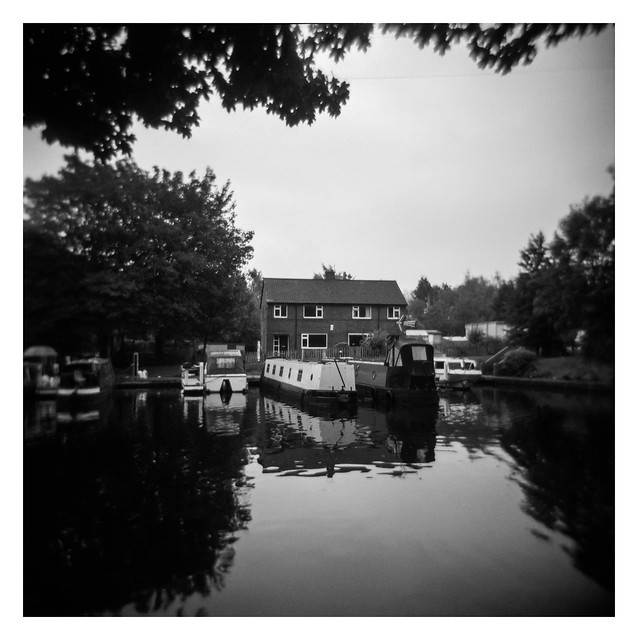
FILM - Lock-keeper's place

And this next picture is of the main marina area. Most canals in the UK are given over to leisure activities nowaday, whether that be pleasure-boating, canal-boat holidays, angling, or just walks along the towpaths. A lot of British canals, when they fell into disuse as the railways took over transportation of heavy goods, went unmaintained and gradually became silted up. Many of these have now been restored, or are in the process of restoration for recreational purposes.

It’s interesting to imaging how this marina might have looked in its height of commercial use back in the 19th century, with barges laden with industrial goods and the atmosphere thick with the smog of coal-driven, steam-powered heavy industry.

FILM - Marina

Holga 120N and Kodak Tri-X / Tmax 400 (expired).

Taken on 22 September 2019