


Minolta X-300 & Minolta 50mm f/1.7 MD on Ilford Type-517. Ilfotec DD-X 1+4 14.5mins @ 20°.
Taken on 25 October 2025

Steel City Snapper photography
35mm, medium format and large format film photography (with the odd bit of digital every now and then…)
Minolta X-300 & Minolta 50mm f/1.7 MD on Ilford Type-517. Ilfotec DD-X 1+4 14.5mins @ 20°.
Taken on 25 October 2025
Good luck playing on this football pitch!

Nikon F80 & Tamron 28-300mm F/3.5-6.3 Di VC PZD. Ilford HP5+ (@800), Ilfotec DD-X 1+4 10mins @ 20°
Taken on 16 February 2025
Neepsend is a district in Sheffield that lies just to the north of Kelham Island. The River Don forms the border between the two areas.
Neepsend remains a largely industrial area, with numerous small factories and workshops throughout the area, although there is a creep of gentrification occurring and the district now also provides homes to a number of different bars, restaurants and other places of entertainment. Whether the entire area will become largely residential over time, as happened to Kelham Island, remains to be seen (a lot of the industry is still very much active whereas I think most of Kelham’s had been lost (leaving a plentiful array of old factory buildings to be converted into residential spaces, or empty land for new build homes)


Yashica Mat 124G & Lomography Color Negative 400. Lab developed. Home scanned and converted with Negative Lab Pro.
Taken on 2 February 2025
I think I’ve photographed this old factory obscured by trees at least three times (although two of those were on the same day, but on different cameras). You can see another one here, which I took a couple of years ago.

Yashica Mat 124G & Kodak Tri-X. Ilfotec DD-X 1+4 for 8 minutes @ 20°
Taken on 2 February 2025
In the midst of the picturesque Hope Valley stands the cement works. This used to be owned by Blue Circle Cement when I was younger, but the plant has been in the hands of multiple businesses since it was first built in 1929. The current owner is Breedon.
Despite the structure being quite a contrast from the otherwise scenic agricultural surroundings, it provides quite a striking focal point and the sight of the building and chimney features frequently in landscape photographs of the area.
I have a memory from a long ago school trip to the area where someone mentioned that it was an eyesore and spoiled the scenery, whereupon the teacher explained that, while that might be the case, the operation also provides a large number of jobs for the people who live in the area.

Nikon F80, Tamron 28-300mm F/3.5-6.3 Di VC PZD & Ilford HP5+. Ilfotec DD-X 1+4 9mins @ 20°
Taken on 18 May 2024
West Burton power station, or rather stations (as there are two on the site – West Burton A and B), sit alongside the River Trent in Nottinghamshire. West Burton A was a coal-fired station, one of only three remaining in the UK in 2022 when it was due to be decommissioned. Due to energy uncertainty caused by the Ukraine War, the station was kept open a further year, before decommissioning took place in 2023.
Demolition of the site has commenced in 2024 and is planned to be complete by 2028.

While I’m glad that we are moving away from environmentally unfriendly coal-fired power stations, I shall be sad to see the structure go. The station can be seen on the horizon from many tens of miles away, including the hills of Sheffield, my home city, and also the Lincolnshire Wolds to the east and it a feature of the landscape that has been present my entire life. It also serves as a visual marker for the River Trent which I always counted as the midway point on trips to my favourite seaside town, Mablethorpe (it’s actually closer to Sheffield than Mablethorpe, but let’s not split hairs… 🙂 ). It will be strange when it has gone.

There have been attempts to preserve the cooling towers as part on the nation’s industrial heritage, but I believe these have been unsuccessful. While West Burton A will go, West Burton B – a gas-fired station – will continue to operate, and the West Burton A site has been announced as the proposed location for the UK’s first nuclear fusion plant.

I hope to visit the site whenever I get the chance to get more photographs before it disappears (or changes) permanently.

Olympus XA3 & Ilford HP5+. Ilfotec DD-X 1+4 9mins @ 20°
Taken on 18 February 2024
Beside the Don Valley Centertainment complex – which houses a multiplex, bowling alley & arcade, kid’s play area, and a selction of restaurants – are industrial streets. This is the east-end of the city where, in it’s industial heyday, the bulk of the steel industry resided. There are still steelworks in the area, and more as you head down river towards Tinsley and Templeborough, but much of it has now become history.
I’m not sure what the building in today’s picture used to house – I’m sure my dad would know, and I’ll ask him next time I see him – but it’s now the home of a scaffolding hire and sales business.
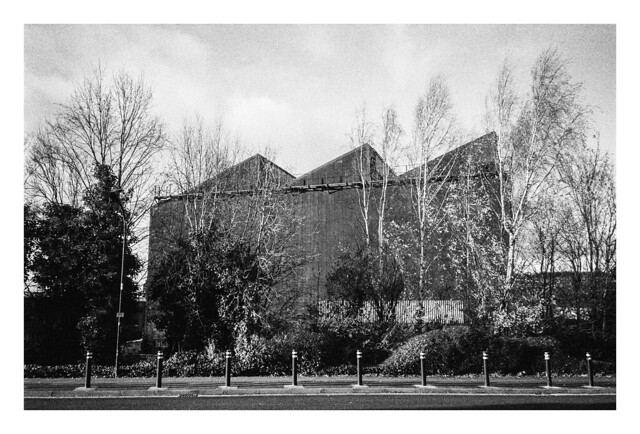
Olympus XA3 & Kodak Tri-X Pan (expired 2003 – shot at box speed and pushed a stop in development). Ilfotec DD-X 1+4 10mins @ 20°
Taken on 15 December 2021
I’ll be stepping back in time a few months for the next batch of blog posts as they’re all shots from a roll of Kodak Colorplus that was in tha camera I’ve been carrying in my coat pocket. Often these rolls are spread out over a few weeks or months before I complete them and get them developed.
Today’s photo was from a walk along the Trans Pennine Trail back in February. I shot a couple of rolls of black and white film with the Yashica Mat on that same day AND finished some Fuji C200 that was in the Sure Shot Supreme. The roll of colorplus was loaded after the C200 but took a while longer to be used up.
On the edge of town
Industry in the landscape
New Topographics
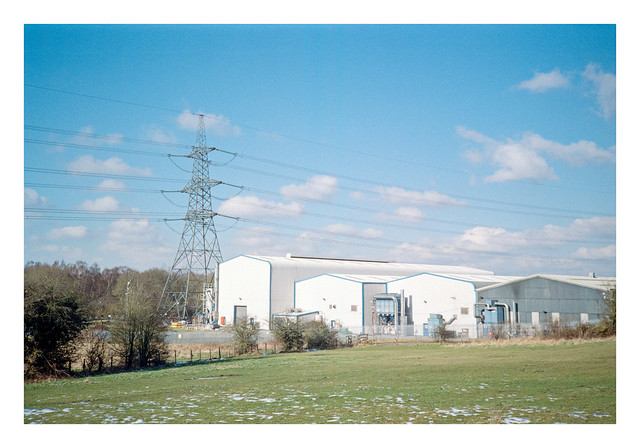
Canon Sure Shot Supreme & Kodak Colorplus.
Taken on 12 February 2021
Millstone Edge, up above the lower Hope Valley in the Peak District is a location where quarrying for gritstone used to take place, withe the main ourput being the production of millstones. There are numerous signs of this former industry to be found, perhaps most notably in the number of abandoned millstones that litter the hillsides in this whole area of the National Park. Indeed, the emblem of the Peak District National Park is a millstone.
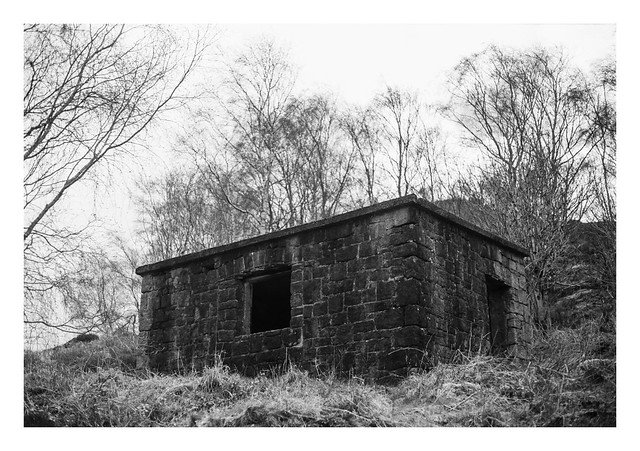
There are other indications of the former industrial activity to be found – there are still holes drilled into rock faces for the placement of never-used explosive charges, and also a number of building remains such as the stone shack featured in today’s blog post.

Quarrying for gritstone at Millstone Edge came to a close in the late 1930s.
Signs of industry
Littering the stony crags
Above the valley

Olympus OM-2N, Zuiko Auto-S 50mm f/1.8 + orange filter & Ilford HP5+ (@800asa). Ilfotec DD-X 1+4 10mins @ 20°.
Taken on 29 March 2021
Edgelands are defined as “the transitional, liminal areas of space to be found on the boundaries of country and town“. I’m not sure that the location in today’s photo is quite true to that description as, while it’s on the edge of an urban area, more recent development means that if merges quite quickly into further, newer, suburban developments long before it can merge into the countryside proper. It seems to be a feature of many industrial cities though that there is no defined boundary between countryside and town. Instead, as you reach closer to the boundaries, so patches of land where perhaps lost industry once stood, or where no development is possible due to natural features such as rivers and their flood-plains, become more commonplace, penned in by industrial estates or suburban housing.
I enjoy getting out into the countryside very much, but I do have an affinity for these semi-industrial / semi-urban areas too. I like the way that I can find relics of the coal-mining that used to be prevalent around here. Disused railway lines, bridges, and brickwork bereft of purpose can be located amongst bugeoning new-growth woodland like the remnants of some past civilisation.
Hidden in the soil
Fragments of brick and metal
Industry as was
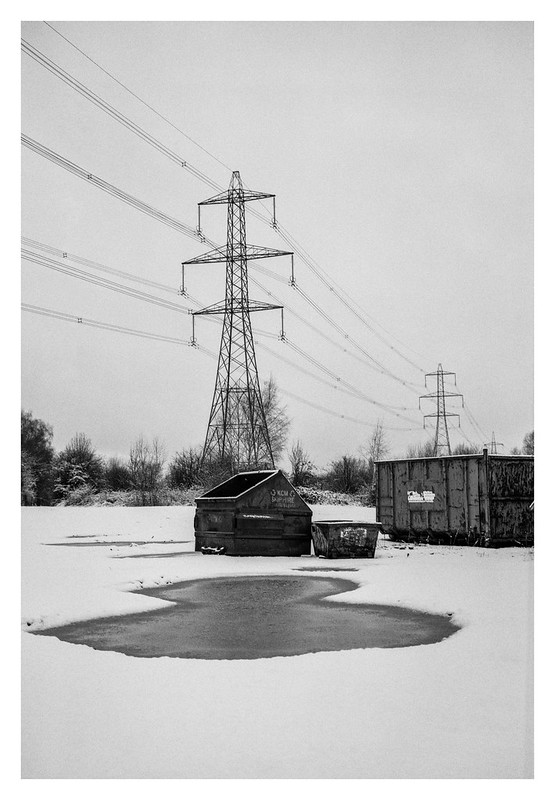
Fujica GW690 & Ilford HP5+. Ilfotec DD-X 1+4 9mins @ 20°.
Taken on 29 December 2020

