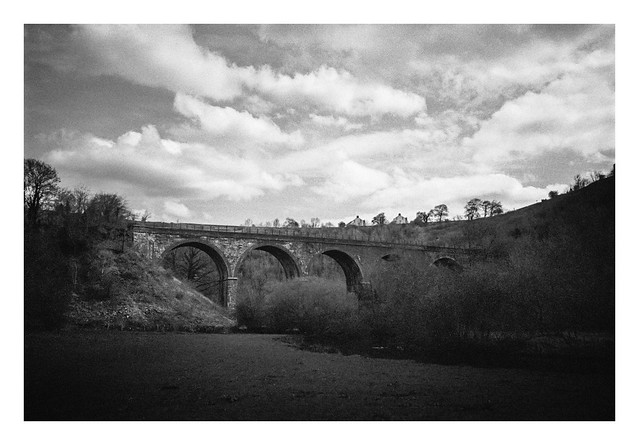
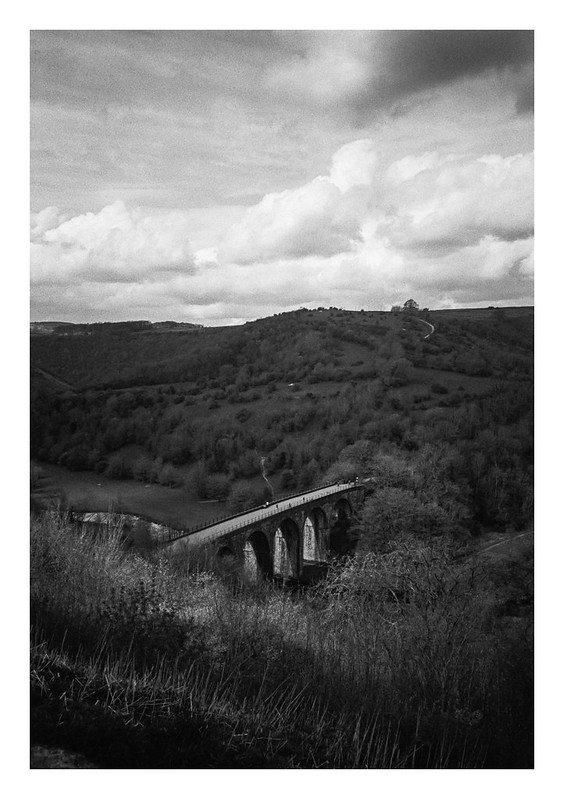
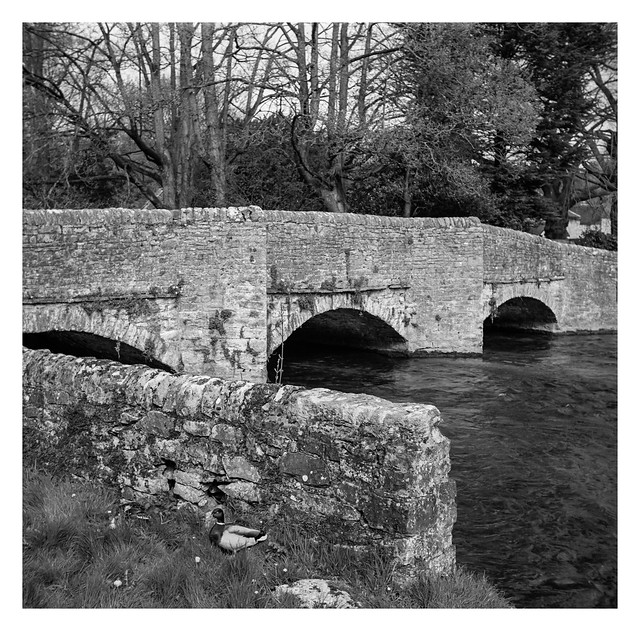
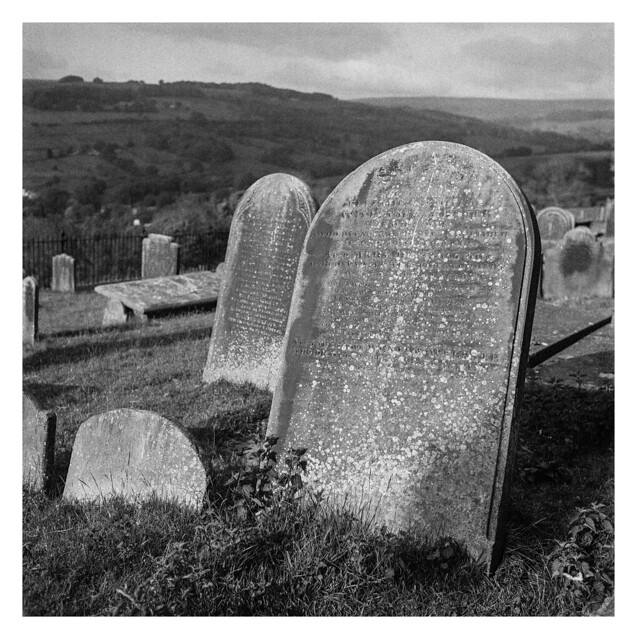
I think that today’s three photos will be the last of the batch from my trip to Monsal Dale (and Asford-in-the-Water). I have a few more images but none that really stand out as worth posting here. For some reason a number of frames from this roll came out a little underexposed – I’m not sure if it was the way the XA3 metered the scenes, or (more likely) that I under-developed them or something. Nonetheless, I’ve managed to get them looking pretty nice (if a bit grainy), I think.
Another view of Monsal Dale (these will come to an end in a day or two, in case you’re fed up of seeing the place). It’s from almost the same vantage point as the colour version I posted a few days ago but this one was made after I’d walked down to the valley floor, across the bridge you can see middle-right in the picture, followed the river beneath Headstone Viaduct, past the weir, and then up a deceptively long and, in parts, steep footpath back up the other side to my starting point.
If you click the image and zoom in, you can make out a person stood in the courtyard between the two houses you can see at the bottom of the dale.
Another bridge picture today, this one crosses the River Wye not far upstream from the Headstone Viaduct but is of a much smaller scale.
I shot another roll of my expired film this morning so I’ll hopefully (if the film gods smile down upon me) be able to post some results from that before too long.
A couple more photographs of the packhorse bridge at Ashford-in-the-Water today. I shared another photo of the bridge a couple of days ago and mentioned that the sheep paddock at one side of the bridge contained only ducks on this occasion. You can see a couple of them (well just the back-end of one) in the second picture.
This is the first in what I hope to be a series of posts in which I document the results from shooting some of the expired film I have in my stash – and I have quite a bit! However, in order to keep some sort of a leash on this exercise, I will only include film that is at least ten years past its use-by date.
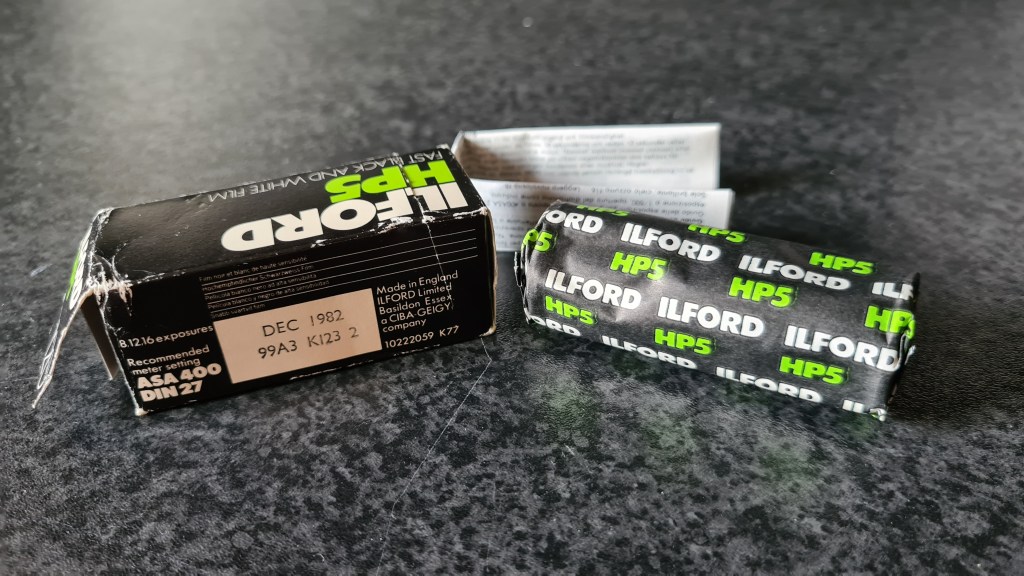
For this first instalment, I’ve decided to send the Delorean back to 1982, back before Ilford added the “Plus” to it’s stocks, back before I’d even entered my teens, and show the results from a roll of HP5 that expired in December 1982.
I chose the HP5 for a couple of reasons. Firstly, I shoot the modern version of the film quite a lot, so was interested to see how they compare (even if it may be an unfair test given the age of this roll) and, secondly, because I have four rolls of this film all from the same year so this first one will serve as a useful test on how it performs before I shoot any more of it. While the person who I got the film from had kept the film frozen, I have no idea of it’s provenance before that.
The sensible thing would have been to shoot the film in, around, or at least fairly close to home. That way, should the experiment be a disaster, at least I wouldn’t have wasted too much time on it. But the weather was nice so I decided to head out into the countryside, to High Bradfield over on the other side of the city. It was a risk but, hey, you only live once, right? I also took a second camera loaded with a fresh roll of Ilford FP4+ as well but only took a single shot with it, so the weight of the expedition would rest on the forty year old HP5.
I loaded the film before leaving the house and almost immediately felt some mild panic when the Yashicamat’s film advance crank partially jammed after a few turns. But, after some gentle pressure, it continued to wind the film on to frame #1. Arriving at my destination, I shot five shots at High Bradfield before driving around the surrounding area and photographing anything that caught my eye. Most of the other pictures were taken around Broomhead reservoir further to the north, although none of the reservoir itself. I rated the film at 100asa using my usual half-a-stop of over-exposure per decade of expiry that I use for expired black and white films. All metering was via incident readings from my Sekonic L-308.
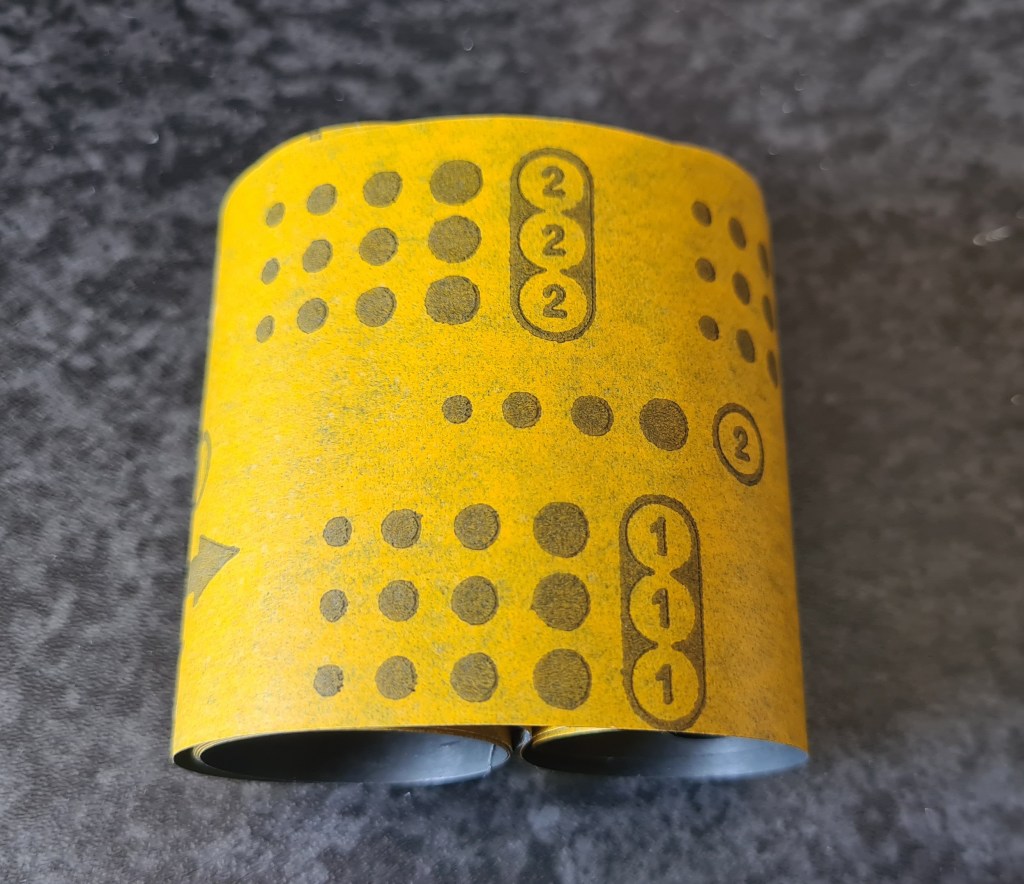
This is what old Ilford backing paper looks like. I’m not sure if the mottling is just a factor of its age.
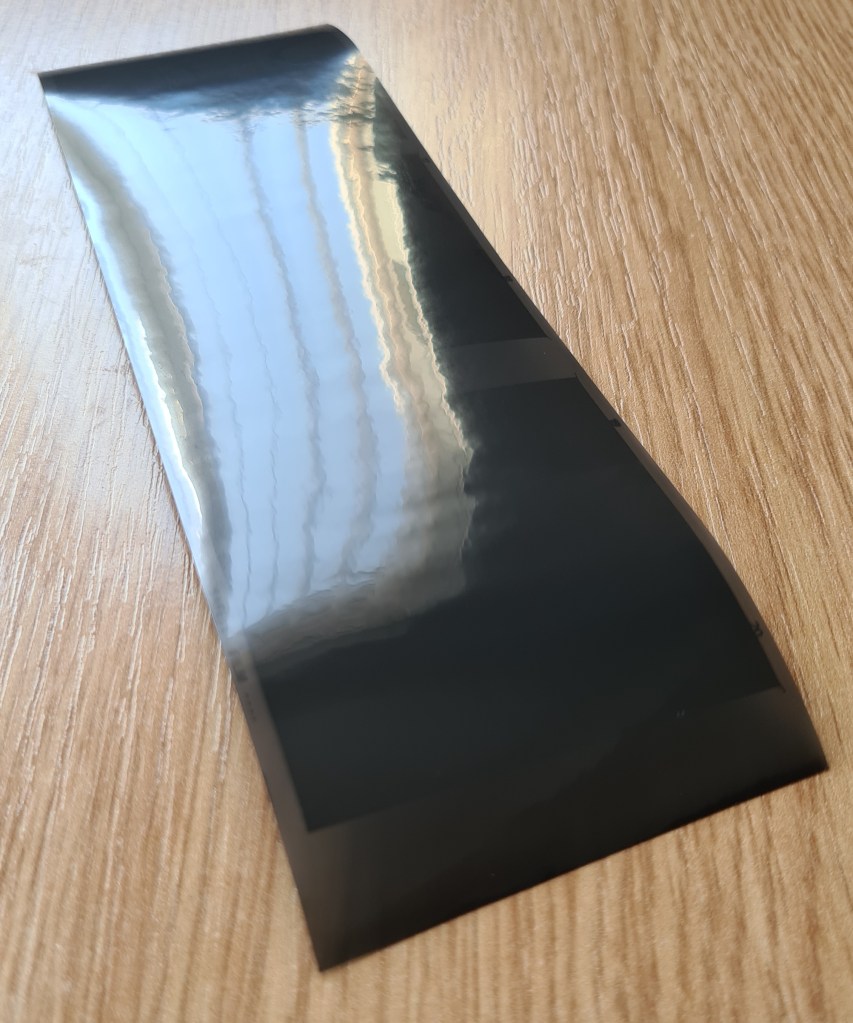
As I went out early, I was home in time to get the film developed and decided to use some Adox Adonal for the job. Ordinarily I use Ilfotec DD-X when developing modern HP5+ as it controls the tones and grain really nicely but, as this was a roll of film decades past its best, I thought the Adonal might be a good choice as I’d read that it can help to reduce fogging where it exists on old films. I used a 1+25 dilution and developed the roll for six minutes, inverting for the first minute, and then for 10 seconds at the top of each remaining minute. After that I used a one-minute stop bath and then fixed for five minutes. I washed the film using the Ilford method and then a final soak in rinse-aid before hanging it to dry for three hours. I was very happy to see easily visible images on the negatives, albeit perhaps slightly thin ones. One thing that I noticed was that the strip of negatives had an unusual, waxy sheen (see the picture below). I’m not sure if this is a factor of the film (perhaps on a different base back then?), it’s age, or even my development (although the chems should all have been in good condition).
It’s perhaps difficult to tell from this picture, but the whole roll of developed negatives had an odd, waxy sheen to them.
So, on to the photographs.
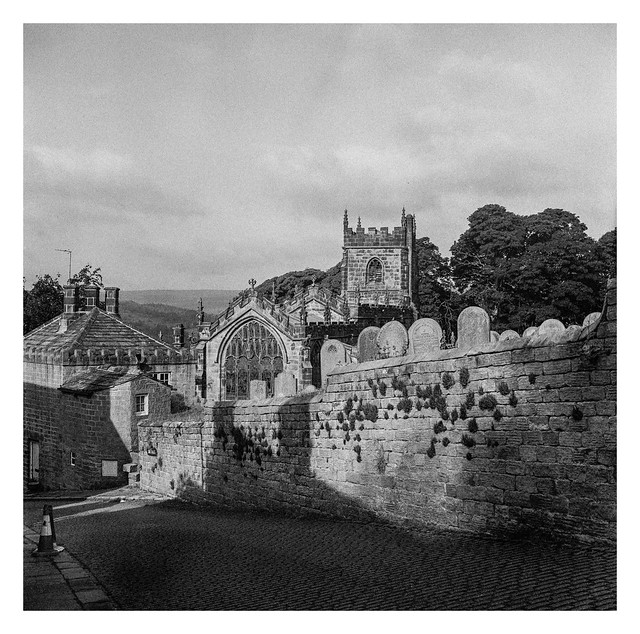
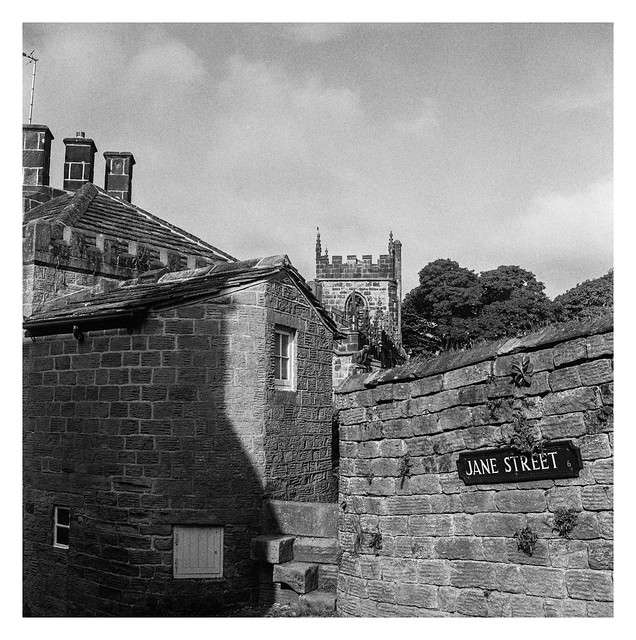
Given the age of the film I’m very happy with the results. While the negatives were a little bit thin, this wasn’t a huge problem and I was able to rectify this for the most part during the scanning phase and in Lightroom (where I also applied my other usual processing and sharpening). The grain is much more apparent than I am used to with modern HP5+ but it’s possible that this is a result of my developing them in Adonal rather than the expired nature of the film – I’ve heard other’s speak about how Rodinal developers can emphasise the grain in HP5+.
I think that I’ll rate the next roll of this HP5 I shoot at 80asa, or maybe even 50asa, and I think I’ll develop the next one in DD-X to see what difference that makes, if any, to the grain.
Here are my favourite eight shots from the roll. The other four were all ok technically but I didn’t think they worked as well artistically.
My wife and I have been on a coach trip today – something we haven’t done for quite some time, a few decades at least! We normally drive when we have a day out, or rather I drive, and my wife takes the passenger seat, so the idea of someone else doing the work while I got the chance to look out the window and enjoy the scenery without fear of taking the car off the road was an appealing novelty.
We visited Skipton and Harrogate, both towns in North Yorkshire and the day was enjoyable. It’s been a very long day though and I haven’t had chance to upload any new photos or think of much to talk abou , so today’s picture is one from a previous set.
I didn’t take a huge number of photos on today’s trip, but the ones I did will show up here at some point assuming they’re any good.
Today’s picture is of Conisbrough Castle with a war memorial in the foreground. I’ve had to tidy the image up somewhat as it had some noticable scratching (as did most of the roll of film) caused by the squeegee. I think I’ve managed to successfully remove most of the marks on this frame, although some of the other shots are something of a lost cause. I shan’t be using the squeegee again I don’t think.
Tucked away from the glasshouse in Sheffield Botanical Gardens sits the Grade II listed bear pit. The pit was constructed in 1836 to house a black bear and, later, two brown bears. Local legend has it the a child fell into the pit and was killed in 1870. It is said to be one of the finest surviving bear pits in the country thanks to it being preserved by it’s later use as a gigantic compost pit!
There is still a bear in the pit, although this one is made of rusty steel, its colour perhaps not dissimilar to a real bear’s fur.
I took a trip to Manchester today to visit the Photo North exhibition. It’s been quite a tiring day.
The exhibition was good, but my planning was not, and it would have been much better had I booked earlier / later trains for the outbound and return journeys as, as it stood, I felt somewhat rushed, especially when the train in the morning was delayed by a half hour! Oh well, I still visited and I managed to attend the screening of a documentary on Picture Post magazine, which was interesting and enjoyable.
I shot about half a roll of film while out – using my Olympus 35RC, a great little camera, but one I’ve not used for a while – but when I came out of the exhibition the weather had changed from bright contrasty sunshine to flat grey conditions, so I held off shooting more. I have another trip to Manchester planned in a month or two’s time, so hope to make more photos then.
In the meantime, and completely unrelated to the rest of the post, here are four photos of Sheffield Botanical Gardens that I scanned this week.
On a wall beside the canal towpath, not far from Victoria Quays, is painted this piece of artwork. I though it would make a good photograph, but didn’t know what it represented.
Googling the words revealed them to be part of a folk song about a highwayman named Spence Broughton. In February 1791 Broughton, and his accomplice John Oxley, robbed the Sheffield to Rotherham mail coach as it travelled across Attercliffe Common. Suposedly the only item of value they were able to get away with was a French bill of exchange with a value of £123, which they had difficulty in attempting to fence. Oxley was later arrested for his part in another robbery and, fearing for his freedom, in October of that year Broughton sought help from another criminal, Thomas Shaw, in London. Unfortunately for Broughton, he was recognised and arrested by the police and Oxley and Shaw both gave testimony against him, although Oxley was later able to break loose and make his escape.
Spence Broughton was found guilty in York assizes and sentenced to be hanged. The following April, after the execution, the body of Broughton was transported back to the scene of the crime on Attercliffe Common and placed in a gibbet. This attracted large crowds – supposedly 40,000 people – and the landlord of the nearby Arrow pub claimed that he was able to make a fortune from the passing trade. Broughton’s boy was to ramain in the gibbet for the next 36 years!
Nearby Broughton Lane is alleged to be named after the criminal, although this is disputed by historians.
It’s fascinating what a walk along the canal can reveal.