I already own one medium format camera in the shape of a Lubitel 166 Universal. My reasons for buying it were primarily based on economics – Lubitels can be had in good condition for around £30-50 ish – but also because, despite their relatively lo-fi build and feature set, they are capable of pretty nice results if you put in the effort. This effort, in my case at least, comes mostly in the shape of squinting very hard into the small magnifying loupe while trying to determine if the image in the dim circle of ground glass is actually in focus or not, coupled with the fact that the waist level viewfinder has to be viewed at quite a specific angle to avoid reflections of the inside of the camera which can make composing your shot (already tricky to those not used to the reversed image) an additional hurdle. What this means in practice is that I tend to chicken out of any close focus shots and just set the thing to infinity and not worry about it beyond a slightly depressing realisation that I’m missing out on some nice shallow depth of field images that medium format can do so nicely. Still, despite thes shortcomings, I’ve managed to get some decent shots out of the 166 U, and they are extremely sharp if time is taken to get things right.
Nontheless, I had a hankering for something with a bit more umph and a bit less of a thermo-plasticky feel to it, so for the past few months I’ve been weighing up a likely replacement – ostensibly as a birthday present. I had a budget of up to £250 in mind which, while ruling out a lot of the Rolleiflexes and Hassleblads and the like, still left a reasonable amount of decent cameras to choose from, and the main decision was around format – TLR or SLR.
While I like the idea of MF SLRs for thir handling, they do tend to have a dwnside when it comes to form factor unless you’re happy to just stick with a waist level finder (which then removes a lot of the handling benefits). A Bronica ETRS becomes a much bigger machine once a grip and prism finder is attached for instance, So, having been quite happy with the 6×6 squares produced by my Lubitel, I decided a TLR was probably the way to go – smaller, lighter, and without the “1980s VHS camcorder” look that some MF SLRs can get when fully kitted out. Again, there were still a number of options – Yashica’s Rolleicords, Autocords, Mamiya C330s etc. – but my decision was mostly made when I spotted a Yashica Mat 124 G in good condition for a fair price on Gumtree. After a bit of umming & ahhing and some questions to the seller, I decided to go for it.
It’s in a different league when compared with the Lubitel. It feels solid and weighty, the focussing is smooth and easy to determine in the viewfinder. The loupe is massive in comparison, and the controls are much simpler to use. The camera is in very nice condition, but didn’t have a lens cap, so I ordered a third part cap from eBay (which, when it arrived, turned out is a pretty poor fit, but it at least stays on the camera and hasn’t fallen off by itself so far), plus a lens hood as I’d heard that the camera could be susceptible to flare.Still, despite not having the protection of either, I was itching to try the camera out so, as the weather was quite dull, I loaded up a roll of 400 ASA HP5+. I was a little unsure of how to wind the film on to the first frame – this is a completely manual process in my Lubitel, so I did something similar wuth the Yashica – stopping winding when I saw the “1” in the frame-counter window. My frst shot was a boring, “itchy trigger finger” shot of the empty HP5 box on the windowsill. I lined up the shot, got the focus dialled in and fired the shutter. I then wound on, but the lever stopped after about an inch, forcing me to back-wind and re-cock the shutter. It appeared that my method of loading the film had been incorrect. I then took a shot of one of my kids. This time the lever advanced as expected, but I was doubtful as to how the shot would emerge, now expcting a double exposure of some sort (this is exactly what I got – a shot of one of my sons superimposed on some vertical blinds).
After my hasty first shot, I decided to venture out. I didn’t have any particular location in mind for my test, but as I had some chores to run, I decided to take a few shots around Handsworth church after dropping some curtains off at the dry cleaners. The sun was showing signs of emerging between the clouds and I fired off five shots in the churchyard while getting used to the handling and then returned to the car. I then decided to have a run up to Penny Hill wind-farm and maybe get some shots of the turbines. The route to the wind-farm takes you on a narrow, high-sided country lane through the village of Ulley, and I stopped off there to take a few more shots at Ulley church. By now the clouds had dissipated quite a lot and I was forced to use narrower apertures and faster shutter speeds to compensate, so one or two of my shots look busier than I’d have liked as I couldn’t isolate the subjects as much as I wanted to. As a result, one of the shots (a small gravestone amongst some ivy) was pretty much a write-off. Still, I was hopeful for some of the others – even if I had little hopes of anything breathtaking.
After the church I had two shots remaining, so moved on to the wind-farm and finished the roll.
As I don’t currently develop my own film, the rest of the weekend passed with an urge for Monday to come around (wishing the weekend away like a fool!) so I could drop the roll off at the lab. Anyway, long story short – film dropped off on Monday morning, picked up and scanned by Monday evening,
As to the results, well those can be seen below. While I’m not massively satisfied with them in terms of interest (shots 4, 6, 7, 8 & 9 are my favourites from the roll), I am very encouraged by the quality. There’s tons of detail and the focus is largely right on the mark and I’m now very much looking forward to putting another roll through the camera.
1: The first shot (not counting the double-exposuere debacle). I wish I’d have been able to use a wider aperture for this, but the sun came out and I could’t be bothered to wait for it to go back in again!

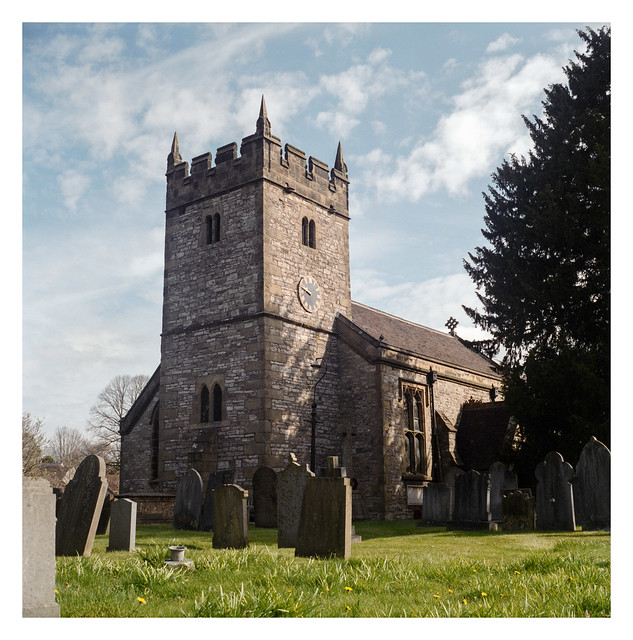
2: The sun was still out and lighting the side of the church, but it stood out nicely against the darker clouds in the sky to the rear.
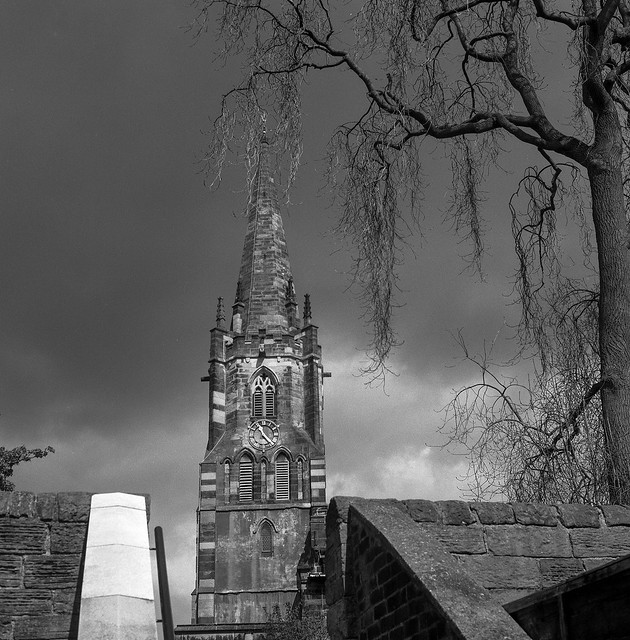
3: Another shot which would’ve benefitted a wider aperture and shallower DOF perhaps?

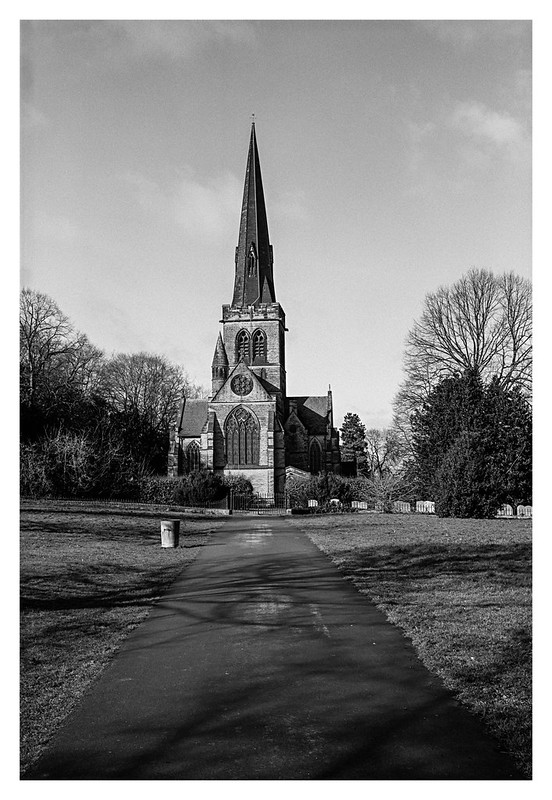
4: Another shot of St. Mary’s steeple.

5: The war memorial at Ulley. The light was a little bright, but the highlights are still intact.

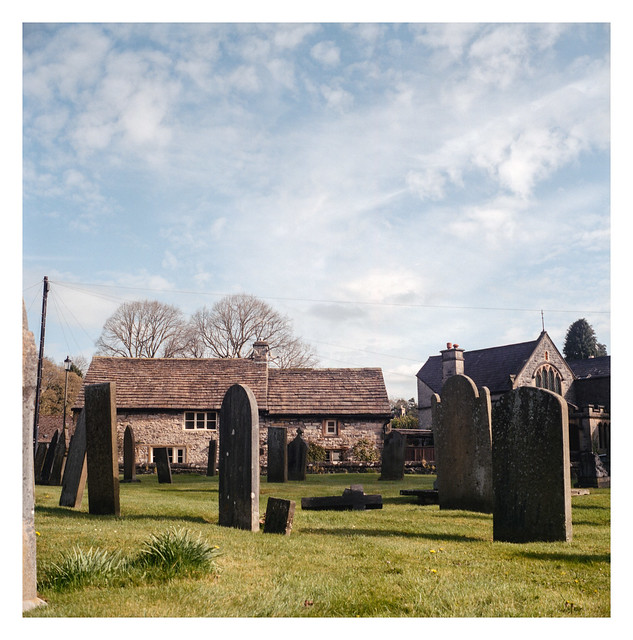
6: Just up the road from the memorial these gravestones are just over the wall in the churchyard.

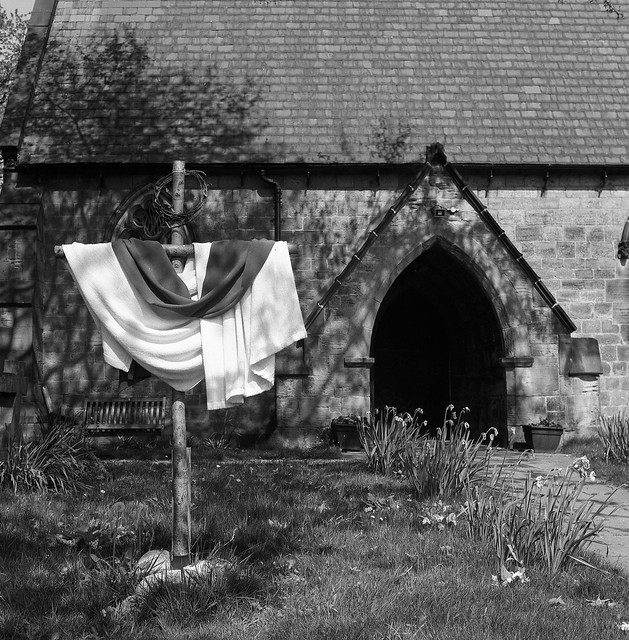
7: These red and white vestements on a wooden cross made for quite a nice subject I thought. I think the sunlight helps.
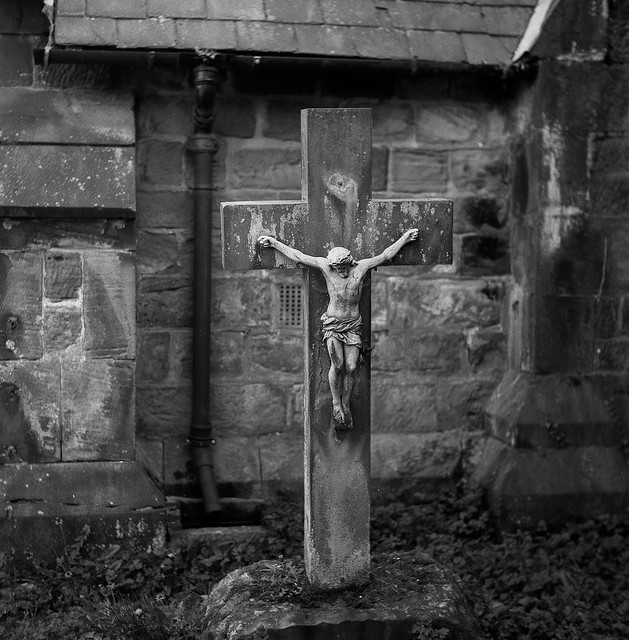
8: Tucked around the back of the church is this stone crucifix. As thei area was shaded by the church I was able to open up the aperture a little more. Not enough to throw the background out of focus, but I wuite like the shot and the figure of Jesus is nice and sharp.
9: There seems to be a feint streak on the negative here, but this is probably my favourite shot from the roll. One of the turbines at Penny Hill wind-farm. The busy M1 / M18 junction is about 100 metres to the right of this location.

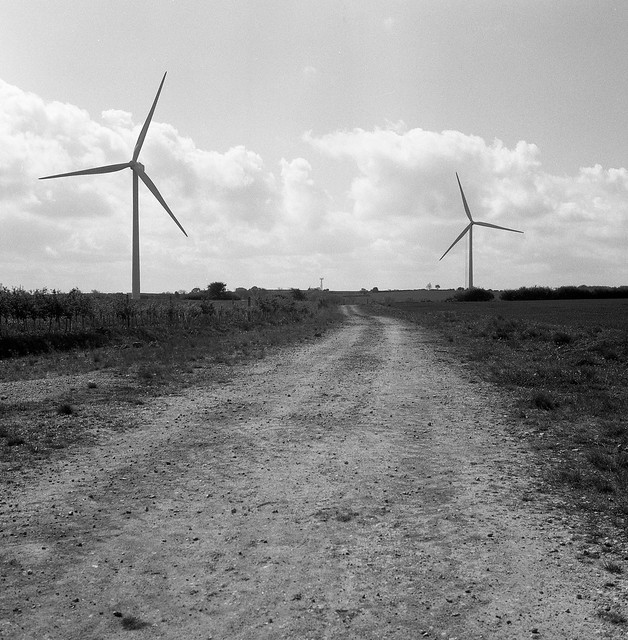
10: Another couple of turbines, this time looking south and taken from the same location as the previous shot.