35mm · Film photography · Photography

A Walk With a Camera – Carlton in Lindrick

This is the fourth of these posts where I document a hike along the the photos I took along the way. This also marks the first walk that went quite awry…

The walk I chose on this day was centred on the village of Carlton in Lindrick in Nottinghamshire, about fifteen miles or so to the east of where I live. The route is just over seven miles in length with a slight elevation of 214 feet. It forms a rough elongated figure-of-eight laid on its side, with a country estate at the eastern (Hodsock Priory) and western (Wallingwells Hall) sides of the route.

After parking in the village, I looked at my map and set off along the westward loop. This was a mistake – had I looked at the map properly I would have seen that I should have headed east first. Not that this matters in the grand scheme of things – I would still see the entire route and end up back where I started, no matter which way I set off. This didn’t happen though, for reasons I’ll get into later…

I began my walk along the main road through the village, passing the methodist church and Sherwood Ranger pub.

At Carlton in Lindrick

A little further down the road I took a left turn where the footpath headed behind a row of houses/

Where it began

The weather in preceding days had been rainy and it didn’t take long before the dirt path became slick and muddy, necessitating an awkward walking stance where I tried to keep my feet on the grass at either side of the path. Despite this, my boots soon had an extra layer of mud clagging up the soles. A few portions of the path had paving laid, but these sections were few and far between.

Slip slidin' away

The path eventually led into an area of woodland that bounded the housing. The shelter of the trees hadn’t kept the path dry however, and the muddy and occasional slippery progress continued. The resolution of my map and lack of obvious signposts also led me astray, sending me further into the woods before backtracking to the path I should have followed beside a field with horses. I would soon be cursing the existence of such creatures.

First horse of the day

The path beside their field was overgrown with shubs heavy with moisture that I had to push past. I also discovered that my new, lightweight hiking trousers, were definitely not nettle-proof when I was stung several times through the material! After passing a house and some farm buildings, eventually the path met a narrow lane, terminating in a stile, and the picture below shows the way I had come

Post-nettle stile

Crossing the lane, I rejoined the footpath. Despite nothing saying so in the weather forecast that I’d checked before leaving the house, it now began to rain. The lightweight mid-layer jacket I was wearing was water-resistant, but not water-proof, so I stood beneath a tree for a while hoping to avoid getting soaked. The tree just concentrated the rain into larger, heavier droplets though, and I had to resort to putting on the waterproof shell jacket that I’d fortuitously stored in my backpack. The picture below doesn’t really do justice to the rain that was falling, but you can see how waterlogged the fields were.

All it needed was trenches

I pressed on and the path soon widened. At first this looked like a welcome change as there would be more space to avoid the muddy parts. Unfortunately, what this actually signified was that I was now on a bridlepath. One that had been traversed by multiple horses and was resultingly far more muddy. Showing thoughtfulness, some of the riders had chosen to ride their steeds on the grassy edged of the path, making those parts similarly difficult to traverse for pedestrians. In places there was no option except to hop and leap between the less sludgy areas, often sinking six inches into the waterlogged earth. If you ride horses in this area and felt your ears burning on that day, that was probably my curses causing it. The next picture shows one of the less waterlogged bits!

so muddy

At this point I was still following the mapped route and took a left turn past a building that I presume was a horse ranch to follow it’s course. Thankfully the rain had passed at this stage and the sun was now visible overhead again. It was soon to warm to wear my waterproof coat so, after shaking off the water, I had to slip it back into a pocket in my backpack. I also got a view of Wallingwells Hall. Despite this being listed as a feature of the walk, I can’t say that it was worth the trouble I’d endured to reach this point, it being barely visible between some distant trees.

Wallingwells Hall

The next part of the path initially looked like it would be easier going – a grassy track between two horse pastures. It soon became apparent that this was as waterlogged as the earlier sections of the route though. If anything, the soft ground was deeper with water than anything I’d yet traversed and I was soon forced to try and support myself by grabbing fence posts (while trying to avoid the helpfully electrified strip that ran along the top of one side of the fence). After about a hundred meters of this particular adventure, I came upon a section of the path that was completely submerged from side to side for about ten feet or so. I ran through a number of ways I might pass this new obstacle, but the mental risk assessment going through my head saw no scenario that didn’t involve my feet becoming completely submerged above the tops of my boots. Reluctantly I had to make my way back the way I had come. Imagine my joy when, while grasping a fence post for support, I put my hand in a big deposit of bird shit!

After consulting my phone for an alternative route, I set off once more, this time planning to avoid any bridlepaths and, if possible, stick to paved routes. At least by this time the weather had brightened considerably. The next photograph I took was, as chance would have it, of a horse. I wonder if this was one that had churned the paths I’d taken into quagmires?

Second horse of the day

I soon passed a small group of houses, including this pleasant looking abode.

Country living

Thankfully, the paths along the section of the route back towards Carlton in Lindrick, while not dry, were at least much less muddy than those in the former sections.

Between hedge and field

The light was now quite nice and the next picture is my favourite from the walk (even if I did then take another wrong turn just after I shot it).

When I missed the turning

The final unpaved part of the route was a track through a field of oil seed rape which was just starting to show its vivid yellow flowers (not that you can tell with this black and white photograph). In the distance you can see Carlton in Lindrick returning to view.

Back towards Carlton in Lindrick

A former watermill was one of the first sights to greet me upon re-entering the village.

Carlton Mill

Shortly beyond the mill is a pleasant looking gate house.

Gatehouse

To the right of this was a grand looking house with the village church beyond.

Carlton in Lindrick

At the end of this lane I rejoined the main road again. Despite this actually being just the halfway point of the hike, my feet were wet and I’d really had enough. I had no reason to expect more of the same muddy paths if I continued, so instead I popped into the Sherwood Ranger to give my hands a good wash and buy a welcome beer before heading back home. I might return and so the walk again at some point, but I will take great care to ensure it’s after a good spell of dry weather!

Olympus XA3 & Ilford HP5+ (@800asa). Ilfotec DD-X 1+4 10mins @ 20°

Taken on 29 March 2024

35mm · Film photography · Photography

A Walk With a Camera – Elton to Robin Hood’s Stride (part 2)

Part one of this walk ended as I passed through a small area of woodland that marked the turning point where the circular route began its return back towards the starting point. Perhaps the most well known landmark on this leg of the journey is Robin Hood’s Stride, but before I got there I took a small detour to Nine Stones Close (also known as The Grey Ladies), a small neolithic stone circle that stands beside a tree in a nearby field.

Nine Stones Close #1

There’s something fascinating and a little eerie about stone circles, both in their age, and the limited understanding we have as to why they were constructed, but also – in large part – the fact that they feature heavily in a number of fantasy / sci-fi movies and TV shows I’m fond of, notably the 1979, John Mills starring, Quatermass series, The Children of the Stones, and the Doctor Who story, The Stones of Blood. All heady material for the youngster I was back when all three aired.

Nine Stones Close #2

After admiring the stone circle (you can see some more photos I took here), I set off back towards Robin Hood’s Stride, first passing a couple of lone trees, one dead, one alive.

Like a hand from the earth
Lone birch

Robin Hood’s Stride is a gritstone rock formation, notable for the two pinnacles at the eastern and western end. The pinnacles are named “Weasel” and “Inaccessible” and legend has it that Robin Hood was able to jumped between them in, hence the name of the formation. All I can say, is that Robin Hood must’ve had some sort of Olympian-level jumping skills as the two pinnacles are around fifty feet apart!

Unfortunately, when I arrived the sun was to the south, backlighting the rocks to a degree, so I wasn’t able to photograph the whole structure in the best light. I took several other close-up shots of part of the formation though, including some carved graffiti that has been there quite some time.

Robin Hood's Stride
Boulders
HB
A tree on Robin Hood's Stride
Flake

I climbed to the top of the formation, although it was tricky with my backpack, tripod, and walking poles, but there were nice views. A couple were up there already, eating their lunch.

Taking in the view

The view back towards The Grey Ladies was a nice one, though probably not done justice by the XA3 on this occasions. The stone circle can be just made out in the centre of the frame if you look closely.

The view from Robin Hood's Stride

After a drink of water, and a careful descent, I took another short detour from my route, this time to another rock formation named Cratcliffe Tor. This is a popular spot for climbing and bouldering, and there were signs of this in evidence with dusty powder marks on the stones where people had sought places to get a grip.

Signs of bouldering

Cratcliffe Tor is also the site of a hermitage dating to the 14th century. The small cave is now fenced off as it was being used as a shelter for climbers, but behind the fence it is just possible to make of a crucifix carved into the rock. You can just about see it on the second picture below about a third of the way from the top right of the image.

Hermitage
No camps or fires

After visiting the hermitage, I made my way back to my route and began a descent down the hillside east of Robin Hood’s Stride, passing a bench bearing the name of someone called Hillary.

Hilary's Seat
Looking back to Robin Hood's Stride

Looking back up the hill, the rock formation can still be seen above the trees. Another name for the location is Mock Beggar’s Mansion as, from a distance in the right light, it looks a little like a turreted house.

Mock Beggar's Mansion

In the hilly Peak District countryside, the descent soon turned back to ascent, and I followed a steeper-than-it-looks lane past a couple of houses on the final stretch back to Elton.

Get those legs pumping!

A footpath branched away from the lane, taking me through a number of muddy fields. To my right the path was bordered by a fence and trees. A rope swing hung from one.

Rope swing

Another tree had seemingly absorbed a cable as it had grown, resulting in a shape in it’s trunk that reminded me of someone sucking spaghetti!

Like eating spaghetti

To the north, Robin Hood’s Stride and Cratcliffe Tor could still be seen peeping out of the ridge line.

Looking back whence I came

I reached the brow of the hill I was climbing and could now see the houses and Church of Elton come into view.

Back to Elton

As I walked back through the village to where my car was parked, I passed a man cleaning his car with a jet spray. He turned it off as he saw my approach, but I cheekily asked if he wouldn’t mind spraying my feet with it to remove the thick clods of mud attached to my boots. He was amused by the request, but I soon had clean (wet) boots again. 🙂

Olympus XA3 & Ilford HP5+ (@800asa). Ilfotec DD-X 1+4 10mins @ 20°

Taken on 26 March 2024

35mm · Film photography · Photography

Exhaustion

I have a week off work and aim to get some photography in the bag while I have the chance. Today I decided to head out into the Peak District and go for a hike.

I chose a location that I’ve not visited before, the village of Tideswell. Or, rather, Tideswell would be on my route. I studied my map beforehand and planned a circular path that would take me from Tideswell Dale car-park (about a mile below Tideswell itself), down the dale to the bottom where it meets Miller’s Dale. The route then followed the River Wye up Miller’s Dale until I would head north up Monk’s Dale. At the top, where the dale meets a road, I’d head back east and then cut through the footpaths in the pastures back to Tideswell, and then back to my car.

The hike would be around six miles, albeit with a lot of altitude to lose and gain along the way, including some steep climbs. While not a long hike, I knew that my backpack and tripod would add some weight and make it more strenuous than if I were travelling light. The part I didn’t really factor into my plans was the trail through Monk’s Dale. Whereas the earlier sections of the walk had been on well defined and surfaced tracks, the path through Monk’s Dale is somewhat more basic. For much of the dale it hugs the stream that runs down the valley and is very scenic, but today, after quite a lot of heavy rain, the path was quite slick with surface mud and I had to keep careful watch on my footing. Further up the valley though is where it got more serious…

Here the path enters into a steep-sided section of the dale which is densely wooded. Over time, the limestone cliffs on either side have shed rocks and boulders which litter the valley bottom and the footpath becomes a half-mile endurance test where every step is a potential sprained ankle, broken hip, or worse! My hiking boots have a nice tread that grips well on many surfaces but, as I found out today, not on worn limestone rubble. It probably took me the best part of an hour to traverse this section of the route, the trees all heavily matted with thick coats of almost orange moss, and I was beginning to think I’d actually lost the footpath and was now just clambering over rocks beside the stream bed (luckily, the water that had been flowing further down the valley was no longer in evidence here, presumably taking an unseen subterranean route through the porous limestone).

I was becoming quite hot from the exertion and sweat was dripping down my face and at one point I almost took a tumble, thoughts about how long I might lay there undiscovered if I became incapacitated flashing across my mind. Thankfully, if this had been the place where I took a fall, I’d have been seen as I then noticed a man nearby examining plants in the undergrowth a little further up the path – he was the first, and only, person I saw on this whole section of the walk, the only other evidence of anyone having passed by being a set of someone else’s footprints that I noticed from time to time in the mud. I stopped to catch my breath, wipe the sweat from my brow, and chat with the man for a while. He’s been to a dental appointment that morning and decided, as he was passing on his way home, to take a look at the valley as it was the first time he’d visited in some time. He was able to tell me that I was maybe more than half-way through the difficult stretch (I’d have preferred to be near the end, to be honest :)) and at least reassure me that this was, indeed, still the actual path.

Continuing along the trail, the way began to become a little easier, albeit still with treacherous footing and the occasional fallen tree to clamber over or duck under, and I eventually managed to reach the open field close the the road. While the worst was behind me, the road itself had a punishing camber that really made my thighs put in the work. The remainder of the route took me through a patchwork of pasture fields back over to Tideswell. I eventually reached the village and found a cafe where I bought myself a sandwich and a slice of “farmhouse slice” – a very tasty shortcacke concoction filled with a selection of juicy dried fruits to eat when I got back to the car – my treat for all the effort!.

The remainder of the route was all downhill back to the carpark and it was with a real sigh of relief that I sat back in the car.

I shot a couple of rolls of film through the Yashica Mat 124G, plus several frames of 35mm with my OM-2. As ever with my blog, these will turn up somewhere down the way after I go through my existing rolls (I have a pretty strict, OCD-style, queuing system for publishing photos if you hadn’t noticed! 🙂

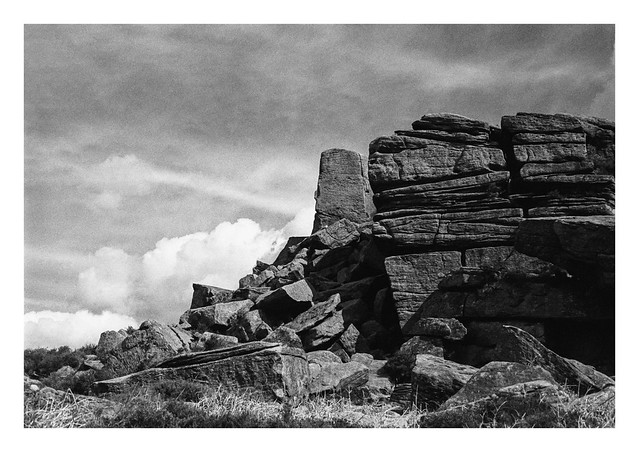
Anyway, to keep things on a bit of a related track, here’s another Peak District photo, this one of Over Owler Tor and a different part of the park. These are gritstone rocks and my boots don’t slip on those!

How long would I lay
Undiscovered in the woods
If I took a fall?

Over Owler Tor

Olympus OM-2N, Zuiko Auto-S 50mm f/1.8 & Kodak Tri-X Pan (expired 2003) + orange filter . Ilfotec DD-X 1+4 8mins @ 20°.

Taken on 6 April 2021