The bottom corner of this field at Elmton floods in wet weather and makes for some interesting picture opportunities, including reflections of St. Peter’s Church.
I guess the shots also continue this week’s molehill theme. 🙂
Following the barn and schoolhouse pictures that I posted a few days back, here’s another subject that’s featured on the blog on multiple occasions (possibly because it stands right next to said schoolhouse and barn…). In fact, one of the pictures I’ve posted before is very similar to the lat one in today’s set. But, again, what the heck. It’s a nice subject, so who wouldn’t photograph it again? 🙂
My son had another job interview today, this one a little less impromptu and with support from his job coach. I don’t know what the outcome will be (apparently one of the other people being interviewed – for a job in a clothes store – was a marine biologist!), but he looked very smart and even if it doesn’t work out, every interview is more experience for him to draw upon.
A few weeks back I shot a roll of Agfa APX 100 during a trip to Lincoln. It was only as I went to rewind the roll of film after shooting all 36 frames that I realised I hadn’t set the ISO dial when I loaded the camera, and that the meter had been set to 400asa for every shot.
If I had been shooting Ilford HP5+ of something, I would have just push procesed the film -something I have done with good success in the past – and, indeed, I thought this would be my plan for the APX 100 too. Unfortunately, there is much less data available on push processing this particular film stock, at least beyond a one stop push to 200asa.
Asking around for advice resulted in a number of recommendations for stand or semi-stand development and, after looking into this further, I decided the semi-stand approach might be the best approach. However, as this would be the first time I’d ever attempted this method of developing film, and as I had an idea there would be some shots from my Lincoln trip that would be worth keeping, I decided that I would have a trial run on another roll of film first.
So, a week after visiting Lincoln, I took a shorter trip to the village of Whitwell and shot another roll of APX 100 at 400asa so I could test out semi-stand developing.
I have two developers to hand at present – Ilford DD-X, and Agfa Rodinal. As there was far more information available on performing semi-stand development with Rodinal, I opted for that. It also has the advantage of being much cheaper than DD-X. My research suggested that a 1+100 solution would be the best option, with a couple of extra millilitres of developer added to compensate for the push processing , so I made up a mixture of 500ml water, with 7ml of Rodinal (again, based on research online). This is more developer than I would need for a single roll of 35mm film, but I wasn’t sure how much extra developer to add to 300ml to compensate for the push as the online advice had stated a 500ml volume of water.
I’d also read that a pre-wash would be a good idea for semi-stand, so before adding the developer I gave it a soak in 20° water for 5 minutes, agitating it for a couple of minutes. I’m not sure if the agitation was necessary at all, but I didn’t think it would hurt.
After emptying the pre-wash water, I added the developer and agitated the developing tank with inversions for 1 minute. I then gave it a tap on the counter and left it to stand undisturbed for the next 30 minutes. After this first half an hour I gave it another single firm inversion, another firm tap on the counter to remove any air bubbles, and then let it stand for a further 30 minutes.
At the end of the hour I emptied the developer, used 20° water as a stop bath for 1 minute, and then a further 5 minutes in the fixer. After this I washed the negatives in tap water using the Ilford method, soaked them for a couple of minutes in a wetting agent solution, spun the reel in a salad spinner to remove most of the water, and then hung them to dry for 3 hours.
I was very happy to see nice looking negatives as I removed the film from the reels. They maybe looked slightly thin, but nothing to cause great concern and I was able to get results I was happy with when scanning and post processing the photographs.
The final results are pretty good, I think. There’s maybe a little more grain than there would have been had I shot and developed the film at 100asa, but it’s nothing I’m concerned about, and the images are sharp, have good contrast, and the highlights and shadows contain plenty of detail.
I don’t think I’ll use semi-stand development all the time, but I will certainly use it again in some situations. I’m already curious about shooting a single roll of film at different exposure settings, for instance, and I have a roll of Fompan 400 that I plan on shooting with my Holga sometime soon which I might develop as semi-stand.
As I’ve been posting pictures of churches over the past few days, I might as well post another. This one wasn’t shot on 4×5 large format, instead it’s a small-by-comparison 6×45 medium format ratio. Despite the smaller negative, the Bronica ETRSi still produces very nicely detailed photographs, such as this one of All Saint’s church in the village of Hooton Pagnell.
I managed to get out and make more photos today. Amazingly, given my usual poor luck when it comes to the weather, it was a beautiful spring day – all blue skies and (later on) fluffly little cumulus clouds. I had a momentary mini panic this morning when I woke to see the lovely conditions but without having a clue where to go to take advantage of them. In the end I decided to visit Newark Air Museum and take some large format photographs of the old aircraft they have there. I exposed 8 sheets of 4×5 and also managed to finish off a roll of 35mm HP5+ in the Canon Sure Shot Supreme that I had in my coat pocket. I’ll try and develop some of the 4×5 pictures tomorrow all being well.
Bronica ETRSi & Zenzanon 75mm f/2.8 PE & Ilford Delta 100. Ilfotec DD-X 1+4 10 mins 30 secs @ 20°
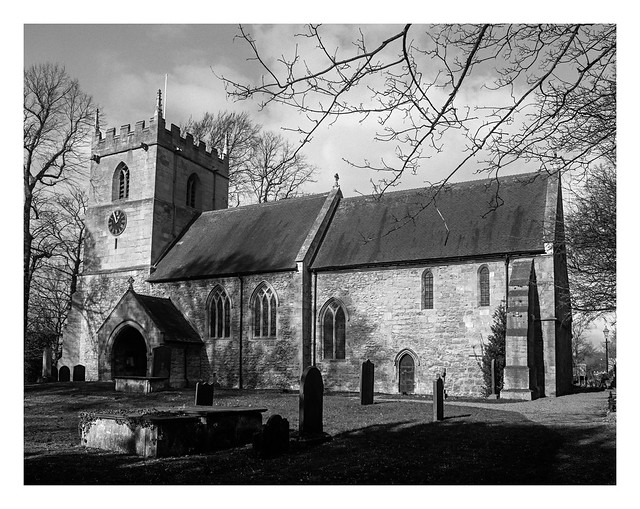
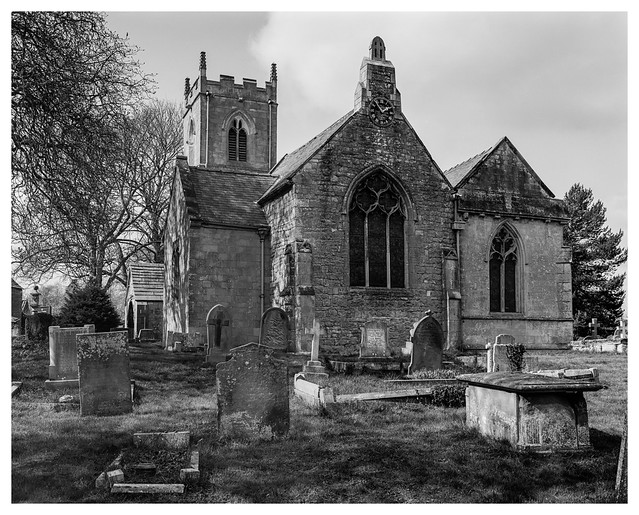
Another church, and another named after St. Peter just a couple of days after I posted a photo of its namesake at Elmton.
Quite a difference in architecture between the two buildings though.
When dust-spotting the scan I spotted a lone pigeon hiding in the scene. Can you spot it? You’ll probably need to click through to Flickr to see the full resolution version in order to find it though.
I’m now very much looking forward to the four days off work that the extended Easter weekend will bring. I’m hoping to do some more photography if the weather remains decent.
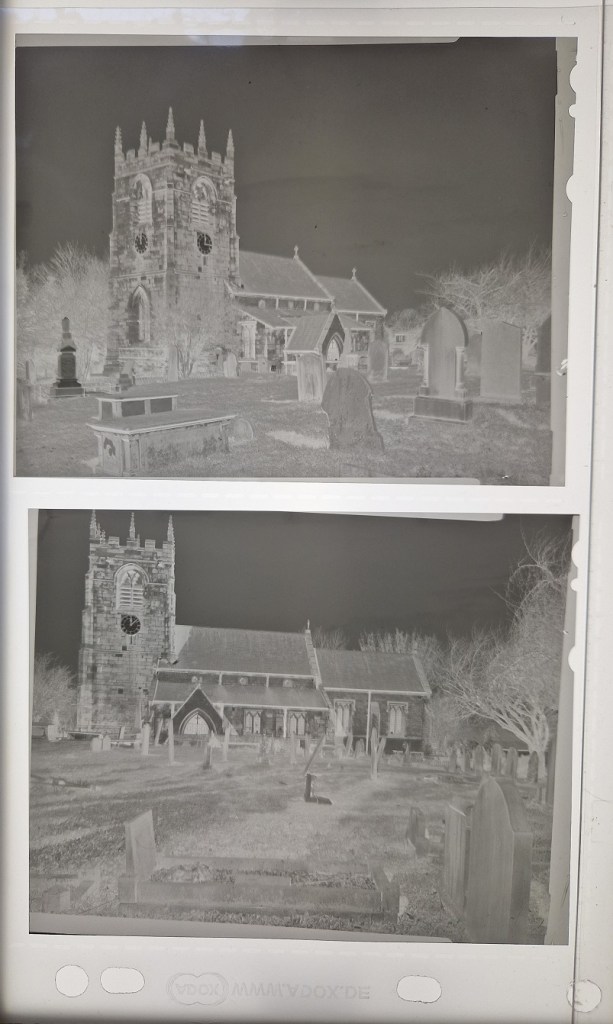
Another couple of shots taken this week and then developed today. The good news is that I’m now fully confident that the light leak issues I had before are now resolved. The bad news is that I think I somehow managed to load these two sheets incorrectly. Not in a significant way, but negatives from both sides of the film holder indicate the the sheet wasn’t aligned properly and the photos are wonky as a result. You can see what I mean in this photo of the negs on my lightbox – if you look at the film border you can see how it’s out of whack:
I’m not sure how I managed to do this and, to be honest, I didn’t even realise it was possible! None of the other sheets I’ve loaded have suffered from this problem so I will have to keep an eye on things in the future. Sadly it means that the side-on picture of the church is spoiled as the wonky frame has chopped the top off the church – this is made worse when scanned as the border isn’t included in the scan.
The other image was retrievable though as I’d not framed the subject so tightly. The good news is that these were really just a couple of final test shots to make sure everything was working ok. I think I’ll make sure not to tightly frame my subjects for the time being though, just to be safe.
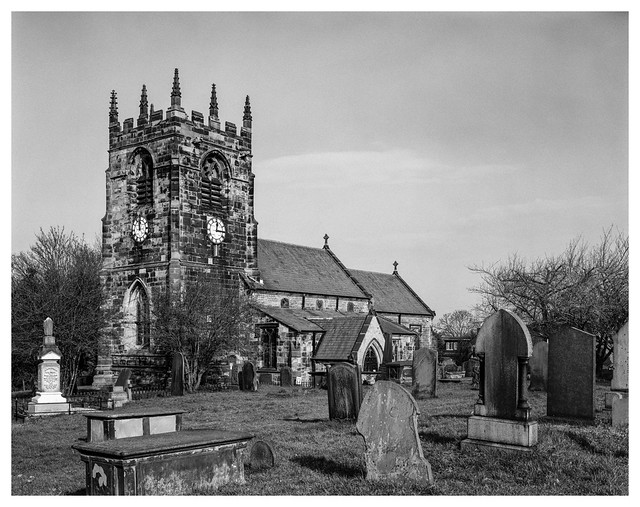
Here’s the shot that worked ok. If you click through to Flickr you can see that there’s a lot of detail.
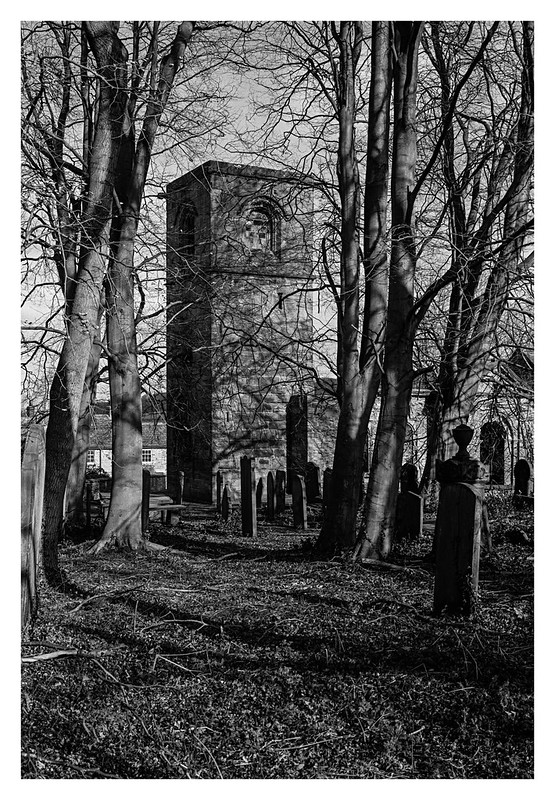
As a direct follow on from yesterday’s post, which showed the new Holy Trinity church – that’s if something nearing one-hundread-and-fifty years old can be considered new I suppose – today’s post shows the old church that preceded it.
The old church tower predates the new one by four or five hundred years, with the rest of the structure having been rebuilt in 1684. The construction is of sandstone and the centuries have taken their toll with the masonry being quite worn by erosion in places, particularly the decorative stonemasonry elements such as carved figures.
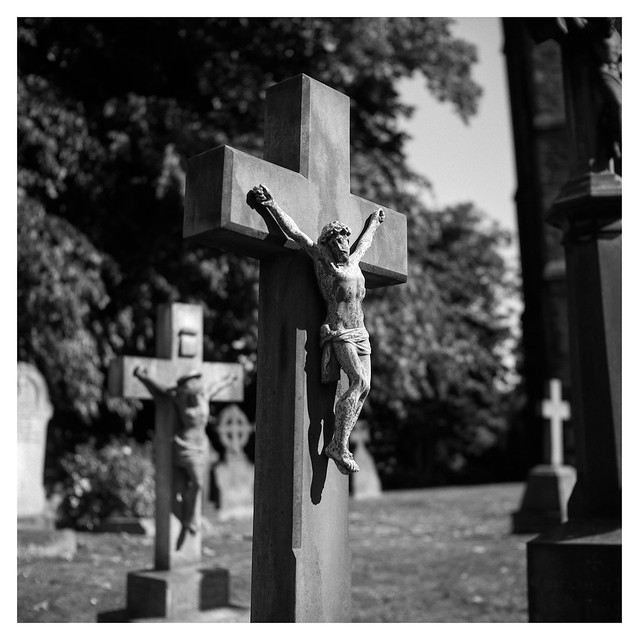
Having just spent the best part of an hour getting rid of thousands of annoying dust specs on some Fomapan 100 negatives, I’m about done for the evening. Therefore this will be a succinct post where I just add this photo of a gravestone with crucifixion design. It was one of several in the churchyard, making it look like some sort of miniature recreation of Golgotha or something.
Yashica Mat 124G & Ilford Pan-F Plus. Ilfotec DD-X 1+4 8 mins @ 20°.
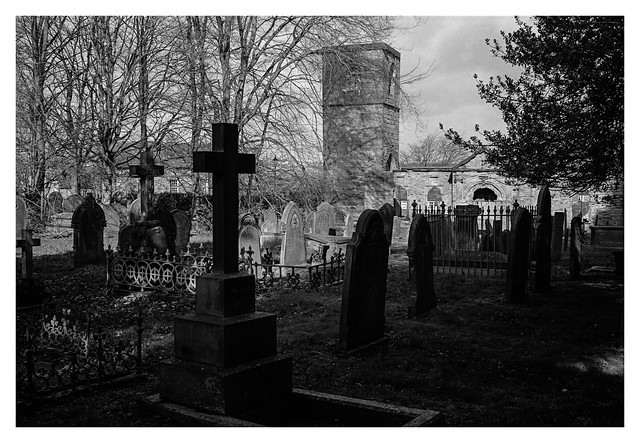
Following on from yesterday’s photograph of the barred church entrance, here are a couple of photos of the churchyard itself.
The light was very nice on the day these were taken and the blossom on the trees glowed in the sunshine. It was an occasion where I really wished I had a roll of nice colour film in the camera. I had Ilford Delta 400 though, so the colours will have to remain in your minds eye.
A couple of weeks ago I paid a short visit to Tinsley Park Cemetery and shot a roll of HP5+ through the Holga. It’s the first time I’ve visited the cemetery in 13 years – the last time was in 2007 when I took some photos with the Canon S2Is bridge camera I used at the time (and which I still have in a cupboard just behind where I sit typing this).
The cemetery is flanked by industrial units near its entrance and then backs onto Tinsley Park Woods and the land that was once part of the short-lived Sheffield Airport.
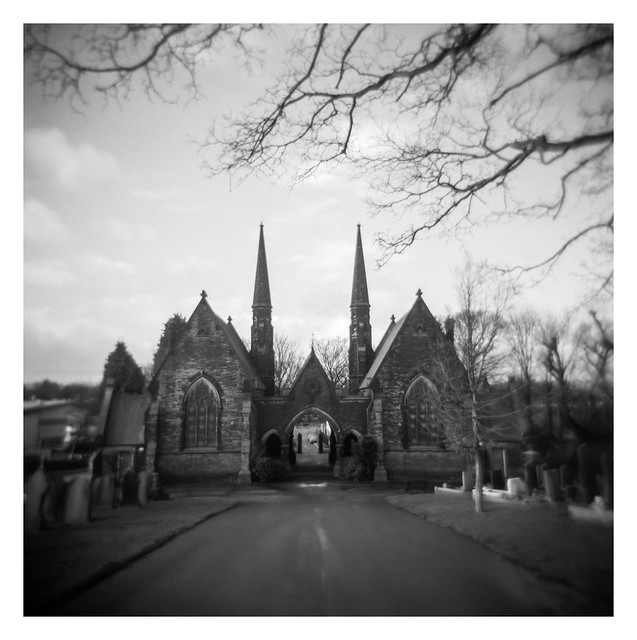
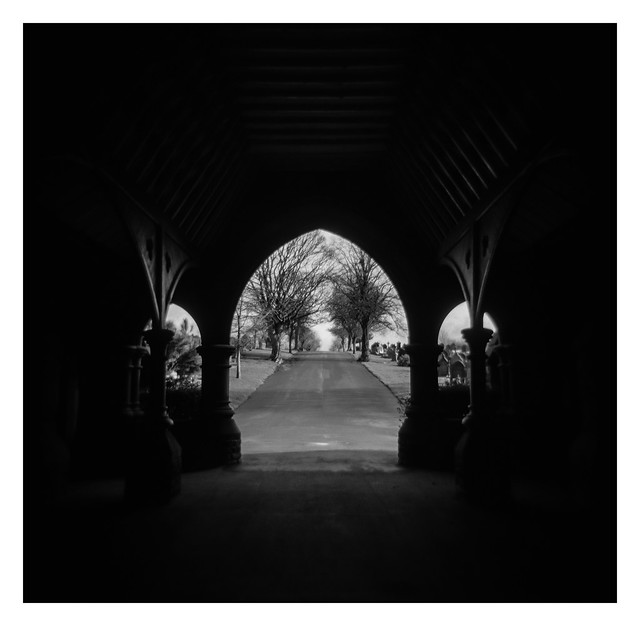
One of its most noteable features is the double gothic chapel, whose twin spires cast a distinctive shape in the air when seen from the nearby Woodburn Road. The two photos below show the chapels as you approach from the entrance and then the view as you descend back down the hill from the cemetery graves.
While there are roads around either side of the chapel structure, the arched route through the centre is the most interesting path to take.
The cemetery also has an intersesting lodge to your left as you approach the chapels.
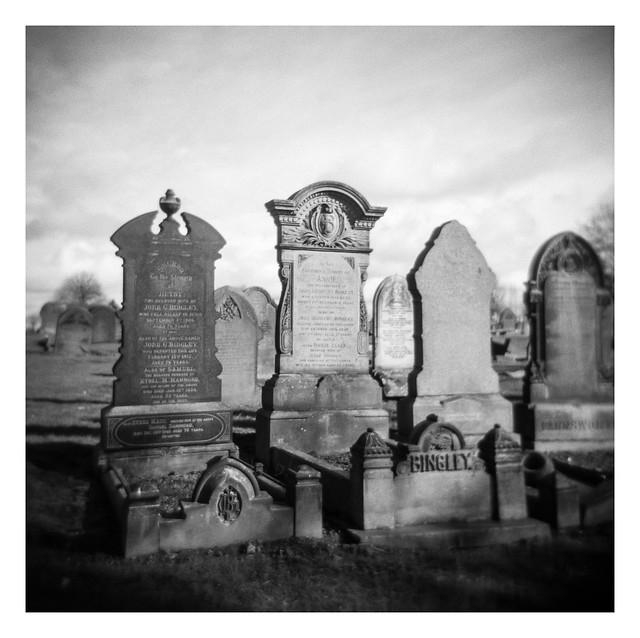
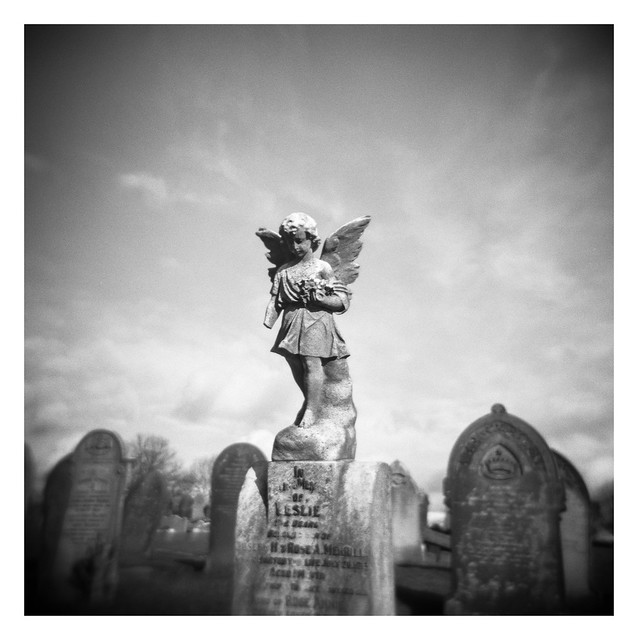
The cemetery was opened back in 1882 and is still in use for new burials today. As with most cemeteries of this age, there are large numbers of impressive Victorian gravestones and other features such as statuettes. Some of these, stood over the graves of Children, are moving to behold.
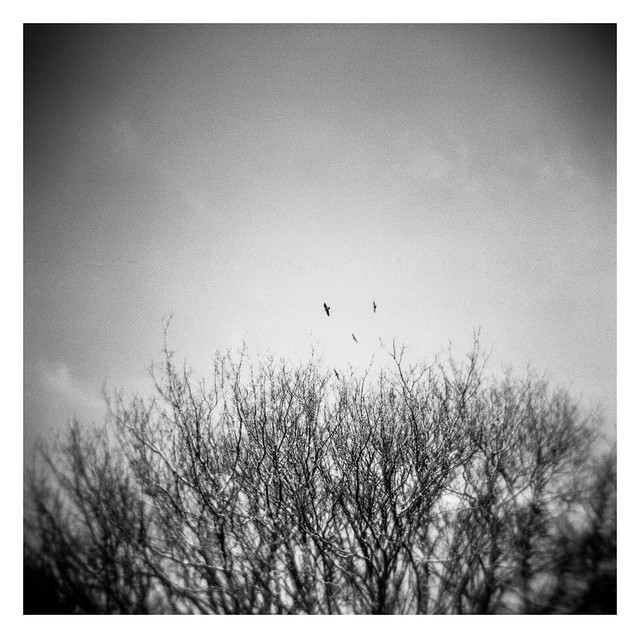
There were large numbers of birds in the trees within the cemetery grounds. I’m assuming them to be ravens, but I’m not a bird expert and they could as easily be rooks or some other member of the crow family.










 Steel City Snapper photography