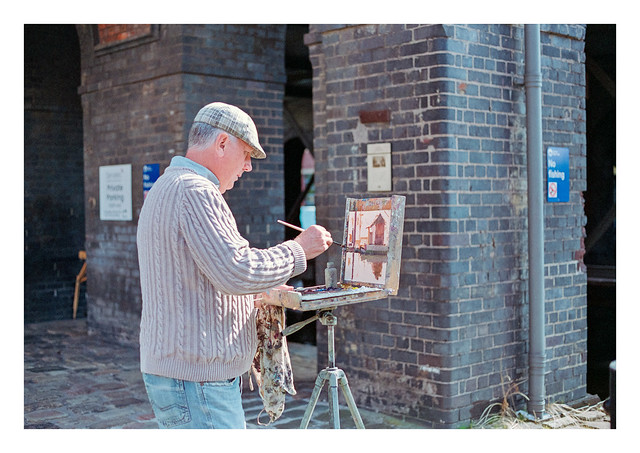
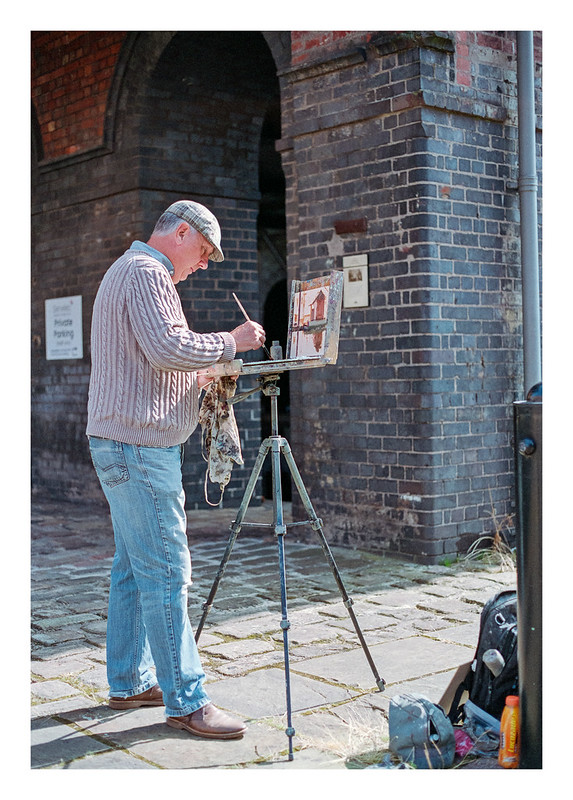
The chap was painting pa picture of the buildings at the canal wharf when I wandered the area with my camera. We were both taking advantage of the lovely light to make our images and I stood and chatted with him awhile before asking if he would mind me making a photograph or two.
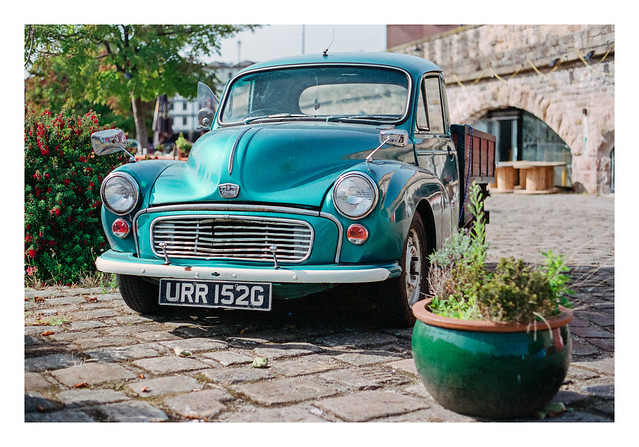
I’ve photographed this same vehicle before, but is seems to have suffered some slight damage to the grille in the intervening period. It’s still a lovely looking truck though.
When I spotted the couple in the distance when I framed this shot, I knew they would be out of focus because I’d set a wide aperture to give the giant ice-cream cone some seperation from the rest of the scene, but liked how they would fill a gap in the frame.
What I didn’t really notice – partly due to making sure I had focus on the ice-cream, but also because I had to be quick as I was in a queue and about to be served my own, normal-sized ice-cream – was that the man’s top was the same shade of pink as the “strawberry” swirl in the foreground cone, and his female companion’s top a similar colour to the blue flavour (whatever that might be). A nice little piece of synchronicity. 🙂
Another photo from my trip to Mablethorpe in September – a trip which is now over a full month in the past! Where does the time go?
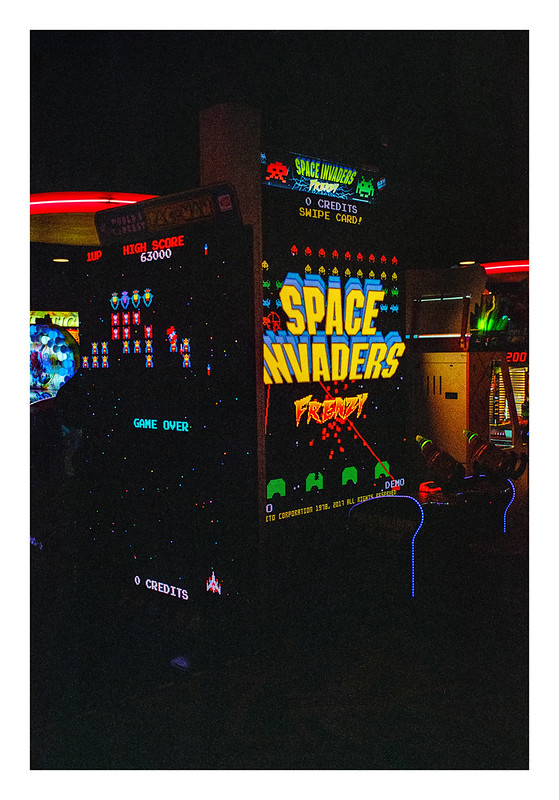
I’ve already posted a couple of shots I made in one of the arcades, and this photograph here was made in the same place, but this one shot with my OM-2n on Superia 100. Although I had a fast f/1.8 lens attached, even at f/1.8 the shutter speeds were hopelessly slow according to the camera’s meter.
So I decided to make an ICM shot. I closed down the aperture until I got a 1-second shutter speed and then made the photo, panning to the left during the exposure. The bright neon of the Looney Tunes characters resulted in something a little like the effect produced by front-curtain sync when using a flash.
I’ve made Intentional Camera Movements before, but with a digital camera as they’re far more cost effective when it comes to making mistakes, so I’m very pleased with how this film exposure came out given it was the one attempt I made.
A couple of pictures to continue the seaside theme today, albeit with nary a grain of sand, nor a splash of salt-water in sight. Both these were made in that other stalwart of the seaside resort – the arcade. This one has been open as long as I can remeber (it’s definitely older than me), although it’s changed considerably since what was (to me and my own personal nostalgia, at least) its heyday.
Back then it was full of bleeping, blooping video games. At first the older titles like Space Invaders, Asteroids, Night Driver and such, but later expanding significantly as the craze for such games grew and grew. A few years later it was possible for show-offs to display theit skills on the Don Bluth animated laser-disc games like Dragon’s Lair and Space Ace, the huge cabinets given pride of place next to the street to draw the crowds.
This arcade is a sizeable place and it used to have some full-sized fairground rides within. A ladybird ride for the younger customers was near the ntrance, but a set of dodgems awaited the bigger kids right at the back of the place. Along one wall were a series of fairground stalls in the form of coconut shies, shooting ranges, ball games, and – perhaps most memorably – a place where you could make artwork by squirting plashes of colourful paint onto a sheet of paper that would then be spun at high velocity on a turntable to create amazing, psychadelic works of art. I remember with fondness the smell of the lacquer that would be applied to hold the image in place, and also the disappointment you’d get when it turned out that some of the paint had stuck to the inside of the card cover, ruining it when you later opened it.
I still love visiting Mablethorpe, and suspect I will for as long as I live, such were the happy memories formed there when I was a child, but each time I go I also feel a certain disappointment that things are not as I remember them in my youth, that the bleeps and bllops of the arcade games of old are mostly gone, the old stand-up cabinets replaced by larger “event” machines offering experiences that cannot be had on home consoles. Much of the floor space is now given over to fruit-machines and devices that let you win lengthy strings of tokens to be exchanged for prizes. It’s not the same as it was. But then, not many things are. Sometimes you really want a time-machine though…
Anyway, one of today’s images shows a couple of retro-games. Not the originals, but still enough to bring a smile to my face when I saw them.
In other news, my zines arrived today! This is the first time (other than the odd print) that I’ve ever had my photos published in physical form. The zines were made ostensibly for me to take part in a zine-swap with a group of other photographers, but I’ve got a whole bunch of them – it was the same price to get twenty-five copies as it was to get ten, so I went for the maximum. I can hopefully use the spares for other zine swapsies (plus I’ve already promised copies to a few people). I’m very happy with the quality of the materials and the reproduction of the photographs – I decided to go with a heavier weight 150GSM paper for the pages, with a 170GSM soft-touch laminated cover and it has a very nice feel to it. There are a few things for me to take away for the next time, but for my first go I’m more than happy.
Not the originals, but still nice to see the old alien foes in their natuaral environment.
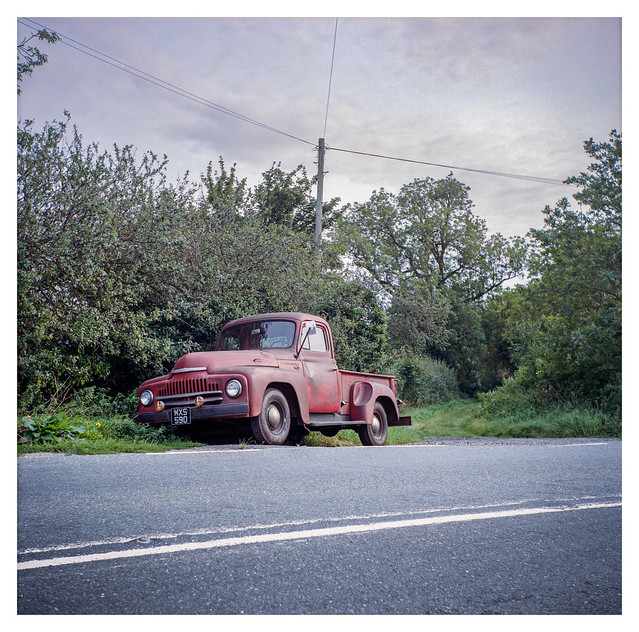
After yesterday’s Chevy photos, I’ll continue a mini-theme of classic American vehicles, this time an International Harvester pick-up truck. Which I think is an L-Series, but which I am again willing to be corrected on. I believe the tow-truck, Mater, in the Cars movies was based in part on an International Harvester.
Like yesterday’s Chevy, this was photographed on my trip to Mablethorpe. While the Chevy is a permanent feature at the garage where I made the photo, this truck was just parked on the verge on a bend in the road not too far from my destination, so I pulled over and took a few quick shots.
I made a few pictures of this vintage Chevy on the way to Mablethorpe the other week, some with my Canon Sure Shot Z135, and some with my Zeiss-Mess-Ikonta 524/16. I photographed the same car before when I passed by last year, using the Zeiss on that occasion too, but with some Ektar (and in bright sunshine). The conditions this year were more subdued, the same layer of thin, high cloud that would be present most of the day, obscuring the sun so that much of of the light was diffused, removing much of the contrast. Despite this, I still like how both these images turned out.
I think the car is a Chevy Townsman from the early 50s, but I’m happy to be corrected by someone more knowlegeable about such things.
EDIT: I’ve been informed my fellow blogger, Jim Grey, that it’s actually a Chevrolet Sedan Delivery. Thank you Jim.
This is the Z135 shot, taken on Kodak Gold 200, scanned on my Plustek 8100 as a linear tiff and then converted with Photoshop and Grain2Pixel.
And this is the Zeiss shot, this time taken on Kodak Portra 400, scanned on my Epson V550 as a linear tiff and converted with Photoshop and Grain2Pixel.
For the best part of the last two years, whenever I’ve shot colour negative film, I’ve sent it off to be developed and scanned. While I have the means to scan it at home, I was never satisfied with the colours I achieved using Epson Scan. I tried a number of other tools to see if I could improve my results and managed to do better with Silverfast for 35mm when I bought my Plustek scanner, but the images still didn’t look quite right. So I resigned myself to getting lab scans of all my colour negative stuff.
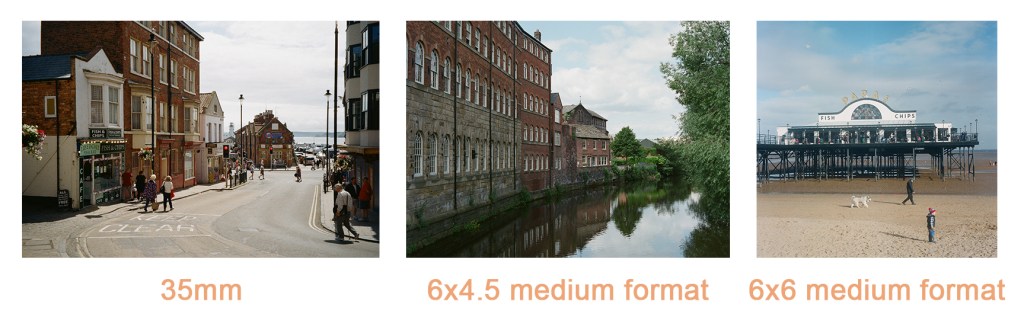
While I’ve been mostly happy with my lab scans, one point of frustration is the way they size the images. The labs I’ve looked at tend to offer scans in small / medium / large options which, on the face of it seems fine. However, what I came to realise was that a scan was based on a particular number of pixels on the short side of the image. This results in a bewildering situation where, for any given scan “size”, it seems medium format scans will be smaller than 35mm scans (or the same size, if shooting 6×9). This is clearly disappointing if you want to benefit from the added detail that medium format allows. The image below shows comparisons of three different image ratios and how the larger medium format images lose out when scan size is determined by the number of pixels on the short edge.
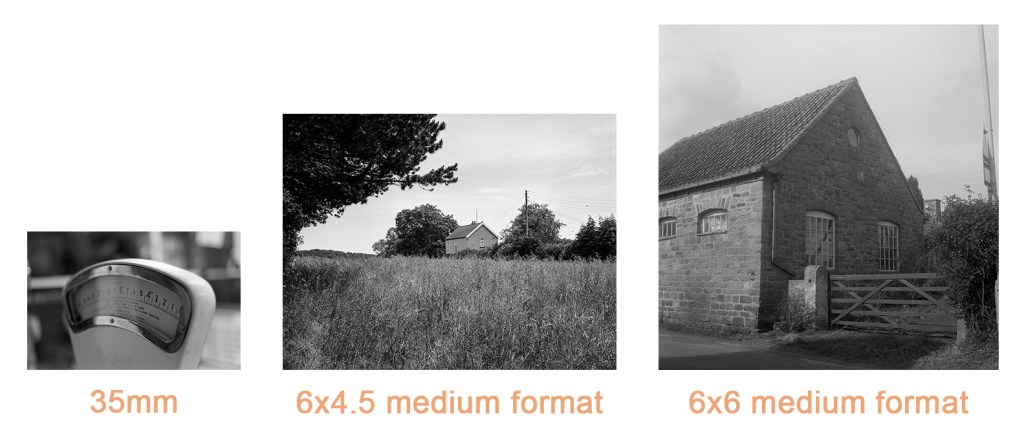
By comparison, when I scan at home I get larger scans for the larger formats, as can be seen in the example below with each image being scanned at a uniform DPI setting and not limited to a specific number of pixels per side:
This discrepancy in image sizes made me want to home scan my negatives. While I don’t think my Epson V550 or Plustec 8100 really compare with the abilities of something like a Noritsu of Fuji Frontier, the ability to control the settings means I can get much more detailed results than what the labs I’ve tried will supply. While I’m sure that there are labs out there who will provide higher resolution scans, many of them also charge a considerable amount for the service, putting them out of my price range unfortunately.
I’d seen very good word of mouth over the past year about Negative Lab Pro, but that costs in the region of £60, which isn’t something I want to pay right now (although I’ve been tempted), so it was with interest when someone alerted me to a new Photoshop plugin called Grain2Pixel recently. Grain2Pixel is used to convert negative scans to positives and is currently free of charge (although I believe a more feature packed version is in the works which will require payment).
In order to use the plugin, you have to make linear scans of your negative, e.g. it still looks like a negative after scanning. The plugin accepts TIFF and DNG files, so you can scan with a digital camera if you like. Once launched in Photoshop, you select your scans via the plugin’s interface, choose any settings you want to apply such as automatic colour correction, and then run the process. The process is straightforward and you can convert individual images or a batch.
I’ve tried a number of different film stocks with it and have been getting good results on the whole. Some that I’ve tried, such as Kodak Ektar and Kodak Portra 160 have looked great directly out of the plugin. Some others have been a little more tricky – Kodak Gold 200 and Kodak Portra 400 seem to have a blue / cyan cast no matter what settings I use. Despite this though, the results are still good and I am able to tweak the results further in Photoshop or Lightroom to get results I’m usually very happy with, with the extra benefit of having much higher resolution images.
The plugin can be found, along with instructional videos, here: https://grain2pixel.com/ There is also a Facebook group for the plugin which gets regular traffic and is useful if you need help.
All three of todays photos have used Grain2Pixel for initial conversion. I’ve then tweaked the results in Lightroom to add additional contrast etc. They were scanned on my Plustek Opticfilm 8100 using Vuescan to create the linear TIFF files.







 Steel City Snapper photography