35mm · Film photography · Photography

Beetle bonnet

I guess that photos like the one posted here today are something of a cliche these days – pictures of the fronts (and rears) of cars, especially classic cars, is something that seems to have become a widespread trend. Nevertheless, they can still be interesting pictures, I feel, so please excuse another one appearing. 🙂

Beetle bonnet

Nikon F80, Nikkor 28-80mm f/3.5-5.6 AF-D & Fujichrome Velvia 100 (expired 2011). Lab developed. Home scanned.

Taken on 25 June 2022

35mm · Film photography · Photography

Small cars with grand names

This little car here is the somewhat graniosely named Vanden Plas Princess 1100. It’s a model from the BMC ADO16 range of which there were multiple variants. The Vanden Plas version was at the upmarket end though, with the model sporting leather interior furnishings and a walnut dashboard. It also had a posh-looking radiator grille by way of distinction from its lower spec stablemates.

Vintage runabouts

Nikon F80, Nikkor 28-80mm f/3.5-5.6 AF-D & Fujichrome Velvia 100 (expired 2011). Lab developed. Home scanned.

Taken on 25 June 2022

35mm · Film photography · Photography

Hot days and gridlock

It’s a bit of a hot day here in the UK today – with temperatures where I live nudging past 30 degrees. That’s not very high compared with other parts of the planet, but it’s high for me and the only consolation is that the humidity isn’t too bad. The forecast is for cooler weather through the rest of the working week, but then it’s predicted that it could soar to potentially record-breaking highs again next weekend.

I hope I’m not stuck in traffic…

Rush hour

Nikon F80, Nikkor 28-80mm f/3.5-5.6 AF-D & Fujichrome Velvia 100 (expired 2011). Lab developed. Home scanned.

Taken on 25 June 2022

35mm · Film photography · Photography

Lincoln Continental

This big barge of a car was at the Sheffield Steam Rally when I visited. I’m not sure what year this dates from – I would guess late 70s, but I could also be out by some margin thanks to my relative ignorance of such things. It looks nice in a photograph though!

Continental
Continental 2

Nikon F80, Nikkor 28-80mm f/3.5-5.6 AF-D & Fujichrome Velvia 100 (expired 2011). Lab developed. Home scanned.

Taken on 25 June 2022

35mm · Film photography · Photography

Popular corrosion and further slide scanning

I wrote a few days ago about how I’ve been having difficulties scanning a roll of Velvia 100 that I shot at the steam rally last weekend. I’ve scanned Velvia 50 before and was similarly granted with the same red-cast that I got this time, although on this occasion I’ve also had problems with the actual exposure of the scans – some images looking under-exposed in comparison with the physical transparencies. The under-exposure issue is something that I’ll have to atempt to rectify in Lightroom, but at least I seem to have found a working solution to the red-cast problem.

After carrying out all my post processing in Lightroom, I always open the final image in Photoshop to add a white border. This time, as well as adding the border, I also used the Auto-colour option in the Image menu. I don’t usually find that this does a great job – it tends to be hit and miss on the occasions I’ve used it in the past – but for these Velvia 100 scans it works a treat. Hopefully this will mean I’ll get much more satisfactory images from the roll than I’d feared.

This picture of a slightly rusted Ford Popular has come out very nicely. I used a polariser for most shots on the roll, and it’s really deepened the sky for this photo.

A hint of corrosion

Nikon F80, Nikkor 28-80mm f/3.5-5.6 AF-D & Fujichrome Velvia 100 (expired 2011). Lab developed. Home scanned.

Taken on 25 June 2022

35mm · Film photography · Photography

Pillar boxes

Given Fuji Velvia’s penchant for rich saturated colours, I couldn’t help photographing a couple of red pillar boxes with it.

Priority postbox

Scanning this Velvia 100 took a bit of trial and error to get the colours and tones correct. My initial attempts resulted in slightly flat looking images, lacking in that brightness that you see when viewing a transparency in natuaral light, so I had to create a Lightroom preset to make the necessary adjustments required. Even then, however, the scans still had a very warm cast to them. A little research revealed that scanned Velvia 100 is sometimes nicknamed Redvia due to the red tones in the shadows. It might be possible to remove this in Lightroom, but I found it easier to set up an action in Photoshop to use a curves layer to drop the shadows in the red channel. They look much closer to the original transparencies now, but retain those saturated tones that the film is known for.

Another priority postbox

I’ve been really pleased with the results from this roll (and the fact that the OM-2n’s meter has proven itself to be dependable even when metering for something as finicky as slide film). I hope the other four rolls I have will be just as satisfying.

Olympus OM-2n, Zuiko Auto-S 50mm f/1.8 & Fujichrome Velvia 100.

Taken on 2 August 2020

35mm · Film photography · Photography

Sheffield Space Centre

After yesterday’s photo of the old Bennett’s shop front, here’s a picture of another shop just a few doors down on The Wicker, this one still in full health though. I’m not sure when the Sheffield Space Centre first moved to these premises, but it was sometime in the 80s as I recall.

I would visit regularly, browsing their wonderful stock, and buying copies of American horror movie magazines like Fangoria or special effects stuff like Cinefex. For a while a harboured a vague dream of becoming a special effects makeup artist in the vein of Tom Savini of Rick Baker or something. I went to work in an office instead…

I particularly like the Batman social distancing poster in the window. 🙂

Sheffield Space Centre

Olympus OM-2n, Zuiko Auto-S 50mm f/1.8 & Fujichrome Velvia 100.

Taken on 2 August 2020

35mm · Film photography · Photography

Bennett’s fishing tackle shop

A number of decades ago, back when I was young, I was interested in fishing. As a teenager still at school and blessed with only limited funds, most of the fishing tackle I owned was either passed down from my dad (including a dated, even at the time, cane fishing rod that snapped in half while making a cast one day, much to the amusement of my friends!), or acquired as presents at birthday or Christmas time.

I did have enough money to buy the other necessities of the pastime though: line; floats; lead shot (long since banned!); hooks; perhaps the occasional bigger-ticket item like a keep-net or something; and, of course, bait, usually in the form of a tub of wriggling maggots, often in a variety of dyed shades to make them more attractive to the fish (the ones at all the places I went must have been colour-blind though…).

At the time, years before online shopping and even the World Wide Web itself would be a thing, there were a considerable number of fishing tackle shops in the city. Some were dedicated to the pastime, others were a sideline, such as the barber’s that I visited as a child where you could have your hair cut and then buy a pike lure or something (while pretending not to look at the girlie mags that were amongst the fishing periodicals on a small table between the seats where you sat and waited your turn).

The largest tackle shop in Sheffield (and the country, so it was claimed) was Bennetts. The shop had been opened back in the 1950s by Harry and Peter Bennet, renowned match anglers and railwaymen who used to organise angling tournaments for thousands of local fishermen.

In later years the store moved to larger premises on Stanley Street just off The Wicker on the edge of the city centre, and it was here that I would drool longingly over the extensive range of tackle that I had no possibility of acquiring, before buying a considerably more affordable packet of hooks or a swim-feeder or something along those lines.

As my teens came to pass so, mostly, did my interest in angling, and I probably didn’t set foot in Bennett’s (or any other tackle shop) after that, although my dad continued to fish on occasional trips with his friends that had been organised by the pubs and clubs he frequents, so I would get the odd fishing story every now and then (usually about how he’d caught nothing!),

In 2010 Bennet’s closed for good, partly as a result of the 2008 financial crash and subsequent recession, but also as result of the extensive flooding that hit parts of Sheffield in 2007, submerging the store in feet of water.

The main entrance to the shop on Stanley Street has been repurposed now, but the smaller entrance on The Wicker remains, gradually fading away and falling into disrepair.

I wish I had a photo of the shop in it’s heyday, but I’m still glad for the one presented below. It still serves as a memory and I suspect it won’t be there for ever.

Bennetts

Olympus OM-2n, Zuiko Auto-S 50mm f/1.8 & Fujichrome Velvia 100.

Taken on 2 August 2020

35mm · Film photography · Photography

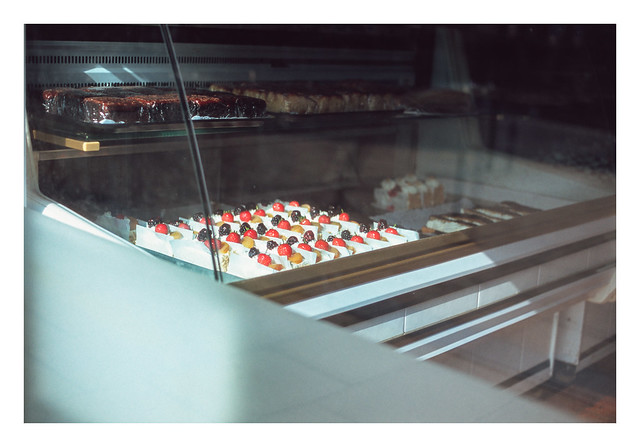
Cakes

A selection of tasty looking cakes on display in a shop window. I really like the way they are lit by the sun, although somewhat less enamoured at the frosted section of the window that takes up much of the bottom-left of the image. Moving to get a better angle introduced unwanted shadows and reflections though. Such is life sometimes.

Cakes

Olympus OM-2n, Zuiko Auto-S 50mm f/1.8 & Fujichrome Velvia 100.

Taken on 2 August 2020