I went to the cinema a few weeks back (to see Dune Part II, I think it was). In one of the car-parks at the shopping mall where the cinema resides, was a circus. The sky was heavy with dark cloud, but the sun was shining through and illuminating things nicely. I’m glad I had the XA3 in my pocket.
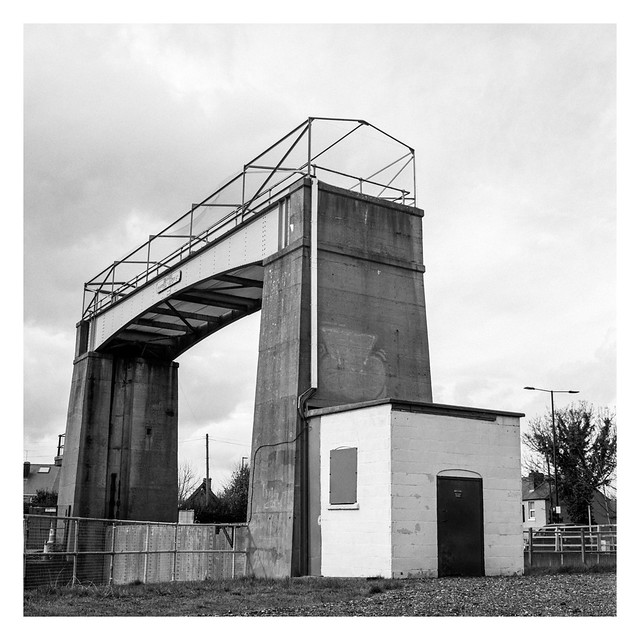
The Woodhouse Mill regulator stands at the northern end of Woodhouse Washlands beside the B6200 Retford Road. It has been there for as long as I remember – unsurprising as it was commissioned a decade before I was born!
Although I know it has been used on many occasions, causing the expected flooding of the washlands, I’ve never actually seen it in use.
There are a number of these raised manhole covers to be found on Woodhouse Washlands. They stand, like strange tumuli atop their mounds of grassy earth.
I expect they are raised to prevent them from flooding if the washland is submerged when the river is high as they probable provide access to sewage pipes – there is a sewage treatment works at the northern edge of the wetlands, just across the B6200 road that marks the boundary.
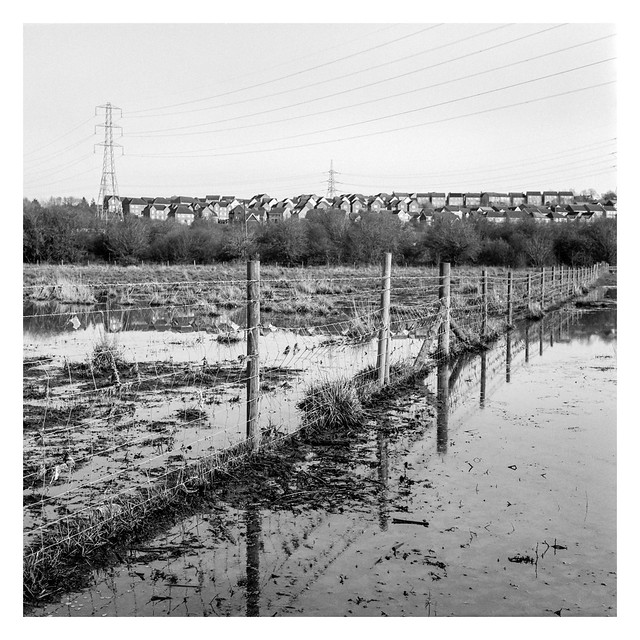
One of the interesting features about Woodhouse Washlands is how it can change noticeable when flooded. As it’s a floodplain (with a flood barrier at the northern end to boot), this is to be expected and, to be honest, it becomes somewhat challenging to navigate without getting wet and muddy in these circumstances. It does allow for different photographs to be found though. What were previously just grassy fields, now become ponds.
As the Hot Chip song goes, “Over and over and over and over. Like a monkey with a miniature cymbal. The joy of repetition really is in you.“, so it seems that I photograph the same things over and over too. The flyover at the southern end of Woodhouse Washlands is one such subject. It is an interesting subject, I think, and I don’t think I’ve exhausted it yet, but I wonder if there is a limit on how many times I can photograph it before the repetition becomes too much?
What, at first glance, looks like a muddy obstacle when out for a walk, might also be seen as two figures shaking hands. On what, who knows? Giving me wet feet probably.
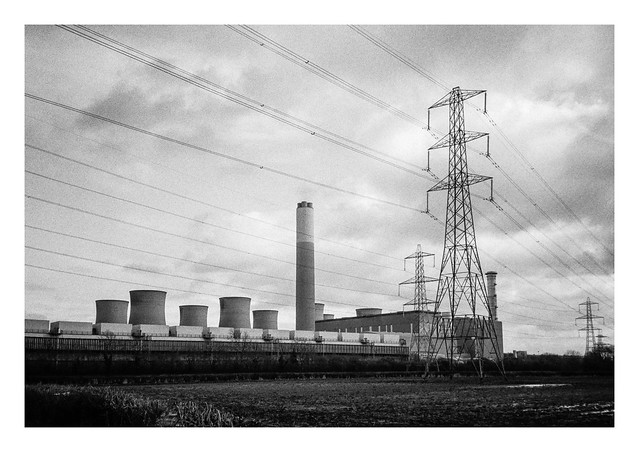
After yesterday’s post about West Burton power station, here’s one about Cottam power station, which also stands beside the Trent a few miles upstream to the south.
Cottam power station went into operation in 1968, generation power for fifty years (20 years longer that it’s original life expectancy). It ceased generation in 2019 and demolition began in 202/ The chimney and cooling towers are due to be demolished by 2025.
Some of the buildings in these pictures were demolished just a few days after I photographed them on the 22 February 2024. I expect the views of, and from, the village of Cottam will look considerably different when the demolition work is complete.
West Burton power station, or rather stations (as there are two on the site – West Burton A and B), sit alongside the River Trent in Nottinghamshire. West Burton A was a coal-fired station, one of only three remaining in the UK in 2022 when it was due to be decommissioned. Due to energy uncertainty caused by the Ukraine War, the station was kept open a further year, before decommissioning took place in 2023.
Demolition of the site has commenced in 2024 and is planned to be complete by 2028.
While I’m glad that we are moving away from environmentally unfriendly coal-fired power stations, I shall be sad to see the structure go. The station can be seen on the horizon from many tens of miles away, including the hills of Sheffield, my home city, and also the Lincolnshire Wolds to the east and it a feature of the landscape that has been present my entire life. It also serves as a visual marker for the River Trent which I always counted as the midway point on trips to my favourite seaside town, Mablethorpe (it’s actually closer to Sheffield than Mablethorpe, but let’s not split hairs… 🙂 ). It will be strange when it has gone.
There have been attempts to preserve the cooling towers as part on the nation’s industrial heritage, but I believe these have been unsuccessful. While West Burton A will go, West Burton B – a gas-fired station – will continue to operate, and the West Burton A site has been announced as the proposed location for the UK’s first nuclear fusion plant.
I hope to visit the site whenever I get the chance to get more photographs before it disappears (or changes) permanently.