Film photography · Medium Format · Photography

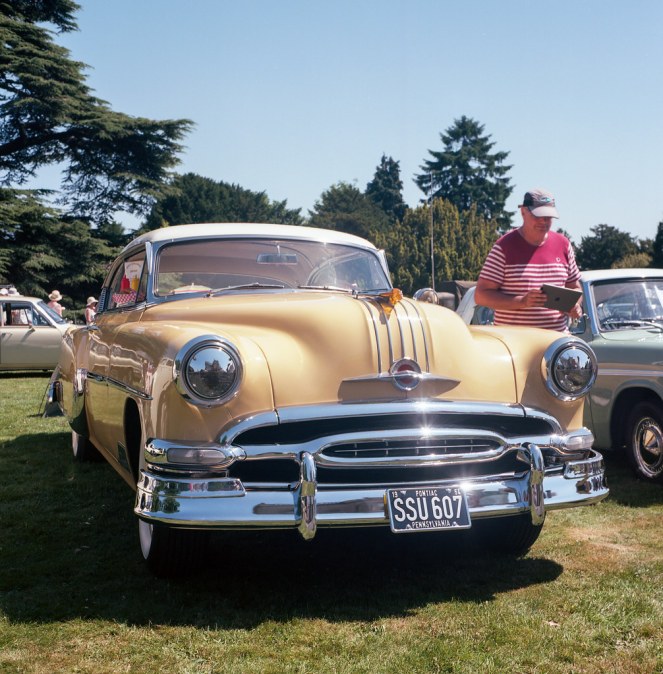
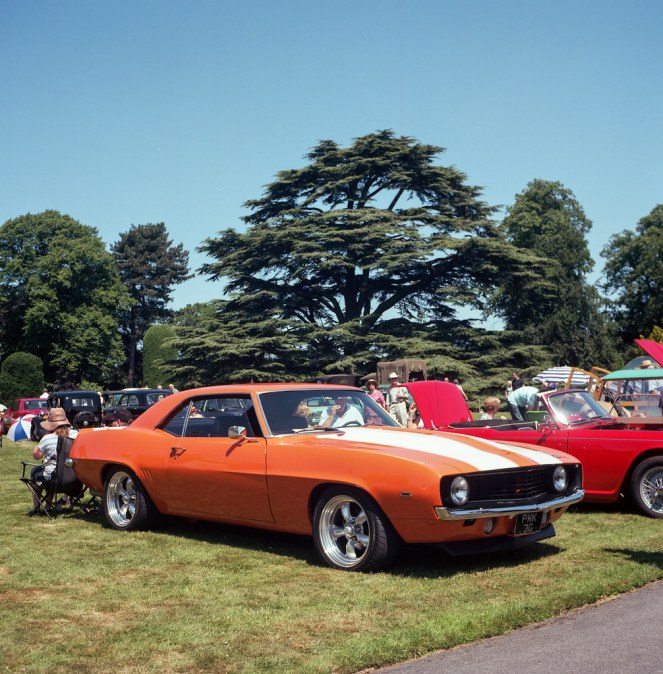
Classic cars at Brodsworth Hall


NOTE: Some of the images in this post are showing broken links. The images are still there if you click them, but they are not being displayed for some reason I can’t fathom.

It was a rare Fathers Day this year where I got to go out and do something rather than being stuck at home because my wife was at work and, as luck would have it, there was a classic car event taking place at Brodsworth Hall on the day in question.

Brodsworth Hall has the benefit of both being not too far away, and also being another English Heritage property that I can use my membership benefits to gain free access. It’s not a place I’ve visited before, but it looked very nice in the English Heritage booklet they sent me, and I’d been planning a visit even before I discovered the classic car show was on. The hall is one of the most complete remaining Victorian country houses in the country and has, apparently, remained largely unchanged since the 1860s. The day I visited was probably not the best on which to appreciate the house and gardens however due to the large numbers of visitors, not to mention dozens of vintage motor vehicles parked around the place.

I also managed to lose my way on the drive there. I’d assumed that there would be signposts on the A1 (there are certainly signs for the hall on the southbound carriageway as I saw them on the way back from York last week), but either they aren’t present or (more likely) I managed to miss them – probably because I was overtaking a lorry that obscured the sign or something. That’s usually the cause! Thankfully, despite taking the wrong exit, there were yellow AA signs showing the way to the “Classic Cars”, and after about ten minutes I reached the entrance to the grounds. Along with dozens of other cars… It must’ve been a good ten minutes from entering the grounds to getting parked thanks to the large number of visitors, and as the temperature was over 30 degrees, I was very glad to be in a modern, air-condition car rather than one of the attractive, but less well equipped vehicles on show.

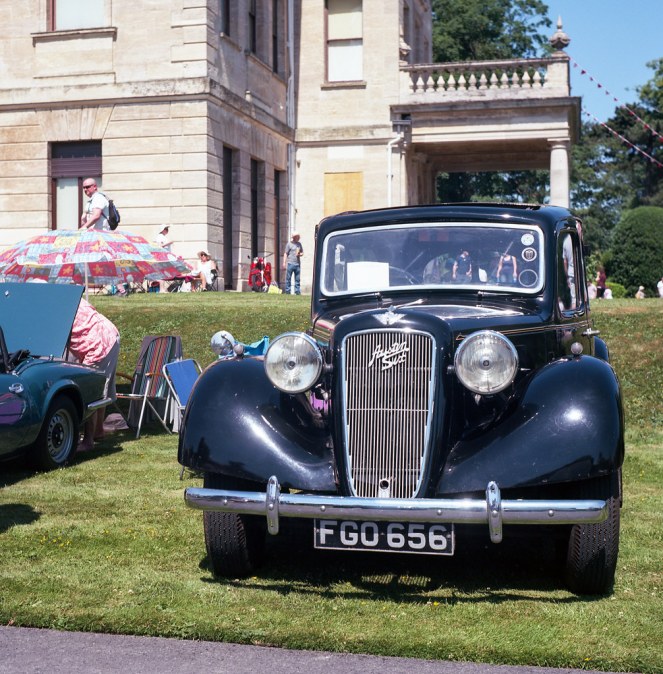
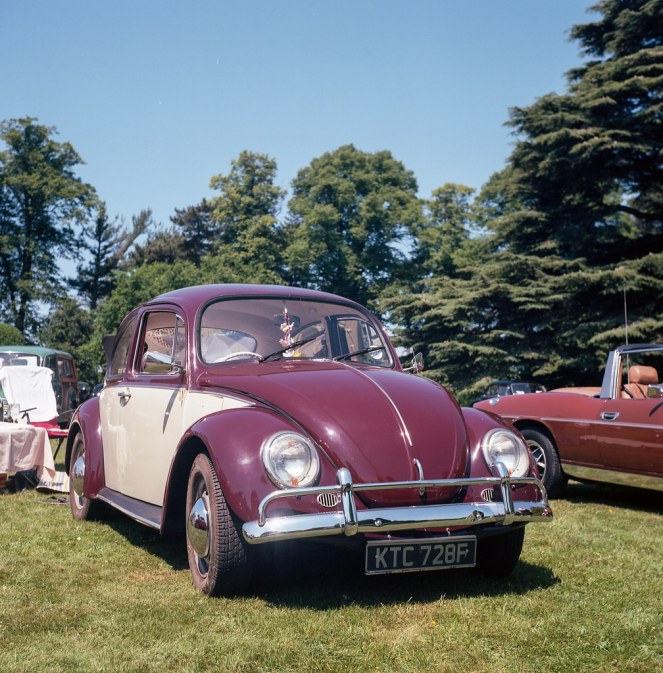
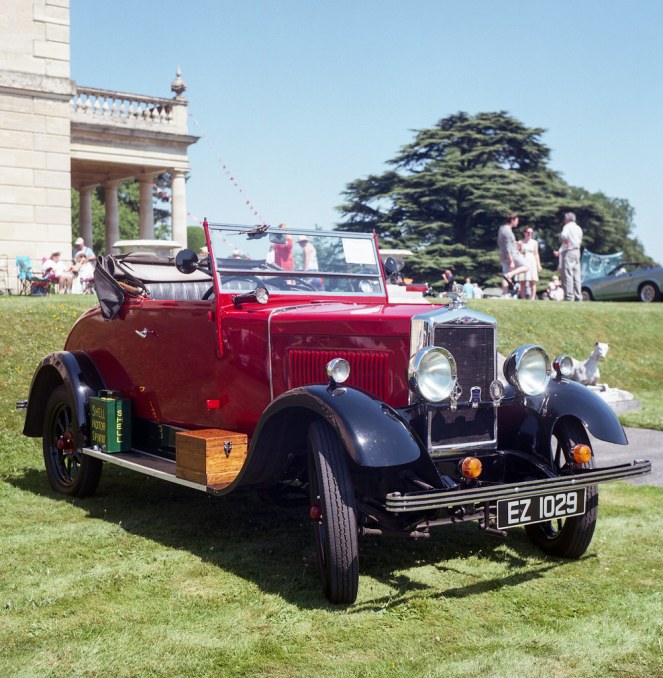
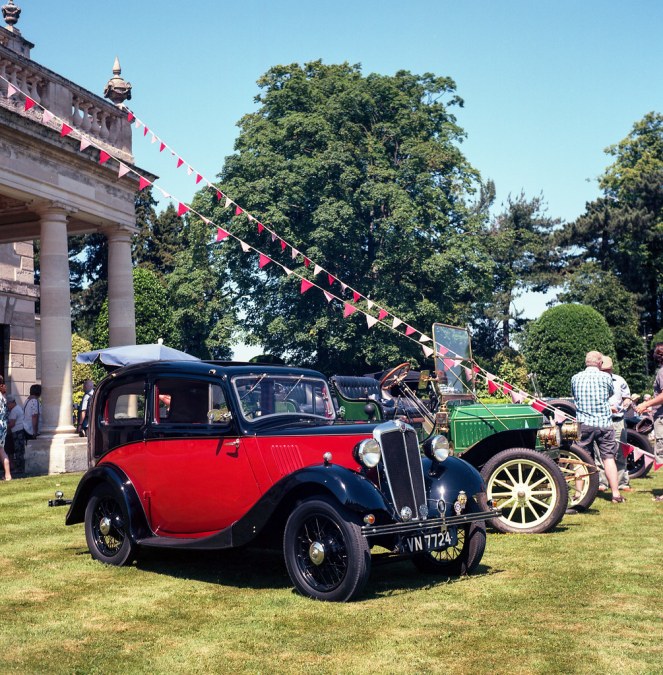
I’d come the the Hall with a couple of cameras – my Yashica Mat 124 G, and my Nikon F70. The F70 contained a roll of Ilford Pan F Plus 50 that I’ve had for a few months but been waiting for a nice bright day to shoot it, and the Yashica had a roll of Ektar, plus a roll of (slightly expired) Portra 400 & some Fuji Acros on standby. In the end I shot the Ektar, the Portra and the Pan F 50, but didn’t use the Acros, and the shots in the post are of the the Ektar (I’ll add another post or two containing the Portra and Pan F shots at a later date).

I’m not going to add descriptions for the all the shots below (I’ll likely embarrass myself by getting the names of the cars wrong or something), but might add a few notes where I have something to say (note: I was going to say “something interesting to say”, but that might be pushing it. 🙂 ).

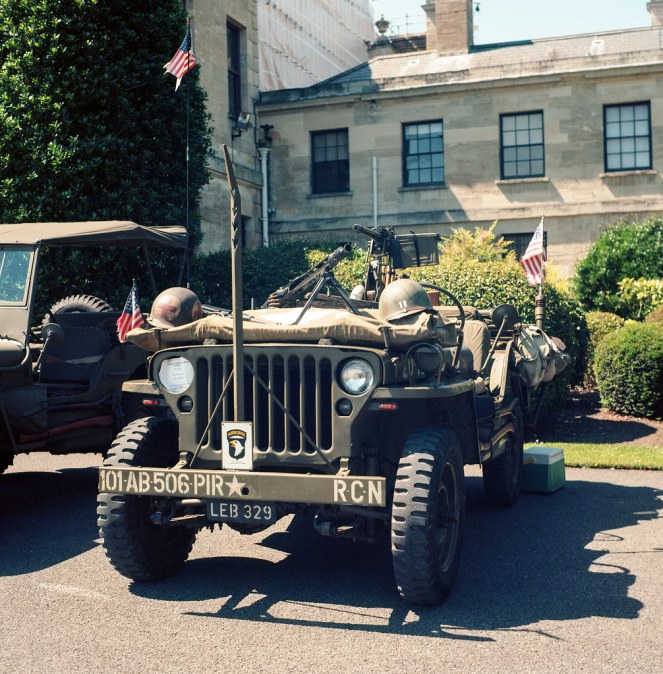
The first couple of shots are of some US Army vehicles from WW2 – a couple of Willys Jeeps to be precise, and I got a couple of shots with the Ektar (and some later shots with the Portra and Pan F 50 too).

35278503501_58fe24ef99_b

35278519421_c48a3763ec_b

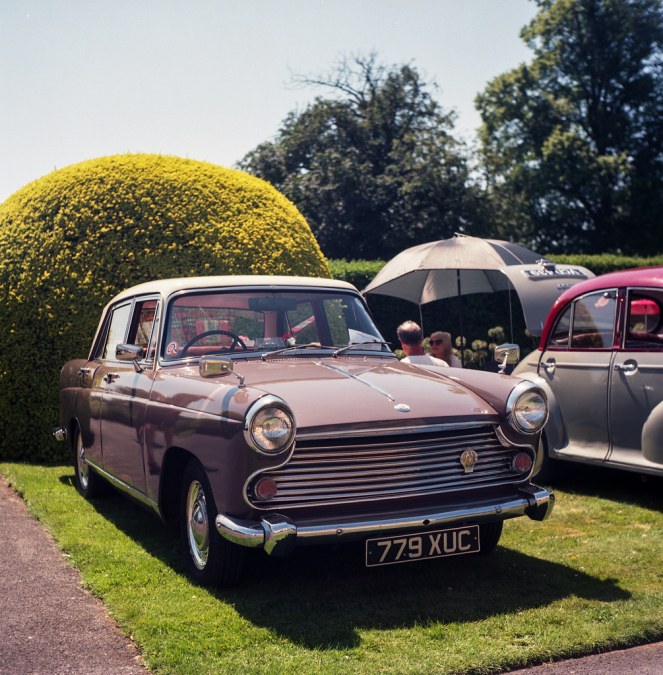
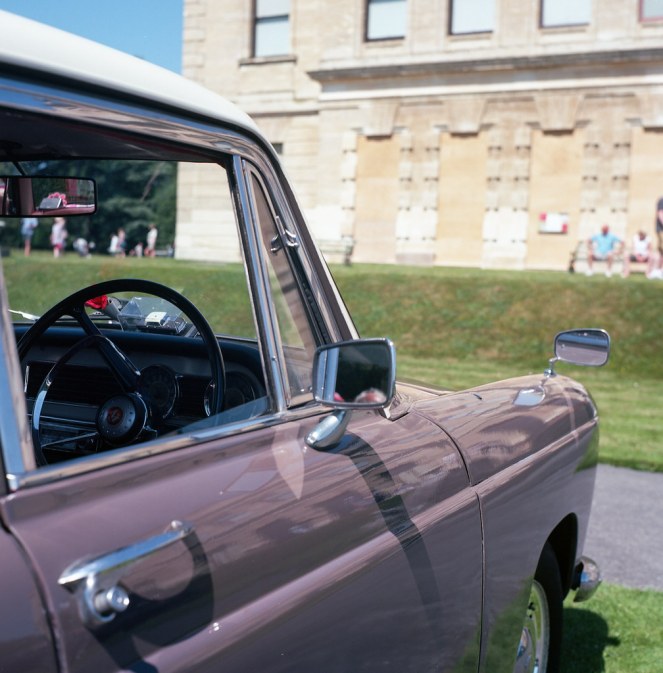
The next couple are of a Morris Oxford. This is notable for me as my granddad had the same car and I rode in it on many occasions, including multiple trips to their caravan at Mablethorpe. His was green though. My memory of it from being a child was that it was some sort of big, finned, American-looking thing, but the reality differs a little. Still a nice car though, and one I have fond memories of.

35408115755_0cda9f6ea7_b

34598609673_c6091fbed6_b

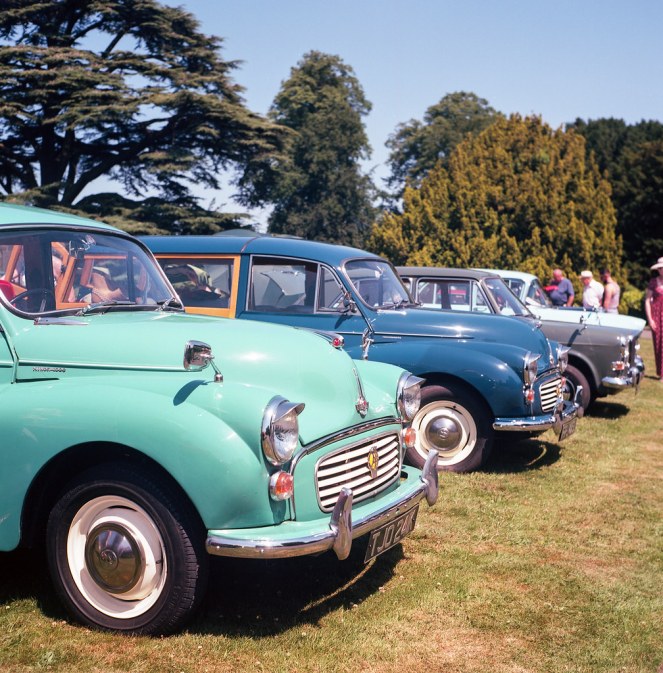
The rest are shots of various other cars. The line of Morris’s and the two American machines are my favourites of these.

35368715636_8b28fdb9ea_b

35278549011_451290d42f_b

35368704426_0215d580b2_b

35408124625_144ffac176_b

34598601333_2de002b261_b

35021040930_1c44a1664d_b

35278560431_b2b9d79f55_b

As a quick postscript to this post, I noticed that a few of the shots from the roll had a colour cast to them. I’m not sure why this is, but can only assume it down to the direction I was pointing the camera and the angle of the sun as all the shots pointing away from the sun seem to be ok. I didn’t have my lens hood with me, so maybe it was caused by flaring of some kind? I colour corrected the shots in question (maybe not perfectly!) to remove the worst of the cast.


35mm · Film photography · Photography

A rainy day in York

The British summer behaved as expected last weekend, when my wife, her sister and I went on a trip to York, delivering a day of rain and muggy humid conditions. The trip came about because I fancied a photography outing, but didn’t want to leave my wife out if I went somewhere nice, but I similarly didn’t want to feel guilty or limited in what I could do by dragging her around while I took photos, so I suggested she bring her sister so that they could do the shopping thing, while I went off to do my stuff.

Anyway, the trip from Sheffield to York takes about an hour, so it’s nothing too onerous to undertake, but the weather definitely put a (literal) dampener on things and so, while the ladies went around the shops, I was forced to find some indoor location myself, and decided upon the National Railway Museum. The museum is worth a visit (even if you’re not all that interested in railways), and I’ve been a number of times in my life, both as a child, and then as an adult, with our own kids. The major downside in the museum, photographically speaking, is that it’s not incredibly well-lit – especially in the hall where the royal trains are housed – and while this isn’t a hindrance to modern digital cameras, where the ISO can be changed on the fly to account for dim light, it’s something of a nuisance for a tripodless film SLR, even with 400 ASA film loaded. So, while I took quite a few shots inside, there were many where I just had to let them go as I would’ve needed far too slow a shutter speed to be able to hand-hold the camera. Oh well.

The photos below were taken on the way to, and inside the museum. I have a bunch of other shots from the day in York (it did mostly stop raining in the afternoon, thankfully), but I’ll perhaps share those in a future post at some point – plus some of them are on a roll of film that hasn’t been finished as yet.

All the shots below were taken with my Olympus OM-1 with a F Zuiko 50mm f/1.8 lens fitted, on Ilford HP5+ film. It’s a lovely camera, and the lens is capable of some very sharp results (although I did lose a couple on the day thanks to camera shake in the low light).

#1 & #2 – While heading towards the museum, I spotted a tour group in the town centre. As the rain was coming down quite hard, they were all holding umbrellas, and I thought they were worth a shot or two. Sadly, just as I got the camera out of my bag and focussed, the group decided to move on, which is why there’s a degree of motion in the first shot. Still, I decided to follow them to their next point of interest and got a more satisfying second shot.

FILM - Tour group

FILM - Umbrellas

#3 – Just before you arrive at the National Railway Museum if coming from the town centre), the road goes beneath the norther edge of York railway station, and there is a separate tunnel for pedestrians and cyclists.

FILM - The Tunnel

#4 – Just inside the museum, next to the reception area, is a steam engine of some sort, and I spotted this interesting-looking gauge on the dome.

FILM - Under pressure

#5 – In the Station Hall section of the museum I was very limited by the available light, and only took a couple of shots – one of which had awful camera shake. If the day had been brighter, then the skylights would have let in much more illumination, but not on this visit unfortunately, so this is the only shot I got in there. It’s a shame as there are lots of things of interest in here, both for the museum visitor and the photographer looking for interesting subjects.

FILM - Old timer

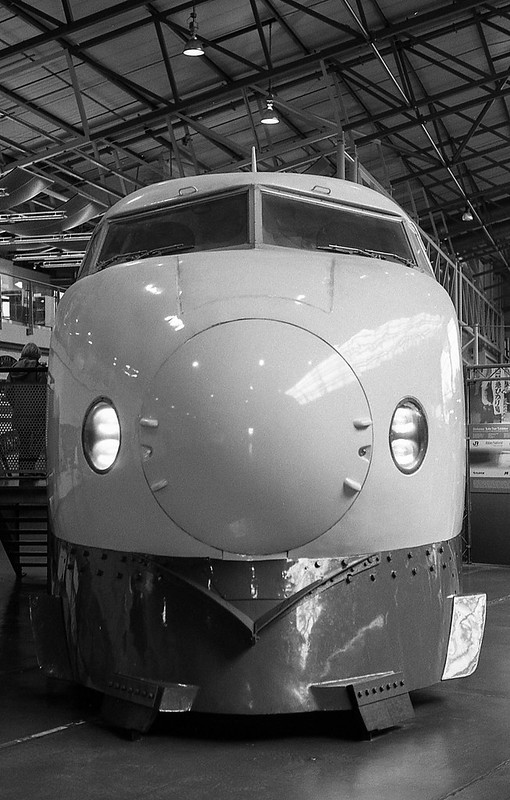
#6 & #7 – The other main section of the museum is the Great Hall. This section houses most of the locomotives and has an operating turntable that is demonstrated at set times throughout the day. One of the first things you see in the Great Hall is a Japanese Bullet Train, and you are able to board the single carriage and watch films that are screened at either end of the compartment. I seem to be receiving a concerned or disapproving look from the lady in the second shot, although I didn’t really notice her at the time of taking the picture.

FILM - Bullet

FILM - Inside the bullet

#8 – The main feature of the Great Hall is the turntable, and the first shot here shows a group of spectators waiting for a demonstration to begin.

FILM - The table is about to turn

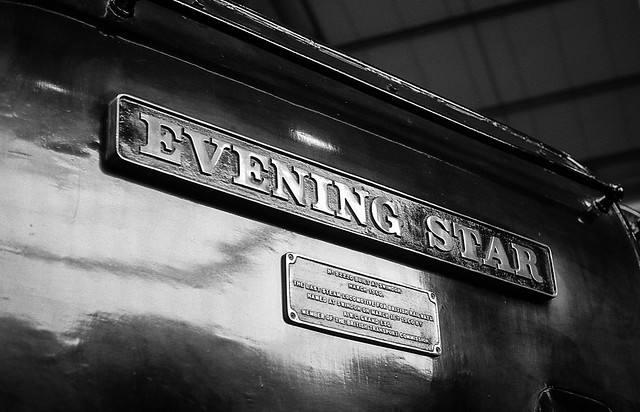
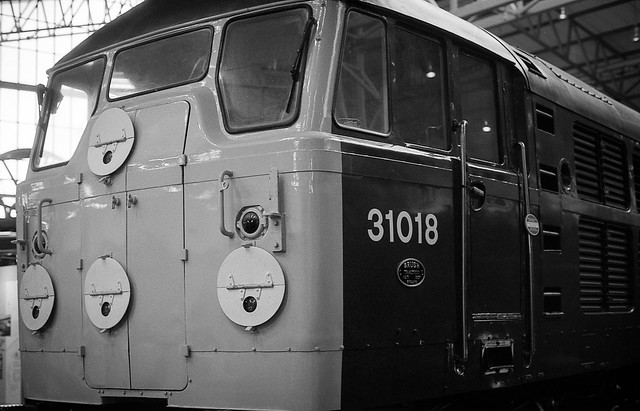
#9, #10, #11 & 12 – show details of some of the locomotives arranged around the turntable, and these shots show a replica of Stephenson’s Rocket, the Mallard, the Evening Star (Britain’s last steam locomotive run by British Railways) and a Class 31 diesel locomotive.

FILM - Rocket

FILM - Built for speed

FILM - Evening Star

FILM - Diesel power

#13 – Also in the Great Hall was this odd little locomotive off to one side of the larger specimens.

FILM - Off the rails

#14 – The final shot I’m including here is of a couple of diesel shunters that were stood outside the Station Hall.

FILM - Face-off

I have to say that I’ve a new-found love for Ilford HP5+. My early attempts with it resulted in slightly flat, grey images that I wasn’t top happy with, but I’ve now realised that this was a fault of the photographer and not the film, and my recent shots have been far nicer in their tones.

Film photography · Medium Format · Photography

Sutton Scarsdale Hall

After spending the best part of £50 on an English Heritage membership earlier in the year, I’ve been trying to ensure that I get value for money on it by visiting various English Heritage sites – although, to date, I’ve only managed to visit three, and the one I’m writing about today was free to enter in any case.

Sutton Scarsdale Hall is in Derbyshire between Chesterfield and Bolsover (one of the other EH sites I’ve visited, Bolsover Castle, can be easily seen from Sutton Scarsdale Hall on the opposite side of the wide valley in which both are situated). It can be observed from the M1 motorway, and this is how the place first came to my attention  many years ago.

The current house dates back to the 18th Century, although it is now just a shell – after falling into disrepair it was asset stripped early in the 20th century and the interior up to, and including, the roof were all removed and sold on. It is freely accessible to visitors, although on this occasion, my first, the interior was off-limits due to maintenance work and the main structure is bordered by some somewhat ugly metal fences that prevent access.

I shot a full roll of Fomapan 200 with my Yashica Mat 124 G during the visit, and I’ll include most of the photos here (three of the shots I took were quite similar, so I’ll just use the best of those, and one was out of focus, so that is omitted too).

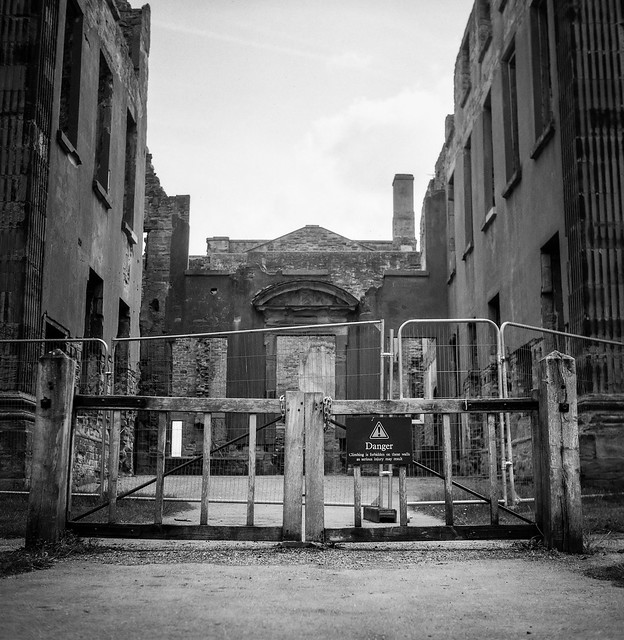
#1. Not the first shot of the roll, but I’ll place it first here as it’s the view from the car park and the first thing you see upon arrival.

FILM - Climbing is forbidden

#2 & #3. The ornately columned east wall of the structure.

FILM - Beware of falling objects

FILM - Faded glory

#4. To the east, the valley slopes down into the wide valley and this shot was taken looking back towards the hall.

FILM - Beyond the meadow

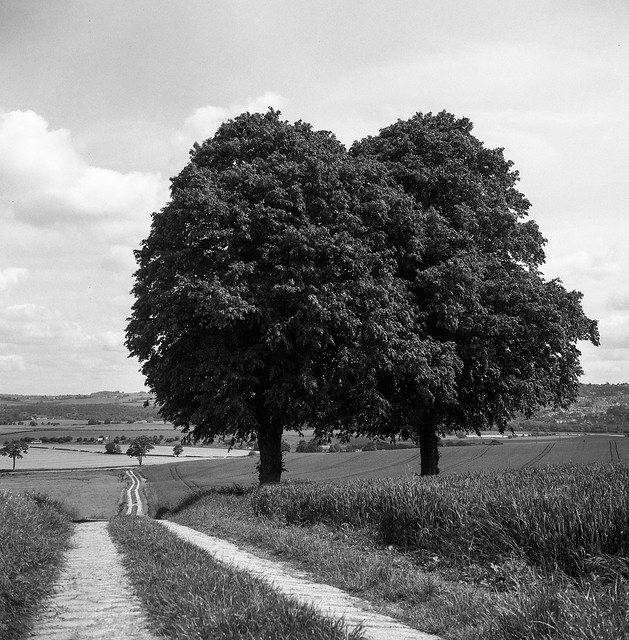
#5. Looking down into the valley, I spotted a couple of trees that made for a nice picture.

FILM - Below the meadow

#6. I decided that I’d like another shot of the trees from a different angle. This involved climbing over a walled ditch (although someone had thoughtfully left a small wooden stepladder against the wall by which to climb up and down) and then walking down a track towards the trees. I actually took three variations of this shot (you can find the other two on my Flickr feed if you click one of the images in this post), but this is the one I really like.

FILM - Down the track, past the twins

#7. A shot of some poppies growing in the field adjacent to the track.

FILM - Black poppy

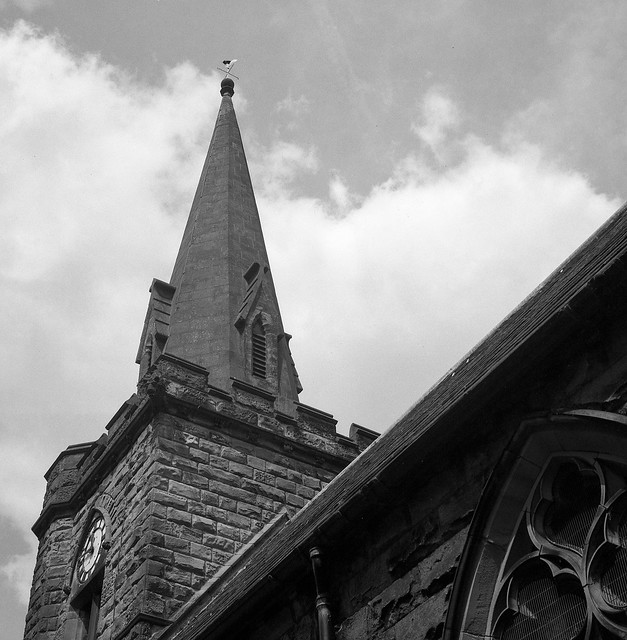
#8 & 9. The final two shots were taken in the churchyard of All Saints church in the nearby village of Heath. I’ve noticed the dollar-like symbols on gravestones before and wondered what they represented, so after taking this shot decided to look up the meaning. I discovered that, despite appearances, it’s not a $ symbol, but the letters I, H & S overlaid on one another and represent the first three letters of Jesus in Greek.

FILM - Steeple-top starling

FILM - Symbols of religion

35mm · Film photography · Medium Format · Photography

Changeable weather #2: The dry(ish) part.

Following on from the last post, here are the remainder of the shots taken on Saturday 27 May.

Shortly after I finished taking the photos in part one, and after walking up towards the West Street / Glossop Road area, the sun decided to re-emerge and bathed everything in bright, and pretty humid, conditions.

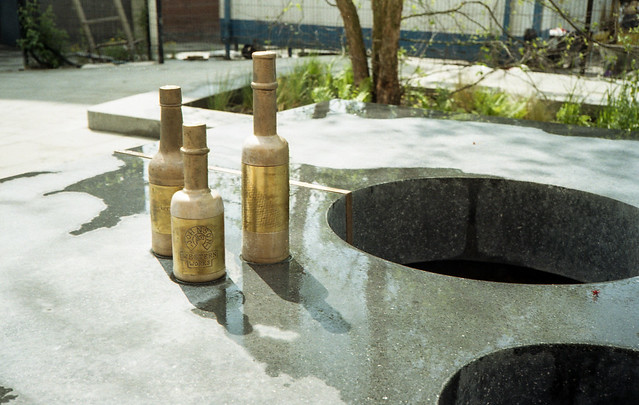
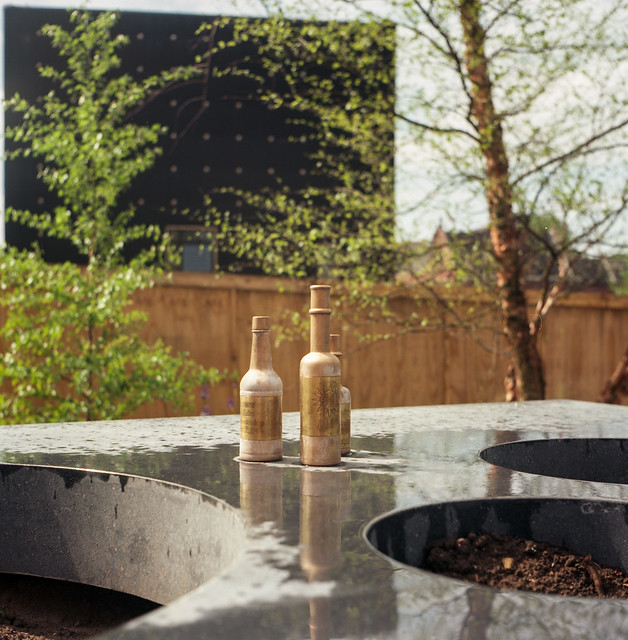
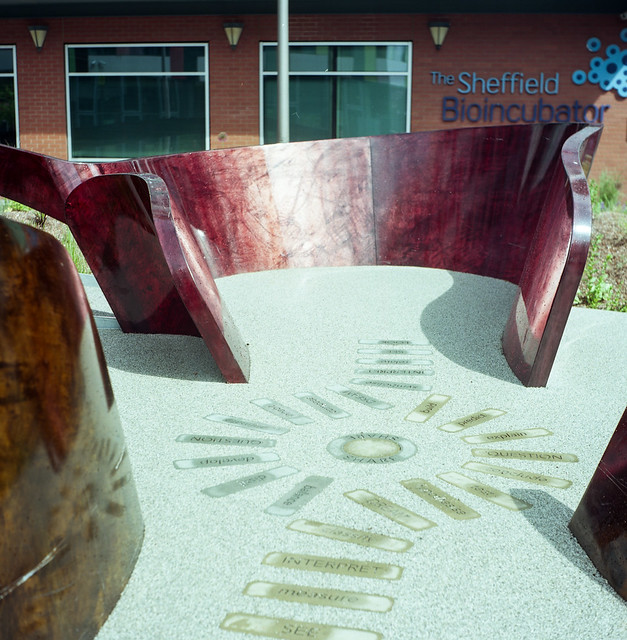
I’d intended to got to the pedestrianised area between the old Henderson’s Relish building and the new university buildings that stand in the spot where the old Jessop’s maternity hospital once stood. The area is in the process of gentrification at the hands of the university and is none the worse for it. As much as I like to see old architecture remaining in place, the new buildings either incorporate the old, listed, architecture, or are modern in a pleasing way that makes for interesting photographs. The university bioincubator facility has a little sculpture / garden thingy in between the buildings that was catching the light nicely too.

Rather than describe each shot, I’ll drop a selection below. As with the previous post, these are a mixture of Yashica Mat 124 G / Kodak Ektar & Olympus 35 RC / Kodak Colorplus photographs.

FILM - Brass bottles

FILM - Holes and bottles

FILM - Underneath

FILM - Bicycles

FILM - Approaching the diamonds

FILM - Things with droplets

FILM - Outside the bioincubator

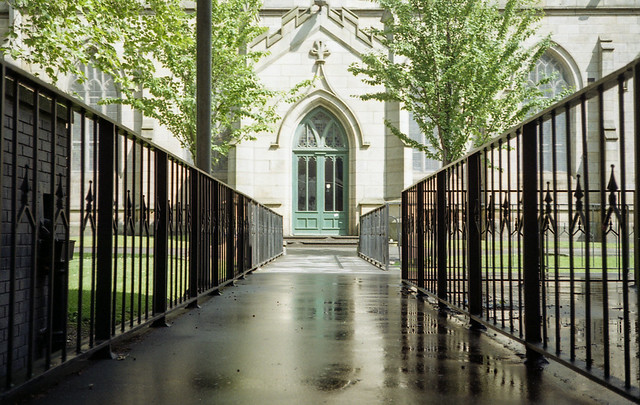
After this batch of shots, I started to walk back towards town down the back streets that run parallel to the main West Street drag. The remnants of the rain made for a nice reflection of a green doorway in the side of St. George’s lecture theatre (a deconsecrated church). I took two shots of this, one with the last frame of Ektar in the Yashica Mat, the other with the 35 RC.

FILM - I saw this after the rain

FILM - Green door reflection

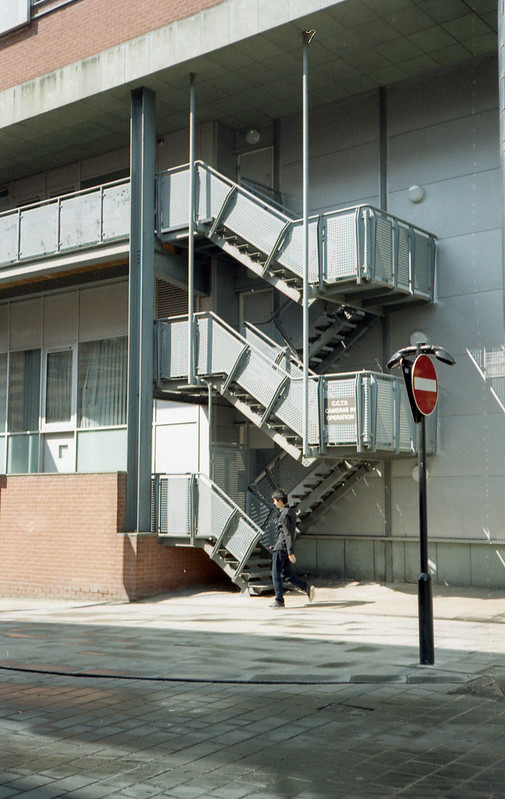
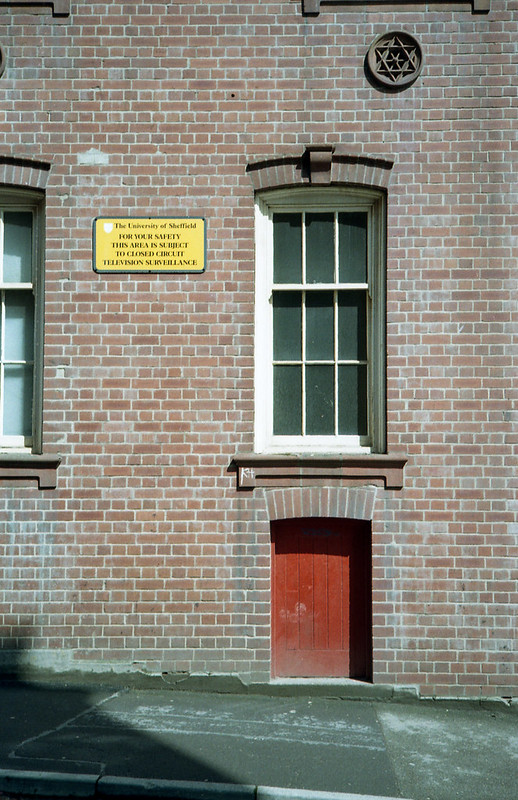
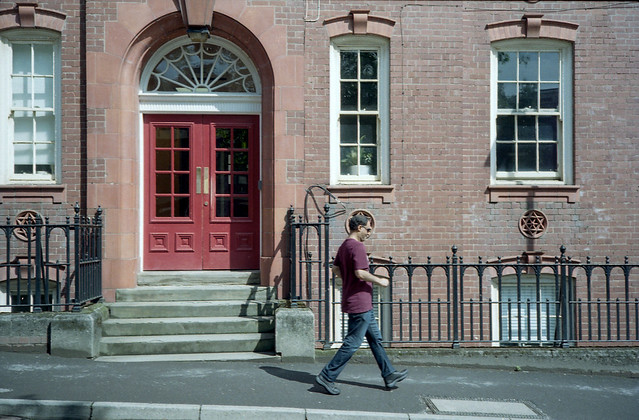
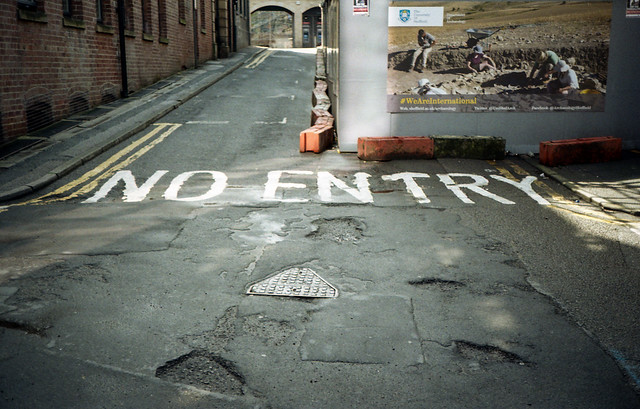
The rest of the day’s shots were with the 35 RC, and I’m pretty happy with a number of them, especially the last two of the set below (the guy walking past the university building and the “No Entry” road marking).

FILM - Up and over

FILM - Portobello 1

FILM - Subject to surveilance

FILM - His head in a star

FILM - No Entry

The final shot below, is of the Q-Park car park building off Rockingham Street. Sheffield has its fair share of mid 20th century brutalist design car-parks, as do most towns and cities in the country, but recently seems to have acquired several of far more interesting design, such as this one.

FILM - Wavy

Probably back to black and white stuff for the next post.

35mm · Film photography · Medium Format · Photography

Changeable weather #1: The wet part.

I went up town last Saturday with the primary intention of taking some photographs (although I did have a secondary mission to pay the deposit for a restaurant booking that my wife had made). The weather was bright and warm, with some fluffs of cumulus (and some bigger wodges of cloud on the horizon) littering the sky. This was not to last.

Despite the conditions remaining the same during the twenty minutes of so it takes to drive into the town centre, literally as soon as I got out of the car, one of the aforementioned “wodges” of cloud was threatening the day with its massive dark bulk. The weather forecast app on my phone said not a word about rain though, so I fed the parking meter and set off to get some pictures.

The weather forecast app tells lies.

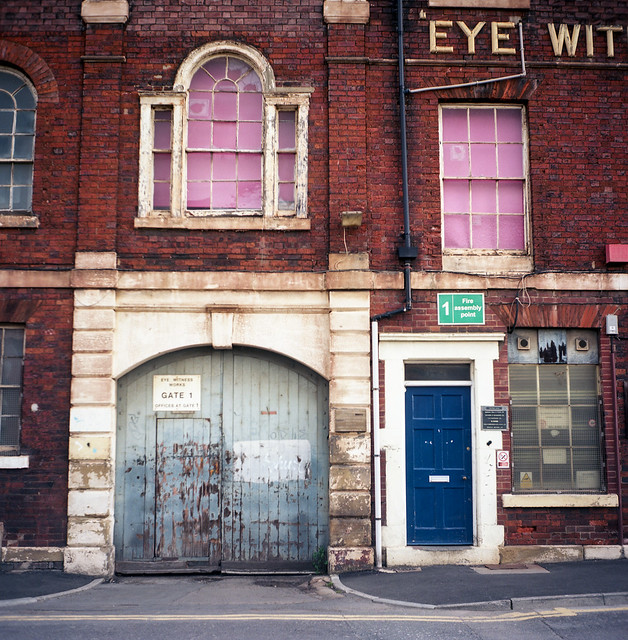
I got the following shot of an old cutlery works entrance.

FILM - Eye Wit

Then I followed the street leading to the back. There I started to line up another shot when I felt a few spots of rain – not heavy at this stage, but enough to potentially get on the lens and spoil the picture (indeed, a single fat droplet fell right into the open top of the Yashica Mat leaving a wet splash on the focusing screen). The only available shelter was a small doorway that was presumably a point of egress from a fire escape or something. It was approximately 18 inched deep, so enough to provide adequate shelter, but with the downside of having a noticeable air of urine odour to put up with. Still, beggars can’t be choosers, and literally seconds after stepping into the doorway, the heavens opened and rain began to pour down as though someone had turned on am enormous  shower in the sky. The heavy rain lasted maybe five minutes, but then took another ten to abate completely, so I remained in my shelter for quite a while. During this time I took the following shot. It’s a little out of focus, but it’s not a great shot anyway, but is included here as a memory of the moment nonetheless.

FILM - When I was trapped by the rain

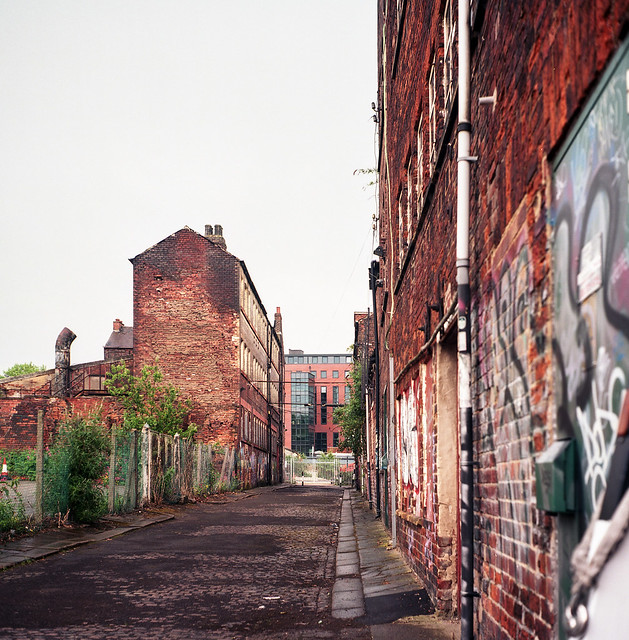
The next shot was taken from right outside my sheltering spot )it is directly to the right of where I took this photo).

FILM - The cobbled way

It’s interesting to see how the tarmac has worn from the streets in this area, revealing the original cobbled surface beneath. As well as the Yashica Mat, I also had my Olympus 35 RC with me, still loaded with the remaining frames of the roll of Kodak Colorplus I’d been shooting previously, and it was with this that I got the shot below (my sheltering place can be seen at the bottom left of the frame).

FILM - Another one of those things

Further along this same street, I took the next shot of some graffiti. The shot is quite nice (if you like this sort of thing) with lots of texture and detail. The small red shape that can be seen at the bottom of the boarded-up window is actually a small door that has been affixed and is labeled “The home of Abdul the world’s smallest muslim”. Whether Abdul is a fictional character in the mind of the artist who added the doorway, or represents a real person (though presumably not small enough to fit through this small doorway!), I know not, but it adds some additional interest to the shot.

FILM - NSFW?

A couple more street shots from the same area are next, one from the Yashica Mat, the other form the 35 RC. There’s a slight John Bulmer-ish feel to the second shot in terms of the colour and conditions that I like.

FILM - Egerton Lane

FILM - No Parking Loading

It’s interesting to think that, although relatively lightly traversed nowadays, that these streets would have been hives of activity at one time, with many hundreds of people employed in the area.

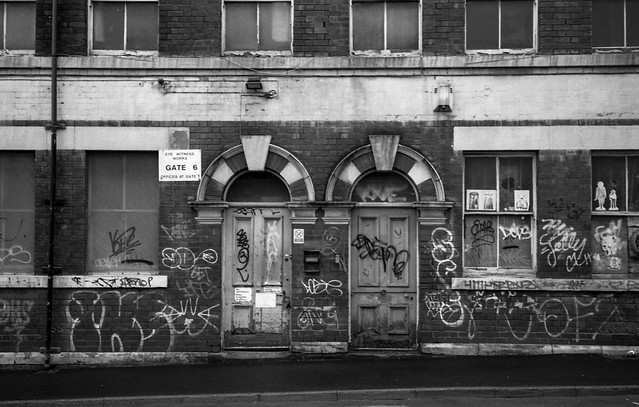
The last shot of this batch is taken again with the 35 RC, although I did a black and white conversion on the Colorplus as I liked the result better than the original colour image.

FILM - Gate 6

The weather was to brighten up again shortly after taking this last shot, and I’ll document the remaining pictures in the next post.

35mm · Film photography · Photography

Barnsley & Elsecar remnants

I mentioned in the last post that I’d also had my Olympus 35 RC with me on the trip to Barnsley and Elesecar Heritage Centre. Most of the roll it contained was shot subsequent to that day and will probably form the basis for another post soon, but here are some shots from that same trip (plus a few  bonus extra pictures that were not).

I like the 35 RC, it’s capable of some nice results and has the great bonus of being absolutely tiny. This means it’s easy to take on trips and also means I can usually get an extra shot or two out of a roll (although I only managed 36 from this 36 exposure roll this time). The film used was Kodak Colorplus 200, Kodak’s budget offering. I’d not used this before but liked the look of the film in other people’s shots (where it had a slightly vintage, 1970s look to it, I thought) and I have to say I’m pretty happy with the results. I like the look of the film and it seems to have less noticeable grain than the other low-cost film I often use – Agfa Vista Plus 200. On the downside, it was an absolute pain in the backside to scan, with the entire roll having a defined bow along the length, and necessitated me scanning just one strip at a time, and then only two or three frames at once as I had to use some pieced of card to flatten the negatives in the holder. In the end I estimate it took at least four times longer to scan than other 35mm films I’ve used. And I still have a couple of rolls left – good job I do like the look then, eh?

The first set was taken in Barnsley in the car park where I’d left my car before attending the photo exhibition, and as I was saving the remaining frames of Ektar that were in my Yashica Mat for Elsecar, I fired off a number of snaps with the Olympus. There’s a bit of lens flare on the second shot, which is a shame, as I like it otherwise, but the third shot with the red fire sticker is may fave of these three.

FILM - Feels like another country

FILM - Buildings with flare

FILM - Flaming 6

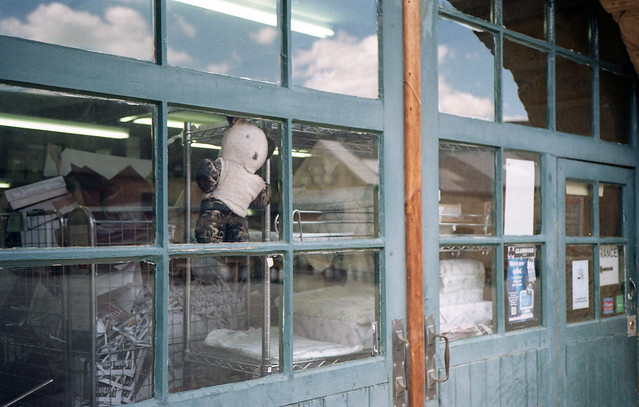
The next small batch are from Elsecar Heritage Centre. I took a shot of the same phone box with my Yashica MAt 124 G and there’s a clear difference in tones between the Colorplus shot below, and the medium format Ektar image, with the Ektar practically vomiting saturated colours from the frame! However, of these three, the window with the teddy bear is, I think, the best.

FILM - Lighting up the sky

FILM - Phonecalls and sweets

FILM - Looking out

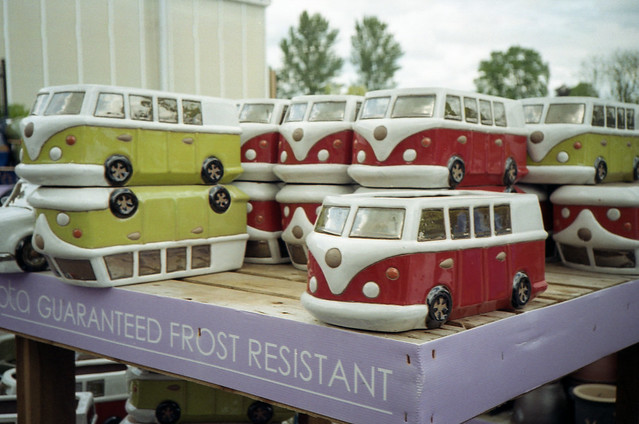
And finally, a few bonus shots. The first two pictures (of the cactuses and camper-van planters) were taken at Wentworth garden centre a couple of days before my trip to Barnsley, while the rhododendron is in my back garden.

FILM - Cacti

FILM - Campers

FILM - Rhododendron-2

So, there you have it. It was nice to use the 35 RC again, and the results from the Colorplus were pleasing. I’ve another batch (taken elsewhere) to post about soon, so  keep your eyes peeled!

Film photography · Medium Format · Photography

Barnsley, and Elsecar Heritage Centre

Last Tuesday I had a day off work, mostly because I had an appointment to keep in the morning (which turned out to be a waste of time thanks to one of the parties not turning up!), but it also meant I had a chance to travel up to Barnsley to see the RPS International Print Exhibition #159 that was on show at The Civic until the end of the month. I decided that I’d see the exhibition, then perhaps take a few shots around Barnsley town centre, and then visit Elsecar Heritage Centre (and perhaps Wentworth) on the way back home, and so took my Yashica Mat 124 G loaded with a roll of Kodak Ektar, and also my Olympus 35 RC (with some Kodacolor 200 in it). While I took a number of sots with the 35 RC, I’ve not had the roll processed as yet, so all the shots in this post are from the Yashica.

The exhibition was worth the visit and I took notes of some of the photographers whose pictures I liked so that I could look into their work more closely later. The exhibition ends this month in Barnsley and then moves on to a new venue elsewhere in the country I believe.

Despite Barnsley being only a short distance from Sheffield, it’s a place I’ve visited rarely – I’ve been maybe half a dozen times in my life – and so there was quite a lot of interesting things to photograph. However, as my plan was to go to Elsecar, I only shot a few frames in the town, mostly in the area just behind The Civic, where the exhibition was hosted.

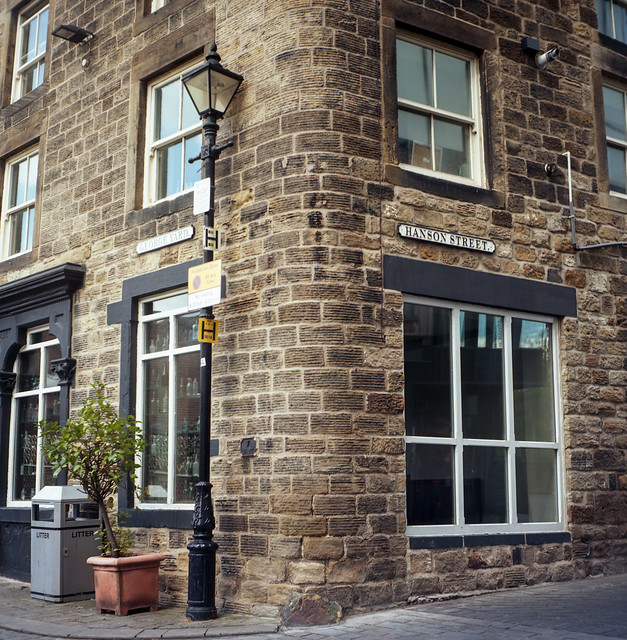
Three shots were of a bar / restaurant called The Old Chemist. The place has, as its name wold suggest, an old apothecary style theme, and the windows are lined with vintage and antique bottles, and there’s an old-style gas-lamp on the corner (probably not gas-powered any longer). I think the third of these three is my favourite.

FILM - The Old Chemist

FILM - The Old Chemist window

FILM - The corner of Hanson Street and George Yard

The final shot I took with the Yashica in Barnsley was of The Arcade, a pleasant pedestrian shopping row with an ornate glass ceiling. The shot’s ok, but it’s a little meh too. Better light would have helped, I think (the sun kept disappearing behind clouds – usually a second after I’d taken a meter reading – and I didn’t have time to hang around for the perfect conditions), and would have allowed me to use a smaller aperture.

FILM - The Arcade

After returning to the car (and taking a few random snaps with the 35 RC) I set off out of Barnsley, down the M1, and to Elsecar (after a quick stop at KFC for a bit to eat. I sat in the car to eat and listened to the awful unfolding news about the previous night’s terror attack on the Ariana Grande concert in Manchester).

Elsecar Heritage Centre is located on the site of a former ironworks and steam railway. The railway still exists as a heritage line and runs a short distance from the centre. I’ve been on the train-ride several times as, at Christmas, there are special trips where Father Christmas is on board and gives the children presents while their parents have a cup of hot-chocolate or mulled wine. It was all very festive, but my kids have outgrown such things now. The station is small, but quite nicely appointed with a vintage feel to it, and I took three shots.

The first is of an old phone box tucked into a corner of the station building. The colour looks a little off, but that is the actual tone of the phonebox, which I suspect has either faded slightly in the sunlight, or maybe been painted an incorrect shade at some point.

FILM - On the platform

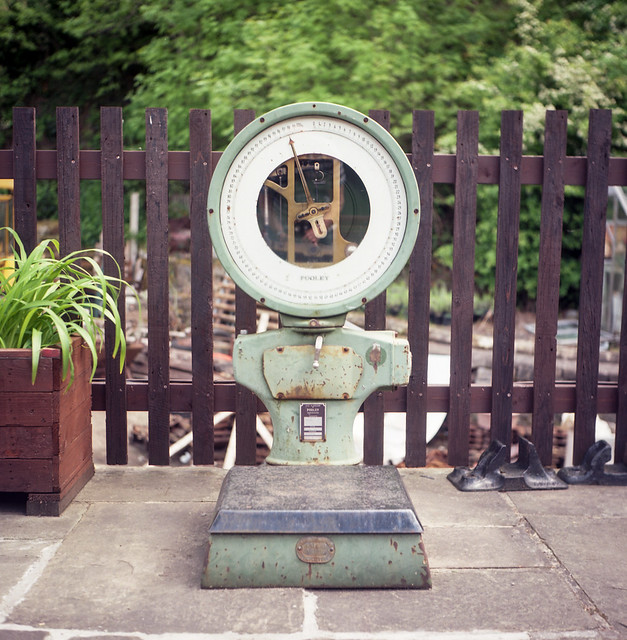
Next is an old set of scales that were on the platform. This ought to have made for a nice shot, but I’ve missed focus ever so slightly, so it’s a little disappointing.

FILM - 97.6 kilograms

And here is a shot of a set of vintage carriages that were pulled in at the station (there were a few old locomotives too, but I couldn’t get a decent composition on any of them). I think this shot is probably my favourite from the day.

FILM - Guard

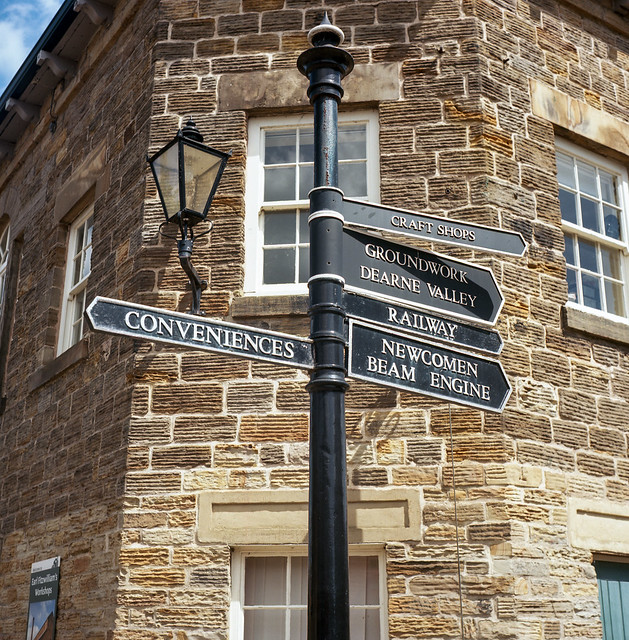
Walking out of the station alongside the railway line leads to an old Newcomen beam-engine, the only one remaining in the world still situated in its original location. Sadly, I couldn’t find a composition of this that I liked either and so, instead, took this photo of a nearby footpath leading up the hill towards Wentworth.

FILM - Another mystery path

After this, I walked back into the heritage centre area proper and took the next three photographs. Most of the buildings are now given over t shops and other commercial enterprises (there’s a large children’s play area in the main building – again, we used to take our kids there sometimes when they were younger), and one of them is a large antiques shop. I spent most of my time in here to be honest, and it’s a lovely Aladdin’s Cave of a place. They had a few old film cameras for sale, but I resisted the urge to buy any! It was upon leaving this place that I realised my phone battery had decided to kill itself and was now bereft of any power, leaving me with no way to meter my shots other than Sunny 16 estimation. Luckily, the day was now quite bright and I managed to get my estimations close to the mark and all the remaining shots were well exposed. I’ve decided to buy a dedicated meter though so this doesn’t happen again. Back to the shots, and I’m in awe at the saturated colours that can be seen in the phone box shot (this was the first roll of Ektar I’ve shot), but the long shot of the foundry building and chimney is the best of the three, I think.

FILM - Things to see and do

FILM - Telephone

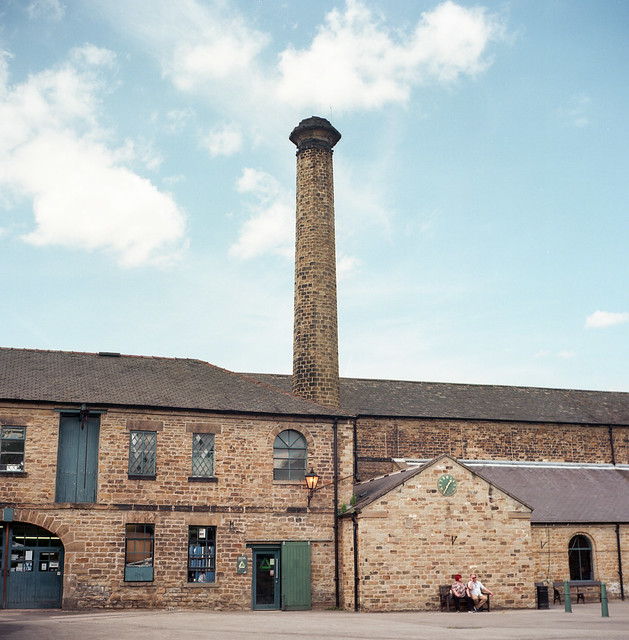
FILM - The memory of activity

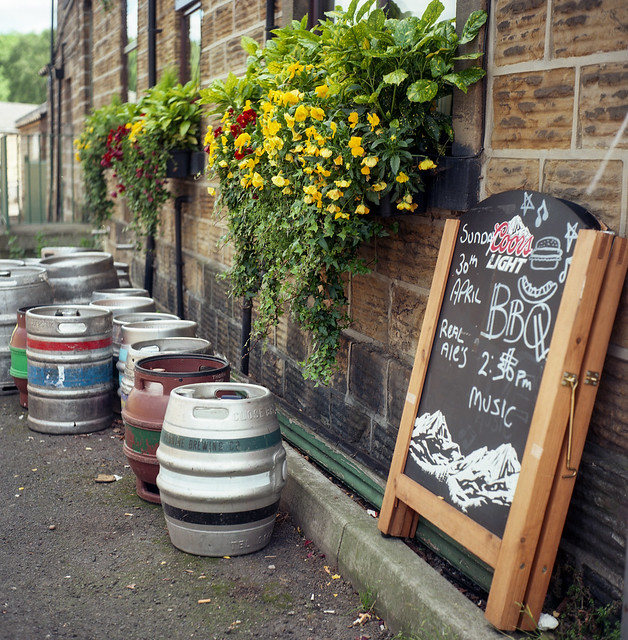
The final shot of the roll was taken as I walked past a pub on the way back to the car. I like the juxtaposition of the sign, flowers, and beer barrels, but I’m not really happy with the shot. The sun was glancing into the viewfinder of the camera and it was difficult to focus and compose the shot, so I didn’t really get what I’d wanted. Anyway, here you go, warts and all…

FILM - Burgers, blooms and beer

35mm · Film photography · Photography

Oddshots #3

This has come rather closer to the last Oddshots posting than I expected, but as I haven’t gotten around to writing about the roll of Ektar I shot on Tuesday as yet, I thought I’d drop this in to keep up the flow of posts (I promised myself I would update the blog at least once a week, but seem to have gotten into a faster pace, so I may as well keep it up while I have stuff to show).

So, today’s oddshot was taken back in January this year with my Olympus OM-1. I’d bought a roll of Rollei Retro 400s film after being impressed by the results I’d seen produced by other people, so I loaded it up and off I went on a somewhat misty and gloomy winter’s day. What I’d not considered however, was the double whammy facts that, 1) Rollei Retro 400s is better shot at 200 ASA rather than box speed (at least according to most of the reports I looked at after I’d shot my roll) and, 2) that my OM-1 meter was out by about a stop due to it containing a 1.5v battery rather than the 1.35v it was expecting. I thought I was compensating for this by the meter needle placement, but I was clearly out by some margin (I’ve since had the camera modified to meter correctly with a 1.5v cell). The result of this was that the entire roll came out pretty significantly underexposed.

While some of the shots were write-offs, thanks to film being film, I was still able to rescue a good percentage of the photos. They’re all still underexposed, but in a way that I wasn’t unhappy with, and which rather suited the murky day on which they were shot. The picture below is an example of this. While’s it’s pretty dark, I really think that it’s added some atmosphere that might otherwise not have been there and resulted in a photo I like a lot. I’ll maybe post others from the same set in future.

FILM - On bleak winter days

35mm · Film photography · Photography

Doors, doors, doors…

I’ve not finished off any rolls in the past week, so this post is from a trawl through my archives (which only really go back to last summer, film-wise).

I’ve noticed that I often take photos of doors, doorways, windows etc. I don’t think I’m alone in this, and there are entire Flickr groups dedicated to just this subject, but I thought it might make a decent subject for a blog post. I’ll limit the post to shots taken on film, and just those where the door is the focal point of the image (or at least a significant part of it) and will give a little background (in so far as my memory allows) on where and, perhaps, why I took each photograph. They’re shown in rough chronological order, oldest first.

#1

First of all, apologies for the quality of this scan. It has loads of dust and marks on it. Partly, no doubt, due to my not doing a great job when scanning it, but mostly because this entire roll came back from being processed in quite a sorry state. Almost every shot had odd marks, smudges, scratches and horrendous blobs of dust-like artifacts on the negatives themselves. It was as though the roll had been fallen down the dusty back of the processing machine and then been scraped back out from underneath with someone’s shoe. Indeed, I’ve never used this particular place for processing since, and now instead use Peak Imaging, who do a marvellous job.

Anyway, this shot was taken at the Lincolnshire seaside town of Mablethorpe – a regular and frequent holiday destination throughout my childhood and teenage years thanks to my grandparents having a caravan nearby – in September 2016 and this house stood out due to the interesting collection or artifacts surrounding the door. The film used was Agfa Vista Plus 200 (converted to B&W in Lightroom) and it was shot on my Olympus 35 RC.
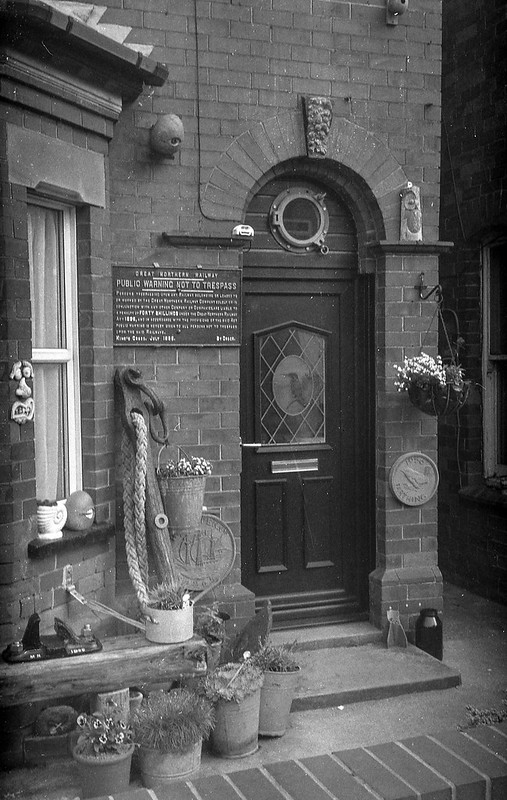
FILM - Public warning not to trespass

#2

This shot was taken in September 2016, again with my Olympus 35 RC. The film used here was an expired roll of Kodak Ultra 400 (which expired around 2004). The film suffered from some additional grain and I think I ought to have overexposed it a little more to compensate (I think I overexposed it by a single stop), but was otherwise ok. I didn’t notice any significant colour shifts or other faults, although I’m by no means the expert on such matters. I still have a few rolls of this expired film left to shoot.

The door in the picture is in Elliot House on Sylvester Street in Sheffield. The building is now converted to apartments, but used to be part of the Joseph Elliot & Sons cutlery works that was based on the same street (although very little now remains, and the cutlery firm closed in 1990).
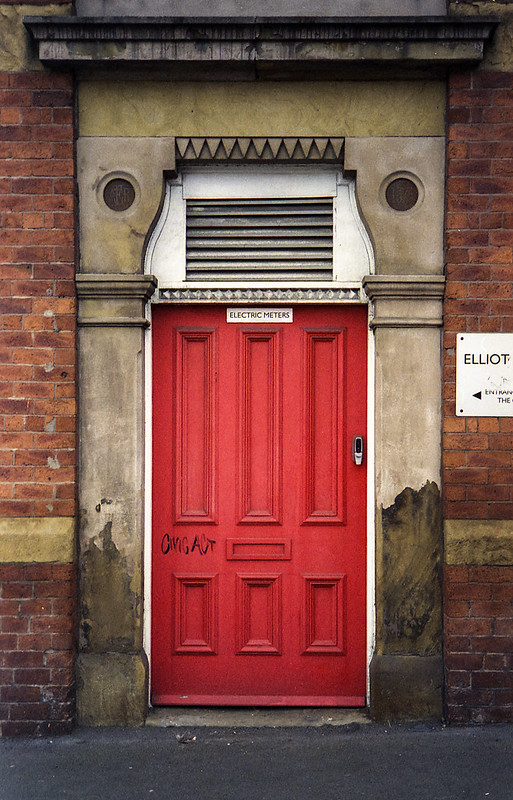
Fun with expired film - Roll #1, shot 20

#3

Taken in early October 2016, these doors are the main entrance to the central glass house in Sheffield Botanical Gardens. The glass houses are grade II listed structures and were built in 1837-38. They were renovated and re-opened in 2002 which is why the clock above the doors is dated as such.  This is another Olympus 35 RC & Agfa Vista Plus 200 photograph.

FILM - The entry to the glasshouse

#4

This was taken on the same day as the shot above. Same camera, same roll of film. It was taken on a road near the botanical gardens and I liked the autumnal look of the leaves piled up on the path and the encroaching holly bush. It’ll not win any prizes but, hey, it fits the theme of todays’ post.

FILM - Autumn's doorway

#5

Taken in November 2016 at Barrow Hill Roundhouse, Britain’s last surviving functional roundhouse. The venue is closed at present due to National Lottery funded renovation work that is being carried out. I discovered this to my detriment after driving out for a visit earlier this year without checking the website, only to discover it was closed when I arrived (I ended up going to Bolsover Castle instead). While I’m not particularly a rail enthusiast, I do find that museums such as this offer lots of nice photo opportunities, so are well worth a trip. The shot below is, again, on Agfa Vista Plus 200, but this time shot with my Olympus OM-1, which I’d recently acquired. The lens used was a 50mm F Zuiko f/1.8. I like the way red comes out on colour film (see #2 above), so this was an easy shot, helped by the nice light on the day in question. I particularly like the inclusion of the smoker’s bench and associated “fag-ends” bin, although I’m not sure that dropping cigarette ends into what looks like a plastic container is a good idea. I suppose it might’ve been full of water though – I’m sure these things were carefully considered by the good people who keep the roundhouse going!
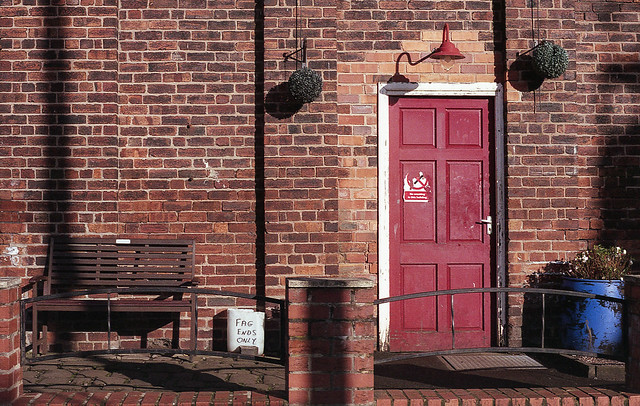
FILM - Where the smoke break takes place

#6

Guess the film… Yes! It’s Agfa Vista Plus 200 again! This time shot with my Olympus Trip 35, which is a great little camera with a nice, sharp lens. This is in Paradise Square, Sheffield (if only I’d stepped to right slightly, you’d have seen the full street name for yourselves! Oh well…). This was taken in January on one of my first film-only outings following the (mostly digital) 366 project I did through 2016. The light was great and I went out with my Lubitel 166 U and the Trip and shot a full roll through each.

Paradise Square is a cobbled square surrounded by Georgian houses built through the 1700s. Thankfully it survived the bombing raids that ruined or destroyed much of the city’s historic architecture the Second World War. It now seems to be mostly home to a variety of solicitors and accountancy firms.

FILM - The corner of Paradise Square

#7

This is the doorway of St. Peter & St. Paul’s church in Eckington, Derbyshire. The church dates back to the 12th century, although has had modifications in the intervening time. I hadn’t gone out to intentionally photograph the church, but I parked my car right outside and the afternoon light was lovely, so I took a couple of shots, one of which you see below. This is the first ‘true’ black & white shot from this set, being shot on Ilford FP4 Plus with my OM-1.
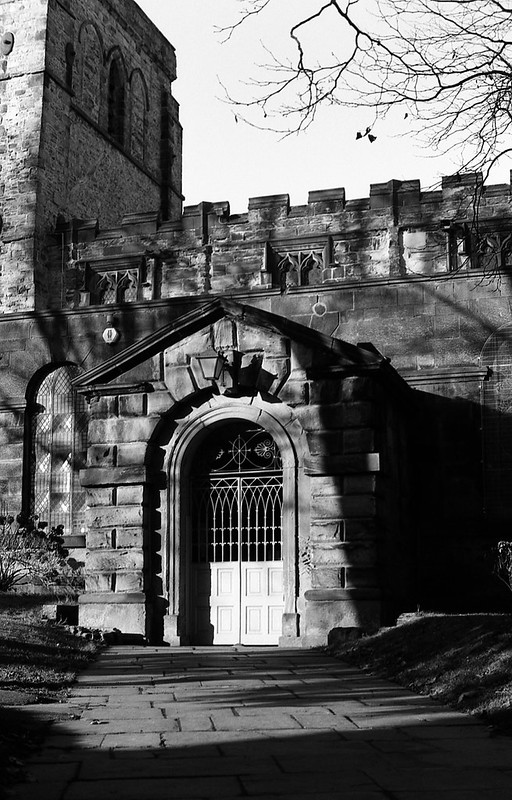
FILM - The path to redemption-

#8

Another church doorway, this time St. Joseph’s Roman Catholic church at Handsworth, Sheffield. My wife had an appointment on our way out on a shopping trip, so I decided to go for a walk rather than sit in the car, and I liked the look of the tree’s shadows cast upon the church wall. The camera I had to hand was an Olympus Superzoom 105 G, which is a point-and-shoot compact that was produced around the turn of the century. I bought it for £2 at a camera fayre and it had a partially used toll of Kodak Gold 400 still inside. This was one of the shots taken to use up the remaining frames. As the camera used doesn’t have any way to change the film speed setting, the expired film was shot at box speed and as a result came out with considerable grain. As a result, I decided that B&W worked best for this (plus a crop to a square). For the curious, the other shots on the part-used film consisted of several photos of the (presumably) previous owners’ cat in a kitchen, plus a series from trip to Scotland (After a bit of larking around on Google Maps, I was able to place the specific location of several of the Scotland pictures, which was nice).
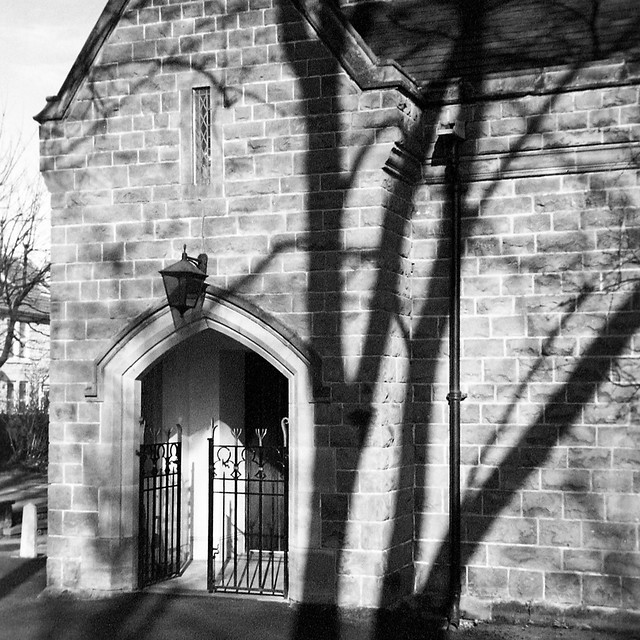
FILM - Shadows on the church

#9

Another shot from the £2 Superzoom 105 G. This one is on Fomapan 100. The doorway in the picture is set in the side of the Manchester Crown Court building, and is a suitably imposing entrance. This was taken in April 2017 while I was attending a training course nearby.

FILM - Doors

#10

Taken while waiting for the train to Manchester to attend the training course I mentioned above. This entrance to the hidden luxuries of the first-class lounge is on one of the platforms of Sheffield’s Midland Station. Shot on our old chum, Agfa Vista Plus 200, and with a Konica Pop camera (the third of the £2 cheapies I picked up at the camera fayre). The camera still had batteries in when I bought it, but they’d leaked and had corroded the battery terminals enough to prevent the electrics from working. Thankfully, if you like a challenge, you can shoot the camera manually by using Sunny 16 guidelines. Although the lens is fixed focus, and the shutter speed is locked at 1/125 sec, you can alter the aperture between f/4 and f/16 by a combination of the ASA setting switch and whether the flash is in it’s up or down position. I know it all sounds a bit Heath-Robinson, but it works nonetheless!

FILM - Not for the likes of me

#11

Olympus OM-1 again and another B&W conversion on Agfa Vista Plus 200. This is the entrance to Chesterfield town hall. The framing is maybe a little tight on this at the bottom, but I think I might’ve just about gotten away with it.

FILM - Three ways in

#12

Broad Lane, Sheffield. I liked the weathered, graffiti-scrawled look of this particular door. It was taken with a Pentax P30T on (you guessed it!) Agfa Vista Plus 200. I had to stand in the road to get it in shot using the 50mm Rikenon f/2 lens that was attached to the camera.
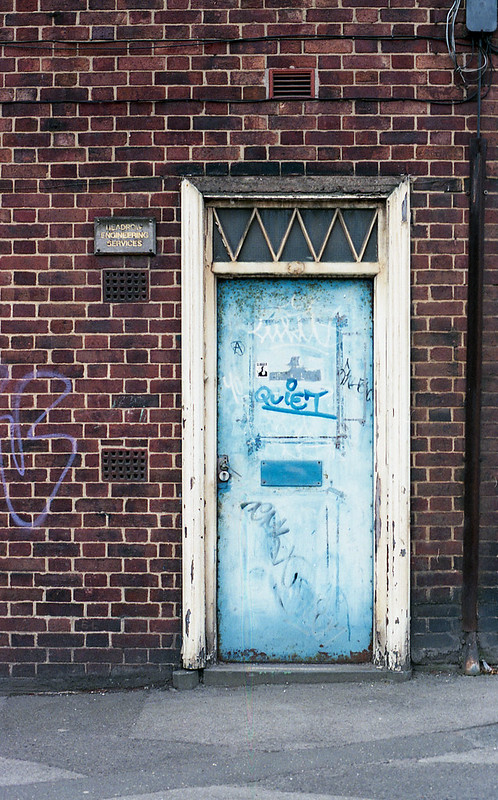
FILM - Quiet

#13

Not far from the door above, is the next one, not a dissimilar shade of blue, on Trippet Lane. They could almost be related! Again, the weathered look drew my eye, and this one has a nice bit of sticker-art affixed. Same camera, same roll of film.

FILM - Inside Number 9(0)

Well, there you go. This turned out to be a longer post than I expected. Thirteen shots in all (I hope no-one is superstitious!). At the rate I photograph scenes like this I ought to have enough for another bakers’ dozen in about a year’s time!

35mm · Film photography · Photography

Victoria Quays part #3

This is the third and (I think) final post regarding last Sunday’s walk around Victoria Quays in Sheffield. The first two parts can be found in the links below.

Part #1

Part #2

The main difference in the shots posted in this piece is that they were shot with a different camera – a Minolta Hi-Matic G2 – and on colour negative film – Agfa Vista Plus 200. I picked the camera up a few months back for £2 when I saw it in a box of compact cameras at a camera fayre. All the items in the box cost £2 each and I ended up with three of them: the Minolta, a Konica Pop, and an Olympus Superzoom 105G. I like to have a camera on me when going out even if not specifically to take photographs, and small compacts like this are ideal for the purpose. I’ve used a number of them over the past six months or so, usually just loading them with a roll of film and then chucking them in a coat pocket to be used in the event that something interesting turns up while I’m out and about.

I always use Agfa Vista Plus 200 as the first film through a newly acquired camera for the simple reason that it can be had for £1 a roll at Poundland (or at least it could, recent developments have revealed that Poundland are to stop stocking the film) and I’d rather that, if the camera turns out to be faulty, I waste a cheap roll of film than some more expensive Tri-X or Portra or something. That said, despite its low-cost, I do like the results the film gives, especially in bright, sunny conditions, and it has a slight magenta tone to it that I think looks nice.

The Minolta is quite a nice little camera. It’s pretty no frills, being a zone-focus camera with little manual control other than setting the focus distance via the lens barrel. It’s very similar to an Olympus Trip 35, but has the advantage of having the distance scale as well as the icons on top of the barrel (the Trip has the icons on the top only, and the distance scale beneath the barrel, which is a little awkward if you’ve not memorized them and can’t remember just how far away the head-and-shoulders icon represents). I also prefer the wind lever on the Minolta to the Trips’ thumb-wheel winder. It’s not as nice looking as the Trip 35 though, but it still has its own charm and it feels nice in the hand. The lens is a 38mm f/2.8 and is nice and sharp. Out of the 25 frames I got from the roll, none is out of focus, a testament to my skill in measuring distances (or perhaps that they were almost all shot in bright conditions and the narrower aperture would’ve covered my mistakes!). The camera’s aperture is set automatically but can be seen through the viewfinder on applying a half-press of the shutter button, giving an idea as to the results you will get from the shot. The camera takes a discontinued 1.35v mercury cell, but mine has a 1.5v inserted and I just compensated by setting the ASA dial two-thirds of a stop slower so that the camera thought I was shooting 125 ASA film rather than the 200 ASA roll that was inside, and the exposures are all pretty much spot on.

These shots were taken after finishing off the roll of Fomapan 200 in the Yashica Mat, and are mostly from the walk away from the canal basin and onto the beginning of the canal proper. I’ll not post every shot I took, but the ones here give a flavour of it and some indication of what this little camera can produce.

The first is of a boat used for cruises up and down the canal – I think they have discos and dining onboard sometimes. I’ve heard of people going on these events but have never done so myself.

FILM - I.B. Hardfeet

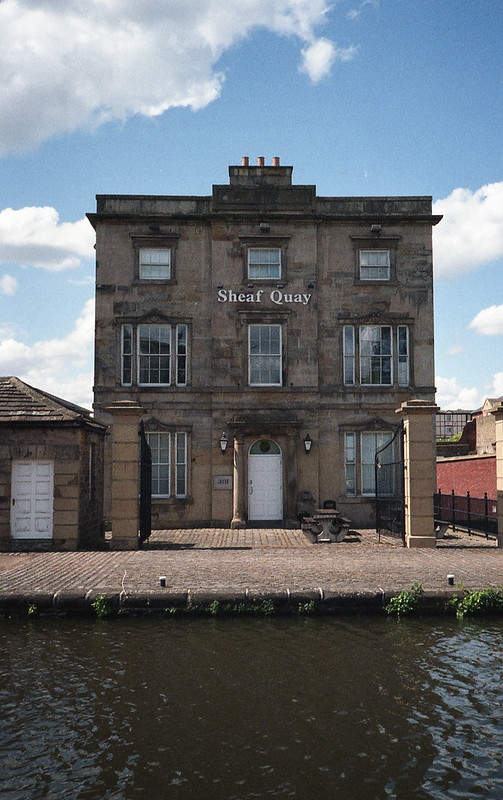
The next couple are of the Sheaf Quay building (I also posted a shot of this taken with the Yashica Mat 124 G in part #2).

FILM - Sheaf Quay in colour

FILM - Sheaf Quay in colour-2

Next is a random barge. The shot above was taken from the towpath just in front of this boats’ bows.

FILM - Barge

The next shot is still on Agfa Vista Plus 200, but converted to black & white in Lightroom. I think the contrasts of light and shade suit mono better than the colour original.

FILM - Chimneystack

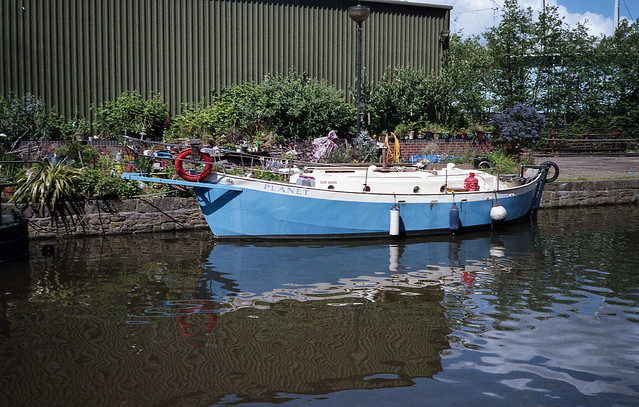
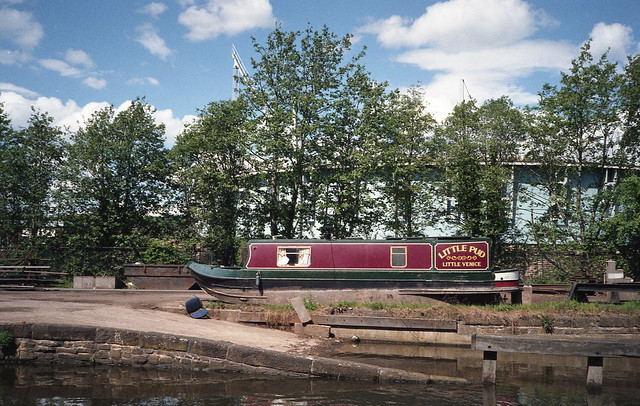
Just beyond the chimney stack and under the next bridge, I took a couple of shots of other boats, one in the water (I like the wavy, geometric reflections of the building in this shot), and another up on the opposite bank of the canal.

FILM - Planet

FILM - Little Pud

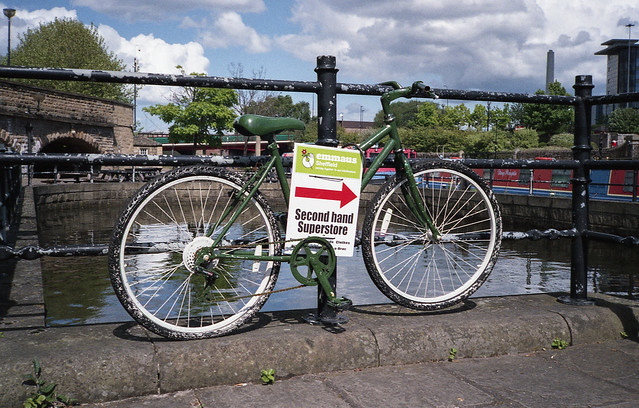
I took a few more shots in this area before walking back to the canal basin and back to the car park. I had to wait for a short time while a man the manually operated swing bridge that joins the north and south parts of the quay. Just on the opposite bank is a bicycle used to advertise a local second-hand shop. Again, I took a similar shot (albeit of a different bike) with the Yashica Mat which can be seen in part #2.

FILM - Emmaus

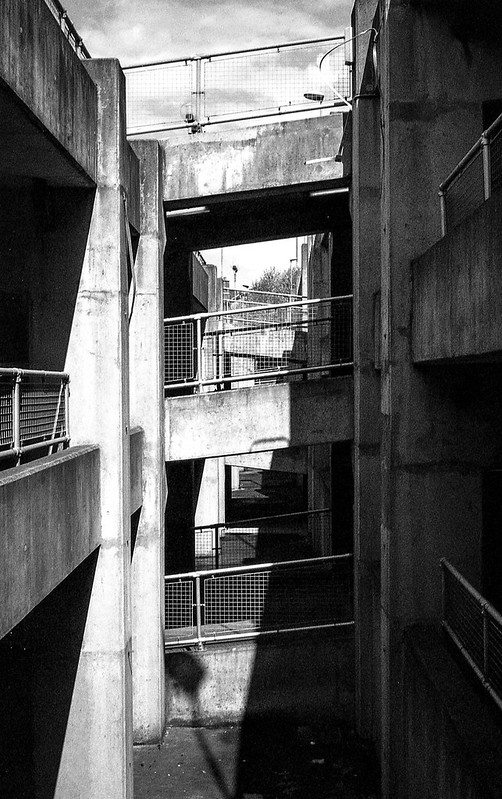
The final shot of the day was taken as I walked through the car-park back to my car. I liked the way the sunlight was falling on the space between the alternating decks of the car park and so grabbed the shot below. Again, I think this works better in black and white.

FILM - Between levels

All-in-all, the little Minolta is a nice camera. I’m pleased with the results and will likely use it again at some point. I don’t think it really offers anything the Olympus Trip 35 doesn’t also provide, but it’s enjoyable to use. Certainly well worth the £2 I paid for it!