A very quick post today as I’ve only just gotten home after a very long day (mostly due to an injury I’ve sustained). I’ll maybe post more details tomorrow, but for now, here’s a mock Tudor house I photographed a few weeks back.
Olympus 35 RC & Kodak Gold 200. Lab developed. Home scanned and converted with Negative Lab Pro.
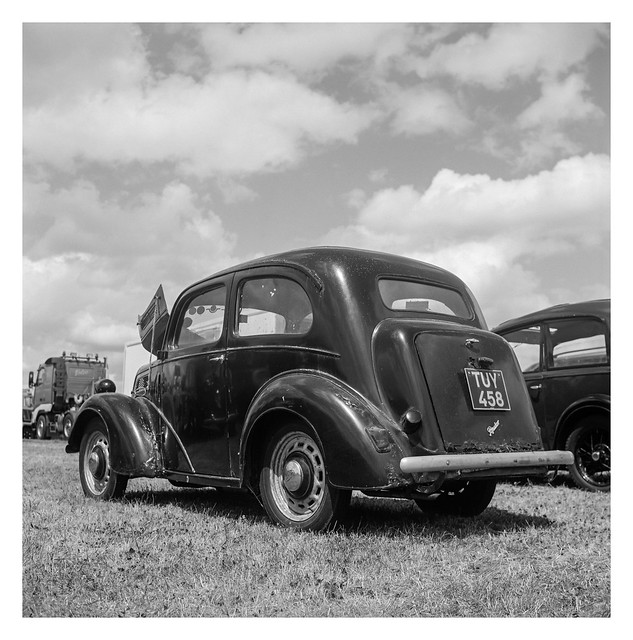
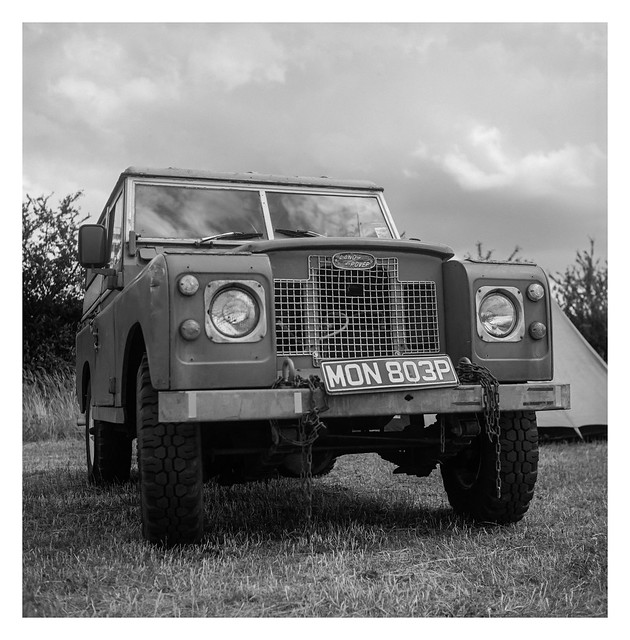
Rather than upload these one-per-day, as I usually do, I thought I’d lump them together in a single post. All were shot with my Yashicamat 124G on Shanghai GP3 film – I like this film a lot. It can occasionally suffer from production problems (I’ve had the backing bleed through on some shots I once took), but it’s quite low cost and produces really nice results.
First, a few pictures of vintage vehicles. The Ford Popular in the second image can also be seen here in colour.
Then a couple of miniature traction engines (and their owners)…
And finally, a trio of full size traction engines…
I’m kinda eking out some of these Kodak Gold photos at present. This is not because I’ve run low on stuff to publish, but because most of the shots I’ve processed recently have been from a visit to a steam rally and I figured I might as well pop those on the blog all at once rather than via my usual drip-feed approach, so those should be up here tomorrow.
In the meantime though, heres a picture of a big white house looking resplendent in the summer sunshine.
Olympus 35 RC & Kodak Gold 200. Lab developed. Home scanned and converted with Negative Lab Pro.
While I was in Hornsea a few weeks back I noticed this man photographing something on the other side of the seawall. To be fair, I knew exactly what he was photographing – the waves crashing against the defences – but I wanted in on this sweet ocean action so, after taking a quick candid, I waited my turn and then made my own picture.
The guy in the photo looked like he had a telephoto attached to his camera, which probably benefited the scene when compared with the fixed 42mm glass on my Olympus 35RC, but the best camera (and lens!) is the one you have with you, right?
Olympus 35 RC & Kodak Gold 200. Lab developed. Home scanned and converted with Negative Lab Pro.
As I’ve stated before on the blog, I’m not an expert when it comes to motorised vehicles, so I can’t provide a huge amount of information on the lorry pictured here today. It was built by Richard Garrett & Sons out of Leiston in Suffolk, and this particular model would have been made possibly quite early in the 20th century, but perhaps a little later in the 1920s.
The thing I’ve learnt today is that an undertype lorry has the engine under the chassis, which had the advantage of allowing a more enclosed cab. Overtype lorries look more akin to a traction engine, with the engine sitting over the chassis, usually in front of the drivers position. This resulted in longer vehicles for the same carrying capacity.
This small Norman chapel at Steetley, not far from Worksop (although it falls under the parish of Whitwell), is a place I’ve photographed before. I found the place by accident one day while out on a hike, and it was a pleasant surprise to find such a nice building when I wasn’t expecting to. I had a few frames left on this roll of Kodak Gold film and decided to re-visit the chapel to use them up.
The building dates back to the 12th century and has seen its share of history, from the Great Plague, when the population served by the chapel was completely wiped out causing the building to fall into disrepair, the roof collapsing in the process. It was the scene of a skirmish during the English Civil War during the 17th century, and apparently there are still musket-ball holes visible in the masonry (although I didn’t spot these).
The fortunes of the chapel lifted when the coal industry rose in the 19th century, the restoration of the chapel being completed in 1880.
The door to the chapel was unlocked when I visited on this occasion and I was able to explore inside. Unfortunately 200ASA film is not the best choice for the interior of a dimly lit chapel, and the slightly faint patch on the rangefinder of my Olympus 35RC didn’t help the situation, but I was still able to take this rather nice picture of the sunlight pouting through one of the stained-glass windows. I’m very happy with this photo.
Olympus 35 RC & Kodak Gold 200. Lab developed. Home scanned and converted with Negative Lab Pro.
This quaint old building sits in the Attercliffe district of Sheffield and is the home of a picture framing business. In a past life it used to be a post office, something perhaps hinted at by the post box that still stands in front. I’ve photographed it before using black and white film, but these colour shots are much nicer.
This whole area used to be a busy shopping area with all manner of businesses catering to the local populace – which, back in the mid 20th century lived in row after row of terraced houses, many of them employed in the thriving steel industry or other trades that made up a huge part of the city’s economy back then.There are still shops and businesses there now, but it is massively changed and is a shadow of the way it once was, with much of the original population gone.
While much of the housing that once stood in the area close to this shop has now been demolished, a lot still remains not too far away and now provides homes to many of the migrants who settled in the city in the latter half of the last century. Shops still abound in the area where the housing stands, albeit many of them of new, different, and more multicultural varieties to what stood there before.
Olympus 35 RC & Kodak Gold 200. Lab developed. Home scanned and converted with Negative Lab Pro.
Something I’ve noticed when taking photos this summer are the number of places flying flags or draped in strings of bunting. While the reason for this is not hard to fathom – it was the royal jubilee just a couple of months ago – it’s still quite striking how much of it is still there in abundance. Perhaps people have decided they don’t want to spend the effort required to take it back down or, probably more likely, that it just looks nice and they want to see it for as long as they can. It certainly makes for prettier pictures.
Here is a row of decorated shops in the Yorkshire seaside town of Hornsea.
Olympus 35 RC & Kodak Gold 200. Lab developed. Home scanned and converted with Negative Lab Pro.
This quaint little street is actually a feature of Hornsea Museum, a place I only came across as I was leaving the town after my visit. The museum looked nice in the afternoon light though, so I pulled the car over into a parking space and grabbed a couple of pictures. I think I missed focus slightly on the second shot, but you probably can’t tell at the size it’s published here.
Olympus 35 RC & Kodak Gold 200. Lab developed. Home scanned and converted with Negative Lab Pro.
Never one to shy away from seeking out the most beautiful of locations, I present today a photograph of a water works in Hornsea. I really don’t care about the subject matter though, to be honest. The fact that the building here is functional and mundane doesn’t distract from the nice way it shows the light, it’s orange bricks contrasting against the flower-speckled grass, and the cornflower blue of the sky above. The couple walking their dog adds some scale and a dash of interest to the scene.
So, it may just be a water works, but it’s also a nice picture, at least in the eyes of this beholder.
Olympus 35 RC & Kodak Gold 200. Lab developed. Home scanned and converted with Negative Lab Pro.