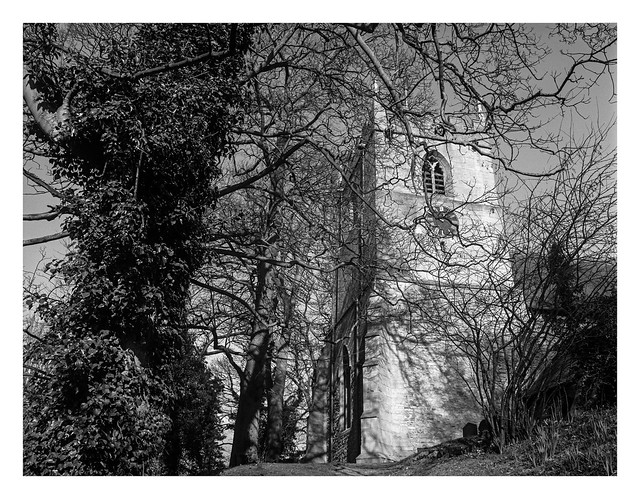
One thing I was particularly pleased about with this roll of snowy scenes was that I managed to expose the majority of them well. Snow can often blow out or be rendered an unattractive grey if not given the correct exposure and recommended guidance if to use exposure compensation to over-expose if you’re using a reflective meter, such as the one built into many cameras.
My Bronica doen’t have a meter though (even the one in my metered prism seems to have carked it!), so I rely on a handheld meter instead, and my preferred technique is to use incident readings – the light falling onto the subject, rather than the light reflecting off it. This has a benefit of giving an accurate reading in these sorts of scenes (well, most of the time anyway). I think a couple of my shots were not metered as well as the others, but even those were retrievable in post processing.
The two below look pretty good though.
Bronica ETRSi & Zenzanon 75mm f/2.8 PE & Ilford HP5+. Ilfotec DD-X 1+4 9 mins 30 secs @ 20°
There will be a number of snowy photographs to come over the next few days – the results of a brief spell of wintery weather where I actually got chance to go out and take advantage of it before it went away. Most of the shots were taken in a rural setting, but this one – in a brief section of my walk that went through a suburban area – turned out particularly nicely, I think.
Bronica ETRSi & Zenzanon 75mm f/2.8 PE & Ilford HP5+. Ilfotec DD-X 1+4 9 mins 30 secs @ 20°
I found this window to be a curious feature, and interesting enough to make a photograph. Because of the location of the house it probably gives a clear view of the road that curves past the rsidence – approaching from the right of frame and then going behind the point of view. Whether there was a practical reason for this beyond giving a nice view, I don’t know.
Bronica ETRSi & Zenzanon 75mm f/2.8 PE & Ilford Delta 100. Ilfotec DD-X 1+4 10 mins 30 secs @ 20°
This is the last of the four large-format air museum pictures that I was able to salvage. The other four are just too much of a PITA for me to try and remedy the light leaks, This is the only HP5+image that I think passes muster – and it’s the one where the light leak is probably most obvious, despite my attempts to hide it. I still think I somehow managed a pretty good rescue attempt though.
The aircraft in the picture is an Avro Shackleton, a post-WWII aircraft developed for anti-submarine warfare and maritime patrol duties. 185 aircraft were produced.
Another of my rescued 4×5 sheets. Of the eight I shot I’ve managed to recover four to an extent that I’m happy with, or at least happy enought to publish. I only managed to fix one of the HP5+ sheets – the others being beyond the limits of my Photoshop skills or, perhaps more likely, my patience.
The picture today, of a Westland Wessex helicopter is one of the least affected images, but not perfect. This one was affected by the loose tripod as much as by the light-leak. The original image on the ground glass included all of the tarpaulin-covered object that is now partly cut off at the bottom left side of the frame whereas the negative included a lot of additional scenery on the right side which I’ve cropped out. It still works as a picture though.
This version of the Wessex is the HC2 which was designed as a troop transport, able to carry 16 troops.
The Avro Ashton fuselage featured in yesterday’s post can be seen in the background.
Another rescued large format photo. A number of the images were less badly affected by the light leaks than others, this one included, and it’s difficult to see it at all now (although, again, there has been some cropping involved).
The aircraft in the picture is an Avro Ashton Mk 2 jet airliner (or the fuselage of one, at least). The Ashton was developed in the 1950s as an experimental aircraft using the airframes from Avro 689 Tudor II piston-driven airliners and was never intended to go into commercial service. Only six were built. The fuselage here is from the second of the six aircraft.
The photograph presented here today, of a post-war DeHaviland Dove passenger aircraft, is one of the 4×5 frames I shot at Newark Air Museum last Friday.
The eagle-eyed amongst you might have noted that this is not a 4×5 aspect ratio picture. This is because it was affected by the light-leak and the loose tripod column I moaned about the other day. The light leak has been largely recovered using graduated masks in Lightroom. It’s still there, but you’ll prbably only spot it if you look very closely (or know where it is). The composition has been, well, not rcovered, so much as salvaged by way of a significant crop. The full frame has the aircraft nose off-centre by a significant margin and one of the propellers fully in-shot. In the end I decided that this panoramic format was the best option.
It isn’t the picture I envisioned, but it’s better than no picture at all.
Apologies for the somewhat curtailed post yesterday. I wasn’t a happy man.
Following a pleasant day out at Newark Air Museum on Friday, I set about developing four of the large format photographs I’d shot. After the process was complete and I saw the images as I hung them to dry I was met with immediate disappontment. There were significant faults on the photographs, taking two seperate forms.
Firstly, the scenes I’d been careful to compose were all out of kilter. Objects that were perfectly framed or centred were no longer in the positions I’d intended when I made the pictures. I can lay the blame for this on two factors: First, the tripod centre column was not tightened fully, so I think I must’ve caused it to rotate slightly when inserting the film holders. Second, because I was having difficulty getting the film holders fully into place, requiring additional force and exacerbating the problem with the untightened tripod.
Secondly, despite me thinking the issues I’d had previously with light leaks were behind me, they clearly are not. Each shot exhibited problems with light leaks. I think the proble lies with the camera rather than the film holders or my technique as the light leaks are identical on each shot, despite using several different holders. Upon developing the other four sheets today I sufferd the same issue, more light leaks in the same configuration, except these are worse as the HP5+ is more sensitive than the Fomapan 100 used in the original four shots, making the effect much more pronounced.
Obviously this was a huge disappointment, and to say I was unhappy is cutting it light. It was a 70-mile round trip, plus entry costs, added to the spoiled film. The worse part is that it was the first nice day I’ve had for ages when I’ve had chance to go somewhere farther afield with a camera. I don’t get as much time to do this as I’d like so to have the time wasted to a large degree (and that includes two one-hour film developing sessions) is probably the hardest part to bear.
To try and be positive, I did have a nice day at the museum and took time to look at the exhibits without a camera in front of my face all the time. I also had my Sure Shot Supreme with me and shot about half-a-roll of HP5+ with that, so those will hopefully turn out ok, meaning it won’t be a complete bust, photographically speaking.
I’ve looked at the Fomapan 100 shots again to day and have managed to Lightroom / Photoshop a lot of the light-leaks form the shots and, with some cropping, got a few pictures that are probably worth posting. But they’re not the shots I intended. Whether I’ll be able to recover anything from the more severely spoiled HP5+ photos, I don’t know. I haven’t even bothered to scan them yet, such is my disappointent.
The photo below wasn’t a disappointment – this was taken at Hooton Pagnell a couple of months back and is the entrance to the church. It was quite a tricky exposure, but one I’ve been fortunate enough to make a good job of. Sometimes things work out ok, thankfully.
Bronica ETRSi & Zenzanon 75mm f/2.8 PE & Ilford Delta 100. Ilfotec DD-X 1+4 10 mins 30 secs @ 20°