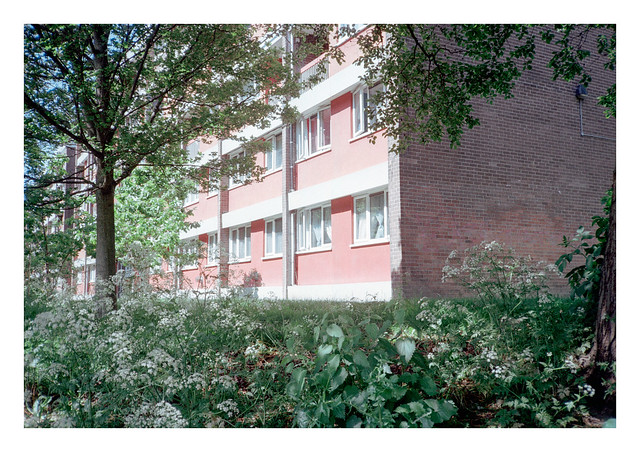
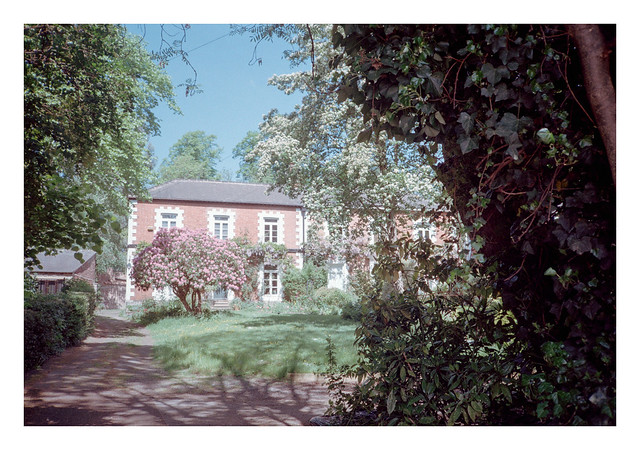
I was going to title todays post “hiding in the bushes” but that just sounded creepy. Framed by Foliage sounds much nicer.
I guess the theme today – if four pictures can be said to constitute a “theme” – is my tendency to choose to frame subjects with vegetation, whether it be shrubs, flowers, trees, or all three. I notice that I do this a lot. I don’t know if it’s unusual or if everyone uses this particular device. Whatever the case, it’s one I use often.
The foliage in these images is rarely the subject, even if it sometimes takes up a lot of the frame, but it is still integral to the picture. All four pictures shown today would still work thout the framing, but they would be markedly different.
Canon Sure Shot Supreme & Kodak Gold. Lab developed. Home scanned and converted with Negative Lab Pro.
Anyway, whatever the plural (and I expect there isn’t a collective noun), here are three photographs of underpasses. They’re all fairly close to one another – in fact, the latter two photos are in the same structure.
They felt like a good trio of pictures to publish together.
This whole roll of film had a sense of suspense about it. I took my Canon Sure Shot Supreme on an outing a couple of months back and decided to carry it in its case using the built-in belt strap. This was very convenient right up to the point where the strap came unglued and the camera fell onto a concrete floor (still inside the case, thankfully). The camera’s plastic shell became slightly misaligned and had to be popped back into shape, an a few little chips of plastic broke of around the shutter button. I was concerned about light leaks (so I filled the chip holes with a bit of black silicone), and also some sort of major damage to the mechanism or electronics. However, when I finished shooting to roll a few weeks later and got the negatives back they were all perfectly fine. So I still have a working Supreme, albeit now with a few battle scars.
Canon Sure Shot Supreme & Kodak Gold. Lab developed. Home scanned and converted with Negative Lab Pro.
There is something that attracts me to photographing post boxes. It’s not hard to figure out – it’s the vivid red that does it. I photograph them in black and white sometimes too, but colour really works best.
This one dates back to the reign of King George, so would have been erected sometime between 1936 and 1952, when he died and new boxes tok on the ER markings denoting Queen Elizabeth II.
It also has a sticker on it advertising a march and rally seeking justice for the events that took place at the Battle of Orgreave during the miner’s strike in June 1984.
Canon Sure Shot Supreme & Kodak Gold. Lab developed. Home scanned and converted with Negative Lab Pro.
One of my primary means of taking photos is to just go for a walk somewhere promising and see what pictures present themselves. Even ordinary looking areas can usually turn up a wealth of subjects, particularly if the lighting or weather is agreeable for what you are seeking to achieve.
This is a photo (as, indeed, are most of the pictures I’ll be posting over the next few days) that was made this way. Just a place I walked past that looked like it would make a nice picture.
Canon Sure Shot Supreme & Kodak Gold. Lab developed. Home scanned and converted with Negative Lab Pro.
On the wall of the Porter Cottage pub, this piece of street art looked great in the sunshine helped, I think, by the black brickwork.
I’m glad that this week has finished. I had two days out of the office, but the other three days felt like five day’s had been squeezed into them. I expect to be busy again next week, but at least I have no travel planned (thopugh maybe a day off on the Friday if I can squeeze it in…). Maybe I’ll be able to write more on the blog.
Canon Sure Shot Supreme & Kodak Gold. Lab developed. Home scanned and converted with Negative Lab Pro.
A third day of little more than just a picture, I’m afraid. I’m so busy with work right not that I just don’t have the time or energy to think about writing anything. Hopefuly things will improve come the weekend.
Olympus Trip 35 & Fujifilm 200. Lab developed. Home scanned and converted with Negative Lab Pro.
The week after we returned home from Italy, I decided to go out and shoot some more large format film with my Chroma 4×5 camera. I decided to visit Roche Abbey, a 12th century Cistercian monastery, or what remains of it at least. It does beg the question of what it would look like today had it not been destroyed as part of Henry VIII’s disolution of the monasteries? Indeed, what would the entire area have looked like – one might imagine a whole town at least, rather than a ruin in a lovely looking valley. Still, trying to imaging how things might have played out with a change in a historical event is quite the rabbit hole to disappear down, and whole novels have been written about such things.
The monastery is under the auspices of English Heritage and there is a fee to enter (although there’s a conveniently placed public footpath just the other side of a fence with full view of the ruins if you don’t feel the need to get right up close). Accessing the abbey is down a narrow cobbled lane that provides some serious rumbling through your car’s suspension and tyres (more on this later…).
Two other visitors had photogenically colourful sweaters on, so I included them in the picture.
I had four sheets of HP5+ to shoot with the Chroma, but I also packed my Olympus Trip 35 in the bag too, figuring I might be able to shoot more of the Fuji 200 that was still in the camera from the Italy trip. This was fortuitous.
This is the entrance to the abbey. Through that arch is the track back to the carpark where my “surprise” awaited me.
I found a number of compositions for the 4×5 and carefully focused, aligned, and exposed the images. This was the first time I would be shooting the camera since McGuyvering another fix for the light-leak issues I’d been having with the camera, but I was pretty confident that I’d fixed them. Spoiler alert: I hadn’t.
In between making the large format pictures, I also shot about a dozen frames with the Trip. This saved the day, photographically speaking.
A smaller part of the abbey structure still standing. There are helpful signs around the place explaining where you would be if the monastery were still intact.
There were two notable negative outcomes from the day. The first was that my light leak fix didn’t work. Upon developing them I found that all four images had massive light leaks in exactly the same way I’d encountered them previously. After making the effort to drive to the location, pay admission, take the time to shoot the images, and then develop them the next day, this was very disappointing
The second outcome was spotted when I returned to my car and noticed that the rear tyre had a noticeable and – given I would have to drive on a motorway, worrying – split in the side wall. Given that cars these days rarely have a spare anymore – just a repair kit – I was left to decide whether to call out a breakdown truck, or to take the risk that the tyre would hold out for the journey home.
I decided, possibly foolishly, to take the second option. The split looked worrying, but also like it should last the thirty minutes or so it would take to get home, although I planned on driving especially carefully and as slowly as possible. Driving back up the cobbled track was a nerve wracking experience, and I expected to hear a loud pop as the tyre burst with every bump of the wheels, but it held out ok. Back on the main road, the car was similarly fine, although I was hunched over the wheel, prepared to react should something happen. After a while I drove past a tyre shop, but it was on the opposite side of the road and I was already past it by the time I realised. However , a short distance further on, there was a tailback of traffic and a police car was parked astride both lanes for some undetermined incident. Deciding that this was a sign, I turned around and returned to the tyre shop.
The building at the back is the entrance to the abbey. The valley was landscaped by “Capability” Brown in the 18th century and is very picturesque.
Unfortunately, there were no new tyres of the correct size, but they did have a used tyre available. I would never buy a used tyre under normal circumstances, but on this occasion it seemed a better bet than the actual damaged tyre on the car. It was also remarkably (and worryingly) cheap, so I decided to go ahead.
Thankfully, the trip home was, while a bit stressful, uneventful, and the used tyre survived without a blowout or any of the other catastrophic failures my mind imagined might happen. I replaced the tyre with a brand new one from my usual tyre dealer the first chance I got though.
Olympus Trip 35 & Fujifilm 200. Lab developed. Home scanned and converted with Negative Lab Pro.