35mm · Film photography · Photography

The Nuns’ Valley

Perhaps the biggest outing I had during our holiday in Madeira was a trip I took to the Nuns’ Valley where the village of Curral das Freiras nestles amongst the mountains. The valley is so-named after the nun’s who retreated there as it was out of sight from the coastline and the threat of passing pirates.

I had originally planned on booking an excursion, but then found I could DIY it for much less money by simply catching a bus! I forget how much the excursion would have cost, but the bus fare was around three Euro each way, so a noticeable saving.

So, after working out which bus I needed to catch, and where in Funchal I needed to catch it, I decided to take the trip on the last day of June.

The bus took a route through the centre of Funchal before rising up into the outskirts and residential areas on the steep hillsides, often following roads that you might not expect a bus to fit – but it obviously did. From there it rose into the mountains, one moment through thick and steeply sloped woodland, then next alongside vertiginous drops to the valleys below.

While Curral das Freiras was my destination, for this trip it would very much be a case of the journey being the destination as well as, rather than going directly to the village, my plan was to leave the bus at Eira do Serrado, the location of a scenic mountain-top viewpoint. From there I would follow the mountain path 1,300 feet down to the village below.

Before I began my descent, and after a quick refreshment break in the small hotel and shop that sits at the peak, I first walked to the scenic viewpoint. On the way I met a curious chap playing an accordion and wearing a flag-bedecked hat. As I approached he asked where I was from. “The UK”, I said, and he began to sing me a song. I gave him a few Euro in thanks and asked if I could take his picture.

Black and white music man

The viewpoint itself was both spectacular and fear inducing. An amazing view out across the mountains and down into the valley floor, albeit with a vertigo inducing sense or terror when I looked over the waist high fence to a drop of maybe a thousand feet! After (very carefully) enjoying the view for ten minutes, I made my way back down the path to the hotel area. The accordion man asked again where I was from – I clearly made little impression before!

The two pictures below were made from the viewpoint and the path back to the hotel.

Nun's Valley
Across the gulf

Past the hotel I found the top of the hiking trail and began my descent. The trail followed a zig zag down the mountainside, but the first section ran through a stand of trees where the air was refreshingly cooler – the day of my visit featured empty blue skies and a hot sun that gradually brought more of the valley into light as the morning progressed. Part of me wished for more cloud to add some (literal) atmosphere but I guess I was lucky in a way as, while I find empty blue skies uninspiring, they were probably preferable to the low cloud I had seen enveloping the mountaintops on other days and which would have both completely obscured the view and, worse, required me to descend the path in what would effectively be fog.

The path was cut from natural rock in places, and in others paved with placed stones. Sometimes the angle was gentle, sometimes steep. There was an occasional section with a wire guard-line, but it crossed my mind numerous times that a trip or loss of footing might easily see my rapidly stumbling out of control and into nothingness.

At one stage I was a little worried that the path might take me on a precipitous looking ledge hugging a cliffside, but thankfully not. You can get and idea of my concern from the picture below.

Lone tree on a mountainside

As I descended, the village below grew from tiny specks of white to recogniseable buildings, as seen in the next two pictures. I did shoot quite a few colour frames during the hike but I’m not satisfied with how most of them look. The one below is ok though. If you look closely at the bottom right of the frame, you can see a small rest area with a bench and viewpoint about halfway down the mountainside. The next picture was taken from the rest area if I remember correctly.

Curral das Freiras
Lower down

As the descent continued, so the trail began to pass through more wooded areas. There was also one section with thousands of bees flying all around. Thankfully they were just interested in going about their business rather than the sweaty englishman passing among them.

I walked with another English couple during this lower stretch of the path, and it was nice to share the experience with others. I also passed at least two other couples walking up the trail from the bottom, which must be a real feat of endurance.

As I got down into the valley floor I took some pictures looking back up at the mountainside, and from where I had come. In the first picture you can just make out the hotel up at the viewpoint and the path zig-zagging below.

Looking back
More mountainside trees

I’ll finish the post off with a couple of pictures I took in Curral das Freiras itself. The village is small and mostly quiet with a few touristy shops and restaurants (in one of which I treated myself to a nice piece of cake and a very welcome ice-cold drink) and is apparently famous for it’s chestnut dishes. I spent an hour or so wandering around the place, looking inside the church (which has a lovingly kept graveyard where all the graves feature an inlaid photograph of their occupants), before making my way to the bus back to Funchal.

I sat across from the couple I’ve shared the descent with, who it turned out were staying in a hotel not far from ours, although they were heading home the following day. Sadly, as I was facing backwards, I felt somewhat travel-sick by the time I arrived back in Funchal, but not enough to place a cloud over the experience.

Old house at the bottom
Church tower

And so we come to the end om my Madeira pictures (unless I dig out some more I like at some point). Now to get on with the rest of my growing backlog…

Olympus Trip 35 & Fujifilm Across II. Ilfotec DD-X 1+4 9mins @ 20°

Taken 30 June 2026.

35mm · Film photography · Photography

Empress Sisi of Austria

Empress Elisabeth of Austria, also know by her nickname Sisi (or Sissi – it seems to be spelt both ways) was Empress of Austria and, then, Queen of Hungary from her marriage to Franz Joseph I on 24 April 1854 until her assassination in 1898.

So why is there a statue of her outside a casino hotel in Funchal? Well, it’s because she visited twice, first in 1860 to 1861 to seek a reprieve from respiratory illness. The villa in which she stayed was eventually demolished, and the casino stands on the same site.

She visited again in 1893-94, but this time stayed at Reid’s Palace Hotel (which still exists and was just down the road from the hotel in which we stayed).

People leave flowers in the hands of the statue in remebrance.

Statue of an empress

Olympus Trip 35 & Fujifilm Across II. Ilfotec DD-X 1+4 9mins @ 20°

Taken 2 July 2026.

35mm · Film photography · Photography

Ronaldo

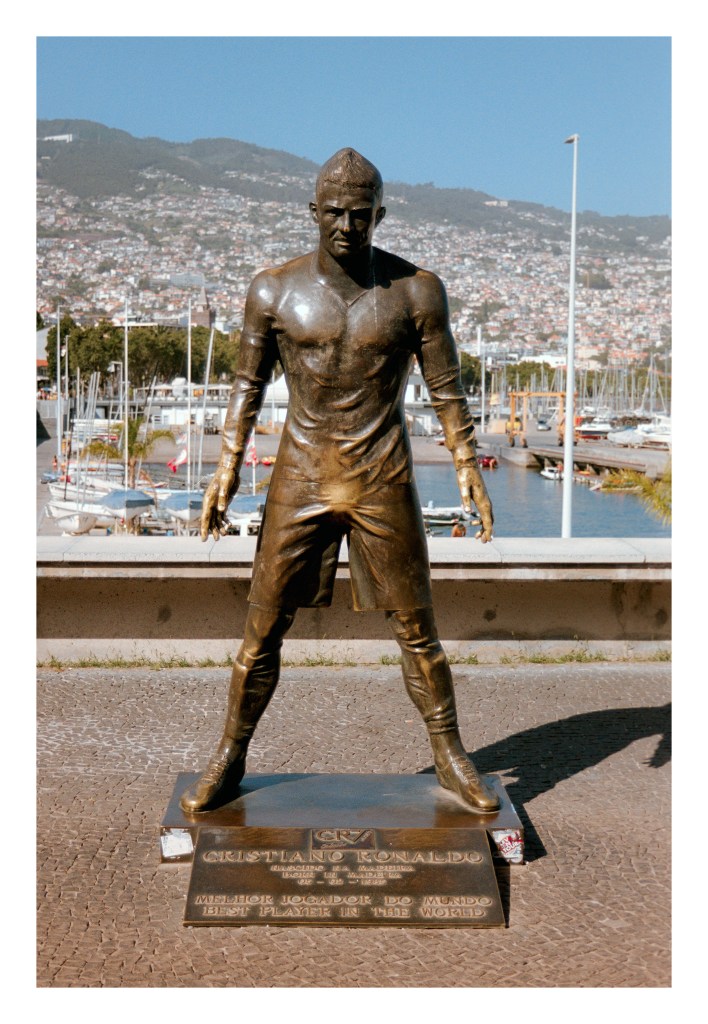
As mentioned briefly yesterday, another draw for visitors in Funchal is the Christiano Ronaldo museum, or – perhaps more specifically – the bronze statue of the man standing outside.

I’m not a big football fan and mostly pay little attention to the game outside of major tournaments, so I can’t really say how good a likeness the statue is. It’s probably closer in resemblance when compared with the much-commented-upon bust of his head that was on display at Funchal airport.

A good likeness or not, the statue is afflicted by the same trend that many such pieces are, namely the need for people to touch them, particularly in places that might be seen as a little risque were it and actual living person (or, indeed animal – the bull in New York’s Wall Street has been similarly fondled), resulting in considerable amounts of brassing. 😀

Apart from walking past a couple of times just to say I’d “been there”, I didn’t venture into the museum (or touch up the statue, for that matter). There were a number of people present having their photos taken with it on each occasion I was there though.

At the Ronaldo museum
At the Ronaldo statue

Here he is in all his glory…

Olympus Trip 35 & Fujifilm Across II. Ilfotec DD-X 1+4 9mins @ 20°

Colour shot: Nikon F70, Nikkor 28-80mm f.3.5-5.6 AF-D & Kodak Portra 160 . Lab developed. Home scanned and converted with Negative Lab Pro

Taken 2 July 2026.

35mm · Film photography · Photography

Up to Monte Palace and a sledge ride back down

Perhaps the most famous activity in Funchal – even moreso that visiting the Ronaldo statue – is the sledge rides.

So, one day during our trip, we decided to have a go. The rides run from a place called Monte, which is high above Funchal (about 550 metres or 1800 feet) and can be reached by a cable-car ride (you can get a bus or taxi too, but where’s the fun in that?). I think my wife might have preferred an alternate mode of transport though as she spent the entire ride up looking at the roof of the car to avoid seeing the drop, clutching my hand tightly whenever the car went over one of the pylons!

Below are a couple of picture of the cable-cars from the station at Monte.

Cable cars
Cable car station

You can go straight to the sledges from the cable-cars, but right outside the station is the entrance to Monte Palace and its beautiful gardens, so we went in there first.

The gardens are glorious, packed with lush vegetation and footpaths that wind around up and down through the steep hillside terrain. There are pools, fountains, ponds and water features dotted around giving the whole place a cool and refreshing feel.

We didn’t go inside the palace (which can be seen in the picture below), but it holds a commanding spot on the mountainside.

Monte Palace gardens - landscape

The gardens had a large number of birds, including swans and flamingos. There were also large numbers of fish in the ponds, including a number of pools with glass sides in this east-Asian themed section of the garden.

Pagoda

Looking back up to the palace.

Lush

After exploring the gardens, we set off to find the sledges. We soon realised we were on the right track when we saw them whizzing past on the road we were climbing.

Funchal toboggan

The Monte Sledges have become one of the most recognisable sights on Madeira, offering a memorable experience that is pretty unique.

The toboggans* first appeared in the 19th century, when people living up in the parish of Monte – about 500 metres above Funchal – used them as a quick way to get down to the city. What started as everyday transport has since turned into one of the region’s best‑known traditions.

* are they toboggans, or sledges? What is the difference? I maybe ought to look it up… [goes and checks online…] Aha! They are actually sledges. Sledges travel on runners, whereas a toboggan runs on a flat base with a curved lip at the front. I have learned something new today!

Back to the story…

Each of the sledges are still made by hand from wicker and wood by local craftsmen. The ride itself is guided by two drivers, called carreiros, dressed in white with straw hats, who steer and brake using the thick rubber soles of their boots.

The route runs down very steep roads for about a mile and takes about ten minutes in total, starting in Monte and finishing halfway down the hill. There’s a definite sense of jeopardy involved, with the sledge at times drifting sideways down the roads and sometimes coming very close to narrow, but deep, drainage channels that run along parts of the route. It’s probably the way my mind works, but it was very easy to picture the whole shebang hitting a pothole and flipping over sideways at speed as we hurtled down the streets!

I’m sure it’s very safe though, and we did reach the bottom unscathed, having enjoyed the ride immensely (the carreiros clearly know their stuff). It’s a very memorable and fun experience, combining the thrills with glorious views down the mountainside into Funchal and out to the expanse of the Atlantic beyond.

At the end of the ride you can buy souvenirs – including theme-park-style photos of your expressions from partway down the hill! The end of the route is still high above Funchal town so a bus or taxi is needed (unless you fancy the walk). The taxis are not cheap, so timing the ride with the buses would have been a good idea.

The best part about the end of the ride though, was seeing how the carreiros get back up the hill again…

Toboggan drivers

Olympus Trip 35 & Fujifilm Superia 100 (expired in 2008). Lab developed. Home scanned and converted with Negative Lab Pro

Taken 29 June 2026.

Digital · Photography

A trip to Barcelona

My wife and I spent the weekend just gone in Barcelona to visit the Christmas markets and just wander round the city. It’s the first time I’ve traveled overseas so close to Christmas and I was a little concerned that we might get caught up in a mass of travelers going home for Christmas, but everything went very smoothly and, while Barcelona was pretty busy, the travel was not.

We had a very nice time just wandering about the place, not doing anything in particular other than visiting shops and markets and eating nice food. We visited the Sagrada Familia as there was another Christmas market there, and I did consider going inside the cathedral, but I would have needed needed to book tickets in advance and there were none available to buy on the day as it was fully booked. My wife isn’t particularly interested in visiting cathedrals anyway, and I would have felt a little guilty if I was dragging her around the place while I took photos and admired the architecture, so I wasn’t too concerned about missing the opportunity. Maybe I’ll get another chance one day.

I shot a roll of colour 35mm film while there, but it will be after Christmas before that gets developed, but took some more photos with my Ricoh GRIII, including the one posted here today, so will share some of those once I’ve gone through them all.

This large star can be found in Plaça Sant Jaume in Barcelona, Spain. It is titled Origen and was created by Xevi Bayona and Àlex Posada. It projects light from the points of the star onto the facades of the buildings in the plaza.

ORIGEN

Ricoh GRIII

Taken on 20 December 2024

35mm · Film photography · Photography

Pursuit

Someone commented that this picture looked like the woman was fleeing from the small black car, like in a suspense movie of something, which I quite liked.

It wasn’t my intent to create such drama – I was simply photographing the large bridge and thought the jogger would add some interest. I probably just waited for her and the car to reach favourable positions in the scene before pressing the shutter button. A happy accident, I guess. 🙂

Towards a big bridge

Canon Sure Shot Z135 & Kodak Gold. Lab developed. Home scanned and converted with Negative Lab Pro.

Taken 31 May 2024.

35mm · Film photography · Photography

Further views over Dubrovnik old town

On one of the days during our holiday in Dubrovnik, I left my wife reading her book on the roof terrace of the hotel while I got the bus into town and took a walk all the way around the city walls which encompass the Old Town. It was a very warm day and there is little shelter atop the wall (although there was a place selling reasonably priced drinks, and a somewhat more expensive bar restaurant at various points of the circuit), but there were plenty of other people doing the same thing.

There are a number of places where you can enter various turrets, and I took a number of pictures looking out of these, one of which is included below, and I also tool many other photographs, some of which I’ve already posted, and quite a few still to come (although I think these are the last city wall shots in colour).

Over Dubrovnik old town
More rooftops
Again with the rooftops
Through a hole in the wall

Canon Sure Shot Z135 & Kodak Gold. Lab developed. Home scanned and converted with Negative Lab Pro.

Taken 29 May 2024.