35mm · Film photography · Photography

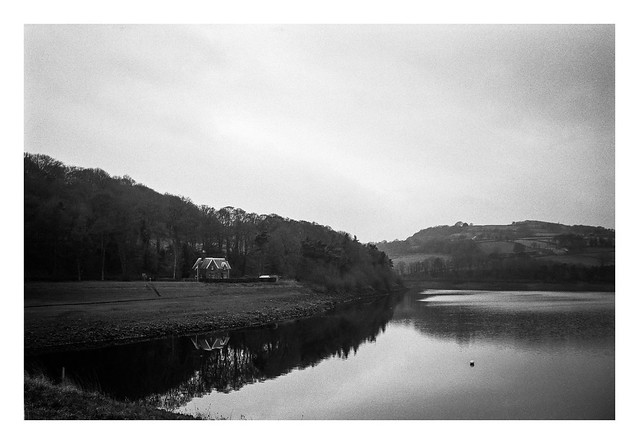
(halfway) around depleted Damflask

I already posted a couple of digital pictures from this hike around Damflask reservoir back in August, but the ones shown today are all on film. It’s not the complete set of images from the day as I changed rolls of film partway through the walk and I’ve not yet scanned the others, but I expect they will appear at some point in the future.

Damflask

We’ve had a long spell of very hot and dry weather through the summer here in the UK (indeed, as has much of Western Europe). Parts of the country were hit by wildfires more serious than would normally be seen in a dry period, and many parts of the nation were placed under drought conditions.

Reservoir house

At the time these pictures were taken drought conditions had not yet been imposed by Yorkshire Water, but it’s quite clear by the reservoir levels that insufficient rain had fallen to keep then at a healthy volume (although, looking at an older image I took in 2017 which is very similar to the picture above, the reservoir has been similarly depleted before).

These water gauges give an indication of how the water level has fallen.

Water level indicators

This is the spillway from the reservoir for when it overflows. It doesn’t look like much water has flowed over it for some time.

Dry spillway

The reservoir would reach the treeline in normal conditions, and the triangular spit of land would be completely submerged.

Low water
Mirrored

It will be interesting to revisit in a few months to see if the water has returned to a more healthy level – particularly given we are forecast to have a wet and stormy autumn followed by a cold winter due to this year’s El Nino.

Nikon F80 & Nikkor 24-120mm f/4 ED VR on Fujifilm Acros II. Ilfotec DD-X 1+4 9mins @ 20°

Taken 22 August 2026.

Digital · Photography

At Damflask

A mini-break from the Madeira pictures today. More of them still to come though.

I went for a walk around Damflask reservoir this morning. It sits to the north-west of Sheffield and is the lowest of four reservoirs that sit in the same valley system (the others being Agden, Dale Dyke, and Strines). I’ve visited Damflask on multiple occasions, particularly when I was a lot younger, and more recently driving past it when visiting the villages of High and Low Bradfield. Today was the first time I’ve ever walked around the entire thing though.

I was there to shoot film primarily, and I’ve got a bunch of shots to be developed, but I also had a second agenda, namely to test out some neutral density grad filters. I’ve had a set of Cokin filters for years but only used them on a very small number of occasions, probably due to the faff of having to attach them, but recently I’ve been thinking that they might be helpful with film photography – particularly if I’m shooting something with a tighter exposure latitude, such as slide film.

However, I didn’t want to waste film on experiments, so I took along a digital camera as well. Any mistakes with that would cost me nothing more than a bit of time. So into my camera bag with my Nikon F80 went my old Lumix GX7 micro-four-thirds camera with a 12-60mm lens (24-120mm full frame equivalent). This was the first time I’ve used the camera in around six years.

At Damflask

I only took a few shots with the GX7, most of which are nothing to write home about, but the one shot where I used the grad filter (a 2-stop soft grad, I think) came out nicely, as did another picture without the filter, both of which you can see in today’s post (the first with the filter).

I took very similar shots with my F80 (which was sporting an actual 24-70mm lens, so the focal lengths will mostly match up) and it will be interesting to see how they compare. These didn’t have the benefit of any filters.

But the experiment worked ok. I like how the grad filter added mood to the sky and I’ll give it a run with a film camera when the need arises. If I get good results, I might invest in a more expensive set.

At Damflask-2

Panasonic Lumix GX7 & Panasonic Lumix G Vario 12-60mm f/3.5-5.6 Asph.

Taken on 22 August 2026

35mm · Film photography · Photography

Damflask

This is another photo dating back to early 2017 and depicts Damflask reservoir to the north-east of Sheffield. It is one of a series of reservoirs in the Loxley Valley and tributaries, the others being Agden, Dale Dyke, and Strines.

Dale Dyke is notorious for having catastrophically burst in 1864, shortly after construction, flooding the valleys downstream and the city of Sheffield, resulting in 244 deaths.

Damflask reservoir is named after the village of the same name that was washed away by the Dale Dyke tragedy.

FILM - Damflask

Olympus 35 RC & Ilford HP5+.

Taken on 13 January 2017