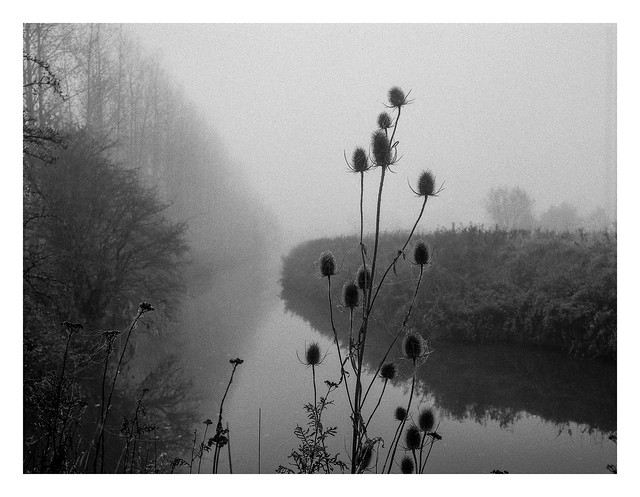
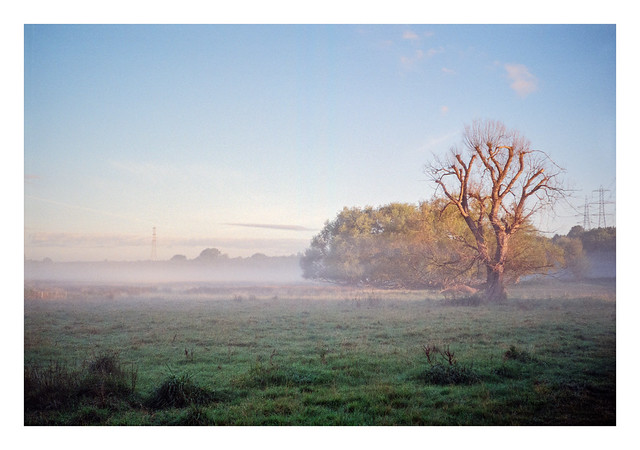
I’ve undoubtedly said this before on here somewhere, but I’ll say it again: Fog and mist are a gift to photography. The diffused light; the sense of calm; the way they hide and obscure distracting detail; and – most of all – the sheer atmosphere (quite literally) that they bring to bear is a wonderful thing to behold.
I do admit to saying this as someone for whom fog and mist are relatively uncommon – at least at the times I’m usually out of bed! I can fully understand the “grass is always greener” sentiment that this bears, and that for those who live in places with regular foggy conditions that this might all be a bit business-as-usual. But for me, well, I love these conditions.
So, when I saw the weather forecast showing this day as having fog, I was up early and out with my camera. I went somewhere I’ve been a number of times before – a walk that takes me across the River Rother, through a copse of trees (it’s probably a plantation as the tress – Poplars I think – are in somewhat orderly rows), and then either up to the Trans-Pennine Trail, or looping alongside the river, then down to Renishaw golf-course, and back around to the starting point.
I’ve photographed these trees on a number of occasions and know that the look their best in a veil of mist. It’s not a large area and on clear days it’s easy to find a distracting background element creeping into the frame. In fog, however, the trees feel like they go on forever.
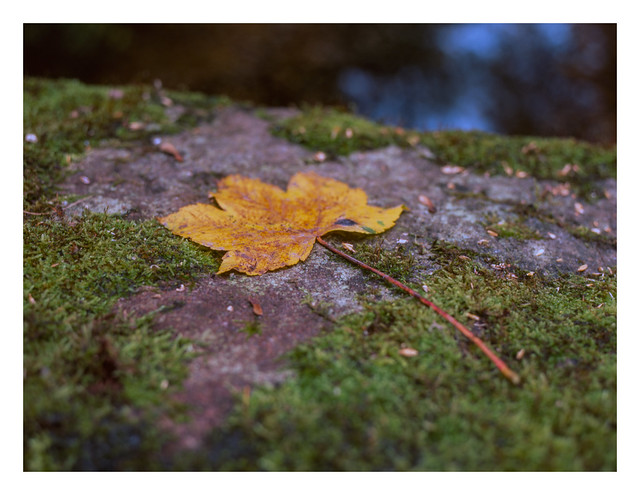
Just a few days ago I said that I was at the end of my autumn colour images for this year. Well. turns out I’m not – I forgot about this roll of Velvia 50 that I shot on a walk along the Chesterfield Canal near Thorpe Salvin a few weeks ago.
The roll was tricky to meter with confidence. Given that I don’t have a spot meter (just a reflective setting that’s has a pretty wide angle and no meand to accurately point it) I almost always use incident readings instead. Incident metering usually serves me very well, but a canal withich has irregular tree cover along it’s banks makes it difficult to match the light falling on the meter with the subject unless it’s pretty close by, or you’re sure it’s in the same levels of light.
As a result, quite a few of the images on this roll are poorly exposed, and the ones here are probably the best from the canal-side walk.
Of the four, the sycamore leaf below is the best I think (even if it did keep attempting to blow away in the light but irregular breeze!).
Bronica ETRSi, Zenzanon 75mm f/2.8 PE & Fujichrome Velvia 50.
Ok, maybe not the most autumnal shades here – more a yellow green than fiery shades of red and orange – but it’s probably the last shot from this year’s clutch of seasonal images where the trees still bear foliage. Today, as I type this, most of the leaves have fallen, littering the pavements and roadsides where they’ll release that rich scent of autumn so evokative of this time of year. There are still some late straggling leaves on the limbs of silver birches – some still green in fact – but most trees have revealed the skeletal form of their branches now.
I still have autumnal images yet to come, but they are of the misty, damp, almost monochromatic feel of late autumn as it rolls over into winter.
Yashica Mat 124G & Lomography Color Negative 100. Grain2Pixel conversion.
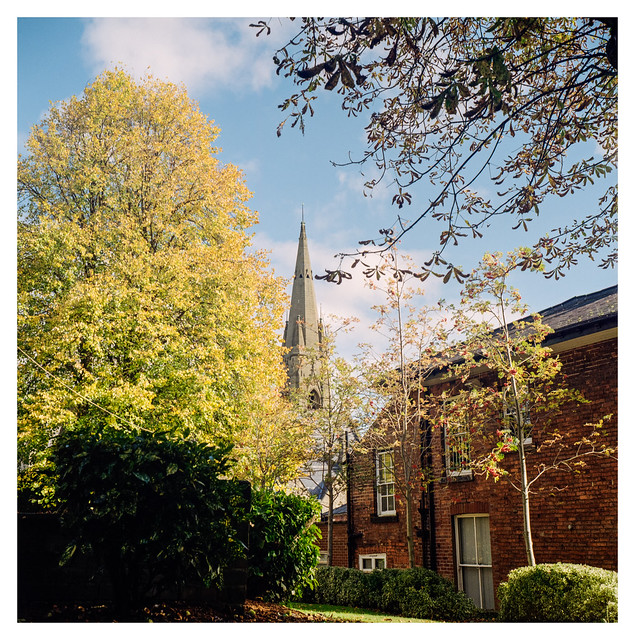
The two photographs today show the former Glossop Road Baptist Church, the first with its steeple rising from between autumnal trees in the back gardens of the stone houses (now mostly owned by the University and Sheffield Teaching Hospitals) on Claremont Place.
The church is now owned by Performance Venues, a small group who run this and two other venues (the Octagon and Firth Hall) in conjunction with the University of Sheffield. It is now known as the Drama Studio.
Yashica Mat 124G & Lomography Color Negative 100. Grain2Pixel conversion.
Early last month, on a bright sunny day, I took a walk around Weston Park, Crookes Vally Park, and the surrounding areas. I took my Yashica Mat 124G loaded with some Lomography Color Negative 100 film, and my Sure Shot Telemax containing some Kodak Gold (the results from which I’ve been posting here over the past week or so).
This was the first time I’ve used the 100asa Lomography Color Negative variant, although I’ve shot several rolls of the 400asa version and liked the results. As is my current process for medium format colour films, these have been home-scanned as linear tiff files with my V550 using Vuescan, and then converted to positives using the free Grain2Pixel Photoshop plug-in. I found that, while the initial conversions looked pretty good, I’ve still had to tweak them to get them looking “right” – or at least as “right” as my own eyes reckon they should be. Grain2Pixel is a very good piece of software, especially given it is free-of-charge, but I do find that I have to remove colour casts sometimes depending on the film I used. The scanner (Epson V550 for medium format / Plustek 8100 for 35mm) can also make a difference too.
Occasionally, certain frames from a roll produce very odd results – oftem at odds with the rest of the shots from the same roll. I tried using the trial version of Negative Lab Pro to compare with the Grain2Pixel results on some of these and it also went slightly crazy – with colour tones looking very odd. All the shots here today were pretty straightforward to deal with though.
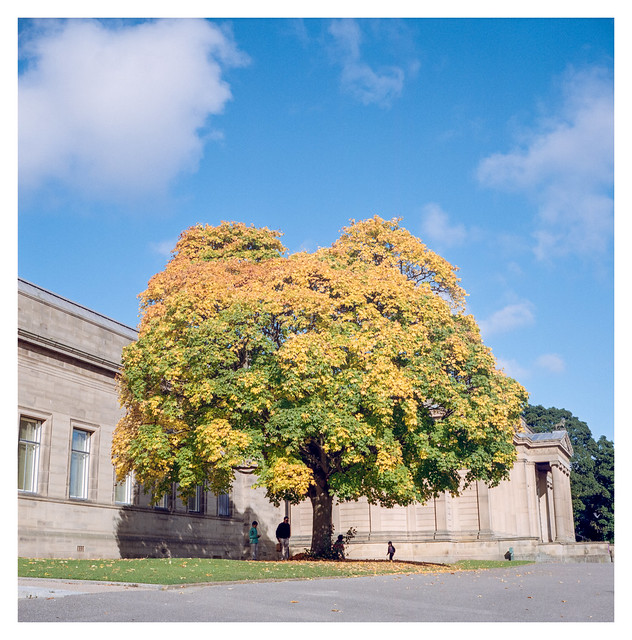
Anyway, the three photos today are all from the Lomgraphy 100 roll, shot with the Yashica, and all three made in Weston Park (with the museum visible in the first, the bandstand in the second, and the nearby Univesity Arts Tower in the third). Autum was underway, but the trees still held onto most of their leaves and a good amount of green at this point.
Yashica Mat 124G & Lomography Color Negative 100. Grain2Pixel conversion.
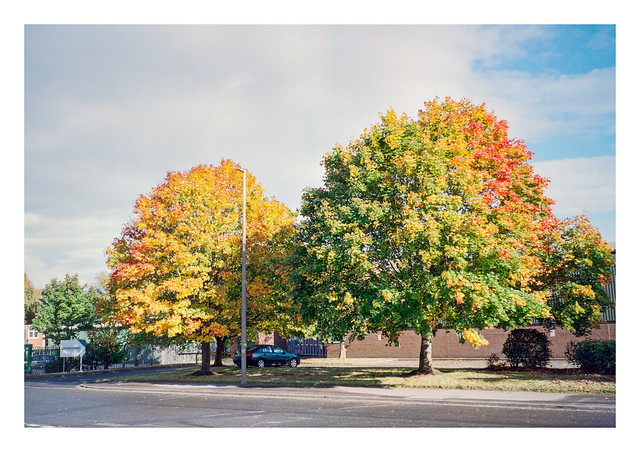
Three autumnal images, all taken almost a month ago now – once again, where does the time go?!
The first two are in an out-of-town industrial estate. I’d spotted them on the way to where we were going and then made my wife wait in the car while I photographed them on our return. I always carry a compact camera in my coat pocket at this time of year for opportunities such as this. I try to carry one in the warmer months too, but having the need to wear a coat gives better opportunity to carry a pocketable camera.
The final photo in today’s post was made on a seperate outing, but was taken on another industrial estate not far from home – I can’t remember if I was out dropping a film off to be developed or visiting the postal sorting office, but it was one of the two.
I have a feeling that my Telemax might have developed a light leak on the lens assembly. It’s displaying minor, but noticeable signs of leakage at one corner of the frame, although easily fixed in Photoshop. It’s similar to, but not as severe as, the leak I had on the Samsung Fino compact I tried a while back. The Telemax is the only camera in my collection (other than my Instax Mini) that I have owned since new – a gift from my parents around 1990-ish. I might have to retire it if the leak persists (although I shan’t get rid of it – I have an attachment to it now).
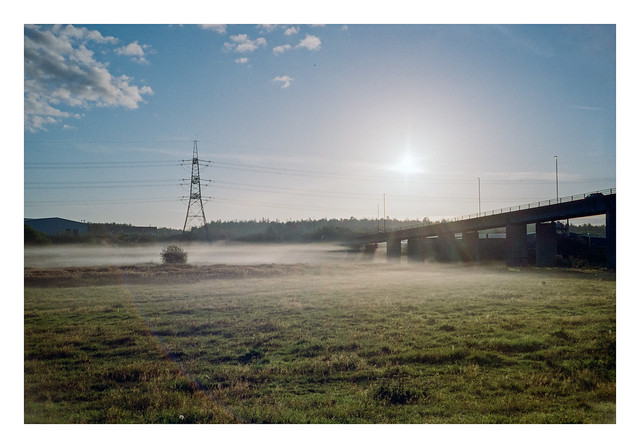
A couple of photographs serving as a direct follow on from yesterday’s pictures of the flyover – the first taken when I was stood almost beneath it, the second featuring it as a subject.
I wasn’t sure the second would work as it was shot with the sun directly in frame. While there’s a little flaring, the Telemax’s lens has coped admirably though.
On my walk up the Limb Valley last week, the first place I came across was Whirlowbrook Hall. A grand-looking manor house that was built back in 1906. Originally a family home, its grounds were opened to public access in 1951.
The building is now used as a venue for weddings, conferences, and other events.
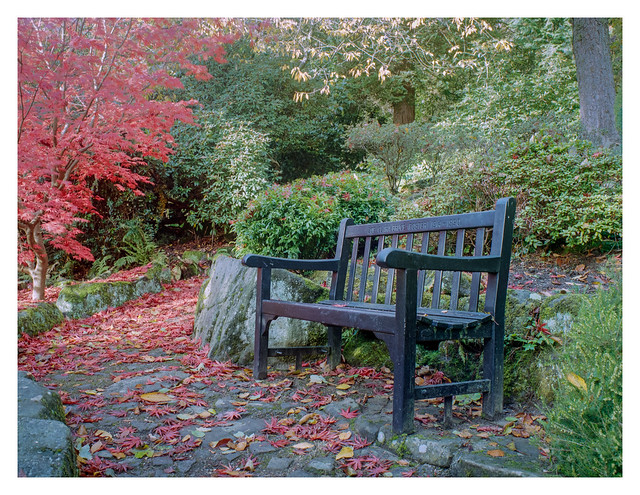
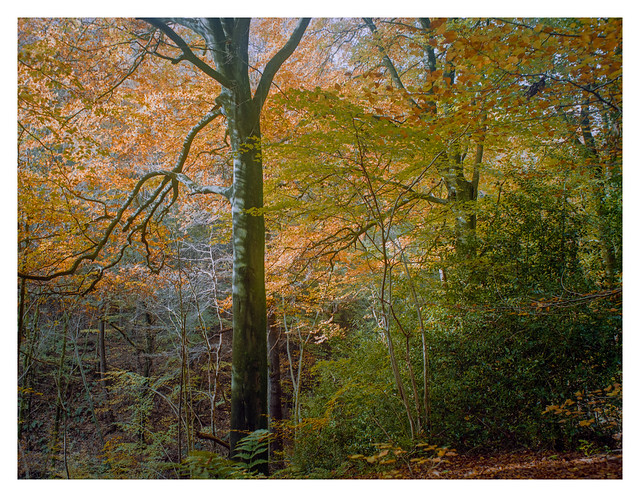
I took some leave last week in the hope that I would be able to get out an about capturing some autumn colour before the leaves fell, but this was hampered by the pincer movement of a Tier 3 Covid-19 restriction being placed on our county and my old friend, bad weather. The Tier 3 restrictions prevented me leaving the borders of South Yorkshire, but there are still many, many other places I can go make photos within the boundary. It was the dull, rainy weather that was the main anchor on my activities. While I subscribe to the saying: “There’s no such thing as bad weather, only unsuitable clothing”, my cameras are sadly not weather sealed so, no matter how suitable my atire may be, the use of vulnerable camera gear forms an Achilles heel.
So, when there was a break in the weather on the Wednesday morning, I decided to make the most of it and set off for the Limb Valley, a wooded area to the south-east of the city that rises into the hills at Ringinglow at the edge of the Peak District. I’ve never walked the valley before and only realised it was ther because I saw some photographs a colleague of my wife had posted. Not having any better plans, it seemed a good place to visit.
I decided that I would use the opportunity to test the newly acquired Zenzanon 50mm f/2.8 MC lens that I’d bought to use with my Bronica ETRSi. I had been looking for a wider-angle lens on and off for a while to complement the 75mm f/2.8 that came with the camera. I missed out on one a few weeks ago when I was outbid at the last moment, so when I saw this one with a buy-it-now option for half the price of the one I missed out on I got in there fast.
The lens was described as having had a lot of use, with some loss of paint on the barrel. It also said that there was some slight haze in the centre of the glass. I examined the photos that were shown on the auction and felt happy with the cosmetic condition – as long as it works properly, I don’t mind a few scrapes here and there. The haze wasn’t very apparent in the photos so I decided to take a chance and clicked the button to make the purchase.
Upos arrival, I can’t really find anything to complain about. The cosmetic wear is nothing serious, and I can’t see any sign of the haze at all, and it hasn’t (that I can see, at least) made its presence felt in the photos I’ve made so far.
I also decided to use the outing to try out some more expired film that I’ve recently picked up – a few rolls of Superia 100 in 120 format. It’s a consumer grade film, but there are precious few options for non-professional colour film for medium format now, so I decided I would take a chance on it. The scans from the negatives tended towards a green cast slightly, but I’ve beebn able to sort that out in Photoshop without any real issues and I’m generally happy with the results for the film.
On the whole I’m really happy with the results from this outing. So much so that I moved them up my pile of stuff to scan and publish (I normally do this in a pretty strict chronological order – blame mild OCD or something:)). It means that they get published pretty close to the period of autumn in which ther were produced.

















 Steel City Snapper photography