I posted some other photos of bridges spanning the Sheffield and Tinsley Canal recently – those shot with my Zeiss medium format folding camera. The ones here were shot on the same day with my Olympus XA3 along the same stretch of water in Attercliffe, Sheffield.
I think I said in the earlier post that this is now a pleasant stretch of the can to walk along. It has a high embankment on both sides which shields it from what is otherwise quite an industrial part of the city. The spring foliage also brings a pleasantly arboreal feel to the place.
When I was much younger the canal was horribly polluted. I remember crossing it on the bus route that took me into the city centre and the water was a vivid orange colour, presumably due to pollutants from the steel industry in the area. Now the water is clear and sustains fish and other wildlife.
This factory, along with it’s distinctive logo, has been around for as long as I remember. When I was a kid I always thought it was a Roman centurion’s head depicted, but the name of the place – Spartan Works – shows I was wrong.
The building is, I believe, currently subject to a planning order that will involve demolition, erection, and conservation of buildings on the site. I hope the Spartan remains.
It seems that, whenever a new building is being built in Sheffield, that there’s a good chance that it it will belong to the university (or one of the universities, I should say, as there are two). This part of the formerly industrial district of Attercliffe has not escaped, and there are several new buildings in place, some new development underway, as well as a host of sports facilities (which is perhaps as it should be, as the area used to be the home of the now demolished Don Valley Stadium that was originally erected for the World Student Games that was held in the city in 1991.
The building in the background in the above picture is the English Institute for Sport. Below is another view. I wasn’t sure if the masts are a structural feature, or there for show, but a quick online search reveals that they support the building’s roof.
Last month I took my Zeiss Mess-Ikonta 524/16 folding camera for it’s first outing in quite some time – about two years, in fact!
It’s quite a nice camera, if a little slow to operate due to its uncoupled rangefinder design which requires focus to be achieved by means of a dial on top of the camera that operates the rangefinder, and then manually transferring the distance on the dial to the lens itself. The lens is quite nice though and gives good results if you set it correctly. Plus, of course, the folding design means it can be slipped into a pocket (ok, a big-ish pocket).
Transferring the focus distance is straightforward enough but, if you’re not paying attention (or haven’t used the camera in a while!) it can be easy to make mistakes where some of the distances have half marks. This is what happened on this outing, and I only realised after I’d taken four or five pictures. I hoped that my use of small apertures might have reduced any focus issues, but on looking at the scans, a few frames are noticeably soft.
The two shots shared here are ok though, as are some others that I’ll share over the next few days. Hopefully I’ll pay closer attention next time I shoot with the camera.
I’m back with the third of my expired film adventures. When I started this series (and I use that term in a loose sense) I think I might have mentioned doing one every month and, for the first two at least, I was true to my word. But it’s now been almost five months since the last entry, so apologies to anyone who was waiting with baited breath. I do still intend to keep doing these though, and hopefully more frequently.
This roll is the youngest one featured to date, being a sprightly nineteen years over its expiry date of 2003. It’s another colour film, this time both in 135 format, and also, I think it’s fair to say, a consumer grade stock. I have actually shot another roll of this previously and you can see some posts containing the results here. I shot the previous roll at box speed and, while I got some nice results, they were somewhat grainy and more than a little vivid, so for this roll I decided to overexpose by a stop and shoot it at 100asa.
But first a little background on the film, and how I got it.
Truprint were a mail order photo processing outfit where you wuld post your rolls of film out in a special envelope and then, a couple of weeks later, you would receive a set of prints AND a free roll of film to shoot more. The Truprint brand was still in business as a photo printing outfit up until fairly recently until it was bought out by Snapfish. Truprint provided a variety of films in the usual 100, 200, and 400asa varieties but these were, I believe, re-branded stocks from other manufacturers. The Big Film Database shows Agfa and Ferrania as the most likely originators of the film stocks used by Truprint. The roll I shot here was Truprint FG+ – a 200asa film, and one which appears to have been manufactured by Ferrania. Although the Big Film Database doesen’t specify this, other sources seem to indicate this particular stock was Ferrania Solaris.
I got hold of my two rolls from a lady who had found them in their fridge in her garage and who had asked online if they would be of any use to anyone. She told me they had always been in the fridge since purchase, which was a good sign, and was the main reason I chanced shooting the first roll at box speed.
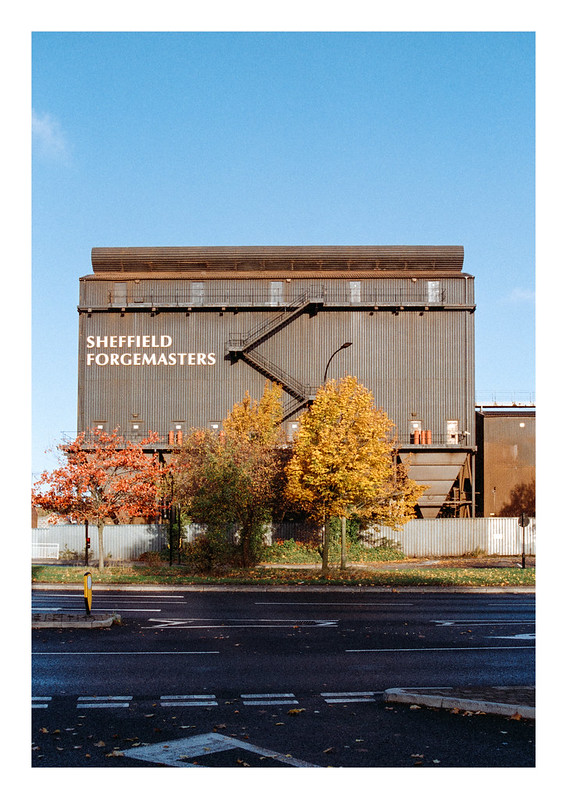
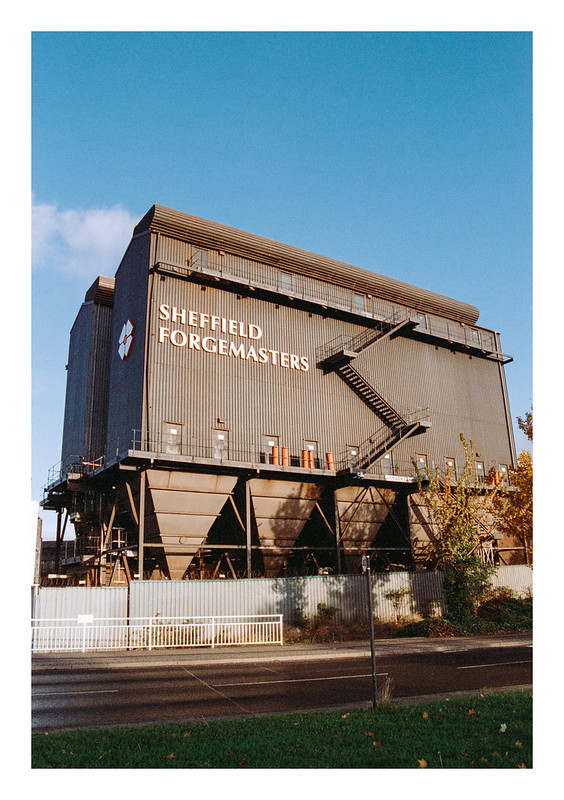
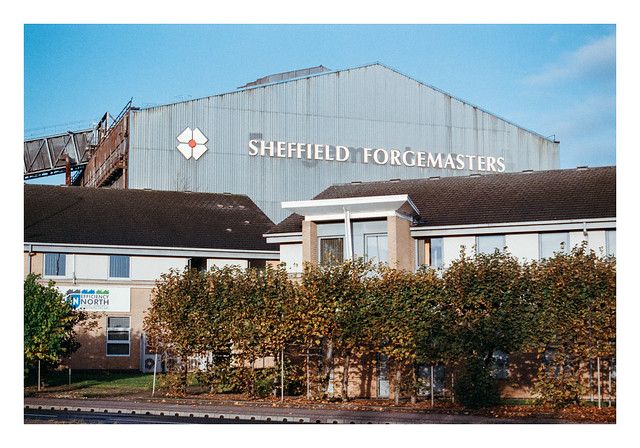
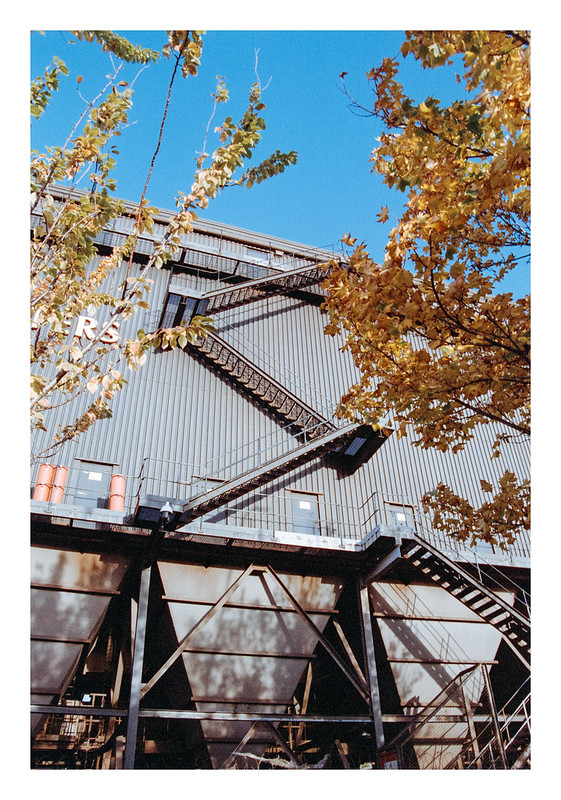
I decided to shoot this second roll partially for some multiple-exposure photography I was attempting, for which I didn’t want to risk wasting a more expensive roll of film, but as I had no intention of using the whole roll for this purpose, I also went out on a sunny autumn morning to shoot a bunch of other frames of whatever subject matter I could find. I ended up in the Attercliffe area of the city – a former industrial area home to Sheffield’s once vast steel industry, but which has now become home to service businesses, retail, and entertainment outlets (although there is still a lot of industry in abundance, including steel foundries). Most of the pictures feature Sheffield Forgemasters, a heavy engineering firm that has been in existence since 1805. In the 1980s the company attracted controversy for it’s part in the Iraqi Supergun Affair, and in 2021 was nationalised because of it’s importance to the nation’s defence industry.
So, on to the results.
This roll came out very nicely indeed, possibly due to the overexposure, or perhaps it had just fared better than its companion roll. Whatever the case I would not be disappointed with these if they had come from a fresh roll of film – the grain is minimal and the colours look natural with just a hint of warmth (and that might just be in the way I processed the pictures in Negative Lab Pro and Lightroom). I’m very happy with the photos and would happily shoot more Truprint FG+ (if I had any).
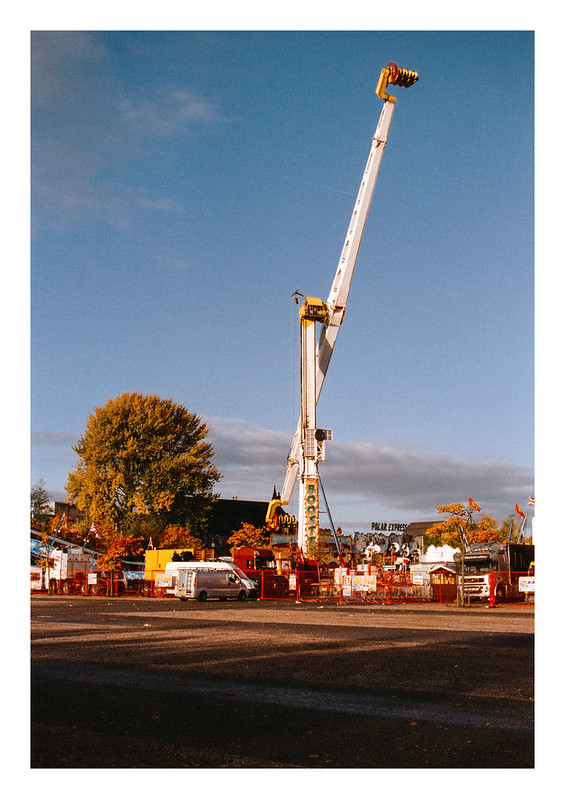
Autumn had arrived when the photos were made, and the colours reveal themselves well on the film – helped by the nice sunlight I had on the day.
More autumnal shades beside Sheffield Forgemasters.
Sheffield Forgemasters is a looming presence in this part of the city.
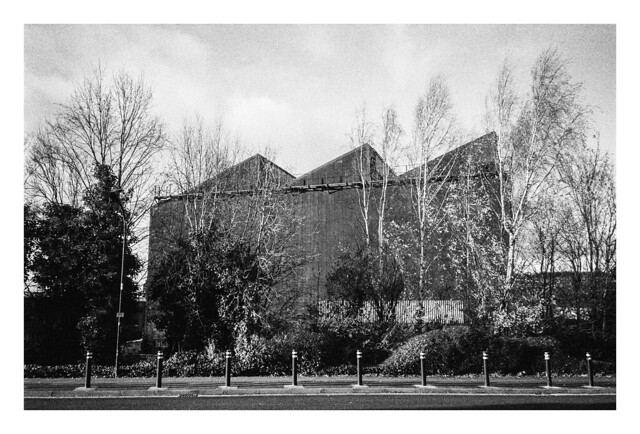
Another industrial building in the area. Not part of Forgemasters, I believe this might be a scaffolding supplier now.
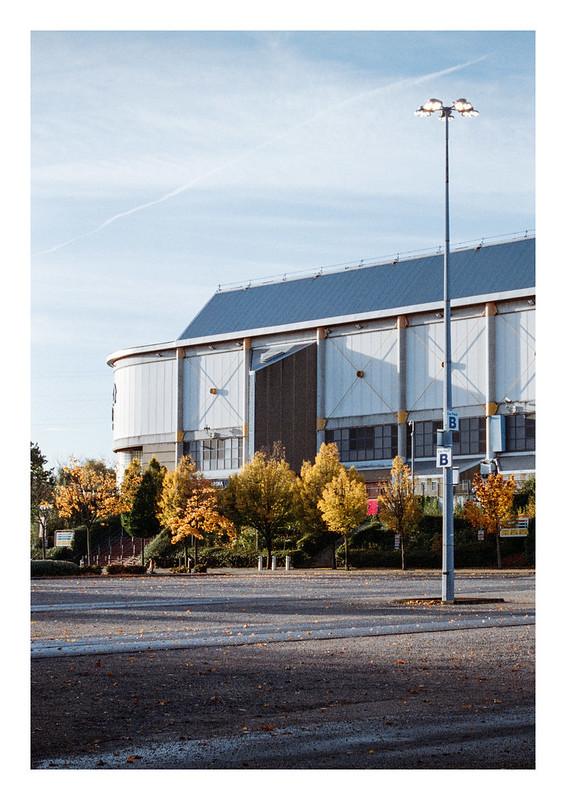
One of the main entertainment facilities in Attercliffe is the Arena – currently the Utilita Arena, but it has gone under a number of sponsored names since construction though it is often known locally as the Don Valley Arena. There was a funfair taking residence in part of the carpark on the day I passed.
The arena itself.
Overall outcome: Success!
Expiriment #4 coming soon (I hope…)…
Nikkon F80, Nikkor 28-80mm f/3.5-5.6 D, Truprint FG+ (expired 2003). Shot at 100asa and lab developed for box speed. Home scanned and converted with Negative Lab Pro.
Beside the Don Valley Centertainment complex – which houses a multiplex, bowling alley & arcade, kid’s play area, and a selction of restaurants – are industrial streets. This is the east-end of the city where, in it’s industial heyday, the bulk of the steel industry resided. There are still steelworks in the area, and more as you head down river towards Tinsley and Templeborough, but much of it has now become history.
I’m not sure what the building in today’s picture used to house – I’m sure my dad would know, and I’ll ask him next time I see him – but it’s now the home of a scaffolding hire and sales business.
Olympus XA3 & Kodak Tri-X Pan (expired 2003 – shot at box speed and pushed a stop in development). Ilfotec DD-X 1+4 10mins @ 20°
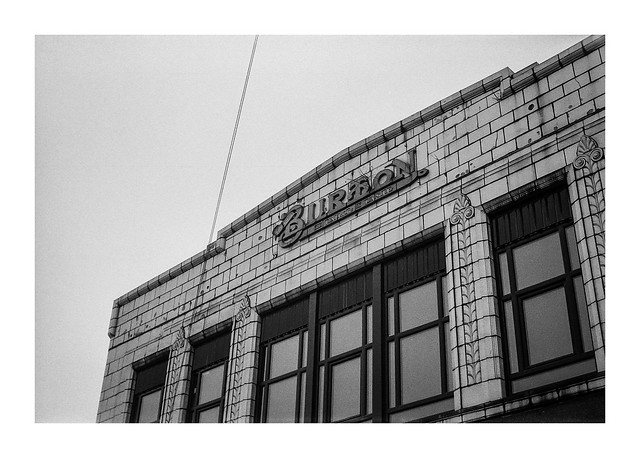
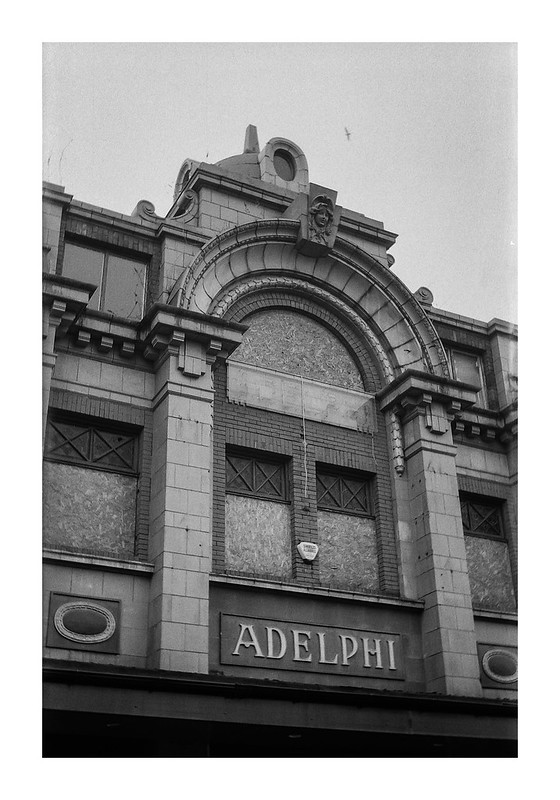
A trio of shots of old buildings still present in the Attercliffe area. There are many more than just these, but I didn’t photograph the others. 🙂
The old Burton’s menswear building and the Adelphi cinema are next door to one another, and neither has been used for their original purpose (or for much else) in many a year. The Momento picture framing shop is still actively trading. Given the post box outside, I wonder if this might have been a post office at some point in the past? I’ll ask my dad next time I see him as he’ll likely know, having grown up and then worked in the area when he was younger.